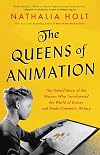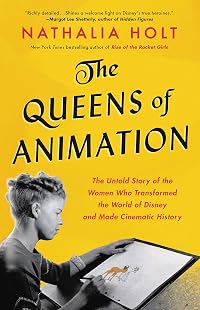
The Queens of Animation: The Untold Story of the Women Who Transformed the World of Disney and Made Cinematic History
by Nathalia Holt
On This Page
Description
From Snow White to Moana, the animated films of Walt Disney Studios have moved and entertained millions. But few fans know that behind these groundbreaking features was an incredibly influential group of women who fought for respect in an often ruthless male-dominated industry and who have slipped under the radar for decades. Holt shows how these women infiltrated the boys' club of Disney's story and animation departments and used early technologies to create the rich artwork and show more unforgettable narratives that have become part of the American canon. While battling sexism, domestic abuse, and workplace intimidation, these women also fought to transform the way female characters are depicted to young audiences. - Adapted from jacket show lessTags
Recommendations








Member Reviews
I RECEIVED THIS LOVELY HARDCOVER AS A GIFT FROM A LADY OF MY ACQUAINTANCE. THANKS, NORA!
My Review: I didn't start this book as a Walt Disney cultist. In fact, quite the opposite...I know about his obnoxious labor practices and frankly was unsurprised at his appalling gender politics, both generationally as well as personally...but WOW. The details of what happened to Bianca Majolie are, in a word, repugnant. (And it's really played to the hilt for nastiness in the book...there's no certainty that it happened as written because it's not from the horse's mouth, as it were.)
And yet he hired Mary Blair, an extraordinarily gifted artist; he hired Majolie (though apparently fired her so fast she figures in the bulk of the narrative not at show more all), and Grace Huntington, Retta Scott, Sylvia Holland...all of them who were guilty of Working While Woman in the Disney snakepit of the 1930s and 1940s, at least were working. Most wouldn't have been considered in other animation studios, and all needed the paychecks. Quite a lot of deadbeat dads through the generations. Single moms will work for less because "this is beneath me and you're not paying me enough" means nothing to a hungry kid.
One area where Author Holt did her subjects proud was the mind-bendingly complicated process of animating a feature-length film. She stints not in the telling and retelling, through memories of the women she's interviewed, the pre-computer days and the zillions of tiny steps required for the simplest movements to come to life; the brain-meltingly detail-oriented task of creating and assuring continuity of backgrounds; compositing, editing, oh my Muse of Painting, and Dance, and Epic Poetry, the lists and lists and it really is all necessary for you to know! It is! And not paying attention isn't gonna work because you will be so lost without it, this detailed information....
What the women who worked on Fantasia and Pinocchio and Bambi all did is quite incredible. These classics are what they are, and have the impact they all have, because all or most of the women Author Holt tells us of were doing the work of many men. The men who, when tasked with creating fairies or flowery bowers, whined that this was girls' work so give it to the girls. The upside to their childish idiocy is that the scenes are stunningly beautiful and now, at long last, we know who really did the hard, tedious, and ultimately gorgeous work of bringing sensitivity and glorious beauty to the screen.
There are moments when this "at last we know" technique gets used against one of the women. Mary Blair, a white lady, comes in for some finger-wagging because she failed to stop The Song of the South from being the appallingly racist and stereotype-churning horror that it is. Um...Author Holt...one lone woman, already fighting at home and at work to survive and get to the next paycheck, is kinda sorta gettin' a pass for not adding Civil Rights Campaigner to her resume. At least from me she is.
And what was the reward for this work, absent the credit they merited? A fat paycheck? Oh hell no, Disney was a cheap bastard (which is one big reason his labor force wanted to unionize and even forced a studio shutdown!) with everyone except himself. And the women were underpaid accordingly. Yeah, they had jobs; no, they had no respect or credit; and then, on payday, they got less than the men around them did. It's enough to make you into a wold-eyed revolutionary with a taste for capitalist-bastard blood!
It did me, anyway.
Author Holt has a Ph. D. You've read one of her other best-selling books, most likely: Cured: The People who Defeated HIV and Rise of the Rocket Girls: The Women Who Propelled Us from Missiles to the Moon to Mars. She's written for every major outlet for science news and popularizations of complicated non-fictional topics: The New York Times, The Atlantic, Time, Slate, Popular Science. This is one helluva resume to bring to the topic of women's lives and work. You'd be excused for expecting the organization of the material in this book to be faultless. But it isn't.
Bianca Majolie, mentioned above, gets one (possibly sensationalized) passage; some passing mentions for her music selections and their, um, responses; and a closing anecdote about how she found out she was fired. None of those things were close to each other, none were made much of, and now I'm left wondering who the lady was. I know the most about Mary Blair, because she had serious horsepower and a steely inner something that made it impossible for her to go unheard forever. She is, however, the character...the others are a collection of one-off stories and the occasional halftone photo. (There is a modest glossy photo insert. Given what these women did, surely there had to be some not-copyrighted-by-Disney something to show other than personal photos and an ID card issued by Disney! I think there were three artistic-ish photos. This is, however, pretty minor hence the parenthesis.)
I alluded above to the details Author Holt included about animation and its labor-intensive nature; the role of technology in creating animated films is astounding as a story of development. The 1930s labor movement wasn't wrong, in this case, to holler about machines taking people's jobs. And Author Holt, science popularizer that she is, does not downplay the personal consequences of automation in animation. Nor does she neglect the beauty that the animation freed artists to create, or the benefits to production schedules and thus to our childhoods' aesthetic development. You might not think of it, unless prompted, but a large part of what seems beautiful to you is probably down to one or more Disney films seen in childhood.
Honestly, I find that chilling...but Mary Blair and her fellow animators, while not paragons of socialist virtue, were at least fine artists and possessed of enough soul to make the worst of Disney's early excesses less awful than they could have been. Author Holt is a fair and reasonable guide to the ins and outs, the ups and downs, and the sheer astounding virtuosity and verve that Disney, at its height, gifted the world with. That the people involved in creating it were flawed is undeniable, despite decades of denial.
One of the most tendentious passages in the book is also one with which I am in complete agreement:
It's a bitter, nasty sentence. It's uttered with the unattributed authority of A Truism. And it is, by all that's unholy, inarguable on any evidence I am aware of. show less
My Review: I didn't start this book as a Walt Disney cultist. In fact, quite the opposite...I know about his obnoxious labor practices and frankly was unsurprised at his appalling gender politics, both generationally as well as personally...but WOW. The details of what happened to Bianca Majolie are, in a word, repugnant. (And it's really played to the hilt for nastiness in the book...there's no certainty that it happened as written because it's not from the horse's mouth, as it were.)
And yet he hired Mary Blair, an extraordinarily gifted artist; he hired Majolie (though apparently fired her so fast she figures in the bulk of the narrative not at show more all), and Grace Huntington, Retta Scott, Sylvia Holland...all of them who were guilty of Working While Woman in the Disney snakepit of the 1930s and 1940s, at least were working. Most wouldn't have been considered in other animation studios, and all needed the paychecks. Quite a lot of deadbeat dads through the generations. Single moms will work for less because "this is beneath me and you're not paying me enough" means nothing to a hungry kid.
One area where Author Holt did her subjects proud was the mind-bendingly complicated process of animating a feature-length film. She stints not in the telling and retelling, through memories of the women she's interviewed, the pre-computer days and the zillions of tiny steps required for the simplest movements to come to life; the brain-meltingly detail-oriented task of creating and assuring continuity of backgrounds; compositing, editing, oh my Muse of Painting, and Dance, and Epic Poetry, the lists and lists and it really is all necessary for you to know! It is! And not paying attention isn't gonna work because you will be so lost without it, this detailed information....
What the women who worked on Fantasia and Pinocchio and Bambi all did is quite incredible. These classics are what they are, and have the impact they all have, because all or most of the women Author Holt tells us of were doing the work of many men. The men who, when tasked with creating fairies or flowery bowers, whined that this was girls' work so give it to the girls. The upside to their childish idiocy is that the scenes are stunningly beautiful and now, at long last, we know who really did the hard, tedious, and ultimately gorgeous work of bringing sensitivity and glorious beauty to the screen.
There are moments when this "at last we know" technique gets used against one of the women. Mary Blair, a white lady, comes in for some finger-wagging because she failed to stop The Song of the South from being the appallingly racist and stereotype-churning horror that it is. Um...Author Holt...one lone woman, already fighting at home and at work to survive and get to the next paycheck, is kinda sorta gettin' a pass for not adding Civil Rights Campaigner to her resume. At least from me she is.
And what was the reward for this work, absent the credit they merited? A fat paycheck? Oh hell no, Disney was a cheap bastard (which is one big reason his labor force wanted to unionize and even forced a studio shutdown!) with everyone except himself. And the women were underpaid accordingly. Yeah, they had jobs; no, they had no respect or credit; and then, on payday, they got less than the men around them did. It's enough to make you into a wold-eyed revolutionary with a taste for capitalist-bastard blood!
It did me, anyway.
Author Holt has a Ph. D. You've read one of her other best-selling books, most likely: Cured: The People who Defeated HIV and Rise of the Rocket Girls: The Women Who Propelled Us from Missiles to the Moon to Mars. She's written for every major outlet for science news and popularizations of complicated non-fictional topics: The New York Times, The Atlantic, Time, Slate, Popular Science. This is one helluva resume to bring to the topic of women's lives and work. You'd be excused for expecting the organization of the material in this book to be faultless. But it isn't.
Bianca Majolie, mentioned above, gets one (possibly sensationalized) passage; some passing mentions for her music selections and their, um, responses; and a closing anecdote about how she found out she was fired. None of those things were close to each other, none were made much of, and now I'm left wondering who the lady was. I know the most about Mary Blair, because she had serious horsepower and a steely inner something that made it impossible for her to go unheard forever. She is, however, the character...the others are a collection of one-off stories and the occasional halftone photo. (There is a modest glossy photo insert. Given what these women did, surely there had to be some not-copyrighted-by-Disney something to show other than personal photos and an ID card issued by Disney! I think there were three artistic-ish photos. This is, however, pretty minor hence the parenthesis.)
I alluded above to the details Author Holt included about animation and its labor-intensive nature; the role of technology in creating animated films is astounding as a story of development. The 1930s labor movement wasn't wrong, in this case, to holler about machines taking people's jobs. And Author Holt, science popularizer that she is, does not downplay the personal consequences of automation in animation. Nor does she neglect the beauty that the animation freed artists to create, or the benefits to production schedules and thus to our childhoods' aesthetic development. You might not think of it, unless prompted, but a large part of what seems beautiful to you is probably down to one or more Disney films seen in childhood.
Honestly, I find that chilling...but Mary Blair and her fellow animators, while not paragons of socialist virtue, were at least fine artists and possessed of enough soul to make the worst of Disney's early excesses less awful than they could have been. Author Holt is a fair and reasonable guide to the ins and outs, the ups and downs, and the sheer astounding virtuosity and verve that Disney, at its height, gifted the world with. That the people involved in creating it were flawed is undeniable, despite decades of denial.
One of the most tendentious passages in the book is also one with which I am in complete agreement:
The rise of women in the workplace, no matter what side of the world it occurred on, was frightening to some men, and they approached the perceived threat much as toddlers would a monster under the bed—by crying about it.
It's a bitter, nasty sentence. It's uttered with the unattributed authority of A Truism. And it is, by all that's unholy, inarguable on any evidence I am aware of. show less
A compelling exploration of the lives and experiences of the women who worked in Disney's animation studios from the mid-1930s through to the release of Frozen. Nathalia Holt does a brilliant job of describing the lives of these women as well as the working conditions and the technical and artistic contributions they made to Disney's animated films as well as to the animation industry at large. She doesn't shy away from some of awful sexism and racism that was endemic in the industry, particularly in the 30s through 50s although the gender gap in animation continues to be significant even in recent years. Fascinating reading for both Disney nerds as well as those interested in women's history.
It was the 1956 rerelease of Fantasia that rocked my world. I was four years old and Mom took me to a Buffalo, NY theater to see my first movie. The images and the music made a lasting impression, driving a lifelong love for symphonic music.
I already was in love with illustrative art, thanks to the Little Golden Books that my mother brought home from her weekly grocery shopping trips. My favorite was I Can Fly, illustrated by Mary Blair. And on my wall were Vacu-Form Nursery Rhyme characters including Little Bo Peep, Little Boy Blue--which I later discovered were also designed by Mary Blair! And even later in life, I learned that Mary Blair had worked for Walt Disney. And of course, growing up in the 1950s, anything Disney was a show more favorite.
Especially the 1959 release of Sleeping Beauty. I was still in my 'princess' phase, which came after my 'cowboy gunslinger' phase. Mom took me to see the film. I had the Disney Sleeping Beauty coloring book. I had the Little Golden Book. And I had the Madame Alexander Sleeping Beauty doll! Sadly, my dog chewed it up but in my 40s I purchased one on eBay to satisfy my inner child.
Fast forward to the late 1980s and my husband and I were buying up Disney videotapes for our son, raising another generation of Disney fandom. His first theatrical movie was The Little Mermaid.
My fandom never took me as far as to read books about the Disney franchise or Walt. Until The Queens of Animation: The Untold Story of the Women Who Transformed the World of Disney and Made Cinematic History. I remembered my love of Mary Blair and thought, Nathalia Holt has something here. I wanted to know the names and the contributions of these unknown women.
It was a joyful read, at once a nostalgic trip into the films that charmed and inspired my childhood-- and our son's --and a revealing and entertaining read about the development of animation and the rise of women in a male-dominated culture. I put aside all other books.
Holt concentrates on the women's careers but includes enough biographical information to make real and sympathetic. I was so moved to read about Mary Blair's abusive marriage.
Holt also does a stellar job of explaining the rising technologies that would impact animation, eventually eliminating the jobs of hundreds of artists. We learn about Walt's interest in each story that inspired the animated movies and the hard work to develop the story, art, and music, along with the conflicts and competition behind the scenes.
I learned so many interesting facts! Like how Felix Salten's novel Bambi: A Life in the Woods was banned in Nazi Germany because it was a metaphor for Anti-Semitism! How Mary Louise Weiser originated the grease pencil, one of the many technologies Disney developed and perfected or quickly adapted.
And I loved the story of Fantasia. Bianca Majolie presented the music selections to Walt, including The Nutcracker Suite's Dance of the Sugar Plum Fairy and the Waltz of the Flowers. Tchaikovsky's The Nutcracker ballet had never yet been produced in the United States at the time! The male animators did not want to work on illustrating fairies (they instead created the Pastoral Symphony's centaurs and oversexualized centaurettes, including an African-American servant who was part mule instead of horse).
Choreographer George Balanchine was touring the studio with Igor Stravinsky, whose The Rite of Spring was included in Fantasia, and he loved the faires in the Dance of the Sugar Plum Fairies. Fifteen years later he debuted The Nutcracker at the new Lincoln Center and it became a Christmastime annual tradition.
I just loved this book for so many reasons!
I was given access to a free egalley by the publisher through NetGalley. My review is fair and unbiased. show less
I already was in love with illustrative art, thanks to the Little Golden Books that my mother brought home from her weekly grocery shopping trips. My favorite was I Can Fly, illustrated by Mary Blair. And on my wall were Vacu-Form Nursery Rhyme characters including Little Bo Peep, Little Boy Blue--which I later discovered were also designed by Mary Blair! And even later in life, I learned that Mary Blair had worked for Walt Disney. And of course, growing up in the 1950s, anything Disney was a show more favorite.
Especially the 1959 release of Sleeping Beauty. I was still in my 'princess' phase, which came after my 'cowboy gunslinger' phase. Mom took me to see the film. I had the Disney Sleeping Beauty coloring book. I had the Little Golden Book. And I had the Madame Alexander Sleeping Beauty doll! Sadly, my dog chewed it up but in my 40s I purchased one on eBay to satisfy my inner child.
Fast forward to the late 1980s and my husband and I were buying up Disney videotapes for our son, raising another generation of Disney fandom. His first theatrical movie was The Little Mermaid.
My fandom never took me as far as to read books about the Disney franchise or Walt. Until The Queens of Animation: The Untold Story of the Women Who Transformed the World of Disney and Made Cinematic History. I remembered my love of Mary Blair and thought, Nathalia Holt has something here. I wanted to know the names and the contributions of these unknown women.
It was a joyful read, at once a nostalgic trip into the films that charmed and inspired my childhood-- and our son's --and a revealing and entertaining read about the development of animation and the rise of women in a male-dominated culture. I put aside all other books.
Holt concentrates on the women's careers but includes enough biographical information to make real and sympathetic. I was so moved to read about Mary Blair's abusive marriage.
Holt also does a stellar job of explaining the rising technologies that would impact animation, eventually eliminating the jobs of hundreds of artists. We learn about Walt's interest in each story that inspired the animated movies and the hard work to develop the story, art, and music, along with the conflicts and competition behind the scenes.
I learned so many interesting facts! Like how Felix Salten's novel Bambi: A Life in the Woods was banned in Nazi Germany because it was a metaphor for Anti-Semitism! How Mary Louise Weiser originated the grease pencil, one of the many technologies Disney developed and perfected or quickly adapted.
And I loved the story of Fantasia. Bianca Majolie presented the music selections to Walt, including The Nutcracker Suite's Dance of the Sugar Plum Fairy and the Waltz of the Flowers. Tchaikovsky's The Nutcracker ballet had never yet been produced in the United States at the time! The male animators did not want to work on illustrating fairies (they instead created the Pastoral Symphony's centaurs and oversexualized centaurettes, including an African-American servant who was part mule instead of horse).
Choreographer George Balanchine was touring the studio with Igor Stravinsky, whose The Rite of Spring was included in Fantasia, and he loved the faires in the Dance of the Sugar Plum Fairies. Fifteen years later he debuted The Nutcracker at the new Lincoln Center and it became a Christmastime annual tradition.
I just loved this book for so many reasons!
I was given access to a free egalley by the publisher through NetGalley. My review is fair and unbiased. show less
Walt Disney's animation studio was famed for making feature films about the lives of princesses and fairies, but especially in its early decades it was an all-boys club. The hiring practices at Disney were not at all subtle about not wanting to hire women, and the few women who did work at the studio met with great resentment from their male colleagues. Nathalia Holt sets the record straight on five women who left their mark on the Disney's style and success, even if there names were not always credited: Bianca Majolie, Grace Huntington, Sylvia Holland, Retta Scott, and Mary Blair.
Blair is probably the most well-known of these artists with her concept art significantly influencing the style of Alice in Wonderland and Cinderella, and her show more work on it's a small world and the mural at Walt Disney's World's Contemporary Resort still persisting. Her personal life is marred by an abusive husband (also a Disney artist) and alcoholism that is the antithesis of her sunny art work. Majolie was the first storyboard artist and developed the stories for Pinocchio, Cinderella, and Peter Pan. She also discovered a recording of Tchaikovsky's Nutcracker Suite - virtually unknown in the US at the time - and used it is a basis for a segment of Fantasia and thus popularizing the music and the ballet.
Grace Huntington was the second women to work as a story artist, but fascinatingly she was also an experienced aviator who set solo altitude records despite test piloting also being a restricted career for women. Holland, another storyboard artist with a musical background, used her experience to inform "The Pastoral Symphony" segment of Fantasia, the "Little April Shower" sequence of Bambi, and "Two Silhouettes" in Make Mine Music. Scott was the first woman to be promoted from ink and paint (a laborious task where most women at the studio worked) to a full animator, and contributed her art to Bambi, Fantasia, and Dumbo.
The book offers great insight into animation and Hollywood culture in the 30s, 40s, and 50s and the doors that were opened to women during that time and those that remained close. Holt does bring the story fully up-to-date with Jennifer Lee rising to the Chief Creative Officer of Walt Disney Animation after the success of Frozen, and the much broader representation of women on-screen and behind the scenes at Disney in the present day. But the book is best and richest in detail on the early decades telling the fascinating stories of these pioneering women and their enduring legacies.
Rating: ***1/2 show less
Blair is probably the most well-known of these artists with her concept art significantly influencing the style of Alice in Wonderland and Cinderella, and her show more work on it's a small world and the mural at Walt Disney's World's Contemporary Resort still persisting. Her personal life is marred by an abusive husband (also a Disney artist) and alcoholism that is the antithesis of her sunny art work. Majolie was the first storyboard artist and developed the stories for Pinocchio, Cinderella, and Peter Pan. She also discovered a recording of Tchaikovsky's Nutcracker Suite - virtually unknown in the US at the time - and used it is a basis for a segment of Fantasia and thus popularizing the music and the ballet.
Grace Huntington was the second women to work as a story artist, but fascinatingly she was also an experienced aviator who set solo altitude records despite test piloting also being a restricted career for women. Holland, another storyboard artist with a musical background, used her experience to inform "The Pastoral Symphony" segment of Fantasia, the "Little April Shower" sequence of Bambi, and "Two Silhouettes" in Make Mine Music. Scott was the first woman to be promoted from ink and paint (a laborious task where most women at the studio worked) to a full animator, and contributed her art to Bambi, Fantasia, and Dumbo.
The book offers great insight into animation and Hollywood culture in the 30s, 40s, and 50s and the doors that were opened to women during that time and those that remained close. Holt does bring the story fully up-to-date with Jennifer Lee rising to the Chief Creative Officer of Walt Disney Animation after the success of Frozen, and the much broader representation of women on-screen and behind the scenes at Disney in the present day. But the book is best and richest in detail on the early decades telling the fascinating stories of these pioneering women and their enduring legacies.
Rating: ***1/2 show less
Thanks to Book Club Cookbook's Galley Match program and publisher Little, Brown and Company for a copy of this book. My thoughts and opinions are my own.
I have always been a fan of anything related to Walt Disney (animation, films, Disneyland, the Wonderful World of Disney, the Disney Museum) so I couldn't wait to read this book, and I found it fascinating. The author did an admirable job of researching the history of the women who worked as animators for Walt Disney Studios and then weaving the facts into a dramatic true story. From the early animated films of Snow White to the live action feature films, to Pixar and Frozen, the development of Disneyland and the various animation technologies - the book focused on the women who were show more crucial in developing the look, sound, and branding of Disney animation. What makes this book so readable is that in addition to their professional lives, Holt shared their personal lives. They battled sexism, domestic abuse, workplace intimidation, competition, and relationships. And a most important factor - they successfully fought to transform the way female characters were depicted for young audiences. show less
I have always been a fan of anything related to Walt Disney (animation, films, Disneyland, the Wonderful World of Disney, the Disney Museum) so I couldn't wait to read this book, and I found it fascinating. The author did an admirable job of researching the history of the women who worked as animators for Walt Disney Studios and then weaving the facts into a dramatic true story. From the early animated films of Snow White to the live action feature films, to Pixar and Frozen, the development of Disneyland and the various animation technologies - the book focused on the women who were show more crucial in developing the look, sound, and branding of Disney animation. What makes this book so readable is that in addition to their professional lives, Holt shared their personal lives. They battled sexism, domestic abuse, workplace intimidation, competition, and relationships. And a most important factor - they successfully fought to transform the way female characters were depicted for young audiences. show less
Walt Disney was the neighborhood in Chicago where I grew up, claim to fame. The house he grew up in, albeit many years previous, was a few blocks from mine. Everyone new in our neighborhood had this pointed out to them.
A terrific book that I enjoyed immensely. Five women who broke the gender barrier, and became integral to the studio. Though the book , and rightly so, centers on these forgotten women, we also get a sense of Walt himself, the studios troubles, and the making of the movies themselves. A process that took years in some cases. We also learn the stories of these women, their struggles, their fight to belong to this entrenched boys club. Glad to see that Walt supported women employees. Was surprised at some of the movies that show more in the early days were deemed flops. Movies that are now treasured.
A wonderful narrative voice enhanced by the narration of Saskia Maarlevid. show less
A terrific book that I enjoyed immensely. Five women who broke the gender barrier, and became integral to the studio. Though the book , and rightly so, centers on these forgotten women, we also get a sense of Walt himself, the studios troubles, and the making of the movies themselves. A process that took years in some cases. We also learn the stories of these women, their struggles, their fight to belong to this entrenched boys club. Glad to see that Walt supported women employees. Was surprised at some of the movies that show more in the early days were deemed flops. Movies that are now treasured.
A wonderful narrative voice enhanced by the narration of Saskia Maarlevid. show less
An interesting examination of the impact of pioneering female storytellers, designers, and animators at Disney whose contributions were unfortunately, but not unsurprisingly, ignored, stolen, or even deliberately suppressed.
As well as providing a much needed spotlight on the women covered the book also provides interesting insights into the operations and developing processes of feature length animation over the decades.
If the book has a flaw, it’s a well-intentioned one in that in trying to give so many women creators their due some of the individual stories start to blur together. It may have been better to focus on one or two key individuals from each era.
As well as providing a much needed spotlight on the women covered the book also provides interesting insights into the operations and developing processes of feature length animation over the decades.
If the book has a flaw, it’s a well-intentioned one in that in trying to give so many women creators their due some of the individual stories start to blur together. It may have been better to focus on one or two key individuals from each era.
Members
- Recently Added By
Lists

Entertainment
174 works; 1 member

Hachette Book Group
152 works; 6 members
Author Information

5 Works 1,637 Members
Nathalia Holt is the author of Cured: The People Who Defeated HIV and a former Fellow at the Ragon Institute of Massachusetts General Hospital, MIT, and Harvard University. Her writing has appeared in the New York Times, the Los Angeles limes, The Atlantic, Slate. Popular Science, and Time. She lives in Boston.
Awards and Honors
Distinctions
Notable Lists
RUSA CODES Listen List (Listen-Alike – Listen-Alike to “When Women Invented Television” by Jennifer Keishin Armstrong – 2022)
Common Knowledge
- Canonical title
- The Queens of Animation: The Untold Story of the Women Who Transformed the World of Disney and Made Cinematic History
- Original title
- The Queens of Animation: The Untold Story of the Women Who Transformed the World of Disney and Made Cinematic History
- Original publication date
- 2019
- People/Characters
- Bianca Majolie; Walter Elias "Walt" Disney; Roy Disney; Mary Blair; Lee Blair; Grace (show all 13); Sylvia Holland; Retta Scott; Jennifer Lee; Fawn; Roy Disney; Michael Eisner; Jeffrey Katzenberg
- Important places
- Anaheim, California, USA; Disneyland, Anaheim, California, USA; Walt Disney World, Orlando, Florida, USA; New York, New York, USA
- Important events
- Premiere of Snow White and the Seven Dwarves; Merger of Disney Studios and Pixar; Opening of Disneyland; New York World's Fair; Opening of Walt Disney World
- Original language
- English US
Classifications
- Genres
- Nonfiction, Biography & Memoir, General Nonfiction
- DDC/MDS
- 384.80979494 — Society, government, & culture Commerce, communications & transportation regulations Communications Motion pictures Standard subdivisions History, geographic treatment, biography North America
- LCC
- NC1766 .U52 .H65 — Fine Arts Drawing. Design. Illustration Drawing. Design. Illustration Pictorial humor, caricature, etc.
- BISAC
Statistics
- Members
- 318
- Popularity
- 100,490
- Reviews
- 13
- Rating
- (4.09)
- Languages
- English
- Media
- Paper, Audiobook, Ebook
- ISBNs
- 10
- ASINs
- 3