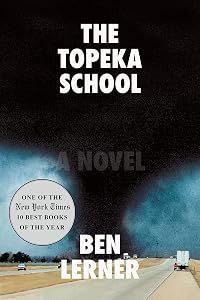
The Topeka School
by Ben Lerner
On This Page
Description
Named one of the most anticipated fall books by:Entertainment Weekly, Esquire, Vogue, Vulture, The Observer, Kirkus, Lit Hub, The Millions, The Week, Oprah Magazine, The Paris Review Daily, Nylon, Pacific Standard, Publishers Weekly, Slate, The Philadelphia Inquirer, and The Guardian
From the award-winning author of 10:04 and Leaving the Atocha Station, a tender and expansive family drama set in the American Midwest at the turn of the century: a tale of adolescence, transgression, and the show more conditions that have given rise to the trolls and tyrants of the New Right.
Adam Gordon is a senior at Topeka High School, class of '97. His mother, Jane, is a famous feminist author; his father, Jonathan, is an expert at getting "lost boys" to open up. They both work at a psychiatric clinic that has attracted staff and patients from around the world. Adam is a renowned debater, expected to win a national championship before he heads to college. He is one of the cool kids, ready to fight or, better, freestyle about fighting if it keeps his peers from thinking of him as weak. Adam is also one of the seniors who bring the loner Darren Eberheart—who is, unbeknownst to Adam, his father's patient—into the social scene, to disastrous effect.
Deftly shifting perspectives and time periods, The Topeka School is the story of a family, its struggles and its strengths: Jane's reckoning with the legacy of an abusive father, Jonathan's marital transgressions, the challenge of raising a good son in a culture of toxic masculinity. It is also a riveting prehistory of the present: the collapse of public speech, the trolls and tyrants of the New Right, and the ongoing crisis of identity among white men.
Cover photograph from The Wichita Eagle. © 1990 McClatchy. All rights reserved. Used under license. Kansas.com
. show less
Tags
Recommendations





















Member Reviews
(58) Really interesting, incredibly well-written novel about a community of psychotherapists in the 1990's in Topeka, Kansas. Really about one family, in particular the son of two therapists, Adam Gordon. We get to know Adam through his parents reflections when he is a child as well as his own. The book is loosely framed as something that Adam himself is writing as an adult. Interspersed are chapters written in italics from a character named Darren - an intellectually disabled boy that unwittingly becomes part of a tragic drama that seems to be a central plot element holding the narrative together. Many of the reviewers blurbs on the pages that lead into the book compare the author to Faulkner, and the comparison is apt. Introspection, show more meandering construction, evocative if not entirely understandable.
There were points in this novel where I absolutely was floored by the turns of phrase and taught edgy intelligent observations. To paraphrase my favorite insight when discussing the downsides of "therapy" - 'giving language to feelings does not mean you will transcend them; instead the opposite is true - you just feed them.' Spot on and oh so snarky - I need to find some way to sneak it into a conversation with some of my bleeding-heart colleagues.
I think though either I am not astute enough to grasp the point of the narrative arc or there is really not great plot resolution in this novel which accounts for the 1 star off. Unfortunately there seems to be no beginning, no middle, no end. I am sure this is purposeful and while it does not detract from the stunning prose - it leaves one with an unsettling feeling of pointlessness at the conclusion. The novel does not feel finished, as fewer and fewer pages were left to be turned - I started to feel disappointed.
Really beautiful, incredible intelligent writing. The high school debate championship underscored my lasting impression of this novel -- precise and accurate language, rhetoric, knowledge and speech as a form of ungovernable power. show less
There were points in this novel where I absolutely was floored by the turns of phrase and taught edgy intelligent observations. To paraphrase my favorite insight when discussing the downsides of "therapy" - 'giving language to feelings does not mean you will transcend them; instead the opposite is true - you just feed them.' Spot on and oh so snarky - I need to find some way to sneak it into a conversation with some of my bleeding-heart colleagues.
I think though either I am not astute enough to grasp the point of the narrative arc or there is really not great plot resolution in this novel which accounts for the 1 star off. Unfortunately there seems to be no beginning, no middle, no end. I am sure this is purposeful and while it does not detract from the stunning prose - it leaves one with an unsettling feeling of pointlessness at the conclusion. The novel does not feel finished, as fewer and fewer pages were left to be turned - I started to feel disappointed.
Really beautiful, incredible intelligent writing. The high school debate championship underscored my lasting impression of this novel -- precise and accurate language, rhetoric, knowledge and speech as a form of ungovernable power. show less
Adam Gordon is a high school senior on the debating team, soon to be national champion at extemporizing, but equally adept at policy debate wherein the favoured modernist technique is the spread. The spread is a presentation of so many “facts”, so much “evidence”, so many “arguments”, so incredibly quickly that those not versed in this technique might easily confuse what they are hearing for nonsense or the glossolalia of rapture. Yet the spread can render one’s opponent impotent, unable to even enumerate all of the rapidly heard arguments that have been presented let alone respond to them. And the spread is spreading. You can hear it in the surfeit of “information” channels submerging not just thoughtful debate but show more thought itself. You can see it in the massed rows of cereal boxes in a superstore rendering choice impossible. You can feel it in the fear of disconnection. But once you are spread, there’s almost nothing you can do about it.
There is something intensifying in a Ben Lerner novel. Images, motifs, phrases, sentences come round again, and again. Each time they take on a different aspect, they complicate themselves and those images or phrases around them. Soon the effect begins to intensify. Everything becomes both more meaningful and less certain. You begin to feel like a space within a highly orchestrated symphony. So much going on around you and you feel like if you could be completely still you might just hear it all at once. It’s a futile hope but inevitable. The effect is sublime. Or maybe you’re just suffering from the spread.
This is a stunning novel of art, politics, the poetry of language, and the increasingly unlikely prospect for actual communication. Each chapter, presented from one of the three main characters’ perspectives, becomes a kind of set piece as motifs and themes re-emerge and complicate. Past and present and future (from some points of view) are always already in play. It could be intimidating but Lerner makes it easeful. This is a novel you will read quickly but be exhausted by, your breath quite literally taken away.
Astonishingly good and thus highly recommended. show less
There is something intensifying in a Ben Lerner novel. Images, motifs, phrases, sentences come round again, and again. Each time they take on a different aspect, they complicate themselves and those images or phrases around them. Soon the effect begins to intensify. Everything becomes both more meaningful and less certain. You begin to feel like a space within a highly orchestrated symphony. So much going on around you and you feel like if you could be completely still you might just hear it all at once. It’s a futile hope but inevitable. The effect is sublime. Or maybe you’re just suffering from the spread.
This is a stunning novel of art, politics, the poetry of language, and the increasingly unlikely prospect for actual communication. Each chapter, presented from one of the three main characters’ perspectives, becomes a kind of set piece as motifs and themes re-emerge and complicate. Past and present and future (from some points of view) are always already in play. It could be intimidating but Lerner makes it easeful. This is a novel you will read quickly but be exhausted by, your breath quite literally taken away.
Astonishingly good and thus highly recommended. show less
When Jane and Jonathan each go to work at the Topeka School, a innovative psychiatric clinic, they never mean to make it permanent, but after finding each other and a nice Victorian they could never have afforded to buy in New York, they have a son, Adam, and settle in. The book moves back and forth between these three characters, and a fourth; a patient at the clinic. The novel is about the three members of the Gordon family, but it's also about the overly close relationships that formed between the therapists working at the clinic, a film project run by Jonathan, the city of Topeka, Kansas in the nineties, Jane's battle with The Men, and a great deal about high school debate tournaments.
Ben Lerner has an easy writing style and and show more this novel went down easy, despite the broad range of ideas and numerous plot threads. And disjointed as it all felt after a while, he does pull all the seemingly disparate elements mostly together at the end. Given the quantity of different topics introduced, there were some I was less interested in (debate team) than others (all of Jane's chapters), but I was never tempted to skip any of it. show less
Ben Lerner has an easy writing style and and show more this novel went down easy, despite the broad range of ideas and numerous plot threads. And disjointed as it all felt after a while, he does pull all the seemingly disparate elements mostly together at the end. Given the quantity of different topics introduced, there were some I was less interested in (debate team) than others (all of Jane's chapters), but I was never tempted to skip any of it. show less
By now we know that a novel by Ben Lerner will never be simple or go about telling its story in an obvious way. His prose is deeply entrenched in his characters’ states of mind. His observations about human behaviour and motivation are subtle, intricate and often startling. He writes with a degree of personal honesty and moral clarity that is refreshing and beguiling, even when he describes unpleasant, difficult, humiliating or traumatic events. He can be funny and profoundly intellectual at the same time. His approach is never straightforward. The building blocks of his fiction rarely line up in expected ways. His novels demand much of the reader, but the rewards are substantial. Such is The Topeka School, which marks the return of show more Adam Gordon, widely recognized by critics as Lerner’s fictional alter-ego, whom we first met in Leaving the Atocha Station. The novel is set in Topeka, Kansas during a fluid time period that encompasses Adam’s early formative years and extends briefly into his young adulthood. A high-school senior (class of 1997), Adam is also a champion debater who is prepping for a national competition that he is expected to win, and he feels the weight of those expectations. Adam’s mother, Jane, is a bestselling feminist author whose liberal views, particularly her opinion that toxic masculinity is to blame for much of what is wrong with American society, have been met with outrage in less progressive circles. Jonathan, Adam’s father, is a psychologist whose special talent is getting troubled young men to recognize and admit to their fears. The Gordon family is well off, privileged, and aware of their privilege. But Jane and Jonathan’s marriage is strained, and Adam endures migraines resulting from a concussion suffered when he was much younger. The novel is narrated by Adam, Jane and Jonathan in discrete sections in which each describes private, family and professional dynamics from an intimate personal perspective. Lerner’s narrative does not play by conventional rules. There are numerous abrupt shifts in time, space and perspective. The text is peppered with meta-fictional authorial interjections—the novel even refers to itself as a novel—and lengthy expository passages on topics like debate strategy and psychological theory. A recurring and crucial presence in the story is Darren Eberheart—a contemporary of Adam and a patient of Jonathan: an emotionally troubled and socially awkward young man who is bullied and mocked by his peers: a butt of jokes treated with cruel disdain by the teenagers whose fellowship and esteem he craves but will never obtain. The story of Adam’s youth pivots on an act of violence perpetrated by Darren on the eve of high school graduation, when, at a party, Darren is driven to extreme behaviour by frustration and rage. The Topeka School is a complex, bracingly alive, highly self-conscious, sometimes bewildering, occasionally exasperating novel that makes no apologies for its eccentricities. It is wise and elegant, difficult, sometimes preachy, and thoroughly engrossing. It is also smart and observant: a novel that has much to say about the turbulent era in which it was written. show less
This is one of the most complex and layered novels I've read in a while. Character-driven and told from multiple points of view, its center set is Topeka, Kansas, original home of the Menninger Clinic, the Fred Phelpses, and of course Brown v. Board of Education. The latter plays no role in this story but its presence is felt as Lerner explores layers of identity, especially as they play out in a teenage boy and his parents. There are ironic riffs that repeat throughout the narrative, often parenthetically and almost always humorously, as Jonathan, Jane, and Adam tell us about Adam's serious concussion at age 8, his developing sense of justice in relation to developmentally disabled classmate Darren, and the path his life takes as a show more competitive debater in high school. Darren has a voice, too, and his is fascinating. Jonathan's was, for me, the least compelling - and least sympathetic - voice. Jane and Adam are central and both are elegantly developed.
I can't do this novel justice. There were moments of irritation with the author's overkill of a thematic element but many more moments of appreciation for his subtlety, for his creative drawing of connections between cultural elements. His grasp of psychological theory is evident but not overwrought (close, that one). And his timing is exquisite. A very satisfying read. show less
I can't do this novel justice. There were moments of irritation with the author's overkill of a thematic element but many more moments of appreciation for his subtlety, for his creative drawing of connections between cultural elements. His grasp of psychological theory is evident but not overwrought (close, that one). And his timing is exquisite. A very satisfying read. show less
The Topeka School is a beautifully written, original and off beat novel. It focuses on the ways that language is used and abused to wield power in personal, analytic and or/ political contexts. The story is told from the perspectives of Adam Gordon and each of his parents who are psychoanalysts at a famous institute in Topeka, Kansas. The alternating narratives provide insight into finely developed and nuanced characters, inter-generational family dynamics and class dynamics in the American mid-west during the 1990's.
For me, one of the most interesting aspects of the book was the way it demonstrated the shifts in political rhetoric through Adam's stint as a high school debater, training to compete at the national level. Lerner brings show more us to the present and subtly shows how these shifting patterns led to the debasement of political rhetoric in the era of Trump.
I listened to this book on audio, which was a mistake. It is a book that needs to be read slowly and carefully. I plan to reread it as text. show less
For me, one of the most interesting aspects of the book was the way it demonstrated the shifts in political rhetoric through Adam's stint as a high school debater, training to compete at the national level. Lerner brings show more us to the present and subtly shows how these shifting patterns led to the debasement of political rhetoric in the era of Trump.
I listened to this book on audio, which was a mistake. It is a book that needs to be read slowly and carefully. I plan to reread it as text. show less
The Topeka School is a book about form, not content, and, as you might expect, it's often frustratingly insubstantial. It seems that Lerner is going for a number of things here. First, it's autofiction that works through the sedimented strata of a complicated family history from a few richly-realized perspectives. Second, it's a fairly conventional coming of age story. Third, it's a novel about the particularities and dramas of psychoanalysis and formal debate. Fourth, it's a political novel, which attempts to tie all of these threads together into some sort of explanation of modern American conservatism.
Unifying these aims is a preoccupation with language. As Lerner's narrator describes the novel (is it meant to be Lerner himself?), show more it is a 'genealogy of his speech, its theaters and extremes.' Speech is unreliable for Lerner's characters, and often threatens to turn against them, to become autonomous. Adam, Lerner's stand-in, finds himself rehearsing and learning to speak in the voice of his amoral debate coach, panicking when he realizes he cannot recall the voices of those closest to him. Jonathan, Adam's father, realizes that the clinical language of psychoanalysis, far from dulling self-destructive impulses, can tacitly legitimize them.
The writing of the novel reflects this preoccupation. The book is told in discrete chapters, each in the voice of a single character, and often as a stream of consciousness retelling. This has a kaleidoscopic effect. We see many events through the eyes of multiple characters, each picking up on different details and drawing different conclusions, giving the events a different place in their minds.
The result of the book's division into so many little pieces, and its stream of consciousness approach, is a text full of discontinuities. In their re-tellings of their memories, characters jump quickly between memories that are years apart, spending long passages describing the intricacies of particular relational dynamics, while breezily passing over formative parts of their lives. It is not always easy, then, to see the connections Lerner intends to draw, to understand how events come to pass, or to appreciate their importance. Much of the early novel is built to lead up to a foreshadowed Terrible Event, but the novel seems almost embarrassed by the conceit once it finally gets there. We are given one or two disconnected pages, and then a brief epilogue of sorts.
Approaches like this serve some of Lerner's goals and undermine others. The portrait of the Gordon family is rich and multilayered, and I found myself invested in many of the relationships between characters. Lerner has a real talent for drawing out the meaning from little bumps in the texture of our lives. But for an ostensibly political novel, the politics seem curiously missing. We only learn that Adam's left of center from the feedback of his debate coach. We almost never see him debate, hear the dialogue in which his explains his beliefs, or see the movement or development of his ideas. We never get a sense, except from very far away, of the way Adam is being pulled in multiple directions. Maybe this indicates a pessimism on Lerner's part: if language has broken down to pure superficial persuasion, without substance, then how could we meaningfully think in order to change our beliefs?
Likewise with other aspects of Adam's development. We see Adam as a child; as a teen; as an adult. But there is curiously little in between. I had no sense, by the end of the novel, who Adam really was, or how he got there. All I had was a collection of little disconnected features that in no way cohered.
I suspect that many of my criticisms of the book are the results of intentional choices on Lerner's part. Maybe my frustration with the lack of character interiority is intended to demonstrate something about the kind of psychoanalytic introspection the book's form mimics. Maybe Lerner's trying to say that, once we start to look into ourselves, we do not find any deep and lasting structure, but rather a thousand tiny reflective scraps spread around, like a kaleidoscope. Maybe. Still, I can't get away from my dissatisfaction with the books central political theme. Drawing a broad analogy between the speech in our toxic media ecosystem and scummy debate tactics does not feel particularly inspired. The book's lack of focus even detracts from some of its strongest elements. For instance, the novel begins with a well-observed vignette between Adam and his girlfriend Amber, positioning her as a laconic, self-aware foil to Adam, and then proceeds to ignore her for the next 200 or so pages. This was my biggest frustration with the book. So many parts of it were good. But they did not jell together, and would disappear just as soon as they appeared. If you like a character, fine. That's all you're getting from them, though.
Looking back, I'm surprised at how critical this review has been. I found the book challenging, rewarding, and frustrating, but certainly worth reading. Lerner has a unique voice and he's doing ambitious things, which don't always succeed, but are enjoyable even when they fail.
This is my first Ben Lerner book, and I thoroughly enjoyed it. I'm looking forward to reading more of his work. show less
Unifying these aims is a preoccupation with language. As Lerner's narrator describes the novel (is it meant to be Lerner himself?), show more it is a 'genealogy of his speech, its theaters and extremes.' Speech is unreliable for Lerner's characters, and often threatens to turn against them, to become autonomous. Adam, Lerner's stand-in, finds himself rehearsing and learning to speak in the voice of his amoral debate coach, panicking when he realizes he cannot recall the voices of those closest to him. Jonathan, Adam's father, realizes that the clinical language of psychoanalysis, far from dulling self-destructive impulses, can tacitly legitimize them.
The writing of the novel reflects this preoccupation. The book is told in discrete chapters, each in the voice of a single character, and often as a stream of consciousness retelling. This has a kaleidoscopic effect. We see many events through the eyes of multiple characters, each picking up on different details and drawing different conclusions, giving the events a different place in their minds.
The result of the book's division into so many little pieces, and its stream of consciousness approach, is a text full of discontinuities. In their re-tellings of their memories, characters jump quickly between memories that are years apart, spending long passages describing the intricacies of particular relational dynamics, while breezily passing over formative parts of their lives. It is not always easy, then, to see the connections Lerner intends to draw, to understand how events come to pass, or to appreciate their importance. Much of the early novel is built to lead up to a foreshadowed Terrible Event, but the novel seems almost embarrassed by the conceit once it finally gets there. We are given one or two disconnected pages, and then a brief epilogue of sorts.
Approaches like this serve some of Lerner's goals and undermine others. The portrait of the Gordon family is rich and multilayered, and I found myself invested in many of the relationships between characters. Lerner has a real talent for drawing out the meaning from little bumps in the texture of our lives. But for an ostensibly political novel, the politics seem curiously missing. We only learn that Adam's left of center from the feedback of his debate coach. We almost never see him debate, hear the dialogue in which his explains his beliefs, or see the movement or development of his ideas. We never get a sense, except from very far away, of the way Adam is being pulled in multiple directions. Maybe this indicates a pessimism on Lerner's part: if language has broken down to pure superficial persuasion, without substance, then how could we meaningfully think in order to change our beliefs?
Likewise with other aspects of Adam's development. We see Adam as a child; as a teen; as an adult. But there is curiously little in between. I had no sense, by the end of the novel, who Adam really was, or how he got there. All I had was a collection of little disconnected features that in no way cohered.
I suspect that many of my criticisms of the book are the results of intentional choices on Lerner's part. Maybe my frustration with the lack of character interiority is intended to demonstrate something about the kind of psychoanalytic introspection the book's form mimics. Maybe Lerner's trying to say that, once we start to look into ourselves, we do not find any deep and lasting structure, but rather a thousand tiny reflective scraps spread around, like a kaleidoscope. Maybe. Still, I can't get away from my dissatisfaction with the books central political theme. Drawing a broad analogy between the speech in our toxic media ecosystem and scummy debate tactics does not feel particularly inspired. The book's lack of focus even detracts from some of its strongest elements. For instance, the novel begins with a well-observed vignette between Adam and his girlfriend Amber, positioning her as a laconic, self-aware foil to Adam, and then proceeds to ignore her for the next 200 or so pages. This was my biggest frustration with the book. So many parts of it were good. But they did not jell together, and would disappear just as soon as they appeared. If you like a character, fine. That's all you're getting from them, though.
Looking back, I'm surprised at how critical this review has been. I found the book challenging, rewarding, and frustrating, but certainly worth reading. Lerner has a unique voice and he's doing ambitious things, which don't always succeed, but are enjoyable even when they fail.
This is my first Ben Lerner book, and I thoroughly enjoyed it. I'm looking forward to reading more of his work. show less
Members
- Recently Added By
Published Reviews
... the center doesn’t quite hold... Deflating what would conventionally be a point of convergence is all too fitting for The Topeka School’s historical scope, however. It should be a comfort that no one’s life is completely determined by any one moment, if for no other reason than because nothing is actually a climax in the scope of history.
added by Lemeritus
... brilliant ... The importance of speech in the novel lets Lerner comment on the state of politics, from glancing references to some people’s inability to decode irrational arguments to more direct critiques ... 'How do you keep other voices from becoming yours?' is a key question of our time, or, for that matter, any era. The Topeka School provides no clear answers, but it memorably show more demonstrates how hard it can be to recognize insidious utterances for what they are. show less
added by Lemeritus
The messy relationship between masculinity and language drives this seeking, eloquent story by poet-novelist Lerner ... The ekphrastic style and autofictional tendencies echo Lerner’s earlier works, and his focus on language games and their discontents fits nicely within the 1990s setting. But the fear at the core of this tale—that language, no matter how thoroughly mastered or artfully show more presented, simply isn’t enough—feels new and urgent. show less
added by Lemeritus
Lists

Pulitzer Prize for Fiction - Finalists
88 works; 9 members

Top Five Books of 2020
982 works; 350 members

2020 Notable Books for Adults
26 works; 5 members

Top Five Books of 2019
387 works; 111 members

Books recommended by Barack Obama
295 works; 28 members

Facebook list
55 works; 3 members

Books Read in 2023
5,547 works; 145 members

Kirkus Starred Fiction Reviews of Books Published in 2019
411 works; 12 members

USA Road Trip
50 works; 3 members

Fiction Published in 2019
35 works; 1 member

Books Set in Kansas
19 works; 7 members

Books Read in 2025
4,091 works; 97 members

Books With Place Names in the Title
215 works; 10 members

Barack Obama's Favorite Books of 2019
19 works; 3 members

Reading Group 2020
6 works; 1 member

Books Read in 2021
5,361 works; 114 members

New Fiction
9 works; 2 members

To Read
617 works; 7 members

Books Read in 2019
4,052 works; 108 members

LIT - Il Bookclub Della McMusa
51 works; 1 member
Author Information

14+ Works 4,585 Members
Some Editions
Awards and Honors
Awards
Distinctions
Common Knowledge
- Canonical title
- The Topeka School
- Original title
- The Topeka School
- Original publication date
- 2019-10-01
- Important places
- Kansas, USA; Topeka, Kansas, USA
- Dedication
- For my brother, Matt
- First words
- Darren pictured shattering the mirror with his metal chair.
- Quotations
- Even before the twenty-four-hour news cycle, Twitter storms, algorithmic trading, spreadsheets, the DDoS attack, Americans were getting “spread” in their daily lives; meanwhile, their politicians went on speaking slowly, ... (show all)slowly about values utterly disconnected from their policies.
...they are told constantly, the culture tells them, although “culture” is hardly the word, Klaus said, patting his forehead with a handkerchief cut from the same linen as his suit, that they are individuals, rugged even,... (show all) but in fact they are emptied out, isolate, mass men without a mass, although they’re not men, obviously, but boys, perpetual boys, Peter Pans, man-children, since America is adolescence without end, boys without religion on the one hand or a charismatic leader on the other; they don’t even have a father—President Carter!—to kill or a father to tell them to kill the Jew; they have no Jew; they are libidinally driven to mass surrender without anything to surrender to; they don’t even believe in money or in science, or those beliefs are insufficient; their country has fought and lost its last real war; in a word, they are overfed; in a word, they are starving.
The man-child represented a farcical form of freedom, magical thinking against the increasingly administered life of the young adult. A teller of fantastic stories. Almost every object in the man-child’s world reflected thi... (show all)s suspension between realms: his alcohol that was also soda, his weapons that were toys, how he might trade you two paper dollars for one of silver, valuing not credit so much as shine. He had trouble managing his height or facial hair and when he injured actual children while demonstrating a wrestling move (clothesline, facehammer, DDT), it was a case of his “not knowing his own strength.” He must, to fit the type, be not only male, but also white and able-bodied: the perverted form of the empire’s privileged subject.
Desert camo does not in Kansas disappear into the foliage but indicates a semiconscious wish to blend in with the soldiery of an empire whose enemies are so vague they’re everywhere.
The desire to know more and the desire to know less fought each other to a standstill within Adam, making it hard to move.
I sensed that even as seasoned a protester as Natalia wasn’t sure what the rules were, what the agents of the state were capable of, now that America was great again. - Last words
- (Click to show. Warning: May contain spoilers.)It embarrassed me, it always had, but I forced myself to participate, to be a part of a tiny public speaking, a public learning slowly how to speak again, in the middle of the spread.
- Blurbers
- Rankine, Claudia; Als, Hilton; Kushner, Rachel; Vuong, Ocean; Nelson, Maggie; Rooney, Sally
- Canonical DDC/MDS
- 813.6
- Canonical LCC
- PS3612.E68
Classifications
Statistics
- Members
- 1,367
- Popularity
- 17,433
- Reviews
- 58
- Rating
- (3.58)
- Languages
- 11 — Dutch, English, Finnish, French, German, Italian, Romanian, Spanish, Swedish, Turkish, Portuguese (Portugal)
- Media
- Paper, Audiobook, Ebook
- ISBNs
- 36
- ASINs
- 6