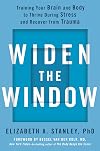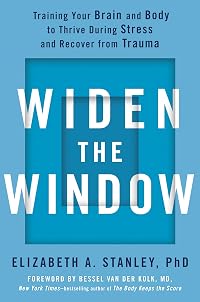
Widen the Window: Training Your Brain and Body to Thrive During Stress and Recover from Trauma
by Elizabeth A. Stanley
On This Page
Description
"I don't think I've ever read a book that paints such a complex and accurate landscape of what it is like to live with the legacy of trauma as this book does, while offering a comprehensive approach to healing."—from the foreword by Bessel van der Kolk
A pioneering researcher gives us a new understanding of stress and trauma, as well as the tools to heal and thrive
Stress is our internal response to an experience that our brain perceives as threatening or challenging. Trauma is our show more response to an experience in which we feel powerless or lacking agency. Until now, researchers have treated these conditions as different, but they actually lie along a continuum. Dr. Elizabeth Stanley explains the significance of this continuum, how it affects our resilience in the face of challenge, and why an event that's stressful for one person can be traumatizing for another.
This groundbreaking book examines the cultural norms that impede resilience in America, especially our collective tendency to disconnect stress from its potentially extreme consequences and override our need to recover. It explains the science of how to direct our attention to perform under stress and recover from trauma.
With training, we can access agency, even in extreme-stress environments. In fact, any maladaptive behavior or response conditioned through stress or trauma can, with intentionality and understanding, be reconditioned and healed. The key is to use strategies that access not just the thinking brain but also the survival brain.
By directing our attention in particular ways, we can widen the window within which our thinking brain and survival brain work together cooperatively. When we use awareness to regulate our biology this way, we can access our best, uniquely human qualities: our compassion, courage, curiosity, creativity, and connection with others. By building our resilience, we can train ourselves to make wise decisions and access choice—even during times of incredible stress, uncertainty, and change.
With stories from men and women Dr. Stanley has trained in settings as varied as military bases, healthcare facilities, and Capitol Hill, as well as her own striking experiences with stress and trauma, she gives readers hands-on strategies they can use themselves, whether they want to perform under pressure or heal from traumatic experience, while at the same time pointing our understanding in a new direction. Psychology. Nonfiction. New Age. Science. show less
Tags
Recommendations

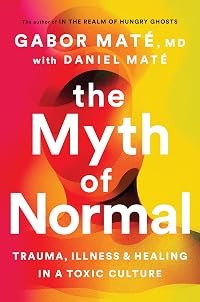
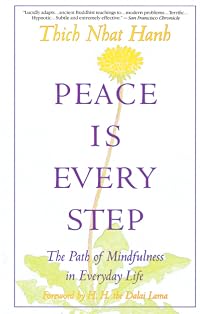
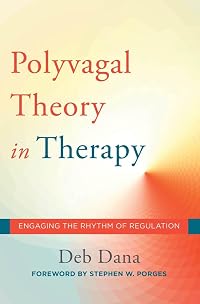
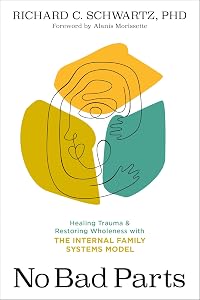


Member Reviews
On the one hand -- lots of useful information, and a thoroughly deep dive into brain function, paired with a decent set of ideas for how to re-wire after trauma.
On the other hand -- the audio book was more than 12 hours long. It took me weeks to get through, and was extremely repetitive. Also, frankly, it was like attending a time-share seminar designed to get you to sign up for the M-FIT program. Useful information? Undoubtedly. But too thorough and too much to get through in order to get to the 2 exercises that she suggests.
On the other hand -- the audio book was more than 12 hours long. It took me weeks to get through, and was extremely repetitive. Also, frankly, it was like attending a time-share seminar designed to get you to sign up for the M-FIT program. Useful information? Undoubtedly. But too thorough and too much to get through in order to get to the 2 exercises that she suggests.
This is a heavy book. I picked it up on recommendation of my counselor. He had read it and thought that the idea of having a narrow window applied to me and my life. He was absolutely right. Through reading this book I have been able to put into words what goes on daily in my head and in my inability to deal with even the most minor of stressors. This is a book I bought and I am glad for that because I will be going back to it again and again as a reference and also re-reading it from time to time. I think that MMFT and other mindfulness techniques can help me to sort through some of the emotions I feel and also help me to find agency, wisdom, and courage during stressful times. Highly, highly, highly recommend.
I have recently (Nov. 2019) began reading this and have not gotten to the exercises. I've given it a provisional four stars because of the way she frames stress and trauma in terms of agency. There is more I could add, but the key for me is how understandable my own history of stress becomes in these terms.
I picked up this book after hearing about, "Window of Tolerance."
I wanted to know, how can people deal with life issues in a better way, eg: Grief, Sorrow, Loss, Trauma, death of a loved one and many issues.
Some day, my friends would face something, and I'd like to offer resources or know, what's best way for me to be of help to them.
The Author misses out Islamic Tradition, Hindu Tradition, Christianity, which is about 80% of World's Population.
In this topic, "Can't they offer something to human life?"
Major Religious traditions of the World have offered something to human life.
I don't know, "Why would the author discard them completely?"
One could argue, they're mumbo-jumbo, by People who differ might say, for bringing any of the show more above religious tradition. But I doubt and would not say, entire human race is foolish since the beginning of history.
Most would resort to, "Aha, now we have science" to which, I can respond, basic human condition, nature of human being is same, regardless of time-line.
Someone who does research have to bring wider perspectives, compare and contrast, invent new ways.
I am sure 2000 years of history, earlier men in army, must have situations, where they'd need to cope with loss, grief, confusion, followed something to deal with pain and suffering that comes with War.
Most of the content is similar to other works in this area, which are popular.
I am not sure if the author can defend her work against researchers in the field.
The Topic is urgent, extremely valuable, sensitive, and meaningful to human life.
Okay, leave my rebuttal to the author, let's get to the meat of the book.
I'd want to get to truth in any conversation or field of inquiry.
How does one increase the Window of Tolerance?
This is what we want in this book.
Turn to Page 308, “safe home base” , which is what noted Child Development, Psychologist, Psychiatrist John Bowlby and others in this field of research recommend.
Elizabeth, the author says, if we don't fully recover, we would narrow down our window of tolerance.
I'd recommend this to anyone who needs a simple introduction, and being aware of this area of life.
Deus Vult,
Gottfried show less
I wanted to know, how can people deal with life issues in a better way, eg: Grief, Sorrow, Loss, Trauma, death of a loved one and many issues.
Some day, my friends would face something, and I'd like to offer resources or know, what's best way for me to be of help to them.
The Author misses out Islamic Tradition, Hindu Tradition, Christianity, which is about 80% of World's Population.
In this topic, "Can't they offer something to human life?"
Major Religious traditions of the World have offered something to human life.
I don't know, "Why would the author discard them completely?"
One could argue, they're mumbo-jumbo, by People who differ might say, for bringing any of the show more above religious tradition. But I doubt and would not say, entire human race is foolish since the beginning of history.
Most would resort to, "Aha, now we have science" to which, I can respond, basic human condition, nature of human being is same, regardless of time-line.
Someone who does research have to bring wider perspectives, compare and contrast, invent new ways.
I am sure 2000 years of history, earlier men in army, must have situations, where they'd need to cope with loss, grief, confusion, followed something to deal with pain and suffering that comes with War.
Most of the content is similar to other works in this area, which are popular.
I am not sure if the author can defend her work against researchers in the field.
The Topic is urgent, extremely valuable, sensitive, and meaningful to human life.
Okay, leave my rebuttal to the author, let's get to the meat of the book.
I'd want to get to truth in any conversation or field of inquiry.
How does one increase the Window of Tolerance?
This is what we want in this book.
Turn to Page 308, “safe home base” , which is what noted Child Development, Psychologist, Psychiatrist John Bowlby and others in this field of research recommend.
Elizabeth, the author says, if we don't fully recover, we would narrow down our window of tolerance.
I'd recommend this to anyone who needs a simple introduction, and being aware of this area of life.
Deus Vult,
Gottfried show less
Ratings
Members
- Recently Added By
Lists

Nervous system
43 works; 1 member
Author Information
2 Works 83 Members
All Editions
Classifications
Statistics
- Members
- 82
- Popularity
- 389,509
- Reviews
- 4
- Rating
- (3.71)
- Languages
- English
- Media
- Paper, Audiobook, Ebook
- ISBNs
- 6
- ASINs
- 2