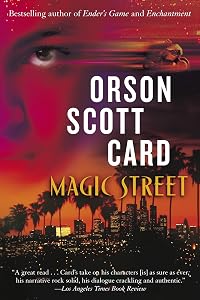
Magic Street
by Orson Scott Card
On This Page
Description
“A modern suburban fantasy . . . There are quests and complications, conflicts and charms. . . . Card’s back in top form, doing as well as or better than any of his fantasy work so far.”—The San Diego Union-TribuneIn a prosperous African American neighborhood in Los Angeles, infant Mack Street is found abandoned in an overgrown park and taken in by a blunt-speaking single woman. Growing up, Mack senses that he is different from most, and knows that he has strange powers. Yet he show more cannot possibly understand how unusual he is until the day he discovers, beyond a mysterious narrow house no one else can see, an entryway into a magical world. Passing through, Mack is plunged into a realm where time and reality are skewed, a place where his actions seem to have disturbing effects in the “real world.” Whether he likes it or not, Mack has become a player in an epic drama. His reward, if he can survive the trip, is discovering not only who he really is . . . but why he exists.
Praise for Magic Street
“A great read . . . Card’s take on his characters [is] as sure as ever, his narrative rock solid, his dialogue crackling and authentic.”—Los Angeles Times Book Review
“[Card] is a master at creating a sense of urgency that keeps you turning pages.”—The Charlotte Observer
“Mind-bending . . . Card’s clever tale comes with sharp writing and crisp dialogue.”—The Tampa Tribune
“Compelling . . . By the time the ultimate conflict comes into focus, the novel is propelling the reader forward like a bullet.”—Deseret Morning News
“A suspenseful fantasy thriller that, during the race to the last page, has one mulling over myth, morals, salvation, and will.”—Booklist. show less
Tags
Recommendations

Member Reviews
When a book starts off with an old homeless man who is brought home by an English professor, who helps deliver a baby boy from the professor's wife who, an hour or so ago, wasn't pregnant, and then takes the baby away in a grocery bag, you know you've got a unique read in front of you.
Set in a middle class black neighborhood, the baby boy reappears as a foundling and is adopted by a single nurse, and looked after by a neighbor's son.
The boy is named Mack Street, and he starts to realize that he can see what people wish for in his dreams. They may get what they wish for, but not in the way they expect. He has his own recurring dream which he does not enjoy and cannot interpret.
When he's 13, Mack realizes that he's special in another show more different way ... he finds a house that leads him to Fairyland, and meets a man in the house whom he dubs Mr Christmas. But all is not as they appear, and before long, we are introduced to an interesting take on Shakespeare's Midsummer Night's Dream, where the stakes are raised to fighting for good against evil.
Who is Mack, exactly? The answer is as surprising as the many turn of events in this book. If you pick this up, be prepared to be settle down for a spell. show less
Set in a middle class black neighborhood, the baby boy reappears as a foundling and is adopted by a single nurse, and looked after by a neighbor's son.
The boy is named Mack Street, and he starts to realize that he can see what people wish for in his dreams. They may get what they wish for, but not in the way they expect. He has his own recurring dream which he does not enjoy and cannot interpret.
When he's 13, Mack realizes that he's special in another show more different way ... he finds a house that leads him to Fairyland, and meets a man in the house whom he dubs Mr Christmas. But all is not as they appear, and before long, we are introduced to an interesting take on Shakespeare's Midsummer Night's Dream, where the stakes are raised to fighting for good against evil.
Who is Mack, exactly? The answer is as surprising as the many turn of events in this book. If you pick this up, be prepared to be settle down for a spell. show less
As with all of Card's books, this most recent of his is very well written.
It takes place in an upper-middle-class black american community. Card's afterword makes much of how he had his black friend vet it before sending it out - I think because he KNEW that he'd be taking a lot of criticism. The characters in this book don't just happen to be black, they make a Big Deal out of being black (or Card makes that deal). At times, his characterization works - but at other times I felt like saying, "Yo, you be Trying Too Hard, bro!"
Nevertheless, I really enjoyed the first half of this book. It's a riff on the classic stories of wishes gone wrong. An adopted foundling, Mack Street, grows up in a tight-knit community... but he has dreams of his show more neighbor's dearest wishes - dreams that begin to come true in horrific ways.
And one day he discovers he can slip sideways through a house no one else can see, and into Fairyland... he is, of course, a changeling, and is pulled into the ago-old drama involving Puck, Oberon and Titania...
However, the second half of the book becomes overtly religious. (As opposed to being a book about religious people, which is fine.) But it got extremely moralizing, and, probably because I don't agree with Card's religious views, the story and plot really just stopped working for me. Card, I felt, was trying to overlay a black-and-white duality over a story of beings who have always been amoral (and are here specified as still being amoral), and eh.... it didn't work. There is also a very weird segment where for some very vaguely explained reason, Mack has to have sex with the 'hot motorcycle hoochie mama' who is Titania. But he won't do it before getting married. rolleyes.gif So Titania says they can be married only in the eyes of God (? A fairy says this?) but not the law, so Titania Hypnotizes the preacher into doing a ceremony (dude, I don't think that counts!), but this makes sex OK! And then, even more oddly, Card makes some comment about this being like a gay marriage where partners are "married in the eyes of God but not the law." Just trying to figure out if Card has changed his stance on homosexuality and gay marriage here, or not??? Anyway, it was all pretty ridiculous. show less
It takes place in an upper-middle-class black american community. Card's afterword makes much of how he had his black friend vet it before sending it out - I think because he KNEW that he'd be taking a lot of criticism. The characters in this book don't just happen to be black, they make a Big Deal out of being black (or Card makes that deal). At times, his characterization works - but at other times I felt like saying, "Yo, you be Trying Too Hard, bro!"
Nevertheless, I really enjoyed the first half of this book. It's a riff on the classic stories of wishes gone wrong. An adopted foundling, Mack Street, grows up in a tight-knit community... but he has dreams of his show more neighbor's dearest wishes - dreams that begin to come true in horrific ways.
And one day he discovers he can slip sideways through a house no one else can see, and into Fairyland... he is, of course, a changeling, and is pulled into the ago-old drama involving Puck, Oberon and Titania...
However, the second half of the book becomes overtly religious. (As opposed to being a book about religious people, which is fine.) But it got extremely moralizing, and, probably because I don't agree with Card's religious views, the story and plot really just stopped working for me. Card, I felt, was trying to overlay a black-and-white duality over a story of beings who have always been amoral (and are here specified as still being amoral), and eh.... it didn't work. There is also a very weird segment where for some very vaguely explained reason, Mack has to have sex with the 'hot motorcycle hoochie mama' who is Titania. But he won't do it before getting married. rolleyes.gif So Titania says they can be married only in the eyes of God (? A fairy says this?) but not the law, so Titania Hypnotizes the preacher into doing a ceremony (dude, I don't think that counts!), but this makes sex OK! And then, even more oddly, Card makes some comment about this being like a gay marriage where partners are "married in the eyes of God but not the law." Just trying to figure out if Card has changed his stance on homosexuality and gay marriage here, or not??? Anyway, it was all pretty ridiculous. show less
Substance: Mack Street is a changeling boy born in mysterious circumstances, who appears to be caught up in a war between Oberon and Titania, but is integral to ending it.
One of the best of Card's fantasies (perhaps influenced by some of Bradbury's early nostalgia-dream-boyhood work), the story is engaging and complex, but not convoluted.
The main characters exemplify friendship, courage, and the need for strong families, in a functioning middle-class neighborhood. Also shows how easy it is to gang up on someone who is different, and that intolerance is not the monopoly of any one segment of society.
Explores the concepts of good and evil, and how to distinguish their influences and consequences. Unusually for the genre, Christianity is show more neither omitted nor vilified, although the aspect of the Fairy King and Queen as ultimate Creators could appear to call its foundation into question.
Style: The effort to replicate a plausible black-American milieu and "authentic" characters has forced Card to jettison the more irritating aspects of his usual narrative style in favor of more dialogue, in the mode of his earlier work.
NOTES: (spoiler alert)
p. 216: This choice might look bad, but how do you know that the others are not worse?
p. 233: Explains why degrees from schools of divinity are junk (probably Card's real opinion).
p. 237: Authentic view of "personal" churches; see Nevada Barr's conversion biography "Seeking Enlightenment...Hat by Hat".
p. 242: How it feels to heal by faith - except it's a con by Oberon, who tailors the miracle to the prediction.
p. 242: Satan can appear to give good fruit, but it's a temporary part of his con game.
p. 284: Mack is the personification of Oberon's good qualities, and thus is the part that Titania loves (Shakespeare sort of got it twisted).
p. 353: "He came to the conclusion that Freud wasn't discovering things, he was creating them. There were no Oedipus complexes until Freud started telling that story and people started interpreting their own lives through that lens. (And nobody does unless a shrink invites them to; and the complex doesn't even match the story).
p. 390: Right makes might.
One of the best of Card's fantasies (perhaps influenced by some of Bradbury's early nostalgia-dream-boyhood work), the story is engaging and complex, but not convoluted.
The main characters exemplify friendship, courage, and the need for strong families, in a functioning middle-class neighborhood. Also shows how easy it is to gang up on someone who is different, and that intolerance is not the monopoly of any one segment of society.
Explores the concepts of good and evil, and how to distinguish their influences and consequences. Unusually for the genre, Christianity is show more neither omitted nor vilified, although the aspect of the Fairy King and Queen as ultimate Creators could appear to call its foundation into question.
Style: The effort to replicate a plausible black-American milieu and "authentic" characters has forced Card to jettison the more irritating aspects of his usual narrative style in favor of more dialogue, in the mode of his earlier work.
NOTES: (spoiler alert)
p. 216: This choice might look bad, but how do you know that the others are not worse?
p. 233: Explains why degrees from schools of divinity are junk (probably Card's real opinion).
p. 237: Authentic view of "personal" churches; see Nevada Barr's conversion biography "Seeking Enlightenment...Hat by Hat".
p. 242: How it feels to heal by faith - except it's a con by Oberon, who tailors the miracle to the prediction.
p. 242: Satan can appear to give good fruit, but it's a temporary part of his con game.
p. 284: Mack is the personification of Oberon's good qualities, and thus is the part that Titania loves (Shakespeare sort of got it twisted).
p. 353: "He came to the conclusion that Freud wasn't discovering things, he was creating them. There were no Oedipus complexes until Freud started telling that story and people started interpreting their own lives through that lens. (And nobody does unless a shrink invites them to; and the complex doesn't even match the story).
p. 390: Right makes might.
A Midsummer Night's Dream transported to the twenty-first century and set with an all Black cast in Baldwin Hills, a "mixed middle-class" African American neighborhood of longstanding in Los Angeles, Magic Street exhibits many of Orson Scott Card's best qualities as a writer--soaring prose, strong characters, wild creativity--and yet, ultimately, falls somewhat flat.
Mack Street is a changeling, found as a newborn in the wild area near a park in Baldwin Hills and raised by Miss Ura Lee Smitcher, a stern spinster nurse. Mack is a being of conscience and great heart, who grows up roaming the neighborhood, welcome in all houses; in his early teens he discovers a hidden house in which Puck--yes, that Puck--lives, masquerading as a homeless show more man. From there, it's just a small step to Fairyland, and adventures galore.
Many of the human characters are exquisite, as are Card's descriptions of the landscape of Fairyland and how it intersects with our world. In the end, however, it's not the big showdown between good and evil that plays out on a freeway overpass in Century City that's most exciting about this book; rather, it's the Acknowledgments section at the end, in which Card tells how he came to write the book and why he wanted to do so. show less
Mack Street is a changeling, found as a newborn in the wild area near a park in Baldwin Hills and raised by Miss Ura Lee Smitcher, a stern spinster nurse. Mack is a being of conscience and great heart, who grows up roaming the neighborhood, welcome in all houses; in his early teens he discovers a hidden house in which Puck--yes, that Puck--lives, masquerading as a homeless show more man. From there, it's just a small step to Fairyland, and adventures galore.
Many of the human characters are exquisite, as are Card's descriptions of the landscape of Fairyland and how it intersects with our world. In the end, however, it's not the big showdown between good and evil that plays out on a freeway overpass in Century City that's most exciting about this book; rather, it's the Acknowledgments section at the end, in which Card tells how he came to write the book and why he wanted to do so. show less
Somehow, I expected more from the acclaimed first modern fantasy of such a big named writer. In an attempt to write a social commentary book, Card has actually written a terrible book. The characters felt cardboard and one dimensional. I felt no connection to the characters as I read the book. A merging of the modern world to the Faerie world which has its basis in Shakespeare could be done so much better through so many different writers. This book does not go on the to be recommended list.
All I want in a fantasy book. Us poor humans caught up in good struggling against evil. Quotable pronouncements which sound deep (tho I'll have to think on them to see how they hold up over time) on the nature of wishes, reality, power, and evil.
I listened to the unabridged version of Orson Scott Card's Magic Street that I borrowed from the local public library. It was read superbly by Mirron E. Willis. He really got into each character's mind and managed to sound as lots of individuals and all authentic. The question of authenticity came up in me all the time as I was listening. The story is set in an African-American neighborhood of Los Angeles, all the characters are black and the actor who read the story to me was too. The book is full of words and elements of that culture. I kept asking myself: was this book really written by a white guy who lives on the East Coast? I felt incredulous. As I learned he frequently consulted a Roland Bernard Brown, black friend of his, but show more still: the lingering feeling that a ghost written this for him couldn't leave me.
Nevertheless who wrote it, I enjoyed the book. The two spaces, Middles class neighborhood with typical characters and fairyland with its fairies and overlord balanced each other well enough for my taste. The Magical and the Realism was pleasantly combined with Shakespeare references and a coming of age story. Mack Street, the unlikely hero--a boy who was born an hour after conceived with a husband's help and then taken away by a mysterious bag man--liberates the queen of the fairies with the help of his friends. As he stores all the positive energies from the dreams of almost everybody of the neighborhood he enjoys the support of all of them. I won't give away more from the story, because the essence of this modern fairy tale is in its unfolding.
I do want to jot down the single sentence that remained with me beyond the book: “Wishes are the true elements underlying the universe.” This makes perfect sense within the context of the book, where it has a particular meaning, because wishes are stored (and often distorted) in a special way. But what can it mean to somebody who didn't read the book? show less
Nevertheless who wrote it, I enjoyed the book. The two spaces, Middles class neighborhood with typical characters and fairyland with its fairies and overlord balanced each other well enough for my taste. The Magical and the Realism was pleasantly combined with Shakespeare references and a coming of age story. Mack Street, the unlikely hero--a boy who was born an hour after conceived with a husband's help and then taken away by a mysterious bag man--liberates the queen of the fairies with the help of his friends. As he stores all the positive energies from the dreams of almost everybody of the neighborhood he enjoys the support of all of them. I won't give away more from the story, because the essence of this modern fairy tale is in its unfolding.
I do want to jot down the single sentence that remained with me beyond the book: “Wishes are the true elements underlying the universe.” This makes perfect sense within the context of the book, where it has a particular meaning, because wishes are stored (and often distorted) in a special way. But what can it mean to somebody who didn't read the book? show less
Members
- Recently Added By
Talk Discussions
Past Discussions
Magic Street? in Orson Scott Card (February 2011)
Author Information

575+ Works 214,626 Members
Orson Scott Byron Walley Card, was born in 1951 and studied theater at Brigham Young University. He received his B.A. in 1975 and his M.A. in English in 1981. He wrote plays during that time, including Stone Tables (1973) and the musical, Father, Mother, Mother and Mom (1974). A Mormon, Scott served a two-year mission in Brazil before starting show more work as a journalist in Utah. He also designed games at Lucas Film Games, 1989-92. He is best known for his science fiction novels, including the popular Ender series. Well known titles include A Planet Called Treason (1979), Treasure Box (1996), and Heartfire (1998). He has also written the guide called How to Write Science Fiction and Fantasy (1990). His novel Ender's Game and its sequel Speaker for the Dead, both won Hugo and Nebula awards, making Card the only author to win both prizes in consecutive years. His titles Shadows in Flight, Ruins and Ender's Game made The New York Times Best Seller List. He is also the author of The First Formic War Series, which includes the titles Earth Unaware, Earth Afire, and Earth Awakens. (Bowker Author Biography) show less
Awards and Honors
Notable Lists
Common Knowledge
- Canonical title
- Magic Street
- Original title
- Magic Street
- Original publication date
- 2005-06-28
- People/Characters
- Mack Street; Puck/Bag Man; Titania/Yolanda White; Cecil "Ceese" Tucker; Dr. Byron Williams; Ura Lee Smitcher
- Important places
- Baldwin Hills, Los Angeles, California, USA; Fairyland
- Dedication
- To Aaron and Lauren Johnston, Who show us that magic can be funny and hopeful- a light in the darkness, conjured out of love
- First words
- The old man was walking along the side of the Pacific Coast Highway in Santa Monica, gripping a fistful of plastic grocery bags.
- Last words
- (Click to show. Warning: May contain spoilers.)You will not die alone, Ura Lee Smitcher, they said to her. There will be two men beside you ... An LAPD cop and a preacher from a storefront church; they'll ... remind you .. [of] the son you raised, the boy who never existed in the world, and yet who saved it.
Classifications
Statistics
- Members
- 1,100
- Popularity
- 23,235
- Reviews
- 22
- Rating
- (3.24)
- Languages
- English, Spanish
- Media
- Paper, Audiobook, Ebook
- ISBNs
- 16
- ASINs
- 4