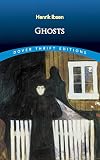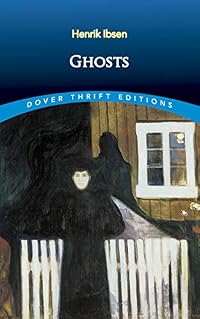
Ghosts
by Henrik Ibsen
On This Page
Description
Fearing rejection by her community, Helene Alving stayed with her philandering husband up until his death. She finds out that her son Osvald not only has congenital syphilis, but is in love with the maid without knowing she is his half-sister. Eventually Mrs. Alving must face the cruel choice of euthanizing her own son as he descends into a syphilitic madness. As with Ibsen's A Doll's House, Ghosts was an intentionally controversial work, through rather than being seen as a bold look at a show more forbidden topic, it was seen by many as merely shocking and indecent, with one critic describing it as "a dirty deed done in public." At the time, the mere mention of venereal disease was scandalous, but to inflict it upon a character who abides by the moral code of society was inconceivable.. show less
Tags
Recommendations














Member Reviews
Ghosts takes place over one night at a mansion in Norway. The majority of the story is unveiled in a conversation between the protagonist, Mrs. Alving, and a pastor from a nearby town, Manders. The two are building an orphanage to honor the late Captain Alving, a man Manders believed to have been an honorable man, but who in fact was a scoundrel and a drunk. The history of Alving mirrors and highlights the present predicaments of two others in the play: Engstrand, a carpenter for the orphanage, and Oswald, Captain and Mrs. Alving's son.
The metaphor of ghosts is entirely appropriate as the remnants of the past have a dire effect on the present situation. The truth of the past and the lies told about it are a constant presence in Mrs. show more Alving's life, and she is overcome by these ghosts daily...as we are all influenced and haunted by our past and our ancestors...except maybe a bit more extreme due to the nature of the Captain's errr...illness.
I chose this play for my Introduction to Literature class for two reasons: one, I had never read it and that is almost a necessity for me in teaching (I really like something new); and two, the critical reaction to the play was one of horror. The play was described as "one of the filthiest things ever written in Scandinavia", "an open drain: a loathsome sore unbandaged", and "unutterably offensive". I just had to find out why. Turns out, there isn't anything a modern reader would find obscene, maybe a bit dirty, but not exactly obscene. And that is perfect for teaching the historical perspective and ideology, so I'm excited.
Thematically, the play stretched the minds of its contemporary audience, promoting joie de vivre and independent thinking while criticizing traditional morays and values. I can't wait to see what my students make of it. show less
The metaphor of ghosts is entirely appropriate as the remnants of the past have a dire effect on the present situation. The truth of the past and the lies told about it are a constant presence in Mrs. show more Alving's life, and she is overcome by these ghosts daily...as we are all influenced and haunted by our past and our ancestors...except maybe a bit more extreme due to the nature of the Captain's errr...illness.
I chose this play for my Introduction to Literature class for two reasons: one, I had never read it and that is almost a necessity for me in teaching (I really like something new); and two, the critical reaction to the play was one of horror. The play was described as "one of the filthiest things ever written in Scandinavia", "an open drain: a loathsome sore unbandaged", and "unutterably offensive". I just had to find out why. Turns out, there isn't anything a modern reader would find obscene, maybe a bit dirty, but not exactly obscene. And that is perfect for teaching the historical perspective and ideology, so I'm excited.
Thematically, the play stretched the minds of its contemporary audience, promoting joie de vivre and independent thinking while criticizing traditional morays and values. I can't wait to see what my students make of it. show less
A fantastic relevant play. One that speaks of the hypocrisy of the church and societal norms while warning us of our own mortality.
Ghosts was read for my EN102 class. The play is exceptionally dark and deals with problems such as incest, venereal disease, extramarital affairs, etc. The introduction said it was one of the first plays to deal with such dark matters and was written to address situations where it might be best to divorce, essentially.
The play raised interesting questions of morality, primarily in the second act during a conversation between Pastor Manders and Mrs. Alving. All in all, this was an enjoyable read, the language was not dense and the plot was straightforward. As with all plays, however, I would have enjoyed seeing it performed more than just sitting and reading it.
Also, the ending was fantastically dramatic.
The play raised interesting questions of morality, primarily in the second act during a conversation between Pastor Manders and Mrs. Alving. All in all, this was an enjoyable read, the language was not dense and the plot was straightforward. As with all plays, however, I would have enjoyed seeing it performed more than just sitting and reading it.
Also, the ending was fantastically dramatic.
Ghosts is a play about the oppressiveness of the rigid 19th century Scandinavian protestant morality that holds it as the only purpose of one's life to do their duty. It is the refutation of this notion, seen through the character of Helen Alvig who has always lived her life in this way, yet it has not brought her happiness ...
Read in Slovene under the title Strahovi.
Read in Slovene under the title Strahovi.
A powerful, controversial play (like most of his), he conveys a less than sterling relationship between mother and son that disintegrates when the truth comes out and the son's mind deteriorates. The truth will always out.
Excellently written, dark, controversial at time and now drama about all kinds of unpleasantries that affect peoples lives from 'dissipated lives' to euthanasia and using morphine to commit suicide cos of VD. I will explore Ibsens Ouvre.
Ibsen's plays really take you to the end of 19th century - and make youfeel the anxiety caused by social pressures and hypocrisy and seek the power to break free from the rules and conventions and reach for something real.
Members
- Recently Added By
Lists

Books I've read
87 works; 2 members

Western World's Greatest Books - Project Gutenberg
295 works; 15 members

19th Century
190 works; 16 members

Favourite Books
1,817 works; 316 members

Books Read in 2018
4,360 works; 110 members

1880s
14 works; 2 members

AP Lit
363 works; 6 members
New Lifetime Reading Plan by Fadiman and Major
225 works; 5 members

Recommended Reading : 600 Classics Reviewed, Editors of Salem Press, 2015
634 works; 6 members

My Play Collection
769 works; 3 members

Books Read in 2025
4,090 works; 97 members

Next Plays / 2025
352 works; 1 member
Author Information

700+ Works 27,360 Members
Henrik Ibsen, poet and playwright was born in Skein, Norway, in 1828. His creative work spanned 50 years, from 1849-1899, and included 25 plays and numerous poems. During his middle, romantic period (1840-1875), Ibsen wrote two important dramatic poems, Brand and Peer Gynt, while the period from 1875-1899 saw the creation of 11 realistic plays show more with contemporary settings, the most famous of which are A Doll's House, Ghosts, Hedda Gabler, and The Wild Duck. Henrik Ibsen died in Christiania (now Oslo), Norway in 1906. (Bowker Author Biography) show less
Some Editions
Awards and Honors
Series
Belongs to Publisher Series
Work Relationships
Is contained in
Pillars of Society / A Doll House / Ghosts / An Enemy of the People / The Wild Duck / Rosmersholm / The Lady from the Sea / Hedda Gabler / The Master Builder / Little Eyolf / John Gabriel Borkman / When We Dead Awaken by Henrik Ibsen
The Master Builder / The Wild Duck / Peer Gynt / Hedda Gabler / Pillars of Society / A Doll's House / The League of Youth / Ghosts / Rosmersholm / John Gabriel Borkman / An Enemy of the People by Henrik Ibsen
Werke 2 : Das Fest auf Solhaug, Brand, Ein Volksfeind, Der Bund der Jugend, Gespenster by Henrik Ibsen
A Doll's House / Ghosts / Hedda Gabler / The Master Builder / An Enemy of the People / The Lady from the Sea by Henrik Ibsen
A Doll's House / Ghosts / An Enemy of the People / The Wild Duck / Hedda Gabler / The Master Builder by Henrik Ibsen
A Doll’s House / Ghosts / An Enemy of the People / The Wild Duck / Rosmersholm / The Lady from the Sea / Hedda Gabler / The Master Builder by Henrik Ibsen
Hedda Gabler / Ghosts / An Enemy of the People / A Doll's House / The League of Youth / The Wild Duck / The Master Builder by Henrik Ibsen
Nine Famous Plays, Including: Peer Gynt, A Doll's House, Ghosts, Hedda Gabler, An Enemy of the People by Henrik Ibsen
Hedda Gabler / Ghosts / An Enemy of the People / A Doll's House / The League of Youth / The Wild Duck / Peer Gynt by Henrik Ibsen
I capolavori: I pilastri della società-Casa di bambola-Spettri-Un nemico del popolo-La casa dei Rosmer-La donna del mare-Hedda Gabler. Ediz. integrale by Henrik Ibsen
Peer Gynt | Pillars of Society | A Doll's House | Ghosts | An Enemy of the People | The Wild Duck | Hedda Gabler | John Gabriel Borkman by Henrik Ibsen
Erster Band : Brand; Peer Gynt; Stützen der Gesellschaft; Ein Puppenheim; Gespenster by Henrik Ibsen
IBSEN: Five Major Plays A Doll's House, Ghosts, The Wild Duck, Hedda Gabler, The Master Builder Analytic Notes and Review text by JOseph T. Shipley, Ph.D, Columbia University by Henrik Ibsen
Nora - Ein Puppenheim. Gespenster. Ein Volksfeind. Die Wildente. Rosmersholm (= Sämtliche Werke Band IV) by Henrik Ibsen
A Doll's House / An Enemy of the People / Ghosts / Hedda Gabler / The Master Builder / Little Eyolf by Henrik Ibsen
Die Höhepunkte seines Schaffens. DAS KLASSISCHE WERK -PeerGynt; Die Stützen der Gesellschaft; Nora oder ein Puppenheim; Gespenster, Ein Volksfeind, Die Wildente, Hedda Gabler, Das Fest auf Solhaug by Henrik Ibsen
Gespenster und andere Dramen (Nora - Gespenster - Die Wildente - Hedda Gabler - Wenn wir Toten erwachen) by Henrik Ibsen
Peer Gynt / A Doll's House / Ghosts / An Enemy of the People / The Wild Duck / John Gabriel Borkman by Henrik Ibsen
Una cassa di bambola - Spettri - L'anitra selvatica - Peer Gynt - La fattoria Rosmer - La do nna del mare - Hedda Gabler - Quando noi morti ci destiamo by Henrik Ibsen
Samlede verker Bind3 : Samfundets støtter ; Et dukkehjem ; Gengangere ; En folkefiende ; Vildanden ; Rosmersholm by Henrik Ibsen
Has the adaptation
Has as a commentary on the text
Has as a student's study guide
Common Knowledge
- Canonical title
- Ghosts
- Original title
- Gengangere
- Original publication date
- 1881
- People/Characters*
- Helene Alving; Osvald; Manders; Jakob Engstrand; Regine Engstrand
- First words
- A spacious garden-room, with a door in the left-hand wall and two doors in the right-hand wall.
- Quotations
- But I almost think we are all of us ghosts, Pastor Manders. It is not only what we have inherited from our father and mother that "walks" in us. It is all sorts of dead ideas, and lifeless old beliefs, and so forth. They have... (show all) no vitality, but they cling to us all the same, and we cannot shake them off.
- Last words
- (Click to show. Warning: May contain spoilers.)OSWALD (still motionless) The sun. The sun.
- Original language
- Danish
*Some information comes from Common Knowledge in other languages. Click "Edit" for more information.
Classifications
- Genre
- Fiction and Literature
- DDC/MDS
- 839.8226 — Literature & rhetoric German & related literatures Other Germanic literatures Danish and Norwegian literatures Norwegian literature Norwegian drama 1800–1899
- LCC
- PT8865 — Language and Literature German, Dutch and Scandinavian literatures Norwegian literature Individual authors or works 19th century Ibsen, Henrik
- BISAC
Statistics
- Members
- 904
- Popularity
- 29,557
- Reviews
- 19
- Rating
- (3.65)
- Languages
- 19 — Mapuche, Catalan, Danish, Dutch, English, Esperanto, Finnish, French, German, Galician, Greek, Italian, Norwegian (Bokmål), Norwegian, Russian, Spanish, Swedish, Turkish, Welsh
- Media
- Paper, Audiobook, Ebook
- ISBNs
- 130
- UPCs
- 1
- ASINs
- 34