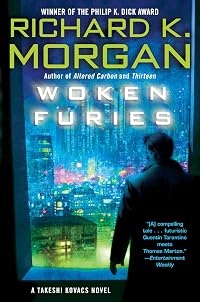
On This Page
Description
Fiction. Literature. Science Fiction. Thriller. Once a gang member, then a marine, then a galaxy-hopping Envoy trained to wreak slaughter and suppression across the stars, a bleeding, wounded Kovacs was chilling out in a New Hokkaido bar when some so-called holy men descended on a slim beauty with tangled, hyperwired hair. An act of quixotic chivalry later and Kovacs was in deep: mixed up with a woman with two names, many powers, and one explosive history. In a world where the real and show more virtual are one and the same and the dead can come back to life, the damsel in distress may be none other than the infamous Quellcrist Falconer, the vaporized symbol of a freedom now gone from Harlan's World. Kovacs can deal with the madness of AI. He can do his part in a battle against biomachines gone wild, search for a three-centuries-old missing weapons system, and live with a blood feud with the yakuza, and even with the betrayal of people he once trusted. But when his relationship with "the" Falconer brings him an enemy specially designed to destroy him, he knows it's time to be afraid. After all, the guy sent to kill him is himself: but younger, stronger, and straight out of hell. show lessTags
Recommendations

Member Reviews
I see a lot of mixed reactions to this book but fortunately, mine is all gung-ho. Why? Because I freaking love this book. Why? Because it has all the best features of the hardest of hard-SF, the fantastic world-building, the hard tech, the bloodthirsty craziness of uploaded and downloaded consciousnesses mixed with the mafia of all breeds and Oligarchies and corporations and all if it is mixed some of the tightest characters I've had the pleasure to read.
That doesn't really describe it, though.
The novel is an extremely complex homecoming for Kovacs, a returning to Harlan's World at long last. A hundred years of travels, war, exploration under shady circumstances under his belt, and his interesting outlook always getting him into show more serious trouble.
A death wish?
That's the big question, isn't it? All through the first two novels, he keeps engaging in super risky behavior such as falling in with traitors or con artists or government executives with dark secrets or just plain rebellions. His situational morality is honed to a very fine degree. :)
Take him back home and have him fall in with random strangers and you'll never believe how much trouble he gets into. Or the scope of the trouble.
Those alien artifacts are still around and causing trouble. The one over Harlan's World is a wonderful wrinkle in the worldbuilding. :) No spoilers, but I was blown away by the sheer weight of the complex storytelling propelled like a rocket named Kovacs. :)
All those little hints and reveals from the first book and the tv series really comes home to shine in this book. Did I mention that there is a lot of really great and complex storytelling going on here? Not just mirroring and externalizing of self-hate or the complications of the tech, but love, humor, and ... screw it. Just read it. :)
I'm going to hunt down some hardcover copies of this trilogy. I want to showcase them and re-read them at extended leisure. :) show less
That doesn't really describe it, though.
The novel is an extremely complex homecoming for Kovacs, a returning to Harlan's World at long last. A hundred years of travels, war, exploration under shady circumstances under his belt, and his interesting outlook always getting him into show more serious trouble.
A death wish?
That's the big question, isn't it? All through the first two novels, he keeps engaging in super risky behavior such as falling in with traitors or con artists or government executives with dark secrets or just plain rebellions. His situational morality is honed to a very fine degree. :)
Take him back home and have him fall in with random strangers and you'll never believe how much trouble he gets into. Or the scope of the trouble.
Those alien artifacts are still around and causing trouble. The one over Harlan's World is a wonderful wrinkle in the worldbuilding. :) No spoilers, but I was blown away by the sheer weight of the complex storytelling propelled like a rocket named Kovacs. :)
All those little hints and reveals from the first book and the tv series really comes home to shine in this book. Did I mention that there is a lot of really great and complex storytelling going on here? Not just mirroring and externalizing of self-hate or the complications of the tech, but love, humor, and ... screw it. Just read it. :)
I'm going to hunt down some hardcover copies of this trilogy. I want to showcase them and re-read them at extended leisure. :) show less
That it has taken me 19 years to get around to reading the third book of the story of Takeshi Kovacs is not something that I have a strong explanation for. This is having thought that the first book might be the last, great, cyberpunk novel, and that the second book was not bad. That the second book was not bad, but not great, might be the answer, as "Broken Angels" did not seem essential, and the trope of people who are a series of downloads is not one of my favorite things. Since if I don't read a novel within three or four years of publication I tend never to get to it, and since not much else that Morgan was writing until recently was really peaking my interest, that was that.
However, in the current day, there is a something of a show more drought of novels that are really grabbing my attention, so I'm doing a bit of back-tracking and cleaning up loose ends. I'm thus here to tell you that if you're reading this trilogy for the first time, don't allow a generation to slide between reading the second and third books. I previously hadn't appreciated the depth of Morgan's world-building, I'm reminded that Kovacs is a great anti-hero, and, in the third book, Morgan gives one a satisfying sense of closure to this epic. It's not the end of the character's story, but Kovacs has now been launched on his final trajectory, regardless of how it all ends up. That Morgan has recently indicated no inclination to return to this milieu I think is a wise move.
As for the gripes of other folks, the one that resonates with me is that this novel is a bit bloated. When dealing with what is basically a thriller, I think the more streamlined the story the better. Then again, any of the approaches that would speed things up might mean a less satisfying ending.
The raw sex complaint basically inspires in me a sense of "whatever;" these are not nice people and if an author wants to have transgressive characters act in a transgressive manner this is merely keeping in character. Now, if there had been a LOT more sex, I could see an issue. This is not to mention that I can imagine ways that Morgan could have made this trilogy so much more sexually exploitive, but didn't.
Ditto the matter of misogynistic fundamentalists as NPC "heavies;" I believe that we'll be afflicted with those folks so long as the Semitic Sky God is with us. Perhaps there might be more elegant ways to move the plot along, and I don't have much use for "fridging" either, but I can overlook a little creaky plot machinery in what is overall a very good novel. show less
However, in the current day, there is a something of a show more drought of novels that are really grabbing my attention, so I'm doing a bit of back-tracking and cleaning up loose ends. I'm thus here to tell you that if you're reading this trilogy for the first time, don't allow a generation to slide between reading the second and third books. I previously hadn't appreciated the depth of Morgan's world-building, I'm reminded that Kovacs is a great anti-hero, and, in the third book, Morgan gives one a satisfying sense of closure to this epic. It's not the end of the character's story, but Kovacs has now been launched on his final trajectory, regardless of how it all ends up. That Morgan has recently indicated no inclination to return to this milieu I think is a wise move.
As for the gripes of other folks, the one that resonates with me is that this novel is a bit bloated. When dealing with what is basically a thriller, I think the more streamlined the story the better. Then again, any of the approaches that would speed things up might mean a less satisfying ending.
The raw sex complaint basically inspires in me a sense of "whatever;" these are not nice people and if an author wants to have transgressive characters act in a transgressive manner this is merely keeping in character. Now, if there had been a LOT more sex, I could see an issue. This is not to mention that I can imagine ways that Morgan could have made this trilogy so much more sexually exploitive, but didn't.
Ditto the matter of misogynistic fundamentalists as NPC "heavies;" I believe that we'll be afflicted with those folks so long as the Semitic Sky God is with us. Perhaps there might be more elegant ways to move the plot along, and I don't have much use for "fridging" either, but I can overlook a little creaky plot machinery in what is overall a very good novel. show less
Masterpiece of noir cyberpunk, which hints at some of the questions that might have arisen from the other books. The story and the action are very engaging, world-building gives enough detail to let your imagination complete the rest, and there are many unexpected twists and surprises. The tech is so outlandish that it seems to get close to fantasy, but the technology is just a tool, not a focus of the book. Most of the characters leave an impression and seem well defined, even if the focus is always on the main character, with others appearing and disappearing from focus gracefully. The accumulated history and interactions between the characters add a level of complexity and strangeness to the book. Despite all the violence, there show more seems to be a lingering sliver of hope and humanity in the story and characters, which makes it less dark than at first sight. Definitely recommended. show less
I wanted to like this a lot more, but it’s just a disjointed let down after the first two. I also didn’t like the easy and counterintuitive, second-level patriarchal condescension in the book, nor the mystifying gender essentialism and concomitant transphobia that had kind of peeked up in the earlier books. If you’re a completist, like me, you’ll read it anyway. If you’re a feminist, again like me, odds are you’ll find a lot to dislike. This series would have been better capped at two if this was the best Morgan could do.
This one felt like a slog. The culmination of all that backstory hinted at in previous books, about the Martians, about Quellism, and Harlan's World, being the focus in this one. The deeper story just failed to connect with me; the neonoir themes from the first book are essentially gone and in place is more of a gruff squad war story. Kovacs has some bizarre episodes that you might charitably call depth or a result of many resleevings but just felt inconsistent; he goes off on a religious woman for being subservient to her husband shortly after what's arguably him raping a woman, combined with slagging them off left and right - it's like the author can't decide if he's writing a neonoir character where violence and misogyny is like show more breathing air, or giving him speeches about liberal values because we're more evolved in the future. Similarly Kovacs' engagement in the politics of the future is all over the place and primarily driven by which way his dick is pointing at the moment. Which, again, you could charitably read as some commentary on how spineless (opportunistic?) and egoistic this type of character is, but it never really feels like it's what the author is going for.
Bonus star for a lot of world building that's interesting even as momentary portrait views. show less
Bonus star for a lot of world building that's interesting even as momentary portrait views. show less
This review is also on Woken Furies (#2 and #3 in the Altered Carbon series)
First I read Altered Carbon and was so touched by it that I then read the other two in the series: Broken Angels and Woken Furies.
So during the day I am tooling around the Baltic: Russia, Finland, Sweden, then Germany. I am soaking up all this stuff from the past, most of it brilliant. By night, however, I am soaking up all this stuff from the future, all of it brilliant.
The main protagonist, Takeshi Kovacs, like all good mass murdering heroes, has some moral dilemmas about what he does for a living. The good thing about sci-fi is that it doesn’t get its head stuck up its arse Moral dilemmas are dealt with in a very pragmatic fashion that usually involves show more someone dying, sometimes the wrong person.
This is not the thinking person’s sci-fi, it is more the feeling person’s sci-fi. I am assuming in writing this that you also like sci-fi and have the same snobbish pretensions that I do.
One real stand out thing about this series is that it is racially blurring. Is Takeshi Kovacs black? or sometimes black? and sometimes Asian? or sometimes something else entirely? I ask that because it is not often in any book that the main protagonist is so very undefined that you cannot hang any racial stereotypes on his frame, benevolent or not. It remind me of something that I came across recently that said, “The body is only a garment, address the wearer not the cloak.” To all practical purposes it places the focus more directly on the character themselves and takes away any visualising you may (unconsciously) do to flesh them out. As a device I really liked it. Having said that, all the arseholes were quite clearly defined.
I cannot think of another genre that has to ride so much stigma from so-called “book people” than sci-fi. I recently read The Sense of an Ending by Julian Barnes, it is brilliant. I also read The Martian by Andy Weir it too, is brilliant.
Both are fiction, but one requires reading things like The Guardian or The New York Times and the other takes imagination. No Bookers for guessing which is which.
As an aside, a few years back I set myself the task of reading all the Booker winners. Man, apart from a few gems, most of them are like looking at your grandparents underwear. show less
First I read Altered Carbon and was so touched by it that I then read the other two in the series: Broken Angels and Woken Furies.
So during the day I am tooling around the Baltic: Russia, Finland, Sweden, then Germany. I am soaking up all this stuff from the past, most of it brilliant. By night, however, I am soaking up all this stuff from the future, all of it brilliant.
The main protagonist, Takeshi Kovacs, like all good mass murdering heroes, has some moral dilemmas about what he does for a living. The good thing about sci-fi is that it doesn’t get its head stuck up its arse Moral dilemmas are dealt with in a very pragmatic fashion that usually involves show more someone dying, sometimes the wrong person.
This is not the thinking person’s sci-fi, it is more the feeling person’s sci-fi. I am assuming in writing this that you also like sci-fi and have the same snobbish pretensions that I do.
One real stand out thing about this series is that it is racially blurring. Is Takeshi Kovacs black? or sometimes black? and sometimes Asian? or sometimes something else entirely? I ask that because it is not often in any book that the main protagonist is so very undefined that you cannot hang any racial stereotypes on his frame, benevolent or not. It remind me of something that I came across recently that said, “The body is only a garment, address the wearer not the cloak.” To all practical purposes it places the focus more directly on the character themselves and takes away any visualising you may (unconsciously) do to flesh them out. As a device I really liked it. Having said that, all the arseholes were quite clearly defined.
I cannot think of another genre that has to ride so much stigma from so-called “book people” than sci-fi. I recently read The Sense of an Ending by Julian Barnes, it is brilliant. I also read The Martian by Andy Weir it too, is brilliant.
Both are fiction, but one requires reading things like The Guardian or The New York Times and the other takes imagination. No Bookers for guessing which is which.
As an aside, a few years back I set myself the task of reading all the Booker winners. Man, apart from a few gems, most of them are like looking at your grandparents underwear. show less
When we reunite with Kovacs, we find him back on Harlan's World, the place of his birth. He's hunting priests of a local patriarchal religion—Knights of the New Revelation—in a damaged synthetic sleeve, but we don't know why. After the events in Broken Angels, it seemed like Kovacs was done with the mercenary life. But things spiral out of control pretty fast. Soon Kovacs is so hot from pissing off the New Revelation crowd and the Yakuza that he's in the outback fighting rogue biomachines with a local mercenary outfit. That's his way of laying low.
After re-sleeving, he learns that a centuries-old backup version of himself has been illegally acquired by the planet's ruling family and is on the hunt for him and Sylvie, the tech-head show more leader of the mercenary group. She apparently caught a computer virus and has been steadily getting worse. They split off from her merc band and hide somewhere else. That doesn't go well either, and now Kovacs is hanging out with some surfers looking to get the revolutionary band back together again.
There's also stuff dealing with the Envoys, the lethal Martian orbital stations, and Quellcrist Falconer—the long dead philosopher leader of a rebellion three centuries ago. Confused? Yeah, I was too. However, I can assure you that by the end of the book, the convoluted plot and storylines all make sense. The pieces start to come together midway through when Kovacs finally explains why he's hunting down priests. I'm not going to spoil it for you, but I'll give you a hint: It's not business; it's personal.
Kovacs has learned the hard way that you can't go home again. He's been gone too long. Places are familiar, yet different. People change; friendships falter. As for ideologies: "Meet the new boss, same as the old boss." Kovacs is angry at everyone and everything, especially himself. The internal dialogues with himself reveal a level of inner conflict that wasn't present in the previous two novels. A particularly cathartic moment comes when he's forced to fight the younger version of himself. The younger Kovacs is highly critical of the choices that the elder Kovacs has made in his life. Nearing exhaustion from all of the mental and physical battles, he responds, "You know what, let's see you do it better."
But before we get there, we have to endure a whole lot of aimless wandering, a lot of misplaced anger, too many disposable minor characters, questionable sexual choices (and graphic sex scenes that neither reveal hidden plot clues nor develop character), and one betrayal after another (What happened to all that Envoy intuition?). There was little in the way of rewards along this journey, and the end payoff was a bit lacking. With the success of the Netflix adaptation of Altered Carbon, Morgan has hinted that he's thinking about revisiting Kovacs. If it means a better send off for the character, I hope so.
3.5 stars rounded down to 3 because it didn't have the feels that the previous two books had. show less
After re-sleeving, he learns that a centuries-old backup version of himself has been illegally acquired by the planet's ruling family and is on the hunt for him and Sylvie, the tech-head show more leader of the mercenary group. She apparently caught a computer virus and has been steadily getting worse. They split off from her merc band and hide somewhere else. That doesn't go well either, and now Kovacs is hanging out with some surfers looking to get the revolutionary band back together again.
There's also stuff dealing with the Envoys, the lethal Martian orbital stations, and Quellcrist Falconer—the long dead philosopher leader of a rebellion three centuries ago. Confused? Yeah, I was too. However, I can assure you that by the end of the book, the convoluted plot and storylines all make sense. The pieces start to come together midway through when Kovacs finally explains why he's hunting down priests. I'm not going to spoil it for you, but I'll give you a hint: It's not business; it's personal.
Kovacs has learned the hard way that you can't go home again. He's been gone too long. Places are familiar, yet different. People change; friendships falter. As for ideologies: "Meet the new boss, same as the old boss." Kovacs is angry at everyone and everything, especially himself. The internal dialogues with himself reveal a level of inner conflict that wasn't present in the previous two novels. A particularly cathartic moment comes when he's forced to fight the younger version of himself. The younger Kovacs is highly critical of the choices that the elder Kovacs has made in his life. Nearing exhaustion from all of the mental and physical battles, he responds, "You know what, let's see you do it better."
But before we get there, we have to endure a whole lot of aimless wandering, a lot of misplaced anger, too many disposable minor characters, questionable sexual choices (and graphic sex scenes that neither reveal hidden plot clues nor develop character), and one betrayal after another (What happened to all that Envoy intuition?). There was little in the way of rewards along this journey, and the end payoff was a bit lacking. With the success of the Netflix adaptation of Altered Carbon, Morgan has hinted that he's thinking about revisiting Kovacs. If it means a better send off for the character, I hope so.
3.5 stars rounded down to 3 because it didn't have the feels that the previous two books had. show less
Members
- Recently Added By
Published Reviews
ThingScore 75
Morgan not only delivers what he proved extremely efficient on in his previous novels, which is: Hollywood-style action, laconic one-liners, heaps of manslaughter and a fast-paced, darting-around plot; he also shows new qualities and such that have been only vaguely discernible until now.
added by corporate_clone
The culmination of everything Richard Morgan has been building towards since he began his Takeshi Kovacs novels in 2002, Woken Furies is better than both Altered Carbon and Broken Angels by an order of magnitude. Lacking both the first novel's derivative obsession with style and the second's unredeeming, bleak worldview, Woken Furies marries breathtaking suspense and action with a more show more consistent and intellectually fulfilling plot that explores the dynamics of power and consequences of revolution from a perspective neither idealistic nor overly cynical and jaundiced. Furthermore, Takeshi Kovacs himself comes into his own as a hero, not merely a long-black-coat clad, boilerplate antihero; this is the first volume of the saga where I found him, at last, a likable and relatable character. show less
added by corporate_clone
Faisons simple, le principal élément moteur de Furies Déchaînées, c’est l’action. Bagarres, fuites, fusillades, sexe... Richard Morgan fait tout pour ne pas laisser un seul instant de répits au lecteur. Un lecteur qui va de scène d’action en scène d’action au point parfois d’être un peu perdu dans ce mélange de gros muscles, de zones de guerre, d’éléments cyberpunk et show more quelques gouttes de polar. Un fourre-tout qui donne un peu le tournis... il faut reconnaître à Richard Morgan un vrai don pour décrire des ambiances dures et âpres qui ont le mérite d’être accrocheuses. Un vrai bon auteur, un peu rentre-dedans et très prometteur. Ceux d’entre vous qui ont lu les deux premiers tomes des aventures de Kovacs seront sans doute ravis de le retrouver et d’en savoir un peu plus sur lui. Attention pour les autres à ne pas se perdre dans les entrelacs d’une intrigue parfois épaisse. show less
added by corporate_clone
Lists

Best Science Fiction Novels
816 works; 426 members

Best Cyberpunk
41 works; 7 members

Books Read in 2016
4,666 works; 199 members

Books Read in 2017
4,249 works; 130 members
Author Information

42+ Works 21,418 Members
Some Editions
Awards and Honors
Notable Lists
Series

Belongs to Publisher Series
Work Relationships
Is contained in
Common Knowledge
- Canonical title
- Woken Furies
- Original title
- Woken Furies
- Original publication date
- 2005-03
- People/Characters
- Takeshi Kovacs; Nadia Makita; Sylvie Oshima; Virginia Vidaura; Segesvar Radul
- Important places*
- Tekitomura, Harlan; New Hokkaido, Harlan; Millsport, Harlan
- Epigraph
- Fury (n): 1a intense, disordered and often destructive rage... 2 wild, disordered force or activity 3a any of the three avenging deities who in Greek mythology punished crimes 3b an angry or vengeful woman The New Pen... (show all)guin English Dictionary, 2001
- Dedication
- This book is for my wife, Virginia Cottinelli, who knows of impediment.
- First words
- The place they woke me in would have been carefully prepared. (prologue)
- Quotations
- Impaler drifted in sideways toward an unused section of the dock. Her grapples fired and chewed holes in the evercrete. A couple of them hit rotten patches and tugged loose as soon as they started to crank taut. The hovelolad... (show all)er backed off slightly in a mound of stirred-up water and shredded belaweed. The grapples wound back and fired again. Something behind me wailed. At first, some stupid part of me thought it was Virginia Vidaura finally venting her pent-up grief. A fraction of a second later I caught up with the machine tone of the sound and identified it for what it was - an alarm. Time seemed to slam to a halt. Seconds turned into ponderous slabs of perception; everything moved with the lazy calm of motion underwater. - Liebeck, spinning away from the water's edge, lit spliff tumbling from her open mouth, bouncing off the upper slope of her breast in a brief splutter of embers - - Murakami, yelling at my ear, moving past me toward the grav sled - The monitor system built into the sled screaming, a whole rack of data coil systems flaring to life like candles along one side of Sylvie Oshima's suddenly twitching body - Sylvie's eyes, wide open and fixed on mine as the gravity of her stare drags my own gaze in - The alarm, unfamiliar as the new Tseng hardware, but only one possible meaning behind it - And Murakami's arm, raised, hand filled with the Kalashnikov as he clears it from his belt - My own yell, stretching out and blending with his as I throw myself foward to block him, hands still bound, hoplesessly slow - And then the clouds ripped open in the east, and vomited angelfire. And the dock lit up with light and fury. And the sky fell in.
- Last words
- (Click to show. Warning: May contain spoilers.)And bring back to life what they hold. (epilogue)
- Original language
- English
- Canonical DDC/MDS
- 823.087628
*Some information comes from Common Knowledge in other languages. Click "Edit" for more information.
Classifications
- Genres
- Science Fiction, Fiction and Literature
- DDC/MDS
- 823.087628 — Literature & rhetoric English & Old English literatures English fiction By type Genre fiction Adventure fiction Speculative fiction Science fiction Cyberpunk
- LCC
- PR6113 .O748 .W65 — Language and Literature English English Literature 2001-
- BISAC
Statistics
- Members
- 2,905
- Popularity
- 6,173
- Reviews
- 65
- Rating
- (3.87)
- Languages
- 10 — Bulgarian, Czech, English, French, German, Hungarian, Italian, Polish, Portuguese, Turkish
- Media
- Paper, Audiobook, Ebook
- ISBNs
- 37
- ASINs
- 21