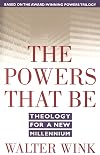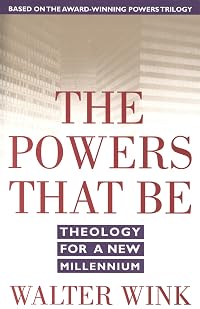
The powers that be : theology for a new millennium
by Walter Wink
The Powers (Collections and Selections — excerpts & digest)
On This Page
Description
In our fast-paced secular world, God and theology are second-class citizens. Money, politics, sports, and science seem better suited to the hard realities of our world. As the church steeple has been eclipsed by the skyscraper as the centerpiece of the urban landscape, so has the divine realm been set aside in favor of more immediate human experience. One sad consequence of this shift is the loss of spiritual and theological bearings, most clearly evident in our inability to understand show more or speak about such things. If the old way of viewing the universe no longer works, something else has to replace it. The Powers That Bereclaims the divine realm as central to human existence by offering new ways of understanding our world in theological terms. Walter Wink reformulates ancient concepts, such as God and the devil, heaven and hell, angels and demons, principalities and powers, in light of our modern experience. He helps us see heaven and hell, sin and salvation, and the powers that shape our lives as tangible parts of our day-to-day experience, rather than as mysterious phantoms. Based on his reading of the Bible and analysis of the world around him, Wink creates a whole new language for talking about and to God. Equipped with this fresh world view, we can embark on a new relationship with God and our world into the next millennium. show lessTags
Recommendations





Member Recommendations
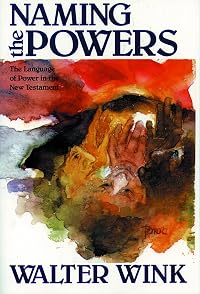
StephenBarkley Dawn and Wink both approach "the powers" from different perspectives. Wink's more sociological, while Dawn's more exegetical.
Member Reviews
The Powers that Be is a digest of Wink's Trilogy on the Principalities and Powers. After years of seeing Wink's name curiously sprinkled through the footnotes of other books I've read, I finally decided to read him for myself.
His big idea is this: spiritual evil does not consist of fallen angels named demons who, as individual entities, drag things south. Instead, every entity on earth—people, churches, corporations, nations—has a spiritual identity. These principalities and powers often turn from their God-subjected role and need to be redeemed. This redemption happens through non-violent but often confrontational means.
His description of spiritual evil reminded me of Ellul's view in The Subversion of Christianity where evil is not show more a distinct entity on its own, but only has power as it aligns itself with humanity.
Wink's theory of Principalities and Powers resonates with our world quite accurately. He often fails, however, on basic exegetical grounds. For instance, in order to encourage people to stand up for themselves non-violently, he interprets the Sermon on the Mount's "turn the other cheek" passage to mean people should proudly assert their defiance to the Powers.
The most disturbing part of the book was the last chapter. In it he used the Daniel account of an angel being delayed to state that God is often powerless to intervene and that it is our job to wake him up! Here are a couple relevant passages:
"We will recognize that God, too, is hemmed in by forces that cannot simply be overruled. ... Prayer in the face of the Powers is a spiritual war of attrition. When we fail to pray, God's hands are effectively tied."
"In our prayer we are ordering God to bring the kingdom near. ... Prayer is rattling God's cage and waking God up and setting God free and giving this famished God water and this starved God food and cutting the ropes off God's hands and the manacles off God's feet and washing the caked sweat from God's eyes and then watching God swell with life and vitality and energy and following God wherever God goes."
In the last chapter in particular ("Prayer and the Powers"), Wink's deity sounds a lot more like Baal than YHWH.
This book is an easy read, and I would encourage you to give it a try if you're interested in this topic. Just make sure (as with any work) to leave your critical apparatus engaged. show less
His big idea is this: spiritual evil does not consist of fallen angels named demons who, as individual entities, drag things south. Instead, every entity on earth—people, churches, corporations, nations—has a spiritual identity. These principalities and powers often turn from their God-subjected role and need to be redeemed. This redemption happens through non-violent but often confrontational means.
His description of spiritual evil reminded me of Ellul's view in The Subversion of Christianity where evil is not show more a distinct entity on its own, but only has power as it aligns itself with humanity.
Wink's theory of Principalities and Powers resonates with our world quite accurately. He often fails, however, on basic exegetical grounds. For instance, in order to encourage people to stand up for themselves non-violently, he interprets the Sermon on the Mount's "turn the other cheek" passage to mean people should proudly assert their defiance to the Powers.
The most disturbing part of the book was the last chapter. In it he used the Daniel account of an angel being delayed to state that God is often powerless to intervene and that it is our job to wake him up! Here are a couple relevant passages:
"We will recognize that God, too, is hemmed in by forces that cannot simply be overruled. ... Prayer in the face of the Powers is a spiritual war of attrition. When we fail to pray, God's hands are effectively tied."
"In our prayer we are ordering God to bring the kingdom near. ... Prayer is rattling God's cage and waking God up and setting God free and giving this famished God water and this starved God food and cutting the ropes off God's hands and the manacles off God's feet and washing the caked sweat from God's eyes and then watching God swell with life and vitality and energy and following God wherever God goes."
In the last chapter in particular ("Prayer and the Powers"), Wink's deity sounds a lot more like Baal than YHWH.
This book is an easy read, and I would encourage you to give it a try if you're interested in this topic. Just make sure (as with any work) to leave your critical apparatus engaged. show less
The Powers are not confined to the spiritual realm argues Wink. This is a holdover from history when the ancients thought of the material and the spiritual as different realms of being. In the 21st century we must look at reality as an integral whole without separating the two. And then look critically at another ancient holdover that should also be discarded. This is what he terms the “Domination System.” It originated when Eurasians domesticated the horse. Before then, plunder was too much of a burden to haul back home. War didn’t pay. But with a beast of burden that changed. It led, the author states, to the “conquest state” in “Mesopotamia around 3000 B.C.E.”
"The horse and the wheel suddenly made conquest fantastically show more lucrative. And plunder included the seizure of desirable females as slaves, concubines, wives, and sexual toys (male captives were unreliable, and so were generally killed). The numerical excess of females depreciated the value of all females, and the system of patriarchy was either born or sharply expanded. As warfare became the central preoccupation of states, taxation became necessary in order to support a standing army, a warrior class, and an aristocracy."
This new more rigid and brutal hierarchy needed a new myth to justify the way things were. This is what Wink terms “The Myth of Redemptive Violence.” This myth, the author says, “is the real myth of the modern world. It and not Judaism or Christianity or Islam, is the dominant religion in our society today.” He then goes on to point out that X-men, Transformers, Batman, Superman, Popeye, and numerous others socialize children into this way of thinking. Wink traces the pattern back to the Babylonian Myth of Marduk. In order to subdue Tiamat, the Dragon of Chaos, Marduk demands that he , “…must be given chief and undisputed power in the assembly of gods.”
This is preceded by an ugly dysfunctional family conflict. Apsu, the father of the younger gods, and Tiamat, their mother, can’t get any sleep because of the racket their children, Marduk included, are making. Apsu plans to kill them, and when the children hear of this, they make a preemptive strike and kill Apsu instead. Tiamat is out for revenge. But Marduk kills her and from her corpse creates the universe.
"In this myth, creation is an act of violence. … Chaos (symbolized by Tiamat) is prior to order (represented by Marduk, high god of Babylon). Evil precedes good, The gods themselves are violent.
The biblical myth in Genesis 1 is diametrically opposed to all this. (Genesis 1, it should be noted, was developed in Babylon during the Jewish captivity there as a direct rebuttal to the Babylonian myth.) The Bible portrays a good God who creates a good creation, Chaos does not resist order. Good is prior to evil. Neither evil nor violence is a part of the creation, but enter later, as a result of the first couple’s sin and the connivance of the serpent (Gen. 3). A basically good reality is thus corrupted by free decisions reached by creature. In this far more complex and subtle explanation of the origin of things, violence emerges for the first time as a problem requiring a solution."
The rest of the book, and a critique of the national security state, nationalism, and any other current isms that depend on the myth of redemptive violence stats with chapter 3: “Jesus’ Answer to Domination,” which is nonviolent individual and collective action. Wink confesses his initial hesitation to embrace nonviolence, until he could see the wisdom of Jesus’s practice, and return to the basic message of the gospels that the church held before it became the official religion of the Roman Empire. It is, he argues, the only way to repair the ills of the world that works in the long run. It will, however, take conviction, action, and the potential of self-sacrifice. It will also produce results. If the reader still doubts the effectiveness of nonviolence, he concludes the book with historical examples of where it worked. show less
"The horse and the wheel suddenly made conquest fantastically show more lucrative. And plunder included the seizure of desirable females as slaves, concubines, wives, and sexual toys (male captives were unreliable, and so were generally killed). The numerical excess of females depreciated the value of all females, and the system of patriarchy was either born or sharply expanded. As warfare became the central preoccupation of states, taxation became necessary in order to support a standing army, a warrior class, and an aristocracy."
This new more rigid and brutal hierarchy needed a new myth to justify the way things were. This is what Wink terms “The Myth of Redemptive Violence.” This myth, the author says, “is the real myth of the modern world. It and not Judaism or Christianity or Islam, is the dominant religion in our society today.” He then goes on to point out that X-men, Transformers, Batman, Superman, Popeye, and numerous others socialize children into this way of thinking. Wink traces the pattern back to the Babylonian Myth of Marduk. In order to subdue Tiamat, the Dragon of Chaos, Marduk demands that he , “…must be given chief and undisputed power in the assembly of gods.”
This is preceded by an ugly dysfunctional family conflict. Apsu, the father of the younger gods, and Tiamat, their mother, can’t get any sleep because of the racket their children, Marduk included, are making. Apsu plans to kill them, and when the children hear of this, they make a preemptive strike and kill Apsu instead. Tiamat is out for revenge. But Marduk kills her and from her corpse creates the universe.
"In this myth, creation is an act of violence. … Chaos (symbolized by Tiamat) is prior to order (represented by Marduk, high god of Babylon). Evil precedes good, The gods themselves are violent.
The biblical myth in Genesis 1 is diametrically opposed to all this. (Genesis 1, it should be noted, was developed in Babylon during the Jewish captivity there as a direct rebuttal to the Babylonian myth.) The Bible portrays a good God who creates a good creation, Chaos does not resist order. Good is prior to evil. Neither evil nor violence is a part of the creation, but enter later, as a result of the first couple’s sin and the connivance of the serpent (Gen. 3). A basically good reality is thus corrupted by free decisions reached by creature. In this far more complex and subtle explanation of the origin of things, violence emerges for the first time as a problem requiring a solution."
The rest of the book, and a critique of the national security state, nationalism, and any other current isms that depend on the myth of redemptive violence stats with chapter 3: “Jesus’ Answer to Domination,” which is nonviolent individual and collective action. Wink confesses his initial hesitation to embrace nonviolence, until he could see the wisdom of Jesus’s practice, and return to the basic message of the gospels that the church held before it became the official religion of the Roman Empire. It is, he argues, the only way to repair the ills of the world that works in the long run. It will, however, take conviction, action, and the potential of self-sacrifice. It will also produce results. If the reader still doubts the effectiveness of nonviolence, he concludes the book with historical examples of where it worked. show less
Inspiring combination of Jesus's life of non-violence and encouragement to live a life of non-violence. This can be used for social change. The most eye opening part of this book is that a non-violent practitioner is in danger of having violence being acted on him/her.
This was a very easy read based on his powers trilogy. Gives one a good idea of the basic concepts without having to be a scholar or the interest of a scholar. It deals less with the powers themselves and more with how we are to engage the powers, namely - nonviolence.
Based on his reading of the Bible and analysis of the world around him, a biblical scholar develops a way of viewing ancient concepts, such as heaven, hell, angels, and demons, in light of modern experience and in a way accessible to all peoples.
My introduction to the idea of the spirit of institutions, and a thoughtful evangelical presentation of the issues.
An explanation of how national and international institutions wield power in such a way as to perpetuate poverty, and what can be done to reform these sysems for the good of all.
Members
- Recently Added By
Author Information

40+ Works 3,582 Members
Walter Wink was professor emeritus of biblical interpretation at Auburn Theological Seminary in New York City. He also taught at Union Theological Seminary. From 1989 to 1990, he was a Peace Fellow at the United States Institute of Peace. He authored several books, including the award-winning Fortress Press trilogy: Naming the Powers, Unmasking show more the Powers, and Engaging the Powers. show less
Series

Common Knowledge
- Canonical title
- The powers that be : theology for a new millennium
- Original publication date
- 1998-04
- Dedication
- To
June
". . . and there is only the dance . . ."
—from Four Quartets
by T. S. Eliot - First words
- All of us deal with the Powers That Be.
- Last words
- (Click to show. Warning: May contain spoilers.)And as we tell it and live it, we may see ourselves—and maybe even the world—a little bit transformed.
- Blurbers
- L'Engle, Madeleine; Brueggemann, Walter
Classifications
Statistics
- Members
- 802
- Popularity
- 34,465
- Reviews
- 9
- Rating
- (4.27)
- Languages
- Dutch, English
- Media
- Paper, Ebook
- ISBNs
- 5
- ASINs
- 3