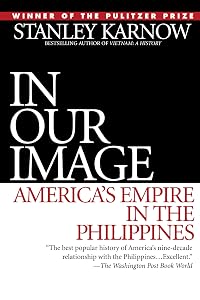
In Our Image: America's Empire in the Philippines
by Stanley Karnow
On This Page
Description
"A brilliant, coherent social and political overview spanning three turbulent centuries."--San Francisco Chronicle Stanley Karnow won the Pulitzer Prize for this account of America's imperial experience in the Philippines. In a swiftly paced, brilliantly vivid narrative, Karnow focuses on the relationship that has existed between the two nations since the United States acquired the country from Spain in 1898, examining how we have sought to remake the Philippines "in our image," an show more experiment marked from the outset by blundering, ignorance, and mutual misunderstanding. "Stanley Karnow has written the ultimate book--brilliant, panoramic, engrossing--about American behavior overseas in the twentieth century."--The Boston Sunday Globe "A page-turning story and authoritative history."--The New York Times "Perhaps the best journalist writing on Asian affairs."--Newsweek show lessTags
Recommendations













Member Reviews
Mr. Karnow is probably more famous for his book on Vietnam but this one is a forceful reminder of earlier times, earlier unpopular wars and how the US became a colonial power sometimes willingly sometimes not. This is just one more area of the world where we have left our footprint without fully realizing what we have done, not nearly comprehending the reactions of the locals to us because of our mixed histories. President McKinley is shown as a weak leader who was hopeless before the machinations of Theodore Roosevelt, Dewey, and Senator Lodge. Later on General Douglas MacArthur is shown as major player whose support of the reactionary landowners/businessmen still leaves its imprint on the Philippines today. This is a solid read that show more might surprise one on how much influence the US has had on Filipino history.
Quote: ( page 310) “Adventurers and bandits of every stripe posed as partisans, and local factionalism riddled the various movements as well. As rival families and clans settled old feuds, duplicitously fighting or helping the enemy to suit their aims. Late n 1944 when the U.S. landings in Leyte presaged the liberation of the archipelago, self styled guerrillas surfaced everywhere in a final frenzy of plunder.
The strongest force was the Peoples Anti Japanese Army, in Tagalog the Hukbong Bayan Laban sa Hapon===Hukbalahap for short , run by a coalition of communists and socialists. Its leaders though mainly urban intellectuals, astutely realized that central Luzon long a caldron of rural unrest was ripe for their efforts.” show less
Quote: ( page 310) “Adventurers and bandits of every stripe posed as partisans, and local factionalism riddled the various movements as well. As rival families and clans settled old feuds, duplicitously fighting or helping the enemy to suit their aims. Late n 1944 when the U.S. landings in Leyte presaged the liberation of the archipelago, self styled guerrillas surfaced everywhere in a final frenzy of plunder.
The strongest force was the Peoples Anti Japanese Army, in Tagalog the Hukbong Bayan Laban sa Hapon===Hukbalahap for short , run by a coalition of communists and socialists. Its leaders though mainly urban intellectuals, astutely realized that central Luzon long a caldron of rural unrest was ripe for their efforts.” show less
2356 In Our Image: America's Empire in the Philippines, by Stanley Karnow (read 6 Feb 1991) (Pulitzer History prize in 1990) This is a journalistic history of the Philippines and I found it absorbing reading. I guess I somehow had not realized how gruesome our "conquest" of the country was, and I found the account of the time since then, while more or less familiar, well worth reading. It is a problem country and Corey Aquino is probably not going to accomplish much. The Marcos years were an awful waste. The Filipinos have not been converted to American political probity, that's for sure.
nonfiction (history of the Phillipines). this guy uses a lot of esoteric vocabulary! I think my brain stretched, just a little; I wasn't able to absorb as much of it as other people might, but you have to start somewhere.
Unlike Wm. Manchester; Karnow really dislikes Douglas MacArthur. Very good book of the History of the Philippines from the spanish to the 1980s
Once again(should I say as always) the U.S. goes plowing in insulting the local culture and the native population. Us Americans must be very slow learners
Once again(should I say as always) the U.S. goes plowing in insulting the local culture and the native population. Us Americans must be very slow learners
Revisionist history that makes widely reactionary conclusions without much backing, such as the assertion that Filipinos "submitted voluntarily to their own exploitation" and the imperialist beliefs that the Philippines would not have formed its own infrastructure had it not been for American intervention.
For more specifics, see Peter Tarr's review in The Nation and various scholarship by E. San Juan Jr.
For more specifics, see Peter Tarr's review in The Nation and various scholarship by E. San Juan Jr.
Ratings
Members
- Recently Added By
Lists

r/History Recommended Reading List
603 works; 12 members
Author Information

19+ Works 3,448 Members
Stanley Karnow was born in Brooklyn, New York on February 4, 1925. During World War II, he served in the Army Air Force. He received a bachelor's degree from Harvard University in 1947. After graduating, he sailed for France intending to spend the summer, but he stayed for a decade. He studied politics at the University of Paris in 1948-1949, and show more from 1950 to 1957 was a Paris correspondent for Time magazine. He was an Asian correspondent for Time-Life from 1959 to 1962, The London Observer from 1961 to 1965, The Saturday Evening Post from 1963 to 1965 and The Washington Post from 1965 to 1971. He was a diplomatic correspondent for The Washington Post in 1971 and 1972, and a special correspondent for NBC and an associate editor of The New Republic from 1973 to 1975. He was a columnist for King Features from 1975 to 1988, wrote for the French newsweekly Le Point from 1976 to 1983 and for Newsweek International from 1977 to 1981. His first book, Southeast Asia, was published in 1962. He also wrote Mao and China: From Revolution to Revolution and Paris in the Fifties. Vietnam: A History was published in 1983 and resulted in a 13-hour PBS documentary entitled Vietnam: A Television History. In Our Image: America's Empire in the Philippines was published in 1989 and won the 1990 Pulitzer Prize for history. It resulted in a three-part PBS documentary entitled The U.S. and the Philippines: In Our Image. He was also a co-author of or contributor to books based on his years in Asia, including Asian-Americans in Transition, Passage to Vietnam, Mekong, and Historical Atlas of the Vietnam War. He died of congestive heart failure on January 27, 2013 at the age of 87. (Bowker Author Biography) show less
Awards and Honors
Awards
Common Knowledge
- Original publication date
- 1989
- Important places
- The Philippines; USA
- Related movies
- The U.S. and the Philippines: In Our Image (1989)
- Original language
- English
Classifications
Statistics
- Members
- 345
- Popularity
- 90,575
- Reviews
- 5
- Rating
- (3.78)
- Languages
- English
- Media
- Paper, Ebook
- ISBNs
- 7
- ASINs
- 2