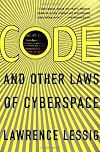
Code and Other Laws of Cyberspace
by Lawrence Lessig
On This Page
Description
There’s a common belief that cyberspace cannot be regulated--that it is, in its very essence, immune from the government’s (or anyone else’s) control. Code argues that this belief is wrong. It is not in the nature of cyberspace to be unregulab≤ cyberspace has no "nature.” It only has code--the software and hardware that make cyberspace what it is. That code can create a place of freedom--as the original architecture of the Net did--or a place of exquisitely oppressive control.If we show more miss this point, then we will miss how cyberspace is changing. Under the influence of commerce, cyberpsace is becoming a highly regulable space, where our behavior is much more tightly controlled than in real space.But that’s not inevitable either. We can--we must--choose what kind of cyberspace we want and what freedoms we will guarantee. These choices are all about architecture: about what kind of code will govern cyberspace, and who will control it. In this realm, code is the most significant form of law, and it is up to lawyers, policymakers, and especially citizens to decide what values that code embodies. show lessTags
Recommendations


Member Recommendations
Member Reviews
There's a common belief that cyberspace cannot be regulated -- that it is, in its very essence, immune from the government's (or anyone else's) control.
Code argues that this belief is wrong. It is not in the nature of cyberspace to be unregulable; cyberspace has no ""nature"". It only has code -- the software and hardware that make cyberspace what it is. That code can create a place of freedom -- as the original architecture of the Net did -- or a place of exquisitely oppressive control.
If we miss this point, then we will miss how cyberspace is changing. Under the influence of commerce, cyberspace is becoming a highly regulable space, where our behaviour is much more tightly controlled than in real space.
But that's not inevitable show more either. We can -- we must -- choose what kind of cyberspace we want and what freedoms we will guarantee. These choices are all about architecture: about what kind of code will govern cyberspace, and who will control it. In this realm, code is the most significant form of law, and it is up to lawyers, policymakers and especially citizens to decide what values that code embodies. show less
Code argues that this belief is wrong. It is not in the nature of cyberspace to be unregulable; cyberspace has no ""nature"". It only has code -- the software and hardware that make cyberspace what it is. That code can create a place of freedom -- as the original architecture of the Net did -- or a place of exquisitely oppressive control.
If we miss this point, then we will miss how cyberspace is changing. Under the influence of commerce, cyberspace is becoming a highly regulable space, where our behaviour is much more tightly controlled than in real space.
But that's not inevitable show more either. We can -- we must -- choose what kind of cyberspace we want and what freedoms we will guarantee. These choices are all about architecture: about what kind of code will govern cyberspace, and who will control it. In this realm, code is the most significant form of law, and it is up to lawyers, policymakers and especially citizens to decide what values that code embodies. show less
Code is a great book on the regulation of cyberspace. There is no dancing around the point that it is a tedious read. Keeping my focus till the end was difficult, but it was worth finishing. Lessig makes it clear that cyberspace can and will be governed by the nature of its architecture even if it is not governed directly by law. If the regulation of cyberspace is of any interest to you, this book is an essential read.
Remarkable intellectual material presented in over-elaborated language. Lessig is a much better lawyer than he is an author and would be well served by a ghost writer.
His key concept is that conduct in cyberspace (and more widely) is regulated as much by computer code as by legal code. He postualtes four key regulators (Architecture, Law, aMarket,nd Norms) and considers the effect of each upon society. He argues that the computer technology that enables copying overturns the legal power to control such copying. This has profound implications for copyright and if it becomes possible to create a license every aspect of use (through software) then fair use is no longer a valid refuge.
All the arguments in this book are refined and updated show more in Code V2, which is available at no commercial cost under Creative commons licensing. show less
His key concept is that conduct in cyberspace (and more widely) is regulated as much by computer code as by legal code. He postualtes four key regulators (Architecture, Law, aMarket,nd Norms) and considers the effect of each upon society. He argues that the computer technology that enables copying overturns the legal power to control such copying. This has profound implications for copyright and if it becomes possible to create a license every aspect of use (through software) then fair use is no longer a valid refuge.
All the arguments in this book are refined and updated show more in Code V2, which is available at no commercial cost under Creative commons licensing. show less
Brilliant book. Wonder what an update would look like.
Important concept on how risk can be reduced, what controls does a system exert: Regulations, Norms, Architecture, and Market. This idea can be played out in lots of other contexts.
Important concept on how risk can be reduced, what controls does a system exert: Regulations, Norms, Architecture, and Market. This idea can be played out in lots of other contexts.
One of the great books of the 20th century!
this is the first of his books that i read. it talks about how trajectories legislate by eliminating options.
A famous book that I own but have never read because I am skeptical of the author's entire enterprise.
Members
- Recently Added By
Author Information

18+ Works 4,917 Members
Lawrence Lessig is the Roy L. Furman Professor of Law and Leadership at Harvard Law School, host of the podcast Another Way, and co-founder of Creative Commons. Lessig has received numerous awards, including a Webby Life Time Achievement Award and the Free Software Foundation's Freedom Award. He is the author of ten books, including Republic, show more Lost, and a member of the American Academy of Arts and Sciences and the American Philosophical Society. He lives in Brookline, Massachusetts. show less
Common Knowledge
- Original publication date
- 1999-12-15
Classifications
Statistics
- Members
- 679
- Popularity
- 42,444
- Reviews
- 7
- Rating
- (4.07)
- Languages
- English, German, Croatian, Spanish
- Media
- Paper
- ISBNs
- 7
- ASINs
- 1