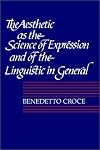
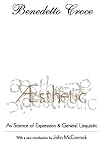
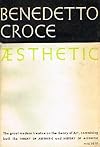
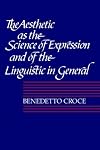
Aesthetic
by Benedetto Croce
On This Page
Description
"Benedetto Croce is one of the most influential philosophers of the twentieth century. His work in aesthetics and historiography has been controversial, but enduring. When the first edition of ^Esthetic appeared in 1902, Croce was seen as foremost in reasserting an idealistic philosophy, which despite its source in continental idealists from Descartes to Hegel, offers a system that attempts to account for the emergence of scientific systems. Croce thus combines scientific and metaphysical show more thought into a dynamic aesthetic.Croce regards aesthetics not merely as a branch of philosophy, but as a fundamental human activity. It is inseparable from historical, psychological, political, economic, and moral considerations, no less than a unique frame of artistic reference. Aesthetic is composed of two parts: Part One concentrates on aesthetic theory and practice. Among the topics it covers are: intuition and expression, art and philosophy, historicism and intellectualism, and beauty in nature and in art. Part Two is devoted to the history of aesthetics. Croce analyzes such subjects as: aesthetic ideas in the Middle Ages and Renaissance, Giambattista Vico as the inventor of aesthetic science, the philosophy of language, and aesthetic psychologism.In his new introduction to a classic translation, John McCormick assesses Croce's influence in aesthetic theory and historiography. He notes that the republication of this work is an overdue appreciation of a singular effort to resolve the classic questions of the philosophy of art, art for its own sake and art as a social enterprise; both find a place in Croce's system."--Provided by publisher. show lessTags
Recommendations




















Member Reviews
Members
- Recently Added By
Author Information

263+ Works 1,979 Members
Benedetto Croce was born in Pescasseroli, Italy on February 25, 1866. He studied literature and philosophy in Rome and Naples and in 1902 published Estetica. In 1903, he established the journal La Critica. He became a senator in 1910 and served as Minister of Education from 1920 to 1921. He was fiercely opposed to the Fascist regime and was ousted show more from public life by Benito Mussolini. After World War II, he returned to politics and became a member of the Constituent Assembly. In 1947, he was elected president of the Italian Liberal Party. He was also a historian, humanist, and foremost Italian philosopher of the first half of the 20th century. His most influential work, Aesthetic as Science of Expression and General Linguistic, was published in 1902. His other works include Logic As the Science of the Pure Concept, Philosophy of the Practical: Economic and Ethic, and History: Its Theory and Practice. He died on November 20, 1952 at the age of 86. (Bowker Author Biography) show less
Awards and Honors
Notable Lists
Series
Belongs to Publisher Series
Common Knowledge
- First words
- Human knowledge has two forms: it is either intuitive knowledge or logical knowledge; knowledge obtained through the imagination or knowledge obtained through the intellect; knowledge of the individual or knowledge of the uni... (show all)versal; of individual things or of the relations between them: it is, in fact, productive either of images or of concepts.
- Last words
- (Click to show. Warning: May contain spoilers.)And one of the means for attaining this end is an exact understanding of the limits of art, that is, the construction of a solid Aesthetic.
Classifications
Statistics
- Members
- 256
- Popularity
- 127,160
- Rating
- (3.92)
- Languages
- 8 — English, Estonian, French, Italian, Norwegian (Bokmål), Portuguese, Spanish, Turkish
- Media
- Paper, Audiobook, Ebook
- ISBNs
- 33
- ASINs
- 18