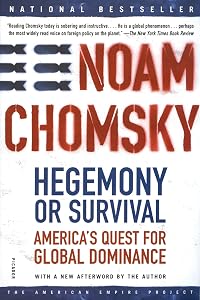
Hegemony or Survival: America's Quest for Global Dominance
by Noam Chomsky
The American Empire Project
On This Page
Description
In this book Noam Chomsky offers an analysis of America's pursuit of total domination and the catastrophic consequences that follow. The United States is in the process of staking out not just the globe but the last unarmed spot in our neighborhood-the heavens-as a militarized sphere of influence. Our earth and its skies are, for the Bush administration, the final frontiers of imperial control. In Hegemony or survival, Noam Chomsky investigates how we came to this moment, what kind of peril show more we find ourselves in, and why our rulers are willing to jeopardize the future of our species. Chomsky dissects America's quest for global supremacy, tracking the U.S. government's aggressive pursuit of policies intended to achieve "full spectrum dominance" at any cost. He lays out how the various strands of policy-the militarization of space, the ballistic-missile defense program, unilateralism, the dismantling of international agreements, and the response to the Iraqi crisis-cohere in a drive for hegemony that ultimately threatens our survival. In our era, he argues, empire is a recipe for an earthly wasteland. show lessTags
Recommendations

Member Reviews
In case you're not familiar, this is the book that Hugo Chavez cited at the UN, the day he was railing against the US and calling Dubya the devil and whatever else. A group here in town was doing kind of an impromptu book-group reading of it, so I thought I'd join in. I knew that few of them had read Chomsky before, and being liberals I wondered what they'd think. Personally, I'm a little ways left of liberal, but I'm not the world's biggest Chomsky fan. Before this one I had read some short stuff from him, seen/heard a few interviews, and read about 2/3 of Manufacturing Consent. That last one, especially, I'm not a fan of. It's propaganda, if you ask me. This is part of my reason for wanting to be in this group, was so that there would show more be at least one critical voice there.
I was surprised how little the book bothered me, though. It does have those propagandist moments. One of his favorite rhetorical tools, for example, is to choose "just a sample" of world events that illustrate his point on something. But it's so transparent; you can find a set of world events to prove virtually any thesis. Some of his "samples" seem pretty well representative, and others seem to be just the cherries that were ripe enough to serve.
The other thing you always expect from Chomsky, of course, is that he'll thoroughly depress you. Which he did—maybe not "thoroughly," I guess, but there's certainly plenty here to be depressed about. In spite of the page and a half at the end of the book where he says, "But things aren't so bad, because people always try to make the world a better place. The end." But there are things to build some hope on, too. He makes an observation early on, for example, about the level of criticism of the war in Iraq. People often compare it to Vietnam, with desperate questions as to why the American public aren't getting as worked up this time around. But the fact is that by the time we were this deep in Vietnam, the public was still hardly taking any notice at all. Lots more people had died on both sides before there was a real public backlash in that case. This time around, there were protests even before the initial invasion.
Still, if you're not already inclined to believe the "positives" to which he appeals and/or alludes, you're going to think the world is going straight to Hell. He does an exhaustive job of detailing the ways. I'm not sure where I am in that regard, so I did find it slightly depressing. But still quite good. show less
I was surprised how little the book bothered me, though. It does have those propagandist moments. One of his favorite rhetorical tools, for example, is to choose "just a sample" of world events that illustrate his point on something. But it's so transparent; you can find a set of world events to prove virtually any thesis. Some of his "samples" seem pretty well representative, and others seem to be just the cherries that were ripe enough to serve.
The other thing you always expect from Chomsky, of course, is that he'll thoroughly depress you. Which he did—maybe not "thoroughly," I guess, but there's certainly plenty here to be depressed about. In spite of the page and a half at the end of the book where he says, "But things aren't so bad, because people always try to make the world a better place. The end." But there are things to build some hope on, too. He makes an observation early on, for example, about the level of criticism of the war in Iraq. People often compare it to Vietnam, with desperate questions as to why the American public aren't getting as worked up this time around. But the fact is that by the time we were this deep in Vietnam, the public was still hardly taking any notice at all. Lots more people had died on both sides before there was a real public backlash in that case. This time around, there were protests even before the initial invasion.
Still, if you're not already inclined to believe the "positives" to which he appeals and/or alludes, you're going to think the world is going straight to Hell. He does an exhaustive job of detailing the ways. I'm not sure where I am in that regard, so I did find it slightly depressing. But still quite good. show less
Noam Chomsky, a well-known left-wing academic, writes here about globalization’s political impact as a main point of the U.S. foreign policy. Political economics is very sensitive subject, but Chomsky in this book attacks as he argues that U.S. foreign policy has been imperialist and heavy handed since World War I. He speaks of that in the invasion of Iraq, and elsewhere, the U.S. disregarded the U.N. as well as public opinion at home and abroad. Chomsky makes important points, but I feel he would have a larger and politically more diverse audience if he developed a more detailed andd less harsh sounding writing style, provided more background on some events he covers, particularly America’s political and military interventions. He show more is provocative, harsh and very negative about the U.S. even calling us a “terrorist state.” For me despite beliefs very different from my own this book helped me to gain more and a better insight into our country’s politics show less
Noam Chomsky provides yet another sweeping political indictment of the United States, and this time he places the human species entire as potential victims of far-right elite power. This volume is extraordinarily broad and far-reaching. Chomsky discusses the Bush doctrine, Iraq, the Middle East, Globalization, the Cold War, and Nuclear proliferation to name justa few. His scholarship is praiseworthy, although he continues to overstretch himself. On the issue of the FRY, Chomsky continues to make false assumptions about the appropriate response to Serbian aggression. He is not an expert on this issue, and relies almost entirely on leftist publications, though his section on Israel-Palestine is evidence of his continued mastery of the show more topic.
A few points to raise: Chomsky occasionally applies passing references to well established systems of thinking without quoting directly. For example, in discussing Clinton's unilateral bombing of the al-Shifa plant in Sudan in 1998, he refers to "the Hegelian doctrine that Africans are `mere things', whose lives have `no value.'" (pg. 207). No direct reference to Hegel is provided. Additionally Chomsky claims on page 100 that "the figure of $17 billion is the amount that Iraq has paid to people and companies [...]", without a citation. Chomsky also quotes Paul Wolfowitz to the fact that he was "praising the monstrous Suharto and supporting the brutal and corrupt Marcos" (pg. 114), without proper citation. One last scholarly issue, on page 233, Chomsky writes that "Washington had argued that `access to American bio-defense installations' might reveal military secrets" but he refers to the Judith Miller in the footnote (see #35 pg. 266), who later of course turned out to be a rubbish journalist.
Never the less, Chomsky's belief that the forces of U.S. power are a threat to the survival of the human race are legitimate and worth taking seriously. His knowledge of politics is undeniably intimidating, yet I disagree with his incessant employment of the term "truism" (see esp. chapter 8 `Terrorism and Justice, pgs. 187- 216), there are no "truisms" in human affairs. No matter how scrupulously one arranges facts, facts are all they remain, not "truisms." Even the most reputable journalists, scholars, and human rights organizations are incapable of reporting the facts truthfully and correctly. show less
A few points to raise: Chomsky occasionally applies passing references to well established systems of thinking without quoting directly. For example, in discussing Clinton's unilateral bombing of the al-Shifa plant in Sudan in 1998, he refers to "the Hegelian doctrine that Africans are `mere things', whose lives have `no value.'" (pg. 207). No direct reference to Hegel is provided. Additionally Chomsky claims on page 100 that "the figure of $17 billion is the amount that Iraq has paid to people and companies [...]", without a citation. Chomsky also quotes Paul Wolfowitz to the fact that he was "praising the monstrous Suharto and supporting the brutal and corrupt Marcos" (pg. 114), without proper citation. One last scholarly issue, on page 233, Chomsky writes that "Washington had argued that `access to American bio-defense installations' might reveal military secrets" but he refers to the Judith Miller in the footnote (see #35 pg. 266), who later of course turned out to be a rubbish journalist.
Never the less, Chomsky's belief that the forces of U.S. power are a threat to the survival of the human race are legitimate and worth taking seriously. His knowledge of politics is undeniably intimidating, yet I disagree with his incessant employment of the term "truism" (see esp. chapter 8 `Terrorism and Justice, pgs. 187- 216), there are no "truisms" in human affairs. No matter how scrupulously one arranges facts, facts are all they remain, not "truisms." Even the most reputable journalists, scholars, and human rights organizations are incapable of reporting the facts truthfully and correctly. show less
The title refers to Chomsky's belief that the world has two mutually exclusive options: American global hegemony, or the survival of the human race. The premise is interesting, but gets bogged down in the academic intelligentsia style of writing--it's off putting and not conducive to casual reading for big picture understanding. Maybe if it weren't an audio book, one could read and skim without assault. Long parenthetical phrases and big words sag the story. This, from a linguistics professor/professional. The book was written in 2004 and the liberal, left leaning, academic author bashes Bush (W) right off and doesn't stop there. Seems like every body who ever drove the beltway is at fault. Multiple case studies are used to defend the show more points he's making; they get old after awhile. Liking a book of this type usually depends upon where you stand politically but I couldn't get past the writing style and tone. I'll not read another Chomsky book. show less
I've always been one to question Noam Chomsky's positions on issues, and at times have even felt his proclivity for citing himself in support of an argument to be a bit questionable from a scholarly perspective. But that being said, this is an excellent read. Despite what one may think of this author's point of view there is much to be considered within this book.
Chomsky supports his arguments and delivers them in a concise way that puts into context so much of recent histories worst attrocities. I recomend this book highly for any one who is ready to see what has been well hidden by a very tight knit group of commercial interests and elitists who do not have the needs of humanity at heart.
Chomsky supports his arguments and delivers them in a concise way that puts into context so much of recent histories worst attrocities. I recomend this book highly for any one who is ready to see what has been well hidden by a very tight knit group of commercial interests and elitists who do not have the needs of humanity at heart.
http://pixxiefishbooks.blogspot.com/2008/04/hegemony-or-survival-americas-quest-...
One of the more rational, clear-headed thinkers out there. Chomsky's book is well-thought out and, in my opinion, fairly uncontroversial - just because you might not agree with him doesn't make him wrong - everything he says is backed up with real evidence, and he's pretty good about showing the evidence in the other direction, too. A must-read.
Noam Chomsky was one of those authors who would show up from time to time on my undergraduate mass communications degree reading lists. Though a linguist and philosophy professor at MIT, he has written many works that also lie firmly in political science and media studies. At the time, however, I remember dreading show more the Chomsky readings. However, I have grown to truly appreciate much of his work, mostly because I have learned more since then and am now more ready to understand and engage with his work.*
In this book, Chomsky outlines the tactic of 'full spectrum dominance' pursued by the American government in its international relations since at least the end of WWII. From the Bay of Pigs, through Nicaragua, Cuba, the Middle East, Afghanistan, and, most recently (at least at the time the book was written, in 2003), Iraq, the U.S. has followed policies and practices geared toward global control, a new kind of colonialism. At the same time, it has fairly consistently worked to undermine certain principles of international law, and refused to recognize many instruments of international justice, such as the World Court and the International Criminal Tribunal.
I'm going to leave the review at that, closing off with a blurb from author Arundhati Roy on the book, because she says it better than I could:
'If, for reasons of chance, or circumstance, (or sloth), you have to pick just one book on the subject of the American Empire, pick this one. It's the Full Monty. It's Chomsky at his best. Hegemony or Survival is necessary reading.'
For more on this topic, see the American Empire Project.
* Sometimes I feel that university is wasted on 17-21 year old students. Better we all go at 32, no? show less
One of the more rational, clear-headed thinkers out there. Chomsky's book is well-thought out and, in my opinion, fairly uncontroversial - just because you might not agree with him doesn't make him wrong - everything he says is backed up with real evidence, and he's pretty good about showing the evidence in the other direction, too. A must-read.
Noam Chomsky was one of those authors who would show up from time to time on my undergraduate mass communications degree reading lists. Though a linguist and philosophy professor at MIT, he has written many works that also lie firmly in political science and media studies. At the time, however, I remember dreading show more the Chomsky readings. However, I have grown to truly appreciate much of his work, mostly because I have learned more since then and am now more ready to understand and engage with his work.*
In this book, Chomsky outlines the tactic of 'full spectrum dominance' pursued by the American government in its international relations since at least the end of WWII. From the Bay of Pigs, through Nicaragua, Cuba, the Middle East, Afghanistan, and, most recently (at least at the time the book was written, in 2003), Iraq, the U.S. has followed policies and practices geared toward global control, a new kind of colonialism. At the same time, it has fairly consistently worked to undermine certain principles of international law, and refused to recognize many instruments of international justice, such as the World Court and the International Criminal Tribunal.
I'm going to leave the review at that, closing off with a blurb from author Arundhati Roy on the book, because she says it better than I could:
'If, for reasons of chance, or circumstance, (or sloth), you have to pick just one book on the subject of the American Empire, pick this one. It's the Full Monty. It's Chomsky at his best. Hegemony or Survival is necessary reading.'
For more on this topic, see the American Empire Project.
* Sometimes I feel that university is wasted on 17-21 year old students. Better we all go at 32, no? show less
Hegemony or Survival demonstrates how, for more than half a century the United States has been pursuing a grand imperial strategy with the aim of staking out the globe. Noam Chomsky investigates how we came to this perilous moment and why our rulers are willing to jeopardize the future of our species.
Members
- Recently Added By
Published Reviews
ThingScore 25
His work is dense and filled with non sequiturs (here he seeks to use the Cuban missile crisis to explain the Iraq war, which is a little like using the first Moon landing to explain the dotcom boom). He claims to confront the comfortable with uncomfortable facts they don't want to face. Yet his audience is primarily a comfortable Western audience.
added by mikeg2
Lists

LT picks: Blue Books
197 works; 39 members

Blue Pyramid 1,276 Best Books of All Time
1,248 works; 32 members
Author Information

584+ Works 47,593 Members
Noam Chomsky was born in Philadelphia, Pennsylvania on December 7, 1928. Son of a Russian emigrant who was a Hebrew scholar, Chomsky was exposed at a young age to the study of language and principles of grammar. During the 1940s, he began developing socialist political leanings through his encounters with the New York Jewish intellectual show more community. Chomsky received his Ph.D. from the University of Pennsylvania, where he studied linguistics, mathematics, and philosophy. He conducted much of his research at Harvard University. In 1955, he began teaching at MIT, eventually holding the Ferrari P. Ward Chair of Modern Language and Linguistics. Today Chomsky is highly regarded as both one of America's most prominent linguists and most notorious social critics and political activists. His academic reputation began with the publication of Syntactic Structures in 1957. Within a decade, he became known as an outspoken intellectual opponent of the Vietnam War. Chomsky has written many books on the links between language, human creativity, and intelligence, including Language and Mind (1967) and Knowledge of Language: Its Nature, Origin, and Use (1985). He also has written dozens of political analyses, including Manufacturing Consent: The Political Economy of the Mass Media (1988), Chronicles of Dissent (1992), and The Prosperous Few and the Restless Many (1993). (Bowker Author Biography) show less
Series

Belongs to Publisher Series
Penguin Celebrations (22)
Common Knowledge
- Canonical title
- Hegemony or Survival: America's Quest for Global Dominance
- Original publication date
- 2003
- First words
- A few years ago, one of the great figures of contemporary biology, Ernst Mayr, published some reflections on the likelihood of success in the search for extraterrestrial intelligence.
- Last words*
- (Click to show. Warning: May contain spoilers.)Den aktuella frågan är om vi kan vakna ur mardrömmen innan den uppslukar allt och ge världen det mått av fred och rättvisa och hopp som ligger inom räckhåll för våra möjligheter och vår vilja.
*Some information comes from Common Knowledge in other languages. Click "Edit" for more information.
Classifications
- Genres
- General Nonfiction, Nonfiction, Politics and Government, History, Philosophy
- DDC/MDS
- 327.7309051 — Society, government, & culture Political science International Relations: Spies North America United States U.S.-Pacific Relations
- LCC
- E902 .C47 — History of the United States George W. Bush's administrations, 2001-2009
- BISAC
Statistics
- Members
- 3,366
- Popularity
- 5,027
- Reviews
- 25
- Rating
- (3.90)
- Languages
- 16 — Catalan, Danish, Dutch, English, Finnish, French, German, Italian, Norwegian (Bokmål), Polish, Portuguese, Romanian, Serbian, Croatian, Spanish, Swedish
- Media
- Paper, Audiobook, Ebook
- ISBNs
- 43
- UPCs
- 1
- ASINs
- 11