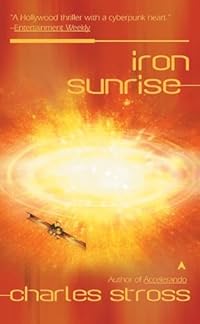
On This Page
Description
Planet Moscow is vaporized by an unnatural star explosion, prompting those who escaped to counterattack the likely culprit--planet New Dresden of the neighboring system. But New Dresden wasn't to blame, and as worlds go to war, an unseen enemy labors to destroy the universe itself.Tags
Recommendations





Member Reviews
After the Singularity scattered humanity across thousands of worlds, one of them has its sun blown up. Only scattered survivors are left, including a young girl whose imaginary friend knows a lot more than he should, and may be connected with the Singularity’s continued interest in humans. The victim world’s automated defense systems send retaliatory gunships at sublight speed, and only the surviving ambassadors can stop them—but someone is killing the ambassadors. And there’s an autocracy rising based on erasing humans and turning them into puppets, though even in the autocracy there are factions. Stross is much more willing to include sexual coercion in his sf than in the Laundry Files, which I find abstractly interesting but show more is worth pointing out in case that’s not what you want to read. show less
Not quite as mindblowingly original as the first book (Singularity Sky) but still immensely creative and better written. Also, about as subtle as a chainsaw, with the villains being literal space nazis. Rachel and Martin are back from book 1, but he (the star of book 1) mostly sits in the background, and instead the action follows some new characters most of the time.
Perhaps the biggest disappointment is that Stross ends the book poised for a sequel to pick up where things left off, but then buggered off and never wrote it. I was tempted to deduct a star for this crime, but after reading all about choices and consequences I had to consider whether it was really fair to punish a perfectly fine book because of what didn't come after, and show more ask myself "What would Wednesday do?" show less
Perhaps the biggest disappointment is that Stross ends the book poised for a sequel to pick up where things left off, but then buggered off and never wrote it. I was tempted to deduct a star for this crime, but after reading all about choices and consequences I had to consider whether it was really fair to punish a perfectly fine book because of what didn't come after, and show more ask myself "What would Wednesday do?" show less
Why does future always lead to people fucking like rabbits with reckless abandon. Why can't we develop into a society that is nice and creates loving an nurturing families and meaningful relationships instead. It's either nazis in space or anarchist creating a flawless utopia with hedonism dialled to 11. There's marginally more plot than in the last one but it's still mostly wish-fulfilment about post singularity anarchism. Despite all this supposed progress everyone acts exactly the same as you'd expect them to act in a modern society so I guess singularity won't be as transforming as people imagine today (paying with credit/reputation instead of money? how otherworldly, I simply cannot relate). I'm done with the series.
Having only read Stross's SF/horror/satire Laundry books— which I think are a lot of fun, but also very annoying whenever the humor takes the form of actual jokes— I figured maybe I would dig him better writing straight-faced space opera. Well... kind of. The two stars above are an average: half the time I liked it pretty well, and half the time I wanted to throw it across the room.
I haven't read the previous one in this series, but the background was pretty clear— too clear, because Stross explains things and then a little while later he explains them again, and again. Characters for whom this stuff is supposed to be ancient history are constantly saying or thinking the equivalent of "the Eschaton, as we know, is a time-traveling show more AI that etc. etc..." The same goes for the plot: just because half a dozen main characters all find out the same important plot detail at different times isn't a good reason to have them recap it in conversation every time. Worse, in the last third of the book as things get more hectic (and, possibly, Stross starts getting a little careless/bored), characters often have to be reminded of things that they themselves knew just a little while ago— not little details, but things like "the bad guys are able to turn people into zombies, and that's what just happened to your lover." The tell-don't-show approach even extends to the author's own thoughts about writing: at one point, a villain tells the protagonist that villains don't really think of themselves as villains because everyone is doing what they think is right (which isn't just heavy-handed, but also sort of wrong in that case, since up to that point Stross has depicted that character as consciously venal and driven only by self-interest).
Speaking of villains, the ones here are straight out of Space Nazi central casting, complete with German names, blond hair, hubristic monologuing, and the requisite "terrorize and execute some of your own guys just to show how ruthless you are" bit. What they were up to was treated as a huge surprise toward the end; it wasn't.
The non-villains are a mixed bag. They are all pretty familiar types, and they often can't resist making stupid jokes under pressure, but I was OK with all that except for the one who is pretty much just a retread of all the secret agents from the Laundry series (with a little of Iain M. Banks's Special Circumstances agents thrown in)— i.e. the one who does all the super-scary secret dirty work that most people wouldn't understand, usually with the aid of cool gadgets, and is right about everything, and gets no respect from silly bureaucrats. Except since this one is a woman (and this is overall a very straight universe), the dirty work also involves a very unpleasant sexual interlude that reminded me of the less light-hearted side of Piers Anthony.
I've made this sound totally terrible, so, what did I like? I liked the overall feel of the universe, although it's not all that distinctive if you've read any other contemporary books of this sub-genre. There is some really good prose in places. The plot doesn't necessarily hold up if you stop to think, but page by page it's pretty engaging, and makes good use of his rules for space travel and so on (I like that the heroes have to race to stop a thing that will otherwise hit a planet in 35 years). And as with his other stuff, the humor worked for me whenever it was situational/social, rather than people making wisecracks. There's definitely something about Stross that makes me keep resisting the book-throwing urge, and I'll probably read the rest of this series. show less
I haven't read the previous one in this series, but the background was pretty clear— too clear, because Stross explains things and then a little while later he explains them again, and again. Characters for whom this stuff is supposed to be ancient history are constantly saying or thinking the equivalent of "the Eschaton, as we know, is a time-traveling show more AI that etc. etc..." The same goes for the plot: just because half a dozen main characters all find out the same important plot detail at different times isn't a good reason to have them recap it in conversation every time. Worse, in the last third of the book as things get more hectic (and, possibly, Stross starts getting a little careless/bored), characters often have to be reminded of things that they themselves knew just a little while ago— not little details, but things like "the bad guys are able to turn people into zombies, and that's what just happened to your lover." The tell-don't-show approach even extends to the author's own thoughts about writing: at one point, a villain tells the protagonist that villains don't really think of themselves as villains because everyone is doing what they think is right (which isn't just heavy-handed, but also sort of wrong in that case, since up to that point Stross has depicted that character as consciously venal and driven only by self-interest).
Speaking of villains, the ones here are straight out of Space Nazi central casting, complete with German names, blond hair, hubristic monologuing, and the requisite "terrorize and execute some of your own guys just to show how ruthless you are" bit. What they were up to was treated as a huge surprise toward the end; it wasn't.
The non-villains are a mixed bag. They are all pretty familiar types, and they often can't resist making stupid jokes under pressure, but I was OK with all that except for the one who is pretty much just a retread of all the secret agents from the Laundry series (with a little of Iain M. Banks's Special Circumstances agents thrown in)— i.e. the one who does all the super-scary secret dirty work that most people wouldn't understand, usually with the aid of cool gadgets, and is right about everything, and gets no respect from silly bureaucrats. Except since this one is a woman (and this is overall a very straight universe), the dirty work also involves a very unpleasant sexual interlude that reminded me of the less light-hearted side of Piers Anthony.
I've made this sound totally terrible, so, what did I like? I liked the overall feel of the universe, although it's not all that distinctive if you've read any other contemporary books of this sub-genre. There is some really good prose in places. The plot doesn't necessarily hold up if you stop to think, but page by page it's pretty engaging, and makes good use of his rules for space travel and so on (I like that the heroes have to race to stop a thing that will otherwise hit a planet in 35 years). And as with his other stuff, the humor worked for me whenever it was situational/social, rather than people making wisecracks. There's definitely something about Stross that makes me keep resisting the book-throwing urge, and I'll probably read the rest of this series. show less
A well-written and well-paced tale of planetary genocide, interstellar plots and cults seen through the eyes of a few key players, from a disaffected teenager with voices in her head to some scary totalitarian plotters. Although enjoyable, I didn't find this book as much of a revelation as Stross's debut novel, Singularity Sky. It doesn't contain an idea which is as novel, and as much fun, as The Festival. But it is set in the same overall world of causal channels and the god-like presence of the Eschaton, and humans who want to outwit them. The characters are good and varied and the settings well-imagined, and the plot has enough twists to satisfy those who like such things.
But I would have liked to know more - or less - about the show more ReMastered and quite why they act as they do. Their presence is a given and there are some aspects of the plot which turn on their behaviour which don't quite ring true. We're given to believe that their 'puppets' are key to their plots for planetary takeover. Yet the only one directly described in the text clearly behaves like a B-movie zombie that would convince no one.
But, that nagging problem aside, this is a good read which will satisfy anyone who's enjoyed Stross's other work or that of Ken Macleod (and I include myself in their number.) show less
But I would have liked to know more - or less - about the show more ReMastered and quite why they act as they do. Their presence is a given and there are some aspects of the plot which turn on their behaviour which don't quite ring true. We're given to believe that their 'puppets' are key to their plots for planetary takeover. Yet the only one directly described in the text clearly behaves like a B-movie zombie that would convince no one.
But, that nagging problem aside, this is a good read which will satisfy anyone who's enjoyed Stross's other work or that of Ken Macleod (and I include myself in their number.) show less
This novel's narrative voice is entertaining and absorbing, and it tells an interesting story. Unfortunately, Iron Sunrise falls well short of the quality of its predecessor in Stross' Eschaton series, Singularity Sky. Where the first book was an inspiring and innovative account of an interstellar crisis fraught with the complications introduced by differing factions lying along different points on the singularity acceleration curve, the second is merely well-written space opera with few, shallow references to the post-singularity intelligence(s) introduced in Singularity Sky, appearing rather transparently pointless by comparison. As a stand-alone novel, it is entertaining and interesting, but as a sequel it is disappointing.
Good modern space opera with imperiled worlds, dark agents, fascist baddies, spunky girl, newsman with a past, all moving top speed with a few flashbacks. Interesting, somewhat twisty, a bit explosive (oh did the cover give that away!)
Members
- Recently Added By
Lists

Science fiction novels with a female protagonist
105 works; 30 members

Books Read in 2007
324 works; 8 members

Read in 2007
55 works; 1 member
Author Information

119+ Works 45,390 Members
Born in Leeds, England, Charles Stross knew he wanted to be a science fiction writer from the age of six. Despite this, he went to university in London and qualified as a Pharmacist. He made his first writing sale to Interzone in 1986, and sold about a dozen stories elsewhere throughout the late 1980s and early 1990s. He now writes fiction show more full-time, has sold about 16 novels, has won one Hugo award and been nominated nearly a dozen times, and has been translated into about a dozen languages. He is the author of the Merchant Princes series. His latest book, The Revolution Business, is the fifth in this series. He lives in Edinburgh, Scotland, with his wife Feorag. (Bowker Author Biography) show less
Some Editions
Awards and Honors
Awards
Distinctions
Series

Belongs to Publisher Series
Heyne Allgemeine Reihe (52052)
Work Relationships
Is contained in
Common Knowledge
- Canonical title
- Iron Sunrise
- Original title
- Iron Sunrise
- Original publication date
- 2004-07
- People/Characters
- Rachel Mansour; Wednesday Shadowmist; Martin Springfield
- First words
- Wednesday ran through the darkened corridors of the station, her heart pounding.
- Last words
- (Click to show. Warning: May contain spoilers.)And outside the office -- still hundred of light years away -- the Iron Sunrise continued to expand in its silent and deadly splendor, bearing down upon an Earth shrouded in comforting darkness.
- Publisher's editor
- Buchanan, Ginjer
- Blurbers
- Kelly, James Patrick
- Original language
- English
- Canonical DDC/MDS
- 823.087625
Classifications
- Genres
- Science Fiction, Fiction and Literature
- DDC/MDS
- 823.087625 — Literature & rhetoric English & Old English literatures English fiction By type Genre fiction Adventure fiction Speculative fiction Science fiction Space opera
- LCC
- PR6119 .T79 .I76 — Language and Literature English English Literature 2001-
- BISAC
Statistics
- Members
- 2,102
- Popularity
- 9,729
- Reviews
- 41
- Rating
- (3.83)
- Languages
- 5 — English, French, German, Italian, Spanish
- Media
- Paper, Audiobook, Ebook
- ISBNs
- 21
- UPCs
- 2
- ASINs
- 11