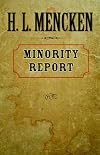
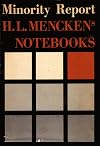
Minority Report
by H. L. Mencken
On This Page
Description
In 1956, Mencken read through his notebooks and extracted those pieces he thought truest, most pertinent, most precise, or most likely to blow the dust out of a reader's brain. With a style that combined biting sarcasm with the "language of the free lunch counter," Henry Louis Mencken shook politics and politicians for nearly half a century.Tags
Recommendations




























Member Reviews
Mencken is always a delightful stylist, and his level of Angst was comforting to my adolescent soul. This is a collection of short snappers as, usual quite informative of the liberal American mind. The format is a tidy up of the notebooks dealing with ideas for his future explorations, and the effect is that of a casual conversation. Disjointed, but very interesting.
This is basically a book of sayings by an iconoclast. His criticisms are sharp and witty, and his targets are mainly on the left.
Ratings
Members
- Recently Added By
Author Information

186+ Works 7,484 Members
H. L. Mencken 1880-1956 H. L. (Henry Louis) Mencken was born in Baltimore, Maryland, on September 12, 1880. He considered Maryland to be his home despite his many years in New York. As a child he attended Professor Friedrich Knapp's Institute, a private school for children of German descent. He completed his secondary education at Baltimore show more Polytechnic Institute, from which he graduated at the age of 16. Mencken wanted to be a writer but was obligated to work in his father's cigar factory. When his father died suddenly in 1899, Mencken immediately sought a job at the Baltimore Herald. Through he began with no experience in journalism, he quickly learned every job at the newspaper and at age 25 became its editor. Mencken went on to build himself a reputation as one of America's most brilliant writers and literary critics. His basic approach was to question everything and to accept no limits on personal freedom. He attacked organized religion, American cultural and literary standards, and every aspect of American life that he found shallow, ignorant, or false - which was almost everything. From the 1920's until his death, Mencken's sharp wit and penetrating social commentary made him one of the most highly regarded - and fiercely hated - of American social critics. He was later memorialized in the dramatic portrait of the cynical journalist in the play and film Inherit the Wind. Shortly after World War I, Mencken began a project that was to fascinate him for the rest of his life: a study of American language and how it had evolved from British English. In 1919 he published The American Language: A Preliminary Inquiry into the Development of English in the United States. To this and his publisher's surprise, the book sold out quickly; its wit and nonscholarly approach attracted many readers who would not normally buy a book on such a subject. In 1936, a revised and enlarged edition was published, and in 1945 and 1948, supplements were added. The work shows not only how American English differs from British English but how the 300 year American experience shaped American dialect. Thus the book, still considered a classic in its field, is both a linguistic and social history of the United States. Mencken died in his sleep on January 29, 1956. He was interred in Baltimore's Loudon Park Cemetery. (Bowker Author Biography) show less
Awards and Honors
Distinctions
Common Knowledge
- Canonical title
- Minority Report
Classifications
Statistics
- Members
- 103
- Popularity
- 315,217
- Reviews
- 2
- Rating
- (3.82)
- Languages
- English
- Media
- Paper, Ebook
- ISBNs
- 4
- ASINs
- 9