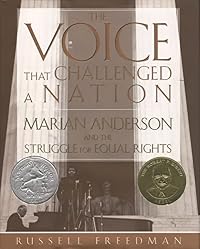
The Voice That Challenged a Nation: Marian Anderson and the Struggle for Equal Rights
by Russell Freedman
On This Page
Description
In the mid-1930s, Marian Anderson was a famed vocalist who had been applauded by European royalty and welcomed at the White House. But, because of her race, she was denied the right to sing at Constitution Hall in Washington, D.C. This is the story of her resulting involvement in the civil rights movement of the time.Tags
Recommendations


Member Reviews
What a magnificent book to be reading the night that the first African American was elected president of the United States!
Aside from the timing, this story of Marion Anderson's life was deftly written, and the the subject is genuinely inspiring.
Ms. Anderson's determination and delight in singing opened many doors for her - her local community raised money so she could go to school, instead of working to help support her family. Undeterred by singing schools and vocal coaches that refused to accept black students, she became hugely successful, touring Europe and enchanting audiences across the US. But at each turn, racism provided an ugly backdrop, with segregated concert halls, train station waiting rooms, and the notorious incident of show more the Daughters of the Revolution refusing to allow her to perform in Washington's most appropriate concert hall.
While the book does use the famous concert on the Lincoln steps as a climax, what was fascinating was the picture of a quiet, gentle person drawn into the struggle for equal rights because she had no choice, not because she intended to change the world. I felt that she was driven to sing, not to be an activist, and that adds a poignancy to the courage she showed by her presence, and her simple dignity under terrible conditions.
I wasn't in the mood to read this, but I found it engrossing, and a timely reminder the freedom and equality I experience must never be taken for granted.
Oh, and there is a nice use of photographs and archival documents throughout the book.
I'd give this to someone interested in Marian Anderson, Eleanor Roosevelt, or interested in civil rights, music, history, or biographies in general. show less
Aside from the timing, this story of Marion Anderson's life was deftly written, and the the subject is genuinely inspiring.
Ms. Anderson's determination and delight in singing opened many doors for her - her local community raised money so she could go to school, instead of working to help support her family. Undeterred by singing schools and vocal coaches that refused to accept black students, she became hugely successful, touring Europe and enchanting audiences across the US. But at each turn, racism provided an ugly backdrop, with segregated concert halls, train station waiting rooms, and the notorious incident of show more the Daughters of the Revolution refusing to allow her to perform in Washington's most appropriate concert hall.
While the book does use the famous concert on the Lincoln steps as a climax, what was fascinating was the picture of a quiet, gentle person drawn into the struggle for equal rights because she had no choice, not because she intended to change the world. I felt that she was driven to sing, not to be an activist, and that adds a poignancy to the courage she showed by her presence, and her simple dignity under terrible conditions.
I wasn't in the mood to read this, but I found it engrossing, and a timely reminder the freedom and equality I experience must never be taken for granted.
Oh, and there is a nice use of photographs and archival documents throughout the book.
I'd give this to someone interested in Marian Anderson, Eleanor Roosevelt, or interested in civil rights, music, history, or biographies in general. show less
This is the inspirational story of Marian Anderson, a great vocal artist and the reluctant breaker of racial barriers. While one may say the climax of her life story is her 1939 performance in front on the Lincoln Memorial, Freedman opens with the story of that Easter Sunday, piquing the reader’s interest and carrying it through the book. This is a biography that spans the duration of Anderson’s life, but this short book has a more limited focus; Freedman focuses on Marian’s pursuits and accomplishments as a singer, specifically as it relates to the obstacles placed in her way by racial discrimination. Though she never sought to become a figure in the struggle for equal rights, she found herself in that position when she was show more refused the opportunity to perform at the Constitution Hall by the Daughters of the American Revolution. The DAR inadvertently gave her a voice on the big stage.
Marian Anderson in an inspirational character and Freeman’s description of her is of a refreshingly humble person for an individual of such tremendous talent. While an interesting story with a fair share of dramatic moments, the young reader may not find some of the more mundane details of her life as interesting. Though the intended audience may not be as fascinated by it as I was, her story is a lesson on race relations for students of American history. She faced many challenges to achieve her goals as a result of racial discrimination, from securing the education and training she needed to succeed, to the venues in which she performed and the places to which she travelled. Marian Anderson’s story highlights the dark side of a troubled time in our nation’s history, while demonstrating that individuals overcome and change does happen. show less
Marian Anderson in an inspirational character and Freeman’s description of her is of a refreshingly humble person for an individual of such tremendous talent. While an interesting story with a fair share of dramatic moments, the young reader may not find some of the more mundane details of her life as interesting. Though the intended audience may not be as fascinated by it as I was, her story is a lesson on race relations for students of American history. She faced many challenges to achieve her goals as a result of racial discrimination, from securing the education and training she needed to succeed, to the venues in which she performed and the places to which she travelled. Marian Anderson’s story highlights the dark side of a troubled time in our nation’s history, while demonstrating that individuals overcome and change does happen. show less
It is a comforting notion that good art is blind, able to be enjoyed by any that open themselves up to it. Yet, there are always exceptions. In 1939, Marian Anderson, a world-renowned singer, was denied the ability to perform at a prestigious concert in Washington because of the color of her skin. Ultimately, it would prove that she had a voice capable of bringing down walls, but these barriers would take a bit louder volume before giving way.
Russell Freedman, author of The Voice of a Nation: Marian Anderson and the Struggle for Equal Rights, was aware of the musical works of Marian Anderson, but had no intention of writing about her until he learned of the grand political effect she had. With the endorsement of the first family, show more Anderson would perform a historic concert on the steps of the Lincoln Monument that would impact the lives of many. It was a fitting locale for such a moment given the cultural resonance of Lincoln's past with African-Americans.
Freedman begins the book on the day of said concert. By doing so, he sticks readers right in the historical thick of things and immediately draws eyes. If, as had happened in his own life, he had begun with simple cursory knowledge of Anderson, perhaps the book could've started on the wrong foot. This way, there is instant recognition of the significance of the moment. In closing, he gives a brief overview of Anderson's accomplishments and discusses the political relevance she held. As the best art tends to do, her work transcended the pop label and effected culture itself. show less
Russell Freedman, author of The Voice of a Nation: Marian Anderson and the Struggle for Equal Rights, was aware of the musical works of Marian Anderson, but had no intention of writing about her until he learned of the grand political effect she had. With the endorsement of the first family, show more Anderson would perform a historic concert on the steps of the Lincoln Monument that would impact the lives of many. It was a fitting locale for such a moment given the cultural resonance of Lincoln's past with African-Americans.
Freedman begins the book on the day of said concert. By doing so, he sticks readers right in the historical thick of things and immediately draws eyes. If, as had happened in his own life, he had begun with simple cursory knowledge of Anderson, perhaps the book could've started on the wrong foot. This way, there is instant recognition of the significance of the moment. In closing, he gives a brief overview of Anderson's accomplishments and discusses the political relevance she held. As the best art tends to do, her work transcended the pop label and effected culture itself. show less
This book chronicles the life of Marian Anderson, an African American Opera Singer who rose to fame despite the segregation and harsh Jim Crow laws of the early 20th Century America. Russell Freedman tells Marion's story in an easy to read, straightforward style that is accessible to even strugging readers. This book could be used as part of a unit teaching students about the civil rights movement, perhaps together with a music education class.
Though I enjoyed reading this book, I gave it a lower star ranking because I don't know that children will find it as compelling as adults do. This seems to me to be one of those books that adults think children should enjoy, but they really don't. Let's face it: few children are interested in or show more have even been exposed to opera, and it is an art form that requires a bit of maturity and patience to enjoy. I also think that there are other leaders of the civil rights movement whose life could better illustrate the time. show less
Though I enjoyed reading this book, I gave it a lower star ranking because I don't know that children will find it as compelling as adults do. This seems to me to be one of those books that adults think children should enjoy, but they really don't. Let's face it: few children are interested in or show more have even been exposed to opera, and it is an art form that requires a bit of maturity and patience to enjoy. I also think that there are other leaders of the civil rights movement whose life could better illustrate the time. show less
Marian Anderson didn't ask to be front and center in the early civil rights movement, but when her chance came she stepped up to the podium and sang her heart out. I don't know if I would ever have guessed that a singer's extraordinary gift could be as powerful as a preacher's words, but I'm grateful to Freedman's book for teaching me. Her story is as much about the transcendent power of art and music as it is about the history of race relations in our country. She needed to sing, and people wanted to hear.
Russell Freedman’s The Voice that Challenged a Nation: Marian Anderson and the Struggle for Equal Rights is a beautifully written and moving biography about one of the United States’ most renowned singers, who was significant not only because her voice was “one in one thousand,” but also for her contributions to the civil rights movement.
Russell Freedman is an acclaimed writer of many nonfiction books for young readers, and has won numerous awards, including a Newbery Medal Book, for The Voice that Challenged a Nation, as well as two Newbery Honor Books. This book is based completely on fact, yet is written in a way so the reader feels as though he or she is reading the story of a heroine. Freedman provides source notation on show more all of the quoted material for each chapter, as well as a thorough bibliography, detailing the books and sources that were especially helpful for his research. It is clear that Freedman spent a great deal of time on his research of Marian Anderson, which is reflected in his writing. The reader not only gets a whole picture of what Marian was like as a person and a singer, but also the influence that she had politically, especially in regards to the civil rights movement. Freedman does not sensationalize or stereotype; rather, he tells Marian’s triumphs and struggles true to the fact of the time, as magnificent or horrific as the situation may have been.
This book is interesting in that it not only tells the story of Marian’s entire life – her childhood in Philadelphia, following her career traveling through the United States and eventually touring Europe, but it also demonstrates Marian as the quiet yet influential civil rights representative that she was. The book follows the struggles she encountered with her singing, and also the discrimination she faced as an African American living in a very segregated United States, pre-1960.
Stylistically, this work of nonfiction is magnificent. Freedman writes in a way that completely captivates the reader; he makes the reader truly feel for Marian, and the reader feels as though they are struggling and triumphing along with her. The author seamlessly incorporates Marian’s own words and quotes that others said about her into his own text. There are no literary breaks between Freedman’s own writing about Marian and the sources that he used. Freedman’s tone is both quiet and yet triumphant, much like Marian herself. He writes in a way that humbles and celebrates Marian at the same time. He helps the reader to see what a brilliant and gracious person she really was. She did not revel in the attention she received; she simply wanted to share her voice with everyone around her.
The book is written in clear language, and is appropriate for grades 6 through 12; it does not require extensive background knowledge, but it would be helpful for the reader to have some knowledge of the racial landscape of the United States before the civil rights movement. It is important for the reader to know the grand strides that Marian Anderson was making as an African American woman at this time.
The Voice that Challenged a Nation is written chronologically following Marian’s early life and subsequent career as a concert vocalist, and also in the format of a story narrative; Freedman is clearly telling the story of Marian’s life as an artist and also as a civil rights activist. The chapter headings are informational, but also meant to grasp the reader’s attention. Titles such as “Marian Fever” and “Breaking Barriers” really capture the reader’s interest and engage him or her in what the next chapter will be about. Before Freedman discusses Marian’s early life, he uses chapter one to intrigue the reader about a momentous moment in Marian’s later life: singing at the Lincoln Memorial. This serves to capture the reader’s attention at the very beginning of the book. The subsequent chapters follow Marian’s life in a chronological order.
Freedman includes a table of contents at the beginning of the book, outlining chapter headings and page numbers. At the conclusion of the book the author includes extensive chapter notes, a selected bibliography, a selected discography for a reader that may want to listen to some of Marian’s music (I did! The first thing I did after finishing the book was YouTube a number of Marian’s songs), as well as an Index covering places, events, important terms and significant people.
One of the aspects of the book that I enjoyed most as a reader were the ample photographs that Freedman included throughout the entire book. Each chapter contained photographs of Marian and certain events throughout her life, such as her performances at concerts or her tour throughout Europe. It was both enjoyable and helpful to put “faces to names” throughout the reading process. It helped Marian’s singing and her struggles come to life. One especially moving picture, taking up two pages of the book (66 and 67), shows Marian’s perspective singing outward from the Lincoln Memorial when 75,000 people came to hear her voice.
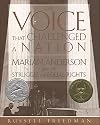
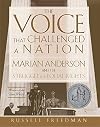
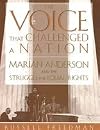
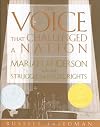
The front and back covers of the book both include pictures of Marian: the front cover, at her concert at the Lincoln Memorial, and the back cover including a picture of Marian singing. The typeface on the cover is large and clear; the focus word is “voice,” which ultimately enabled Marian to do everything that she did. The front cover also includes the Newbery Honor Book medal, clearly accrediting the book as a great work of nonfiction.
I thoroughly enjoyed this book and think that it would be a fantastic addition to a history class studying the civil rights movement. It demonstrates how one individual is able to overcome adversity and break barriers in a humble and beautiful way. Through the description of Marian’s experiences a young reader can more fully grasp the horrors of discrimination at the time. I highly recommend this book to anyone interested in the civil rights movement or music in general. show less
Russell Freedman is an acclaimed writer of many nonfiction books for young readers, and has won numerous awards, including a Newbery Medal Book, for The Voice that Challenged a Nation, as well as two Newbery Honor Books. This book is based completely on fact, yet is written in a way so the reader feels as though he or she is reading the story of a heroine. Freedman provides source notation on show more all of the quoted material for each chapter, as well as a thorough bibliography, detailing the books and sources that were especially helpful for his research. It is clear that Freedman spent a great deal of time on his research of Marian Anderson, which is reflected in his writing. The reader not only gets a whole picture of what Marian was like as a person and a singer, but also the influence that she had politically, especially in regards to the civil rights movement. Freedman does not sensationalize or stereotype; rather, he tells Marian’s triumphs and struggles true to the fact of the time, as magnificent or horrific as the situation may have been.
This book is interesting in that it not only tells the story of Marian’s entire life – her childhood in Philadelphia, following her career traveling through the United States and eventually touring Europe, but it also demonstrates Marian as the quiet yet influential civil rights representative that she was. The book follows the struggles she encountered with her singing, and also the discrimination she faced as an African American living in a very segregated United States, pre-1960.
Stylistically, this work of nonfiction is magnificent. Freedman writes in a way that completely captivates the reader; he makes the reader truly feel for Marian, and the reader feels as though they are struggling and triumphing along with her. The author seamlessly incorporates Marian’s own words and quotes that others said about her into his own text. There are no literary breaks between Freedman’s own writing about Marian and the sources that he used. Freedman’s tone is both quiet and yet triumphant, much like Marian herself. He writes in a way that humbles and celebrates Marian at the same time. He helps the reader to see what a brilliant and gracious person she really was. She did not revel in the attention she received; she simply wanted to share her voice with everyone around her.
The book is written in clear language, and is appropriate for grades 6 through 12; it does not require extensive background knowledge, but it would be helpful for the reader to have some knowledge of the racial landscape of the United States before the civil rights movement. It is important for the reader to know the grand strides that Marian Anderson was making as an African American woman at this time.
The Voice that Challenged a Nation is written chronologically following Marian’s early life and subsequent career as a concert vocalist, and also in the format of a story narrative; Freedman is clearly telling the story of Marian’s life as an artist and also as a civil rights activist. The chapter headings are informational, but also meant to grasp the reader’s attention. Titles such as “Marian Fever” and “Breaking Barriers” really capture the reader’s interest and engage him or her in what the next chapter will be about. Before Freedman discusses Marian’s early life, he uses chapter one to intrigue the reader about a momentous moment in Marian’s later life: singing at the Lincoln Memorial. This serves to capture the reader’s attention at the very beginning of the book. The subsequent chapters follow Marian’s life in a chronological order.
Freedman includes a table of contents at the beginning of the book, outlining chapter headings and page numbers. At the conclusion of the book the author includes extensive chapter notes, a selected bibliography, a selected discography for a reader that may want to listen to some of Marian’s music (I did! The first thing I did after finishing the book was YouTube a number of Marian’s songs), as well as an Index covering places, events, important terms and significant people.
One of the aspects of the book that I enjoyed most as a reader were the ample photographs that Freedman included throughout the entire book. Each chapter contained photographs of Marian and certain events throughout her life, such as her performances at concerts or her tour throughout Europe. It was both enjoyable and helpful to put “faces to names” throughout the reading process. It helped Marian’s singing and her struggles come to life. One especially moving picture, taking up two pages of the book (66 and 67), shows Marian’s perspective singing outward from the Lincoln Memorial when 75,000 people came to hear her voice.
The front and back covers of the book both include pictures of Marian: the front cover, at her concert at the Lincoln Memorial, and the back cover including a picture of Marian singing. The typeface on the cover is large and clear; the focus word is “voice,” which ultimately enabled Marian to do everything that she did. The front cover also includes the Newbery Honor Book medal, clearly accrediting the book as a great work of nonfiction.
I thoroughly enjoyed this book and think that it would be a fantastic addition to a history class studying the civil rights movement. It demonstrates how one individual is able to overcome adversity and break barriers in a humble and beautiful way. Through the description of Marian’s experiences a young reader can more fully grasp the horrors of discrimination at the time. I highly recommend this book to anyone interested in the civil rights movement or music in general. show less
Review – The Voice that Challenged a Nation: Marian Anderson and the Struggle for Equal Rights
I would find it hard to believe that anyone reading about Marian Anderson could possibly dislike her. Marian Anderson was a gentlewoman- graceful, modest, and eloquent, as well as being one heck of a singer. Russell Freedman has written a praiseworthy account of a singer who found herself immersed in the civil rights movement from the 1930s and her monumental concert at Lincoln Memorial on Easter Sunday, 1939 to her farewell concert at Carnegie Hall on Easter Sunday, 1965.
The book begins with an introduction to her most famous concert, one that would forever change Lincoln Memorial into a site for the fight for humanitarian rights and show more freedom of speech. On Easter Sunday, 1939 Marian Anderson changed America for the better by offering her voice as a symbol of equality. But, like most famous people, she was not born famous. In south Philadelphia she group up with her mother and two sisters and their extended family. Freedman gives an eloquent account of her rise to stardom through an early career that was scarred by racism, not being allowed to study at Music Conservatories that allowed Whites only, as well as uplifted by the people who fought for her and her right to sing. From the beginning of her career to the end, she had solid supporters from her original choir at Union Baptist Church to Howard Ickes, the Interior Secretary, and Eleanor Roosevelt. That did not mean it did not take a great deal of personal courage and remarkable talent to go from a south Philadelphia choir singer to one of the most renowned female soloist in the world. Learning her journey was well worth the time it took to read.
Not that it did take a great deal of time. Freedman has, like a chef with a balsamic and port reduction, condensed the story of her life and her role in the civil rights movement to 91 pages broken up into eight chapters. To be able to do this only the most important information about her career could be told, leaving some readers wishing their was a little more about her personal life. Forty years of marriage was described in what added up to maybe a paragraph. But her personal life wasn’t the point, her voice was, ‘the voice that challenged a nation,’ was the herald and moral of this work. I was sad not to know Marian Anderson better, but I was intrigued by the idea that a voice could make people color blind and take value in the only thing of importance, that they were listening to an artist. The cover is certainly inviting and intriguing as it shows Marian Anderson standing at a podium of microphones with Abraham Lincoln a shadow over her right shoulder. The photograph captures both the artist and the amazing impact she had on proving the need for equal rights because “all men are created equal.”
The book has a very powerful message. But even the most powerful message needs back up. The reader can tell how much effort Freedman put into this book. The photographs are a biography unto themselves. Before I started reading, I looked at every single picture in the book and I felt like I had already been introduced to Marian Anderson. As we follow the story, the selection of photos becomes essential to our picture of Marian Anderson.
Freedman also included an impressive amount of evidence of his research in his access features. There aren’t any of the fancy access features we see in many modern non fiction texts, such as sidebars, although he does give us a chapter notes with a list of abbreviations used in the book and a quotes list by chapter with citations, a selected bibliography, a selected discography (needed if the reader would like to further their education of Marian Anderson by listening to her), picture credits and index. Out of all these access features, the one I found most interesting was the selected bibliography. It is not an alphabetical list like you would expect. Instead, it is a conversational essay that tells the reader what books, periodicals, etc were used and why. I found myself reading it word for word while I may have only skimmed a traditional bibliography.
The Voice that Challenged a Nation is not a difficult read and I think could easily be used in the classroom when learning about the civil rights movement, most especially how it was a movement of peace by strong people who stood up (or just kept on singing) for what they believed and they did it against what others thought impossible odds. The suggested grade levels for this book are grades 5-9. The book could be used as late as 11th or 12th for students writing papers about the civil rights movement. I think that students in the classroom are too often given just the generalized truth, even as late as high school; they learn about the big leaders, people that have modern streets named after them. It is essential for their education to be introduced to a variety of people and ideas in any movement.
I leave you with one suggestion. While Freedman’s descriptions of people’s reaction to Marian Anderson are very well said and to hear people such as Eleanor Roosevelt and Arturo Toscanini praise her makes you believe in her talent, I did not feel as if I heard Marian’s voice in the book as much as I would have liked. She was, as she herself admitted, not a speaker and yet it is mostly her spoken words that we read. It is one of the hardest things to do, I think, to keep the voice of the person you are writing about in the text without overshadowing that person with description and quotes, and even harder when that person is a singer. My suggestion? Go on youtube and upload a video of Anderson singing so that you can listen to ‘the voice’ while you read Freedman’s interpretation and description of Easter Sunday, 1939 and you will hear why the world listened and changed. show less
I would find it hard to believe that anyone reading about Marian Anderson could possibly dislike her. Marian Anderson was a gentlewoman- graceful, modest, and eloquent, as well as being one heck of a singer. Russell Freedman has written a praiseworthy account of a singer who found herself immersed in the civil rights movement from the 1930s and her monumental concert at Lincoln Memorial on Easter Sunday, 1939 to her farewell concert at Carnegie Hall on Easter Sunday, 1965.
The book begins with an introduction to her most famous concert, one that would forever change Lincoln Memorial into a site for the fight for humanitarian rights and show more freedom of speech. On Easter Sunday, 1939 Marian Anderson changed America for the better by offering her voice as a symbol of equality. But, like most famous people, she was not born famous. In south Philadelphia she group up with her mother and two sisters and their extended family. Freedman gives an eloquent account of her rise to stardom through an early career that was scarred by racism, not being allowed to study at Music Conservatories that allowed Whites only, as well as uplifted by the people who fought for her and her right to sing. From the beginning of her career to the end, she had solid supporters from her original choir at Union Baptist Church to Howard Ickes, the Interior Secretary, and Eleanor Roosevelt. That did not mean it did not take a great deal of personal courage and remarkable talent to go from a south Philadelphia choir singer to one of the most renowned female soloist in the world. Learning her journey was well worth the time it took to read.
Not that it did take a great deal of time. Freedman has, like a chef with a balsamic and port reduction, condensed the story of her life and her role in the civil rights movement to 91 pages broken up into eight chapters. To be able to do this only the most important information about her career could be told, leaving some readers wishing their was a little more about her personal life. Forty years of marriage was described in what added up to maybe a paragraph. But her personal life wasn’t the point, her voice was, ‘the voice that challenged a nation,’ was the herald and moral of this work. I was sad not to know Marian Anderson better, but I was intrigued by the idea that a voice could make people color blind and take value in the only thing of importance, that they were listening to an artist. The cover is certainly inviting and intriguing as it shows Marian Anderson standing at a podium of microphones with Abraham Lincoln a shadow over her right shoulder. The photograph captures both the artist and the amazing impact she had on proving the need for equal rights because “all men are created equal.”
The book has a very powerful message. But even the most powerful message needs back up. The reader can tell how much effort Freedman put into this book. The photographs are a biography unto themselves. Before I started reading, I looked at every single picture in the book and I felt like I had already been introduced to Marian Anderson. As we follow the story, the selection of photos becomes essential to our picture of Marian Anderson.
Freedman also included an impressive amount of evidence of his research in his access features. There aren’t any of the fancy access features we see in many modern non fiction texts, such as sidebars, although he does give us a chapter notes with a list of abbreviations used in the book and a quotes list by chapter with citations, a selected bibliography, a selected discography (needed if the reader would like to further their education of Marian Anderson by listening to her), picture credits and index. Out of all these access features, the one I found most interesting was the selected bibliography. It is not an alphabetical list like you would expect. Instead, it is a conversational essay that tells the reader what books, periodicals, etc were used and why. I found myself reading it word for word while I may have only skimmed a traditional bibliography.
The Voice that Challenged a Nation is not a difficult read and I think could easily be used in the classroom when learning about the civil rights movement, most especially how it was a movement of peace by strong people who stood up (or just kept on singing) for what they believed and they did it against what others thought impossible odds. The suggested grade levels for this book are grades 5-9. The book could be used as late as 11th or 12th for students writing papers about the civil rights movement. I think that students in the classroom are too often given just the generalized truth, even as late as high school; they learn about the big leaders, people that have modern streets named after them. It is essential for their education to be introduced to a variety of people and ideas in any movement.
I leave you with one suggestion. While Freedman’s descriptions of people’s reaction to Marian Anderson are very well said and to hear people such as Eleanor Roosevelt and Arturo Toscanini praise her makes you believe in her talent, I did not feel as if I heard Marian’s voice in the book as much as I would have liked. She was, as she herself admitted, not a speaker and yet it is mostly her spoken words that we read. It is one of the hardest things to do, I think, to keep the voice of the person you are writing about in the text without overshadowing that person with description and quotes, and even harder when that person is a singer. My suggestion? Go on youtube and upload a video of Anderson singing so that you can listen to ‘the voice’ while you read Freedman’s interpretation and description of Easter Sunday, 1939 and you will hear why the world listened and changed. show less
Members
- Recently Added By
Lists

Newbery Honor Books By year - II - 1981-2035
143 works; 4 members

Books Read in 2023
5,547 works; 145 members

Robert F. Sibert Informational Book Medal
102 works; 1 member
Author Information

70+ Works 20,317 Members
Russell Freedman was born in San Francisco, California on October 11, 1929. He received a bachelor's degree in English from the University of California, Berkeley in 1951. After college, he served in the U.S. Counter Intelligence Corps during the Korean War. After his military service, he became a reporter and editor with the Associated Press. In show more 1956, he took a position at the advertising agency J. Walter Thompson in New York, where he did publicity writing for television. In 1965, he became a full-time writer. His first book, Teenagers Who Made History, was published in 1961. He went on to publish more than 60 nonfiction titles for young readers including Immigrant Kids, Cowboys of the Old West, Indian Chiefs, Martha Graham: A Dancer's Life, Confucius: The Golden Rule, Because They Marched: The People's Campaign for Voting Rights That Changed America, Vietnam: A History of the War, and The Sinking of the Vasa. He received the Newbery Medal for Lincoln: A Photobiography and three Newbery Honors for Eleanor Roosevelt: A Life of Discovery, The Wright Brothers: How They Invented the Airplane, and The Voice That Challenged a Nation: Marian Anderson and the Struggle for Equal Rights. He also received the Regina Medal, the May Hill Arbuthnot Lecture Award, the Orbis Pictus Award, the Sibert Medal, a Sibert Honor, the Laura Ingalls Wilder Medal, and the National Humanities Medal. He died on March 16, 2018 at the age of 88. (Bowker Author Biography) show less
Awards and Honors
Awards
Distinctions
Notable Lists
Common Knowledge
- Original publication date
- 2004
- People/Characters
- Marian Anderson; Eleanor Roosevelt; Daughters of the American Revolution
- Important places
- Constitution Hall, Washington, D.C., USA; Washington, D.C., USA; Lincoln Memorial, Washington, D.C., USA
- Important events
- African-American Civil Rights Movement
- Publisher's editor
- Stevenson, Dinah
Classifications
- Genres
- Nonfiction, Kids, Biography & Memoir, Tween
- DDC/MDS
- 782.1092 — Arts & recreation Music Vocal Music, Singing Operas and related dramatic vocal forms; concert versions modified standard subdivisions History, geographic treatment, biography Biography
- LCC
- ML3930 .A5 .F73 — Music Literature on music Literature on music Literature for children
- BISAC
Statistics
- Members
- 676
- Popularity
- 42,247
- Reviews
- 98
- Rating
- (4.09)
- Languages
- English
- Media
- Paper, Audiobook
- ISBNs
- 15
- UPCs
- 1
- ASINs
- 9