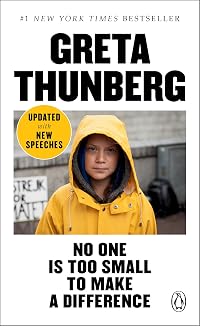
No One Is Too Small to Make a Difference
by Greta Thunberg
On This Page
Description
"The groundbreaking speeches of Greta Thunberg, the young climate activist who has become the voice of a generation, including her historic address to the United Nations"--Tags
Recommendations









Member Reviews
I want to start this review by saying that my opinion of this book has nothing to do with my agreement or disagreement with the issues discussed. While I am all for protecting our environment and making the changes necessary, this belief did not make me like this little paperback collection of speeches. It also does not reflect my opinions on Greta herself.
My first issue with this book was the complete lack of sources. I realize that this is a collection of speeches, however, they are of a scientific nature and are being published as a book... in print. I think that with the publishing of the speeches as a book, citations needed to be added. Without them, it is hard to view things as credible facts. Even as speeches, anything presented show more as a fact really should come with a reference to where it was found. Her more recent speeches are better about this, as she often says where the information is from before she states a number. However, her earlier speeches are severely lacking in source material. This book is being marketed as non-fiction and science. As such, I was shocked by the lack of sources.
A few examples:
"...a number of leading climate scientists wrote that we have at most three years to reverse growth in greenhouse gases..." Who are these scientists? Where did this information come from? To not be 100% specific in a speech is one thing, but the sourcing should have been considered when making a book.
"If people knew that the scientists say that we have a 5 percent chance..." Again, which scientists? It is hard for me to believe information to be credible when a very specific number is thrown out with a vague reference to an unspecified group of scientists.
And these two examples are just on the first page. There are many facts thrown out with no real source. This may not bother some people, as it is a collection of speeches. But to me, it makes sense that someone who decides to publish a collection of their speeches (ones that are marketed as non fiction and science, and have numbers and facts loaded into them, I mean) and distribute it as a book would add sources to said book. Why did I have to search the data being presented as fact and
do a LOT of fact-checking while reading a book that is being marketed as nonfiction?
Another glaring issue with this is how hypocritical some of it is. She condemns activists who travel great distances because they are using valuable resources to travel. However, in a later speech, she lists off all of the different forms of traveling she has to do. To me, this seems hypocritical. Why condemn others for the thing you do?
"Wherever I Go I Seem to Be Surrounded By Fairy Tales" is one of the last speeches included in this book and it left me a little confused. On page 89, she states "...a 50 per cent chance of staying below a 1.5 degree C global temperature rise." However, page 92 (same speech) says "...to have a 67 per cent chance of staying below a 1.5 degree C global temperature rise.... Which is it? She gives the same date: 1 January 2018. She also gives the same amount of CO2 emissions left: 420 gigatonnes. So which percentage is it? This difference in numbers within the same speech, without any source listed, makes it hard to find the information credible.
As excited as I was to read this, and as much as I wanted to love it, it just didn't rub me the right way. show less
My first issue with this book was the complete lack of sources. I realize that this is a collection of speeches, however, they are of a scientific nature and are being published as a book... in print. I think that with the publishing of the speeches as a book, citations needed to be added. Without them, it is hard to view things as credible facts. Even as speeches, anything presented show more as a fact really should come with a reference to where it was found. Her more recent speeches are better about this, as she often says where the information is from before she states a number. However, her earlier speeches are severely lacking in source material. This book is being marketed as non-fiction and science. As such, I was shocked by the lack of sources.
A few examples:
"...a number of leading climate scientists wrote that we have at most three years to reverse growth in greenhouse gases..." Who are these scientists? Where did this information come from? To not be 100% specific in a speech is one thing, but the sourcing should have been considered when making a book.
"If people knew that the scientists say that we have a 5 percent chance..." Again, which scientists? It is hard for me to believe information to be credible when a very specific number is thrown out with a vague reference to an unspecified group of scientists.
And these two examples are just on the first page. There are many facts thrown out with no real source. This may not bother some people, as it is a collection of speeches. But to me, it makes sense that someone who decides to publish a collection of their speeches (ones that are marketed as non fiction and science, and have numbers and facts loaded into them, I mean) and distribute it as a book would add sources to said book. Why did I have to search the data being presented as fact and
do a LOT of fact-checking while reading a book that is being marketed as nonfiction?
Another glaring issue with this is how hypocritical some of it is. She condemns activists who travel great distances because they are using valuable resources to travel. However, in a later speech, she lists off all of the different forms of traveling she has to do. To me, this seems hypocritical. Why condemn others for the thing you do?
"Wherever I Go I Seem to Be Surrounded By Fairy Tales" is one of the last speeches included in this book and it left me a little confused. On page 89, she states "...a 50 per cent chance of staying below a 1.5 degree C global temperature rise." However, page 92 (same speech) says "...to have a 67 per cent chance of staying below a 1.5 degree C global temperature rise.... Which is it? She gives the same date: 1 January 2018. She also gives the same amount of CO2 emissions left: 420 gigatonnes. So which percentage is it? This difference in numbers within the same speech, without any source listed, makes it hard to find the information credible.
As excited as I was to read this, and as much as I wanted to love it, it just didn't rub me the right way. show less
"Acollection of articulate, forceful speeches made from September 2018 to September 2019 by the Swedish climate activist who was nominated for a Nobel Peace Prize.
Speaking in such venues as the European and British Parliaments, the French National Assembly, the Austrian World Summit, and the U.N. General Assembly, Thunberg has always been refreshingly—and necessarily—blunt in her demands for action from world leaders who refuse to address climate change. With clarity and unbridled passion, she presents her message that climate change is an emergency that must be addressed immediately, and she fills her speeches with punchy sound bites delivered in her characteristic pull-no-punches style: “I don’t want you to be hopeful. I want show more you to panic. I want you to feel the fear I feel every day. And then I want you to act.” In speech after speech, to persuade her listeners, she cites uncomfortable, even alarming statistics about global temperature rise and carbon dioxide emissions. Although this inevitably makes the text rather repetitive, the repetition itself has an impact, driving home her point so that no one can fail to understand its importance. Thunberg varies her style for different audiences. Sometimes it is the rousing “our house is on fire” approach; other times she speaks more quietly about herself and her hopes and her dreams. When addressing the U.S. Congress, she knowingly calls to mind the words and deeds of Martin Luther King Jr. and John F. Kennedy. The last speech in the book ends on a note that is both challenging and upbeat: “We are the change and change is coming.” The edition published in Britain earlier this year contained 11 speeches; this updated edition has 16, all worth reading.
A tiny book, not much bigger than a pamphlet, with huge potential impact." A Kirkus Starred Review, www.kirkusreviews.com show less
Speaking in such venues as the European and British Parliaments, the French National Assembly, the Austrian World Summit, and the U.N. General Assembly, Thunberg has always been refreshingly—and necessarily—blunt in her demands for action from world leaders who refuse to address climate change. With clarity and unbridled passion, she presents her message that climate change is an emergency that must be addressed immediately, and she fills her speeches with punchy sound bites delivered in her characteristic pull-no-punches style: “I don’t want you to be hopeful. I want show more you to panic. I want you to feel the fear I feel every day. And then I want you to act.” In speech after speech, to persuade her listeners, she cites uncomfortable, even alarming statistics about global temperature rise and carbon dioxide emissions. Although this inevitably makes the text rather repetitive, the repetition itself has an impact, driving home her point so that no one can fail to understand its importance. Thunberg varies her style for different audiences. Sometimes it is the rousing “our house is on fire” approach; other times she speaks more quietly about herself and her hopes and her dreams. When addressing the U.S. Congress, she knowingly calls to mind the words and deeds of Martin Luther King Jr. and John F. Kennedy. The last speech in the book ends on a note that is both challenging and upbeat: “We are the change and change is coming.” The edition published in Britain earlier this year contained 11 speeches; this updated edition has 16, all worth reading.
A tiny book, not much bigger than a pamphlet, with huge potential impact." A Kirkus Starred Review, www.kirkusreviews.com show less
Although this is a short book, it packs a very considerable punch. I greatly admire Greta Thunberg for her clarity of thought and focus on what is truly important. This collection of her speeches emphasises the crux of the climate emergency: we are swiftly running out of time to stop emitting greenhouse gases. Climate science demonstrates that we have used up most of our global carbon budget. If we go beyond it, large areas of habitable land will become uninhabitable, extreme weather will become typical, and the survival of human civilisation unlikely. This has been public knowledge for decades, yet action still isn't happening. Thunberg's speeches present these unpalatable facts in uncompromising terms. There is no verbiage about show more sustainability and green growth here, just stark facts. Several passages particularly stood out to me as particularly powerful:
As an indictment of capitalism, that could scarcely be more succinct or damning. Similarly:
I cannot imagine what it must be like for 2021's teenagers to look at the future. I remember learning about climate change in my own teens and realising the environmental destructiveness of neoliberal economics during my A-levels. Back then, the UK had a Labour government and during my undergraduate degree the Climate Change Act went through the UK parliament with cross-party support. Although I knew things were bad, I thought at the time they'd get better with environmental policy (which I was studying and wanted to work in). I remember writing an angry letter to Gordon Brown, then UK Prime Minister, saying the government should invest more in renewable energy. Since then global emissions have risen and risen, global temperature records have repeatedly been broken, and UK politics has got worse and worse. My hope has waned, as technologies that were supposed to save us remain perpetually ten years away from widespread adoption, consumption increases, and wealth inequality worsens. Global GHG emissions were supposed to peak in 2008, in 2012, in 2014, in 2018, and in 2020 but did not. My generation, the older millennials, have had at least some semblance of hope for the climate, whereas generation Z gets no such privilege. Not that it's great to have your hope ground down and your idealism worn into exhaustion and sadness, but all they've known is global climate emergency. Whereas I am enraged by twenty years of watching delays and ineffectual policies, Thunberg's rage has the sharp focus and clarity of youth. This penultimate speech, given to the UN General Assembly, is the most emotive and perhaps the most powerful in the collection:
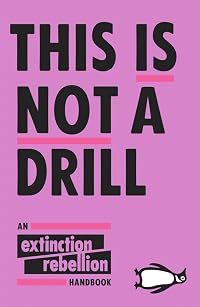
It should not be up to children like Thunberg to say all of this. We adults are letting down future generations. My generation was also let down, but that is no excuse for our own inaction. Thunberg boils the climate emergency down to its essentials: the remaining carbon budget is a limitation within which the economy must function. Capitalism as it stands cannot function within such a quantitative limit, so capitalism must be replaced. We must stop burning fossil fuels. Increasing the wealth of a tiny minority must not be prioritised above the survival of billions. I had similar feelings reading 'No One Is Too Small to Make a Difference' as I did reading [b:This Is Not A Drill: An Extinction Rebellion Handbook|45308227|This Is Not A Drill An Extinction Rebellion Handbook|Extinction Rebellion|https://i.gr-assets.com/images/S/compressed.photo.goodreads.com/books/1559314992l/45308227._SY75_.jpg|70036425]: horror at the reality of the situation coupled with flickers of hope that voices like Thunberg's are being raised. What she says cannot be ignored. show less
[To the UN Climate Change Conference] You are not mature enough to tell it like it is. Even that burden you leave to your children. But I don't care about being popular, I care about climate justice and the living planet.
We are about to sacrifice our civilisation for the opportunity of a very small number of people to continue to make enormous amounts of money. We are about to sacrifice the biosphere so that rich people in countries like mine can live in luxury. But it is the sufferings of the many which pay for the luxuries of the few.
As an indictment of capitalism, that could scarcely be more succinct or damning. Similarly:
[To UK parliament] I was fortunate to be born in a time and place where everyone told us to dream big; I could become whatever I wanted to. I could live wherever I wanted to. People like me had whatever we needed and more. Things our grandparents could not even dream of. We had everything we could ever wish for and yet now we may have nothing.
Now we probably don't even have a future anymore.
Because that future was sold so that a small number of people could make unimaginable amounts of money. It was stolen from us every time you said that the sky was the limit, and that you only live once.
You lied to us. You gave us false hope. You told us the future was something to look forward to. And the saddest thing is that most children are not even aware of the fate that awaits us. We will not understand it until it is too late. And yet we are the lucky ones. Those who will be affected the hardest are already suffering the consequences. But their voices are not heard.
I cannot imagine what it must be like for 2021's teenagers to look at the future. I remember learning about climate change in my own teens and realising the environmental destructiveness of neoliberal economics during my A-levels. Back then, the UK had a Labour government and during my undergraduate degree the Climate Change Act went through the UK parliament with cross-party support. Although I knew things were bad, I thought at the time they'd get better with environmental policy (which I was studying and wanted to work in). I remember writing an angry letter to Gordon Brown, then UK Prime Minister, saying the government should invest more in renewable energy. Since then global emissions have risen and risen, global temperature records have repeatedly been broken, and UK politics has got worse and worse. My hope has waned, as technologies that were supposed to save us remain perpetually ten years away from widespread adoption, consumption increases, and wealth inequality worsens. Global GHG emissions were supposed to peak in 2008, in 2012, in 2014, in 2018, and in 2020 but did not. My generation, the older millennials, have had at least some semblance of hope for the climate, whereas generation Z gets no such privilege. Not that it's great to have your hope ground down and your idealism worn into exhaustion and sadness, but all they've known is global climate emergency. Whereas I am enraged by twenty years of watching delays and ineffectual policies, Thunberg's rage has the sharp focus and clarity of youth. This penultimate speech, given to the UN General Assembly, is the most emotive and perhaps the most powerful in the collection:
I should be back in school on the other side of the ocean. Yet you all come to us young people for hope? How dare you!
You have taken away my dreams and my childhood with your empty words. And yet I'm one of the lucky ones.
People are suffering. People are dying. Entire ecosystems are collapsing. We are in the beginning of a mass extinction. And all you can talk about is money and fairy tales of eternal economic growth. How dare you!
For more than thirty years the science has been crystal clear. How dare you continue to look away, and come here saying that you are doing enough.
It should not be up to children like Thunberg to say all of this. We adults are letting down future generations. My generation was also let down, but that is no excuse for our own inaction. Thunberg boils the climate emergency down to its essentials: the remaining carbon budget is a limitation within which the economy must function. Capitalism as it stands cannot function within such a quantitative limit, so capitalism must be replaced. We must stop burning fossil fuels. Increasing the wealth of a tiny minority must not be prioritised above the survival of billions. I had similar feelings reading 'No One Is Too Small to Make a Difference' as I did reading [b:This Is Not A Drill: An Extinction Rebellion Handbook|45308227|This Is Not A Drill An Extinction Rebellion Handbook|Extinction Rebellion|https://i.gr-assets.com/images/S/compressed.photo.goodreads.com/books/1559314992l/45308227._SY75_.jpg|70036425]: horror at the reality of the situation coupled with flickers of hope that voices like Thunberg's are being raised. What she says cannot be ignored. show less
Greta Thunberg is the bomb.
I first heard about Greta when she began school striking last year, but only, at first, as a curiosity (on the part of the press). It wasn't until her speech before the UK parliament that she got enough press that I was able to understand her story. When I read the speech in the Guardian, I was laughing - in the best way - at the sheer audacity, bravery, and brilliance, of a 16 year old standing before the august (HA!) body of British lawmakers and telling them that:
The UK is, however, very special. Not only for its mind-blowing historical carbon debt, but also for its current, very creative, carbon accounting.
and:
This ongoing irresponsible behaviour will no doubt be remembered in history as one of the show more greatest failures of mankind.
and my favorite:
Did you just hear what I said? Is my English okay? Is the microphone on? Because I'm beginning to wonder.
I handed the speech to MT and said You HAVE TO read this. It's written by a 16 year old Swedish girl whose first language isn't even English! (We who have lived our lives isolated on single language land masses - and yes, yes, Spanish, but it wasn't widespread when I was a kid - are always in awe of those of you who juggle multiple languages with ease, never mind speak it better than us natives.) I've been a following her in the news ever since and I just admire the hell out of her. I found this little collection of all her speeches up to and including her UK Parliament speech, on the bookstore counter, and snapped it up.
It's nothing fancy; just a small booklet containing all 11 of her speeches through 23 April 2019, and if read cover to cover (which I don't recommend), it's repetitive. But the message is powerful, and like it or not, it's dead-on accurate: our house is on fire; what we would never do to our own lawn, we're doing with impunity to the rest of the planet, and we're collectively living like a magic, 23rd-hour solution that will make everything ok again is going to miraculously fly out our asses.
Greta is making waves because she's 16 and she's the only one willing to stand in front of entire governments and actually say, with only a tiny bit more tact: you're all idiots and you're the generation that will always be known as those idiots who destroyed civilisation as we know it.
On a more first-world-problem note: this wonderful 16 year old was nominated for a Nobel Peace Prize and even though she didn't win (and should have), I am still thankful I'm not a teen today. Life is hard enough as an adolescent, but now teens are nominated for Nobels; getting into Yale or Oxford suddenly isn't the acme of teen achievement any more. Yikes. show less
I first heard about Greta when she began school striking last year, but only, at first, as a curiosity (on the part of the press). It wasn't until her speech before the UK parliament that she got enough press that I was able to understand her story. When I read the speech in the Guardian, I was laughing - in the best way - at the sheer audacity, bravery, and brilliance, of a 16 year old standing before the august (HA!) body of British lawmakers and telling them that:
The UK is, however, very special. Not only for its mind-blowing historical carbon debt, but also for its current, very creative, carbon accounting.
and:
This ongoing irresponsible behaviour will no doubt be remembered in history as one of the show more greatest failures of mankind.
and my favorite:
Did you just hear what I said? Is my English okay? Is the microphone on? Because I'm beginning to wonder.
I handed the speech to MT and said You HAVE TO read this. It's written by a 16 year old Swedish girl whose first language isn't even English! (We who have lived our lives isolated on single language land masses - and yes, yes, Spanish, but it wasn't widespread when I was a kid - are always in awe of those of you who juggle multiple languages with ease, never mind speak it better than us natives.) I've been a following her in the news ever since and I just admire the hell out of her. I found this little collection of all her speeches up to and including her UK Parliament speech, on the bookstore counter, and snapped it up.
It's nothing fancy; just a small booklet containing all 11 of her speeches through 23 April 2019, and if read cover to cover (which I don't recommend), it's repetitive. But the message is powerful, and like it or not, it's dead-on accurate: our house is on fire; what we would never do to our own lawn, we're doing with impunity to the rest of the planet, and we're collectively living like a magic, 23rd-hour solution that will make everything ok again is going to miraculously fly out our asses.
Greta is making waves because she's 16 and she's the only one willing to stand in front of entire governments and actually say, with only a tiny bit more tact: you're all idiots and you're the generation that will always be known as those idiots who destroyed civilisation as we know it.
On a more first-world-problem note: this wonderful 16 year old was nominated for a Nobel Peace Prize and even though she didn't win (and should have), I am still thankful I'm not a teen today. Life is hard enough as an adolescent, but now teens are nominated for Nobels; getting into Yale or Oxford suddenly isn't the acme of teen achievement any more. Yikes. show less
Greta Thunberg’s No One Is Too Small to Make a Difference collects her various speeches in a single volume for those looking to learn from her example in tackling the challenge of climate change, the greatest threat to humanity’s future. Thunberg was initially inspired by the activism of the Parkland students (pg. 46), though she now represents one facet of a global movement. In a 2018 speech in Stockholm, Thunberg said, “If people knew that the scientists say that we have a 5 per cent chance of meeting the Paris target, and if people knew what a nightmare scenario we will face if we don’t keep global warming below 2ºC, they wouldn’t need to ask me why I’m on school strike outside parliament” (pgs. 9-10). She challenged show more wealthy nations and businesses in her speech at COP 24 in 2018, saying, “We are about to sacrifice our civilization for the opportunity of a very small number of people to continue to make enormous amounts of money” (pg. 29). Thunberg warned the European Parliament in 2019, “Everything and everyone has to change. But the bigger your platform, the bigger your responsibility. The bigger your carbon footprint, the bigger your moral duty” (pg. 73). Addressing the British Parliament in 2019, Thunberg said, “You lied to us. You gave us false hope. You told us that the future was something to look forward to. And the saddest thing is that most children are not even aware of the fate that awaits us. We will not understand until it’s too late. And yet we are the lucky ones. Those who will be affected the hardest are already suffering the consequences. But their voices are not heard” (pg. 82). Speaking to the Austrian World Summit in 2019, she said, “The longer we wait the harder it will be to turn this around” (pg. 100). Thunberg addressed the French National Assembly in 2019, saying, “Now political leaders in some countries are starting to talk. They are starting to declare climate emergencies and announcing dates for so-called ‘climate neutrality’. And declaring a climate emergency is good. But only setting up these vague distant dates, and saying things which give the impression that things are being done and that action is under way will most likely do more harm than good. …The climate and ecological emergency is right here, right now. But it has only just begun. It will get worse” (pg. 109). No One Is Too Small to Make a Difference is a great collection of Thunberg’s speeches, particularly useful for students looking to study her work and movement. It is a must-read in particular for any world leaders who genuinely want to make a difference, but Thunberg herself addresses the skepticism people feel about those who have had the power to act these last thirty years. show less
this is a compilation of some of the speeches (read by her; i was glad it was literally in her voice) that greta thunberg has given over the last year and a quarter. as such, there is a lot of repetition (both of the information and of some of the same phrases that she uses again and again). one of the things she says is that she doesn't think that people know the information she is talking about. i was definitely one of them. i had never heard the extremely disturbing statistics she gives. she is absolutely right - we should be panicked, we should be focusing nearly all of our attention on this, we are failing our children and the world itself. it is unconscionable that our politicians are more worried about securing votes than making show more uncomfortable policy; that a few rich businessmen are literally ruining the world just so they can get more rich (and how will that matter in the face of the disaster we are facing down?).
i also don't know what can possibly be done. she says being hopeless is perhaps the worst of the responses, and she probably isn't wrong. but catastrophic and irreversible climate change is a mere few years away, and we are relying on inventions that don't exist (and that have little or no funding to be created) to fix it. how can i feel hope? show less
i also don't know what can possibly be done. she says being hopeless is perhaps the worst of the responses, and she probably isn't wrong. but catastrophic and irreversible climate change is a mere few years away, and we are relying on inventions that don't exist (and that have little or no funding to be created) to fix it. how can i feel hope? show less
Best for:
Those who like to collect books of speeches.
In a nutshell:
Collection of Thunberg’s speeches, delivered throughout 2018 and 2019
Worth quoting:
“You can’t simply make up your own facts, just because you don’t like what you hear.”
“Every time we make a decision we should ask ourselves: how will this decision affect that [emission] curve?”
Why I chose it:
I recently subscribed to the Books That Matter box, and this was included in November’s delivery.
Review:
How does one review a collection of speeches by a child? It seems … odd to do so. Instead, I want to talk about what I read in these speeches, and the overall issue of climate change and activism. However, I will say that these speeches are nearly identical in show more content, and are basically understandably angry and frustrated calls to action.
Action that isn’t happening.
Thunberg talks a lot about how she does not like hearing from adults and politicians that people like her give them hope. And she’s right - it’s absurd to look to children to fix things we as adults have broken, to look for them for hope, when there are people in power nodding along to her speeches who could actually, y’know, do something. At the same time, it’s really impressive how so many younger people aren’t waiting until they’re older to speak up about the things that matter to them.
And also … I’m old enough to be Thunberg’s mother, and I don’t have any more of a clue how to fix things, nor do I find myself in a position of power. Shit, I just voted in an election where 70 million people thought it’d be cool to keep a racist bigot sexual assaulting asshole in office, and where one elderly turtle can hold up economic assistance for 350 million people. How DOES someone make a difference in these systems?
Climate change is one of those issues where on an individual level there are obviously loads of things we can do (not eat meat, not consume dairy, not take flights, etc.), but corporations continue to produce the carbon on such a massive scale. There’s obviously a need for collective action - and Thunberg’s school strike has turned into something like that - but I also think it’s hard when what some people see as the biggest emergency of our life time is competing with other emergencies that might seem more immediate to a lot of people.
Like I said. Frustrating.
Keep it / Pass to a Friend / Donate it / Toss it:
Donate it show less
Those who like to collect books of speeches.
In a nutshell:
Collection of Thunberg’s speeches, delivered throughout 2018 and 2019
Worth quoting:
“You can’t simply make up your own facts, just because you don’t like what you hear.”
“Every time we make a decision we should ask ourselves: how will this decision affect that [emission] curve?”
Why I chose it:
I recently subscribed to the Books That Matter box, and this was included in November’s delivery.
Review:
How does one review a collection of speeches by a child? It seems … odd to do so. Instead, I want to talk about what I read in these speeches, and the overall issue of climate change and activism. However, I will say that these speeches are nearly identical in show more content, and are basically understandably angry and frustrated calls to action.
Action that isn’t happening.
Thunberg talks a lot about how she does not like hearing from adults and politicians that people like her give them hope. And she’s right - it’s absurd to look to children to fix things we as adults have broken, to look for them for hope, when there are people in power nodding along to her speeches who could actually, y’know, do something. At the same time, it’s really impressive how so many younger people aren’t waiting until they’re older to speak up about the things that matter to them.
And also … I’m old enough to be Thunberg’s mother, and I don’t have any more of a clue how to fix things, nor do I find myself in a position of power. Shit, I just voted in an election where 70 million people thought it’d be cool to keep a racist bigot sexual assaulting asshole in office, and where one elderly turtle can hold up economic assistance for 350 million people. How DOES someone make a difference in these systems?
Climate change is one of those issues where on an individual level there are obviously loads of things we can do (not eat meat, not consume dairy, not take flights, etc.), but corporations continue to produce the carbon on such a massive scale. There’s obviously a need for collective action - and Thunberg’s school strike has turned into something like that - but I also think it’s hard when what some people see as the biggest emergency of our life time is competing with other emergencies that might seem more immediate to a lot of people.
Like I said. Frustrating.
Keep it / Pass to a Friend / Donate it / Toss it:
Donate it show less
Members
- Recently Added By
Published Reviews
ThingScore 75
Thunberg's appeal to us now is slightly different. Her simple emotion and "black-and-white" rationalism suggest authenticity and trust to her audience, many of whom are wary of adult experts suspected of harbouring hidden agendas. [...] And as a small, isolated figure, with her pigtails and open face, poised bravely behind an enormous lectern, facing down a roomful of powerful, suited adults, show more she embodies what it's like to be an individual who yearns for change, against a juggernaut of commercial and political interests defending the status quo. I wonder if many of us right now, across a multitude of political persuasions, see ourselves in Thunberg, in the fragility of our political and environmental hopes, and our sense of personal impotence. As she says: "I'm too young to do this. We children shouldn't have to do this." A greater readiness to involve ourselves in collective action would go a long way towards lessening not just Thunberg's vulnerability, but our own. show less
added by Cynfelyn
Lists

Climate Change
50 works; 1 member

All About Climate Change: Resources for Teens
5 works; 1 member

Reading LIst
648 works; 1 member
Author Information

17+ Works 1,805 Members
Some Editions
Awards and Honors
Awards
Distinctions
Little Free Library Action Book Club Selection (Middle Readers – In Our Nature)
Notable Lists
Series
Belongs to Publisher Series
Work Relationships
Is contained in
Common Knowledge
- Original publication date
- 2019-05-30; 2019-11-21 (expanded version) (expanded version)
- People/Characters
- Greta Thunberg
- Important events
- climate crisis
- Epigraph*
- "Wenn ein paar Kinder es schaffen, Schlagzeilen auf der ganzen Welt zu bekommen, indem sie einfach nicht zur Schule gehen, dann stellen Sie sich mal vor, was wir alles erreichen könnten, wenn wir es wirklich wollten."
"Ich habe gelernt, dass man nie zu klein dafür ist, eine Veränderung zu bewirken." - First words*
- Zum Schulbeginn nach den schwedischen Sommerferien im August 2018 entschied sich die junge Schülerin Greta Thunberg, in einen Schulstreik zu treten, um auf die Missachtung des Pariser Klimaabkommens aufmerksam zu machen.
- Last words*
- (Click to show. Warning: May contain spoilers.)Es liegt an uns.
- Original language*
- English; Englisch
*Some information comes from Common Knowledge in other languages. Click "Edit" for more information.
Classifications
Statistics
- Members
- 1,134
- Popularity
- 22,221
- Reviews
- 34
- Rating
- (3.89)
- Languages
- 8 — Catalan, Dutch, English, French, German, Italian, Spanish, Swedish
- Media
- Paper, Audiobook, Ebook
- ISBNs
- 32
- ASINs
- 4