On This Page
Description
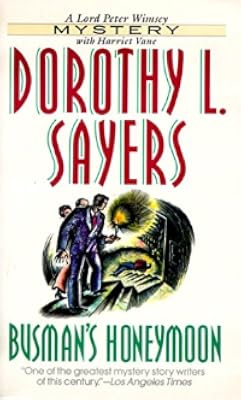
Society's eligible women are in mourning. Lord Peter Wimsey has married at last, having finally succeeded in his ardent pursuit of the lovely mystery novelist Harriet Vane. The two depart for a tranquil honeymoon in a country farmhouse, but find, instead of a well-prepared love nest, the place left in a shambles by the previous owner. His sudden appearance, dead from a broken skull in the cellar, only prompts more questions. Why would anyone have wanted to kill old Mr. Noakes? What dark show more secrets had he to hide? The honeymoon is over, as Lord Peter and Harriet Vane start their investigations. Suspicion is rife and everyone seems to have something to hide, from the local constable to the housekeeper. Wimsey and his wife can think of plenty of theories, but it s not until they discover a vital fact that the identity of the murderer becomes clear. show lessTags
Recommendations














Member Reviews
Busman’s Honeymoon by Dorothy Sayers has sat on my shelf for some time but was certainly well worth the wait. This book will be remembered as my favorite of the series highlighting as it does both the author’s style and her wonderful characters. We are celebrating the marriage of Lord Peter and Harriet Vane but I have to admit I was most thrilled that Lord Peter’s manservant, Bunther, was front and center in this offering.
Instead of going somewhere exotic for their honeymoon, Peter and Harriet slip away from their wedding and go to their newly purchased country home bringing Bunther along with them. Much to their surprise and although they had sent instructions, the house was far from ready for them. When the previous owner is show more discovered dead and most likely murdered, Harriet, Peter, and of course, Bunther have a mystery to solve.
In Busman’s Honeymoon we get to really appreciate the relationship between Harriet and Peter and can see that this is going to be a very successful marriage. The mixture of romance and murder mystery was very well done, and we also got to see a softer, more sensitive side to Lord Peter than he usually shows. My favorite line of the book was when Harriet declared her love for Peter but said she could happily marry Bunther. Of course Lord Peter totally agreed with her. This is the final book in the series and I am going to miss reading about these characters. show less
Instead of going somewhere exotic for their honeymoon, Peter and Harriet slip away from their wedding and go to their newly purchased country home bringing Bunther along with them. Much to their surprise and although they had sent instructions, the house was far from ready for them. When the previous owner is show more discovered dead and most likely murdered, Harriet, Peter, and of course, Bunther have a mystery to solve.
In Busman’s Honeymoon we get to really appreciate the relationship between Harriet and Peter and can see that this is going to be a very successful marriage. The mixture of romance and murder mystery was very well done, and we also got to see a softer, more sensitive side to Lord Peter than he usually shows. My favorite line of the book was when Harriet declared her love for Peter but said she could happily marry Bunther. Of course Lord Peter totally agreed with her. This is the final book in the series and I am going to miss reading about these characters. show less
"A love story with detective interruptions" says Sayers about this book, which might seem odd in light of the fact that it takes place *after* Peter and Harriet have fallen in love and gotten married. But while it may not be a conventional boy-meets-girl love story, it is a story, above all, *about* love, about all the tiny compromises that marriage requires and love makes possible, and about the big scary changes that living with a love so all-consuming creates in one's heart.
Harriet and Peter head for their honeymoon for a month at an old farmhouse that Harriet loved as a child, but they get there to discover that nobody knew they were coming, and inconvenience and farce piles one on top of another until it culminates when they find a show more week-dead body in the basement. show less
Harriet and Peter head for their honeymoon for a month at an old farmhouse that Harriet loved as a child, but they get there to discover that nobody knew they were coming, and inconvenience and farce piles one on top of another until it culminates when they find a show more week-dead body in the basement. show less
Aristocratic sleuth Lord Peter Wimsey has finally married the love of his life, detective novelist Harriet Vane. Harriet has always fancied an old country house near the Hertfordshire village where she grew up as the doctor’s daughter. Lord Peter aims to please, so he sets things in motion to buy the house and prepare it for their honeymoon. The newlyweds and Lord Peter’s valet, Bunter, arrive at the deserted house to find nothing as promised. The house soon fills with charwoman, chimney sweep, gardener, vicar, and spinster organist, with each new arrival making it that much more difficult for the newlyweds to find any time to themselves. Then a body is discovered in the cellar, turning the whole adventure into a busman’s show more honeymoon. The plot is an unusual mashup of an inverted country house party and a locked room mystery, with the house party assembling after the murder instead of before.
In the author’s introduction (in the form of a letter to three women), Sayers writes:
It has been said, by myself and others, that a love-interest is only an intrusion upon a detective story. But to the characters involved, the detective-interest might well seem an irritating intrusion upon their love-story. This book deals with such a situation...If there is but a ha’porth of detection to an intolerable deal of saccharine, let the occasion be the excuse.
Sayers achieved exactly what she intended to, with intimate moments between Lord Peter and his bride interspersed with detective inquiries. Lord Peter and Harriet’s high spirits rubbed off on this reader. I laughed more through this one than in any of Lord Peter’s other adventures. show less
In the author’s introduction (in the form of a letter to three women), Sayers writes:
It has been said, by myself and others, that a love-interest is only an intrusion upon a detective story. But to the characters involved, the detective-interest might well seem an irritating intrusion upon their love-story. This book deals with such a situation...If there is but a ha’porth of detection to an intolerable deal of saccharine, let the occasion be the excuse.
Sayers achieved exactly what she intended to, with intimate moments between Lord Peter and his bride interspersed with detective inquiries. Lord Peter and Harriet’s high spirits rubbed off on this reader. I laughed more through this one than in any of Lord Peter’s other adventures. show less
Another re-read, following on from Gaudy Night. Ahh, those first days of marriage, when you can't quite get used to the idea of being married, when you wander around with a daft grin on your face, when you get used the the other person being there, and when you discover that the previous owner of the house has been lying dead in your cellar. All does not go well on Harriet & Peter's wedding night. They are successfully smuggled from the wedding breakfast and into the house they've bought in the country, but from there is goes less well. The house is shut up and locked, no sign of the previous owner. The cast assembles itself, the nosy neighbour, the niece, the gardener, the sweep,the vicar - all the local characters are present and show more correct. And so the mystery is revealed. The elements are all there, they fit together neatly, but the joy of the re-read is that you can see them coming together in a way that you don't on the first time of asking. Alongside the detective side you have the ongoing relationship between Harriet & Peter, they're still finding their way together and the blossoming relationship shouldn't fit with the rather sordid murder, but it does, if only as counterpoint. This ends with an execution, but it also ends with Peter in his Harriet's arms and all will be well - possibly not without its ups and downs, but they will survive this as so much else. show less
Loved the read--but then I was predisposed to.
Lord Peter Wimsey & Harriet Vane finally get married & (almost incidentally) solve the problem of nasty Noakes who sold his 'country' house to them being found with his head bashed in in the celler.
No, this probably wasn't the best if you're looking for tight plots & procedurals.
But I really loved:
Dowager Duchess of Denver's appearances--she is so sweetly loving & adaptable to anything Lord Peter comes up with.
Bunter losing his cool with the dreadful Mrs Ruddles over port.
The so sarky snobbish Helen.
The loyal, unworldly lady dons of Harriet's 'home' college.
The wonderfully nasty yet charismatic Frank Crutchley
The vicar & cactus devotee, Mr Goodacre.
Their game of applied quotations.
So yes--I show more really enjoyed reading it, though it might not qualify as a great whodunnit it felt like a cross between fantasy & nostalgia for a time I never experienced. show less
Lord Peter Wimsey & Harriet Vane finally get married & (almost incidentally) solve the problem of nasty Noakes who sold his 'country' house to them being found with his head bashed in in the celler.
No, this probably wasn't the best if you're looking for tight plots & procedurals.
But I really loved:
Dowager Duchess of Denver's appearances--she is so sweetly loving & adaptable to anything Lord Peter comes up with.
Bunter losing his cool with the dreadful Mrs Ruddles over port.
The so sarky snobbish Helen.
The loyal, unworldly lady dons of Harriet's 'home' college.
The wonderfully nasty yet charismatic Frank Crutchley
The vicar & cactus devotee, Mr Goodacre.
Their game of applied quotations.
So yes--I show more really enjoyed reading it, though it might not qualify as a great whodunnit it felt like a cross between fantasy & nostalgia for a time I never experienced. show less
Re-read, November 2021: I maintain my theory that reading the Lord Peter books in order is almost a mistake...I think if I had started with the very first one, I would not have felt a strong inclination to read any more. No, it's in the quartet of books featuring Harriet Vane that Peter develops into a complex human. And the process of finding his fragile, painful, extraordinary balance with Harriet is the thing that actually matters.
Busman's Honeymoon is an exquisitely written story of the beginning of a marriage of two equal minds. It's unique and it's thought-provoking.
---------------------
Original review:
This is either a love story with detective interruptions, or the other way round. Either way, one is certain to prefer one part of show more it over the other, and I definitely prefer the interludes between Lord Peter and his new bride. Not only are they very much in love, they are incredibly honest, communicative, and generous with each other about the adjustment that married life means. They have both found rest from the weary world, in each other.
Here's one of my favorite of their exchanges:
"Harriet," he said, suddenly, "what do you think about life? I mean, do you find it good on the whole. Worth living?"
(He could, at any rate, trust her not to protest, archly: "That's a nice thing to ask on one's honeymoon!")
She turned to him with a quick readiness, as though here was the opportunity to say something she had been wanting to say for a long time:
"Yes! I've always felt absolutely certain it was good--if only one could get it straightened out. I've hated almost everything that ever happened to me, but I knew all the time it was just things that were wrong, not everything....It seems like a miracle to be able to look forward--to--to see all the minutes in front of one come hopping along with something marvelous in them, instead of just saying, Well, that one didn't actually hurt and the next may be quite bearable if only something beastly doesn't come pouncing out--"
"As bad as that?"
"No, not really, because one got used to it--to being everlastingly tightened up to face things, you see. But when one doesn't have to anymore, it's different--I can't tell you what a difference it makes."
Harriet's line has stayed with me ever since I first read it years ago, and I sometimes say it to myself--"It's just things that are wrong, not everything." I find it profound.
That Dorothy Sayers really has a gift for words.
Just a note on the text: There are a ton of classical allusions here, most of which I don't get, as I'm not good on Latin and my knowledge of poetry is patchy. Doesn't affect my enjoyment. There are also a few passages in French. But that's what Google Translate is for.
On re-reading this in 2021, I found an absolutely invaluable site here where someone has done a beautiful job with annotations and translations chapter by chapter. show less
Busman's Honeymoon is an exquisitely written story of the beginning of a marriage of two equal minds. It's unique and it's thought-provoking.
---------------------
Original review:
This is either a love story with detective interruptions, or the other way round. Either way, one is certain to prefer one part of show more it over the other, and I definitely prefer the interludes between Lord Peter and his new bride. Not only are they very much in love, they are incredibly honest, communicative, and generous with each other about the adjustment that married life means. They have both found rest from the weary world, in each other.
Here's one of my favorite of their exchanges:
"Harriet," he said, suddenly, "what do you think about life? I mean, do you find it good on the whole. Worth living?"
(He could, at any rate, trust her not to protest, archly: "That's a nice thing to ask on one's honeymoon!")
She turned to him with a quick readiness, as though here was the opportunity to say something she had been wanting to say for a long time:
"Yes! I've always felt absolutely certain it was good--if only one could get it straightened out. I've hated almost everything that ever happened to me, but I knew all the time it was just things that were wrong, not everything....It seems like a miracle to be able to look forward--to--to see all the minutes in front of one come hopping along with something marvelous in them, instead of just saying, Well, that one didn't actually hurt and the next may be quite bearable if only something beastly doesn't come pouncing out--"
"As bad as that?"
"No, not really, because one got used to it--to being everlastingly tightened up to face things, you see. But when one doesn't have to anymore, it's different--I can't tell you what a difference it makes."
Harriet's line has stayed with me ever since I first read it years ago, and I sometimes say it to myself--"It's just things that are wrong, not everything." I find it profound.
That Dorothy Sayers really has a gift for words.
Just a note on the text: There are a ton of classical allusions here, most of which I don't get, as I'm not good on Latin and my knowledge of poetry is patchy. Doesn't affect my enjoyment. There are also a few passages in French. But that's what Google Translate is for.
On re-reading this in 2021, I found an absolutely invaluable site here where someone has done a beautiful job with annotations and translations chapter by chapter. show less
Parts of this, especially the beginning, are broad comedy, which seems a little odd except for how this one was apparently written as a stage play first and then adapted into a novel. I enjoyed it a lot, although I had a few moments of embarrassment squick and I had a great deal of impatience with the ingrained antisemitism and classism. Granted, the collapse of the aristocracy is part of what makes it interesting to read, but I'm democratic enough in my outlook that I cringe when they call Harriet Lady Peter. Fucking feudalism. Anyway, I liked that this one (again!) was as much a book about people as it was about a mystery. There's never a doubt as to where its heart is, so it succeeds even if the reader solves the puzzle fairly early show more on.
Gender politics tag because even though this was published in 1939, the women's rights issues are the same.
Disability tag in part because of how they all demean and patronize a female character who is exceptionally short, never mind that she has as much right to respect, happiness, and her own livelihood as anyone. show less
Gender politics tag because even though this was published in 1939, the women's rights issues are the same.
Disability tag in part because of how they all demean and patronize a female character who is exceptionally short, never mind that she has as much right to respect, happiness, and her own livelihood as anyone. show less
Members
- Recently Added By
Lists

Books I've Read More Than Once
602 works; 49 members

Best of British Literature
226 works; 41 members

Best Love Stories
107 works; 14 members

Female Author
1,235 works; 67 members

Crime and Mysteries to Read
746 works; 31 members
Comfort Reads
221 works; 41 members

Survey of Mysteries and Crime Fiction
96 works; 17 members
Female Protagonist
1,056 works; 57 members

British Mystery
469 works; 14 members

Murder Mysteries
57 works; 11 members

Books About Murder
313 works; 7 members

Best Crime Fiction
48 works; 3 members
Detective Stories
343 works; 5 members

Books mentioned in Julian Symons’ Bloody Murder
438 works; 6 members

Top Five Books of 2021
604 works; 181 members

Books Read in 2006
421 works; 8 members
Favorite Romance Fiction
247 works; 115 members

TBR - Older Books
92 works; 1 member

Read in 2006
140 works; 1 member

1930s
262 works; 5 members
Books tagged favorites
390 works; 30 members

Writers as Characters in Fiction
120 works; 19 members

Books Read in 2018
4,360 works; 110 members
Houses and Buildings as Characters in Fiction
182 works; 28 members
Five star books
1,756 works; 108 members

Books Read in 2013
1,630 works; 51 members

Allie's Favourite 150 Books
145 works; 3 members

Library List 4.5
25 works; 1 member
Author Information

277+ Works 70,821 Members
Dorothy Sayers's impressive reputation as a contemporary master of the classic detective story is eclipsed only by Agatha Christie's. Sayers was born in Oxford and attended Somerville College, where she received a B.A. in 1915 and an M.A. in 1920. During that period, Sayers worked as an instructor of modern languages at Hull High School for Girls show more in Yorkshire and as a reader for a publisher in Oxford. Her early literary work was in poetry; she published several volumes and served as an editor for the journal Oxford Poetry from 1917 to 1919. Sayers also worked as a copywriter for a major advertising firm in London. She was president of the Modern Language Association from 1939 to 1945 and of the Detection Club in the 1950s. Around 1920 Sayers developed the idea for her detective hero Lord Peter Wimsey, and she soon published her first mystery, Whose Body? (1923), in which Lord Peter is introduced. For the next dozen or so years, Sayers wrote prolifically about Wimsey, creating in the process what many critics of the genre consider to be the finest detective novels in the English language. Perhaps her most famous Wimsey mystery was The Nine Tailors (1934). Although Sayers essentially followed the classic form in her detective fiction---a formula in which the plot assumes a greater importance than do the characters---Sayers maintained that a detective hero's greatness depended on how effectively the character was portrayed. All but one of Sayers's mysteries feature Lord Peter Wimsey. By the late 1930s, Sayers had apparently tired of writing detective fiction. She stated in 1947 that she would write no more mysteries, that she wrote detective fiction only when she was young and in need of money. Thus saying, Sayers turned her attention to her early loves, medieval and religious literature, spending her remaining years lecturing on and translating Dante (see Vol. 2). (Bowker Author Biography) show less
Some Editions
Awards and Honors
Notable Lists
Series


Belongs to Publisher Series
Work Relationships
Is contained in
Common Knowledge
- Canonical title
- Busman's Honeymoon: A Love Story with Detective Interruptions; Busman's Honeymoon
- Original title
- Busman's Honeymoon: A Love Story With Detective Interruptions
- Alternate titles
- Busman's Holiday
- Original publication date
- 1937
- People/Characters
- Peter Death Bredon Wimsey (Lord Peter Wimsey); Harriet Deborah Vane; Mervyn Bunter; Honoria Lucasta Delagardie (Dowager Duchess of Denver); William Noakes; Agnes Twitterton (show all 10); Martha Ruddle; Frank Crutchley; Joe Sellon; Kirk
- Important places
- Talboys, England, UK; London, England, UK
- Related movies
- Busman's Honeymoon (1940 | IMDb); Busman's Honeymoon (1947 | IMDb); Busman's Honeymoon (1957 | IMDb)
- Epigraph
- That will ask some tears in the true performing of it: if I do it, let the audience look to their eyes; I will move storms, I will condole in some measure. . . . I could play Ercles rarely, or a part to tear a cat in, to make... (show all) all split . . . a lover is more condoling.
Shakespeare: A Midsummer-Night's Dream. - Dedication
- TO MURIEL ST. CLARE BYRNE,
HELEN SIMPSON AND
MARJORIE BARBER
Dear Muriel, Helen, and Bar,
With what extreme of womanly patience you listened to the tale of Busman's Honeymoon while it was being writ... (show all)ten, the Lord He knoweth. I do not like to think how many times I tired the sun with talking--and if at any time they had told me you were dead, I should easily have believed that I had talked you into your graves. But you have strangely survived to receive these thanks.
You, Muriel, were in some sort a predestined victim, since you wrote with me the play to which this novel is but the limbs and outward flourishes; my debt and your long-suffering are all the greater. You, Helen and Bar, were wantonly sacrificed on the altar of that friendship of which the female sex is said to be incapable; let the lie stick i' the wall!
To all three I humbly bring, I dedicate with tears, this sentimental comedy.
It has been said, by myself and others, that a love-interest is only an intrusion upon a detective story. But to the characters involved, the detective-interest might well seem an irritating intrusion upon their love-story. This book deals with such a situation. It also provides some sort of answer to many kindly inquiries as to how Lord Peter and his Harriet solved their matrimonial problem. If there is but a ha'porth of detection to an intolerable deal of saccharine, let the occasion be the excuse.
Yours in all gratitute,
Dorothy L. Sayers - First words
- Prothalamion:
MARRIAGES
WIMSEY-VANE.
Chapter I:
Mr. Mervyn Bunter, patiently seated in the Daimler on the far side of Regent's Park, reflected that time was getting on. - Quotations
- ... May I express the hope that the present union may happily exemplify that which we find in a first-class port---strength of body fortified by a first-class spirit and mellowing through many years to a noble maturity. [Bunt... (show all)er's wedding toast]
- Last words
- (Click to show. Warning: May contain spoilers.)So she held him, crouched at her knees, against her breast, huddling his head in her arms that he might not hear eight o'clock strike.
(Click to show. Warning: May contain spoilers.)Last sentence of poem at end:
This is joy's bonfire, then, where love's strong arts
Make of so noble individual parts
One fire of four inflaming eyes, and of two loving hearts.
John Donne: Eclogue for the Marriage of the Earl of Somerset - Original language
- English; French
- Disambiguation notice
- Note: Busman's Honeymoon subtitled A Love Story with Detective Interruptions is a novel by Dorothy L. Sayers. It should not be confused with Busman's Honeymoon subtitled A Detective Comedy in Three Acts, a play, which was pen... (show all)ned by Dorothy L. Sayers and M[uriel] St. Clare Byrne.
Classifications
Statistics
- Members
- 4,284
- Popularity
- 3,529
- Reviews
- 100
- Rating
- (4.18)
- Languages
- 11 — Danish, Dutch, English, Finnish, French, German, Italian, Japanese, Russian, Spanish, Swedish
- Media
- Paper, Audiobook, Ebook
- ISBNs
- 67
- UPCs
- 1
- ASINs
- 69