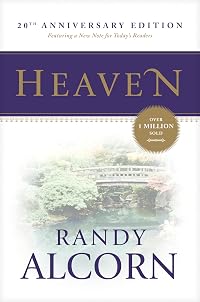
Heaven: Biblical Answers to Common Questions
by Randy Alcorn 
On This Page
Description
What will heaven be like? Randy Alcorn presents a thoroughly biblical answer, based on years of careful study, presented in an engaging, reader-friendly style. His conclusions will surprise readers and stretch their thinking about this important subject. Heaven will inspire readers to long for heaven while they're living on earth.Tags
Recommendations

















Member Reviews
"Other than the Bible itself, this may well be the single most life-changing book you'll ever read." - says a quote prominently displayed on the dust jacket. I remember the first time I looked at this book and saw this quote from a man I have no knowledge of named Stu Weber. I thought to myself "Yeah, right... I'm sure it's a good book, but THAT's gotta be an exaggeration." Now having finished the book, I can agree with Stu Weber's analysis! This has been a life-changing read for me - one that I'm sure to revisit again.
The author does a fantastic job of taking deep subject matter and explaining it in a conversational tone, meant to be understood by the masses - he didn't write this just to impress his colleagues. The chapters typically show more range between 8-12 pages each, making for easily digestible chunks.
There is a deficiency in the church when it comes to teaching about heaven, and a considerable amount of the teaching that does exist makes incorrect assumptions that are unbiblical in nature. It's difficult to have a longing for something that we don't understand and cannot rightly imagine. Randy Alcorn has attempted to correct this, having written an in-depth analysis of what the Bible has to say about heaven - and there's more there than many might assume. Going beyond a simple textual study of the doctrinal side of heaven, Alcorn instructs the reader in how having a right understanding of eternity should impact our day to day lives. This should spark the average reader to transform his thinking, attitude and actions.
Knowing that this present world will end and be resurrected into new heavens and a New Earth should profoundly affect our behavior. Thinking of Heaven leads inevitably to pursuing holiness. Our high tolerance for sin testifies of our failure to prepare for heaven.. show less
The author does a fantastic job of taking deep subject matter and explaining it in a conversational tone, meant to be understood by the masses - he didn't write this just to impress his colleagues. The chapters typically show more range between 8-12 pages each, making for easily digestible chunks.
There is a deficiency in the church when it comes to teaching about heaven, and a considerable amount of the teaching that does exist makes incorrect assumptions that are unbiblical in nature. It's difficult to have a longing for something that we don't understand and cannot rightly imagine. Randy Alcorn has attempted to correct this, having written an in-depth analysis of what the Bible has to say about heaven - and there's more there than many might assume. Going beyond a simple textual study of the doctrinal side of heaven, Alcorn instructs the reader in how having a right understanding of eternity should impact our day to day lives. This should spark the average reader to transform his thinking, attitude and actions.
Knowing that this present world will end and be resurrected into new heavens and a New Earth should profoundly affect our behavior. Thinking of Heaven leads inevitably to pursuing holiness. Our high tolerance for sin testifies of our failure to prepare for heaven.. show less
I read this book on the enthusiastic recommendation of a friend, and now I have become one of those people enthusiastically recommending it to my own friends. Between us, the first friend and I make a pretty good tag-team! If you know us, your chances of reading this book have just shot up.
It's not too much to say that this book has completely changed the way I view the life to come, and my attitude toward this life as well. Alcorn starts by confronting many of the myths that we've unconsciously swallowed about what Heaven will be like (note that I am capitalizing the word following his example, treating Heaven as a real place). We have a vague idea that Heaven will be so spiritual that we will just float around as disembodied souls show more in a kind of saline solution of hyper-holiness. It almost sounds like the Matrix — but I think if we really scrutinize our beliefs, we'll find this isn't an inaccurate description. We've been influenced by what Alcorn terms "Christoplatonism," the heretical idea that the material world is inherently sinful and that the spiritual world is the only thing that matters.
We have a guilty feeling about Heaven because this picture of it sounds so incredibly boring. We try to comfort ourselves by saying there is no way we can appreciate what Heaven will be like, with our puny minds and sinful flesh in the way. I remember being told as a young believer that though Heaven's nonstop singing and worship sounded boring, it wouldn't be, because all I could understand was the weariness of my currently sinful flesh. This answer satisfied me somewhat, but I still couldn't quite make myself look forward to a Heaven like that.
But worship is not just standing and singing in church. Romans 12:1 says that offering our bodies to God as a living sacrifice is our spiritual act of worship. And worship is not just singing, but a lifestyle. I worship God in my treatment of other people, in every detail of everyday life. This verse also underscores one of Alcorn's main points in this book: the physical world, and our physical bodies, are not evil. Our physical bodies can actually be used to worship God! All creation is currently suffering under the Curse, but it will not always be this way. God's big plan is not to harvest our souls from this world and then trash the planet. Oh no — He is going to redeem it. He is going to make all things new, yes, but not alien, not completely different. It's the New Heavens and the New Earth, not a new place altogether.
Alcorn gives a Scriptural breakdown of what happens to Christians who die before the Second Coming, the sequence of events at the time of judgment, and the believer's sure destination of the wedding-feast with the Lamb. He also speculates quite a bit on what life in Heaven will be like. Will we forget who we were on Earth? Alcorn says that's silly; why would we? In Revelation chapter 6, the saints pray for vengeance on those who killed them; how could they do that unless they remembered their martyrdom? Alcorn also points out that those saints were told to wait, which implies that there is time in Heaven. John even gives specific amounts of time in Revelation, like when he says there was silence in Heaven for about one half-hour (Revelation 8:1)! How have we missed that all these years?
Will we know everything instantly in Heaven? Is that what it means to be perfect? Alcorn argues that no, we will not instantly know everything, and perfection does not mean complete omniscience. There will be learning in Heaven. The saints in Revelation chapter 6 are asking a question ("how long, O Lord?") because they do not know the answer. Learning is not inherently sinful, nor does it imply that the learner is imperfect. We will continue to develop and explore new things throughout eternity.
Will Heaven contain human works of art? Alcorn argues yes. There is verse in Revelation that says the glory of the nations will be brought into the New Jerusalem. Human art created under the Curse can still bring honor and praise to the Creator, and Alcorn talks about the works that have moved him to profound worship of the Father. I can identify with that; certain books have taught me beautiful things and enriched my love for God. Sin-glorifying works will perish, certainly, but I don't see why God would destroy the beautiful. I am dreaming of Heaven's libraries with a sort of quiet ecstasy...
Will our pets and animals be in Heaven? Alcorn discusses this question from a perspective I haven't really considered before. Most Christians agree that animals do not have souls, but perhaps we ought to be more specific and say they don't have human souls. It is possible that they do have souls. And if the New Heavens and the New Earth are going to be faithful to the original unfallen Eden, animals will have to be there! God delights in giving gifts to His children and enjoying their enjoyment of those gifts. Everything will glorify Him, but that doesn't mean we will simply be singing "Jesus, Lover of My Soul" in His direction nonstop forever. Alcorn believes that our love for our pets glorifies the Creator, because they are His gift, and there's no reason why our pets would not be in Heaven. Because we will be perfect, there will be no fear of idolizing a created being in place of God. All loves and all joys will glorify the Godhead and find perfect fulfillment in Him.
The cover of my copy has a quote by Stu Weber, saying "Other than the Bible itself, this may well be the single most life-changing book you'll ever read." He isn't too far-off in that claim. This book has opened my eyes to the Scriptural truth about eternity, and I have learned to long for Heaven. When I see something beautiful, I realize that I am experiencing just a shadow of Heaven's beauty. When life's bitternesses and regrets pain me, when I look at people I love suffering chronic pain, when I live in imperfect and misunderstood relationships — I rejoice in my hope of Heaven. And the hope of the future helps sustain me in the now.
I cannot recommend Heaven highly enough, and I'm very thankful for the Scriptural perspective it is restoring to believers around the world. If I could give it ten stars, I would! I urge you to read it... I can't promise that it will radically change your perspective, but it certainly did mine. Great book, great truths, and a fantastic addition to the literature on Heaven. show less
It's not too much to say that this book has completely changed the way I view the life to come, and my attitude toward this life as well. Alcorn starts by confronting many of the myths that we've unconsciously swallowed about what Heaven will be like (note that I am capitalizing the word following his example, treating Heaven as a real place). We have a vague idea that Heaven will be so spiritual that we will just float around as disembodied souls show more in a kind of saline solution of hyper-holiness. It almost sounds like the Matrix — but I think if we really scrutinize our beliefs, we'll find this isn't an inaccurate description. We've been influenced by what Alcorn terms "Christoplatonism," the heretical idea that the material world is inherently sinful and that the spiritual world is the only thing that matters.
We have a guilty feeling about Heaven because this picture of it sounds so incredibly boring. We try to comfort ourselves by saying there is no way we can appreciate what Heaven will be like, with our puny minds and sinful flesh in the way. I remember being told as a young believer that though Heaven's nonstop singing and worship sounded boring, it wouldn't be, because all I could understand was the weariness of my currently sinful flesh. This answer satisfied me somewhat, but I still couldn't quite make myself look forward to a Heaven like that.
But worship is not just standing and singing in church. Romans 12:1 says that offering our bodies to God as a living sacrifice is our spiritual act of worship. And worship is not just singing, but a lifestyle. I worship God in my treatment of other people, in every detail of everyday life. This verse also underscores one of Alcorn's main points in this book: the physical world, and our physical bodies, are not evil. Our physical bodies can actually be used to worship God! All creation is currently suffering under the Curse, but it will not always be this way. God's big plan is not to harvest our souls from this world and then trash the planet. Oh no — He is going to redeem it. He is going to make all things new, yes, but not alien, not completely different. It's the New Heavens and the New Earth, not a new place altogether.
Alcorn gives a Scriptural breakdown of what happens to Christians who die before the Second Coming, the sequence of events at the time of judgment, and the believer's sure destination of the wedding-feast with the Lamb. He also speculates quite a bit on what life in Heaven will be like. Will we forget who we were on Earth? Alcorn says that's silly; why would we? In Revelation chapter 6, the saints pray for vengeance on those who killed them; how could they do that unless they remembered their martyrdom? Alcorn also points out that those saints were told to wait, which implies that there is time in Heaven. John even gives specific amounts of time in Revelation, like when he says there was silence in Heaven for about one half-hour (Revelation 8:1)! How have we missed that all these years?
Will we know everything instantly in Heaven? Is that what it means to be perfect? Alcorn argues that no, we will not instantly know everything, and perfection does not mean complete omniscience. There will be learning in Heaven. The saints in Revelation chapter 6 are asking a question ("how long, O Lord?") because they do not know the answer. Learning is not inherently sinful, nor does it imply that the learner is imperfect. We will continue to develop and explore new things throughout eternity.
Will Heaven contain human works of art? Alcorn argues yes. There is verse in Revelation that says the glory of the nations will be brought into the New Jerusalem. Human art created under the Curse can still bring honor and praise to the Creator, and Alcorn talks about the works that have moved him to profound worship of the Father. I can identify with that; certain books have taught me beautiful things and enriched my love for God. Sin-glorifying works will perish, certainly, but I don't see why God would destroy the beautiful. I am dreaming of Heaven's libraries with a sort of quiet ecstasy...
Will our pets and animals be in Heaven? Alcorn discusses this question from a perspective I haven't really considered before. Most Christians agree that animals do not have souls, but perhaps we ought to be more specific and say they don't have human souls. It is possible that they do have souls. And if the New Heavens and the New Earth are going to be faithful to the original unfallen Eden, animals will have to be there! God delights in giving gifts to His children and enjoying their enjoyment of those gifts. Everything will glorify Him, but that doesn't mean we will simply be singing "Jesus, Lover of My Soul" in His direction nonstop forever. Alcorn believes that our love for our pets glorifies the Creator, because they are His gift, and there's no reason why our pets would not be in Heaven. Because we will be perfect, there will be no fear of idolizing a created being in place of God. All loves and all joys will glorify the Godhead and find perfect fulfillment in Him.
The cover of my copy has a quote by Stu Weber, saying "Other than the Bible itself, this may well be the single most life-changing book you'll ever read." He isn't too far-off in that claim. This book has opened my eyes to the Scriptural truth about eternity, and I have learned to long for Heaven. When I see something beautiful, I realize that I am experiencing just a shadow of Heaven's beauty. When life's bitternesses and regrets pain me, when I look at people I love suffering chronic pain, when I live in imperfect and misunderstood relationships — I rejoice in my hope of Heaven. And the hope of the future helps sustain me in the now.
I cannot recommend Heaven highly enough, and I'm very thankful for the Scriptural perspective it is restoring to believers around the world. If I could give it ten stars, I would! I urge you to read it... I can't promise that it will radically change your perspective, but it certainly did mine. Great book, great truths, and a fantastic addition to the literature on Heaven. show less
Reason read: bible study small group
A comprehensive, biblically-based exploration of the afterlife, arguing that eternal life is not a disembodied, ethereal existence but a tangible, physical life on a restored New Earth.
Key Takeaways from Heaven:
The Physical New Earth: Alcorn emphasizes that God will restore the physical world, bringing a new heaven and a new earth together. It is a tangible place with resurrected bodies that eat, drink, and explore.
A "Christo-Platonism" Rebuttal: The book argues against the false, popular notion that our eternal home is a formless spiritual realm, a view Alcorn terms "Christo-platonism". Instead, it posits that our earthly experiences—work, art, community, and joy—are shadows of the meaningful show more activities we will enjoy, perfected, on the New Earth.
Continuity of Identity: Humans will maintain their personal histories and identities, retaining memories of their life on earth and living in close community with God and others.
Intermediate vs. Ultimate Heaven: The book clarifies that when Christians die, they go to an "intermediate" heaven to be with the Lord, which is a temporary state awaiting the final resurrection and the creation of the New Earth.
Worship and Joy: Heaven will be full of wonder, devoid of sin, suffering, and death, where worship is not a never-ending church service but a way of life. (This summary was taken from 9Marks)
This deserves a reread. At the time I found these areas to be relying on speculation, particularly regarding intermediate heaven, pets, and earthly activities continuing in eternity. I since have decided that God would have us working. There is no place where God doesn't expect us to be "doing". I also understand that animals are a part of his creation and may have a place in the new heaven and new earth. My thoughts since reading this have changed a great deal, I can imagine. I believe that there are dimensions in the world that we humans are totally unaware. I support a physical tangible resurrection over an ethereal existence. I found Alcorn's book to be helpful in making the resurrection a desirable state for those who are redeemed by the blood of the lamb. show less
A comprehensive, biblically-based exploration of the afterlife, arguing that eternal life is not a disembodied, ethereal existence but a tangible, physical life on a restored New Earth.
Key Takeaways from Heaven:
The Physical New Earth: Alcorn emphasizes that God will restore the physical world, bringing a new heaven and a new earth together. It is a tangible place with resurrected bodies that eat, drink, and explore.
A "Christo-Platonism" Rebuttal: The book argues against the false, popular notion that our eternal home is a formless spiritual realm, a view Alcorn terms "Christo-platonism". Instead, it posits that our earthly experiences—work, art, community, and joy—are shadows of the meaningful show more activities we will enjoy, perfected, on the New Earth.
Continuity of Identity: Humans will maintain their personal histories and identities, retaining memories of their life on earth and living in close community with God and others.
Intermediate vs. Ultimate Heaven: The book clarifies that when Christians die, they go to an "intermediate" heaven to be with the Lord, which is a temporary state awaiting the final resurrection and the creation of the New Earth.
Worship and Joy: Heaven will be full of wonder, devoid of sin, suffering, and death, where worship is not a never-ending church service but a way of life. (This summary was taken from 9Marks)
This deserves a reread. At the time I found these areas to be relying on speculation, particularly regarding intermediate heaven, pets, and earthly activities continuing in eternity. I since have decided that God would have us working. There is no place where God doesn't expect us to be "doing". I also understand that animals are a part of his creation and may have a place in the new heaven and new earth. My thoughts since reading this have changed a great deal, I can imagine. I believe that there are dimensions in the world that we humans are totally unaware. I support a physical tangible resurrection over an ethereal existence. I found Alcorn's book to be helpful in making the resurrection a desirable state for those who are redeemed by the blood of the lamb. show less
A book that succeeds at failing. I had high hopes for this book which I had seen at the bookstore and wanted to read. It was fatally flawed but in design but at least I got the chance to look at it. Sometimes you stumble upon a great book out of nowhere, and sometimes a book's high expectations leave you flat. This was written awhile back so the tone might have been different if it were written today. This Christian author tries to weave all of his past reading/source material into this book which is always a disaster from any perspective. Alcorn tries to illustrate scripture's references to Heaven with a plausible correlation to life as it is lived un-redeemed on here on earth. The issue then becomes how can a real non-speculative show more version of heaven be given if there is no theology for that connection. Historically this has been called Natural Theology. Natural Theology is now out of fashion but is still studied by some academics and adhered to by the Catholic Church. Most Christian denominations eschew natural theology since they adopt Luther's non-scriptural dictum of salvation by faith alone. The phrase "by faith alone" restricts faith to not allowing reason to have any place in theological self awareness. Without reason having a place in faith self-understanding, all natural theology becomes nonessential and according to Luther as an idol supplanting God's grace. Natural theology is looking at created reality and seeing traces or outlines of God the creator in his creation. This is done without recourse to the articles of faith and divine revelation itself which are not against reason but above it, as Thomas Aquinas says.
Alcorn tries hard to reconcile the Christian "by faith alone" stance, but, here at least, can't accomplish his goal except to say that Heaven's scriptural descriptions as not exactly like things here on earth now. Which is something we all already knew. Much of theology is in fact apophatic (what God is not) but Natural Theology makes it much easier to not fall victim to speculations and stick closer to the New Testament scriptures and the Old Testament prophecies. I did like that he favored C.S. Lewis and JRR Tolkien and tried to use personal stories of his to illustrate examples. I wouldn't recommend this book but it's obvious Alcorn put a lot of work into researching it. Decent bibliography. show less
Alcorn tries hard to reconcile the Christian "by faith alone" stance, but, here at least, can't accomplish his goal except to say that Heaven's scriptural descriptions as not exactly like things here on earth now. Which is something we all already knew. Much of theology is in fact apophatic (what God is not) but Natural Theology makes it much easier to not fall victim to speculations and stick closer to the New Testament scriptures and the Old Testament prophecies. I did like that he favored C.S. Lewis and JRR Tolkien and tried to use personal stories of his to illustrate examples. I wouldn't recommend this book but it's obvious Alcorn put a lot of work into researching it. Decent bibliography. show less
In Randy Alcorn’s eponymous book on Heaven, the place where good people go when they die, he starts off by setting the record straight: Heaven is not boring. It’s not a place where we float around, singing Hosannahs, playing a harp, and thinking only of God and praising him nonstop. Alcorn says that this way of thinking is not biblical, to which he provides countless passages from the Bible to back up what he’s saying.
Alcorn says that Heaven is a real, physical place where we will have real, physical bodies. He speaks against Christoplatonism, which was largely inspired by Neoplatonism, and totes a belief that the physical world is weak and impure, and the the spiritual world is the ideal, quintessential (quite literally), state. show more While Christoplatonists says matter is evil, Alcorn says: God created matter before the Fall (the fruit incident, not the season) therefore it can’t be evil.
It’s this thinking that drives the rest of the book, answering all manner of questions about what Heaven will be like, usually supporting this theory with another Bible verse.
While I thought that Alcorn did an excellent job studying what the Bible had to say regarding Heaven, and putting aside people’s fears that it would be intolerably boring (even including quotes by Twain and Asimov indicating as much), I felt that at times, his own rhetoric was laced with nonbiblical suppositions that he warns the reader not to fall prey too. Without delving into extensive theology in a book review, I’ll just leave it at this: I had issues with some of the theories he presented, especially in the absence of supporting text from the Bible. The casual manner at which he tosses out one belief or another which may not be founded on scripture, but is instead a commonly held belief among Christians perpetuated by teachings of the Church, sometimes set me on edge, especially due to his disfavor of such circumstances propagating a boring Heaven, something he refers to as “heresy.”
Ultimately, I thought it presented an interesting perspective of Heaven, one closer to the images one sees when they read of Aslan’s Country from Narnia, or Valinor from the Lord of the Rings, but not inherently medieval. This perspective may be useful for those with a little more curiosity in their ultimate destination, especially those who fear going to Heaven more so than going to Hell, or dying. However, like Alistair Begg is known to say in his Scottish accent: “The plain things are the main things, and the main things are the plain things.” So, if something is not made absolutely clear through a reading of the Bible, it’s (a) subject to interpretation, and (b) not all that important for being a good Christian. So, don’t fret too much if you don’t agree with him either. Everybody who gets to Heaven is more of an expert on it than Alcorn could ever be while here on Earth. show less
Alcorn says that Heaven is a real, physical place where we will have real, physical bodies. He speaks against Christoplatonism, which was largely inspired by Neoplatonism, and totes a belief that the physical world is weak and impure, and the the spiritual world is the ideal, quintessential (quite literally), state. show more While Christoplatonists says matter is evil, Alcorn says: God created matter before the Fall (the fruit incident, not the season) therefore it can’t be evil.
It’s this thinking that drives the rest of the book, answering all manner of questions about what Heaven will be like, usually supporting this theory with another Bible verse.
While I thought that Alcorn did an excellent job studying what the Bible had to say regarding Heaven, and putting aside people’s fears that it would be intolerably boring (even including quotes by Twain and Asimov indicating as much), I felt that at times, his own rhetoric was laced with nonbiblical suppositions that he warns the reader not to fall prey too. Without delving into extensive theology in a book review, I’ll just leave it at this: I had issues with some of the theories he presented, especially in the absence of supporting text from the Bible. The casual manner at which he tosses out one belief or another which may not be founded on scripture, but is instead a commonly held belief among Christians perpetuated by teachings of the Church, sometimes set me on edge, especially due to his disfavor of such circumstances propagating a boring Heaven, something he refers to as “heresy.”
Ultimately, I thought it presented an interesting perspective of Heaven, one closer to the images one sees when they read of Aslan’s Country from Narnia, or Valinor from the Lord of the Rings, but not inherently medieval. This perspective may be useful for those with a little more curiosity in their ultimate destination, especially those who fear going to Heaven more so than going to Hell, or dying. However, like Alistair Begg is known to say in his Scottish accent: “The plain things are the main things, and the main things are the plain things.” So, if something is not made absolutely clear through a reading of the Bible, it’s (a) subject to interpretation, and (b) not all that important for being a good Christian. So, don’t fret too much if you don’t agree with him either. Everybody who gets to Heaven is more of an expert on it than Alcorn could ever be while here on Earth. show less
This very informative book has certainly opened my eyes and has given me a totally new perspective of heaven. I’ve had questions in my mind for much of my life about heaven, and this book addressed many of those questions. You will feel encouraged to delve deeper into the Scriptures to understand even more. After reading many of the Scriptures, I found myself thinking that I hadn’t thought about a particular verse in that much depth, or in that way – very inspiring, indeed!
Two of the most interesting concepts presented in the book were the Intermediate Heaven – not our permanent destination, and the New Earth – our final destination. Just thought provoking! And, of course, Satan hates the New Heaven and the New Earth, and will show more do everything he can to keep us from redemption and rob us of the joy we will know in heaven.
There is so much information about the world to come, and this book deals with it in detail. It is hard to wrap your mind around many parts, but it’s enough to fire up your imagination and give you a driven desire to spend eternity in heaven.
It is very clear that there are two possible destinations after death: heaven and hell, and each is just as real and just as eternal as the other. Heaven is not our default destination. We cannot enter heaven as we are. Unless our sin problem is resolved, we will go to our true default destination --- hell. Matthew 7: 13-14 - “Enter through the narrow gate. For wide is the gate and broad is the road that leads to destruction, and many enter through it. But small is the gate and narrow the road that leads to life, and only a few find it.”
“The best of life on Earth is a glimpse of heaven; the worst of life is a glimpse of hell. For Christians, this present life is the closest they will come to hell. For unbelievers, it is the closest they will come to heaven.”
I have highlighted many parts of this book and I will be keeping it close by to read sections again and again. It is one of the most interesting and profound books I’ve ever read! My rating is 5+ stars. show less
Two of the most interesting concepts presented in the book were the Intermediate Heaven – not our permanent destination, and the New Earth – our final destination. Just thought provoking! And, of course, Satan hates the New Heaven and the New Earth, and will show more do everything he can to keep us from redemption and rob us of the joy we will know in heaven.
There is so much information about the world to come, and this book deals with it in detail. It is hard to wrap your mind around many parts, but it’s enough to fire up your imagination and give you a driven desire to spend eternity in heaven.
It is very clear that there are two possible destinations after death: heaven and hell, and each is just as real and just as eternal as the other. Heaven is not our default destination. We cannot enter heaven as we are. Unless our sin problem is resolved, we will go to our true default destination --- hell. Matthew 7: 13-14 - “Enter through the narrow gate. For wide is the gate and broad is the road that leads to destruction, and many enter through it. But small is the gate and narrow the road that leads to life, and only a few find it.”
“The best of life on Earth is a glimpse of heaven; the worst of life is a glimpse of hell. For Christians, this present life is the closest they will come to hell. For unbelievers, it is the closest they will come to heaven.”
I have highlighted many parts of this book and I will be keeping it close by to read sections again and again. It is one of the most interesting and profound books I’ve ever read! My rating is 5+ stars. show less
While I am admittedly less than thoroughly familiar with the things the author quotes to work from and answer the questions he poses, purely going by what he quotes, what he says about those quotes, and the conclusions he draws, there is often an entirely missing middle step or logical pathway. (e.g. "So that when life on Earth is gone, you will be welcomed into eternal dwellings", quoted to display how foolish it is that people think 'eternal dwellings' is referring to Heaven, as "surely Christ isn't saying that we'll enter Heaven because we used our money wisely!" . . . where is the connection between these things, or indeed why 'eternal dwellings', which in the rest of that section does indeed refer to Heaven as used by the author, show more suddenly doesn't here?)
Many of his conclusions or answers seem to be built rather towards his having decided what he wanted/hoped for and then searching out 'supporting evidence' and choosing just the bits he finds most thematically in line with the conclusions he wished to discover. show less
Many of his conclusions or answers seem to be built rather towards his having decided what he wanted/hoped for and then searching out 'supporting evidence' and choosing just the bits he finds most thematically in line with the conclusions he wished to discover. show less
Members
- Recently Added By
Lists

Christianity Books You've Read
179 works; 19 members
Author Information

123+ Works 24,442 Members
Randy Alcorn is the founder and director of Eternal Perspectives Ministries and a New York Times bestselling author of 55 books, including Heaven and Face to Face with Jesus. His books have sold over 11 million copies and been translated into more than 70 languages. Randy resides in Oregon with his wife, Nanci.
Randy Alcorn is a LibraryThing Author, an author who lists their personal library on LibraryThing.
Work Relationships
Has the adaptation
Is abridged in
Inspired
Has as a reference guide/companion
Has as a student's study guide
Has as a teacher's guide
Common Knowledge
- Canonical title
- Heaven: Biblical Answers to Common Questions
- Original title
- Heaven
- Alternate titles
- Heaven: Biblical Answers to Common Questions
- Original publication date
- 2004
- People/Characters
- Aristides, 2nd century (p xviii); Bereans; Florence Chadwick (p xx); A. J. Conyers (p 9); Thaschus Cæcilius Cyprian (p xviii); Jonathan Edwards (p 5) (show all 23); John Eldredge (p 6); God; Wayne Grudem (p 48); Anthony Hoekema (p 45,77,111); Jesus; C. S. Lewis (p 37); Louis XIV, 1638-1715; John Milton (p 53); Paul of Tarsus; Philip II, king of Macedon; Plato, ca. 428-347 BC (p 52); J. C. Ryle (p 8); Seneca; Charles Spurgeon (p 7); Teresa of Avila (p 27); Isaac Watts (p 107); Yahweh
- Important places
- Garden of Eden; Heaven; Hell; New Earth; New Jerusalem
- Epigraph
- "Other than the Bible itself, this may well be the single most life-changing book you'll ever read." Stu Weber
- Dedication
- To Kevin Butler, Jessi Hickman, Gary Stump, Cami Norquist, Jerry Hardin, Greg Coffey, Lucille Alcorn, Leona Bryant, David Reeves, Daniel Traugott, Lynley Herbert, Stephenie Saint, Rachel Terveen, Eli Hubbard, Jonathan Coburn,... (show all) Emily Kimball, Al Baylis, III, John Swartzendruber, Bob Whitson, Owen Raynor, Joyce Kelley, Zach Evans, Ryan Dekker, Cody Ogle, Philip Higgins, Dawn Lechler, Sally Turpin, Laura Libby, Mike Cimmarrusti, Kyle Speer, Matthew Pearson, Jonathan Murphy, Brad and Steffanie Jones, Eric Kuemmel, Cheyenne Fiveash, Elizabeth Wall, Kelley Lance Courtney, Alison Heth, and countless others who departed "prematurely" (yet in God's good time) to a world far greater than this one but far less than the one to come, which all of us who know King Jesus will behold together, slack-jawed, on the New Earth's first morning.
- First words
- Bookstores overflow with accounts of near-death and after-death experiences, complete with angels giving guided tours of Heaven. A few of these books may have authentic components, but many are unbiblical and misleading.
- Quotations
- The truth is, in our seminaries, churches, and families, we are given amazingly little attention to the place where we will live forever with Christ and his people—
God never gave up on his original plan for human beings to dwell on Earth.
It becomes us to spend this life only as a journey toward heaven ... to which we should subordinate all other concerns of life.
God has given us glimpses of Heaven in the Bible—to fire up our imagination and kindle a desire for Heaven in our hearts. - Last words
- (Click to show. Warning: May contain spoilers.)And right when we think "it doesn't get any better than this"—it will.
- Blurbers
- Tada, Joni Eareckson; Jenkins, Jerry B.; Hanegraaff, Hank; Weber, Stu; Warren, Rick; Hunt, Angela (show all 7); Getz, Gene A.
- Original language
- English
Classifications
Statistics
- Members
- 2,894
- Popularity
- 6,268
- Reviews
- 30
- Rating
- (4.26)
- Languages
- 6 — English, German, Norwegian (Bokmål), Norwegian, Spanish, Ukrainian
- Media
- Paper, Audiobook, Ebook
- ISBNs
- 28
- UPCs
- 6
- ASINs
- 12