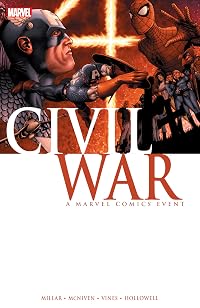
Civil War
by Mark Millar (Author), Steve McNiven (Illustrator)
Civil War (Marvel Comics Event) (Collections and Selections — Vol. 1)
On This Page
Description
Whose side are you on? A conflict is brewing that threatens to pit friend against friend, brother against brother and all it will take is a single misstep to cost thousands their lives and ignite the fuse! As the war claims its first victims, no one is safe as teams, friendships and families begin to fall apart and the Marvel Universe super heroes go to war against each other.Tags
Recommendations

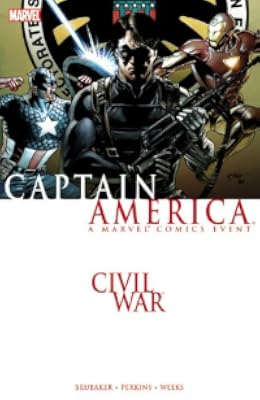
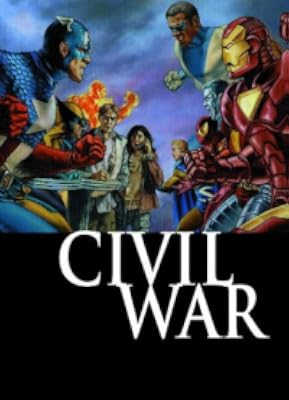
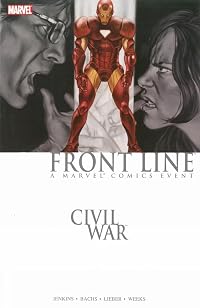


Member Reviews
Civil War was a huge event in the Marvel Universe that pitted hero against hero in an ideological struggle over exactly what it means to be a super-hero. On the one side was a faction anchored by Iron Man, Mr. Fantastic, Hank Pym, and the entire S.H.I.E.L.D. apparatus, while on the other was Captain America and a motley collection of lesser heroes who were seemingly hopelessly outclassed by their opposition. Through the volume, these warring sides battle back and forth with attacks, counterattacks, feints, and ambushes, leading to a climatic final confrontation of epic proportions. Unfortunately, Civil War is an enormous and, at times incoherent mess that is dragged down by the weight of the inherent contradictions within both the show more premises that make up the foundation of the story and the Marvel universe itself.
The story kicks off when a group of minor heroes known as the New Warriors (who seem to have been created specifically for this one scene in this one story arc, and were never heard from before, and have never been heard from since) try to take on a collection of super villains as part of a reality television show they are filming in a suburb in Stamford, Connecticut. The clash quickly spins out of control an Nitro, one of the super villains, sets off an explosion in a residential area, killing hundreds of civilians, including a school bus full of children. Yes, the foundation for this series really a ham-fisted event called the "Stamford Incident" that centers on killing a bus load of kids. Unfortunately, it really only goes downhill from there. In the resulting political fall out, the Superhero Registration Act, which would require all masked super heroes in the United States to register their identity with, and work for the government. Some heroes, including Captain America, refuse to enforce or obey this law, while others, including Tony Stark, Hank Pym, and Reed Richards, eagerly jump on board and try to bring their recalcitrant compatriots to heel. This sets up a conflict between the two sides that grows wildly out of hand in short order, and serves mostly as a set-up for characters who are ostensibly super-heroes to punch one another a lot.
As an aside, I have long held the position that the only reason that Tony Stark, Hank Pym, and Reed Richards are not seen as super-villains is because the Marvel comics writers continually reassure the reader that these three men are, in fact, super-heroes. Without such statements, a fair assessment of the actions of these three over the last several years could easily lead one to the conclusion that they are, in fact, villainous characters. The fact that they line up on the pro-Registration side in this conflict and then all wind up engaging in what could credibly be described as wildly unethical behavior is, I think, supposed to shock the reader somewhat. To be honest, however, given the track records of these characters, I don't think anyone was particularly surprised when they quickly turned into leading forces for evil.
The real trouble with the story is that it tries to frame itself as an ideological conflict between two sides of reasonably equal merit, and simply fails to accomplish this in anything resembling a convincing manner. To be blunt, the "pro-Registration" side is so patently morally bankrupt that the conflict is not so much a community of heroes riven by a split over the way to handle their affairs as it is Captain America leading a team of actual super heroes and fighting a new collection of super villains who happen to be wearing the costumes formerly worn by super heroes. Though there could have been at least some justification for the Registration Act, the writers of Civil War do little more than offer lip service to this aspect of the story, at one point even having Reed Richards explain his decision to choose the pro-Registration side by having him wave at a chalkboard full of incomprehensible equations with no further explanation. The interesting aspect of Civil War should have been the clash of world views, but time and again the writers simply push anything that would develop this element aside so they can get to the punching.
Government registration and control of super heroes raises numerous questions that the story resolutely refuses to answer. The proposed solution of the pro-Registration side is to put all super-heroes on the government payroll and assemble one team per state that would be subject to the orders of that state's governor's office. One only has to look at the current crop of governors in the United States to realize what a hazardous plan that is. More to point, how is this kind of law supposed to be enforced? In a relatively early scene, S..H.I.E.L.D is shown pursuing Patriot of the Young Avengers after Patriot attempted to break up a mugging. Leaving aside the fact that S.H.I.E.L.D. is hunting down an individual (and ultimately causing millions of dollars worth of property damage) whose "crime" was to try to stop a mugger while wearing a mask, what if Patriot had simply left his costume at home? What then? Would he still be guilty of an offense such that S.H.I.E.L.D. would pursue him through the streets of New York City? Suppose someone was coming home from a costume party and tried to stop a crime they saw in progress? Would they be guilty of some sort of crime? Throughout the story, these sorts of issues are never addressed, with the only answers being Tony Stark shrugging off any concerns other have with lines like "Trust me, Captain America is wrong on this one".
To the extent that the pro-Registration ranks have any credibility, they are undermined by the incredibly over the top manner in which they try to enforce the Act. In another early scene, Agent Hill of S.H.I.E.L.D. confronts Captain America over whether he will help them arrest other super-heroes who refuse to follow the law. When Captain America declines, she immediately tries to take him into custody. The first problem is that at the time, the Registration Act had not even been passed, meaning that Hill was trying to get the Captain to enforce a law that didn't even exist yet. The other problem is that the only thing Captain America had done at that point was refuse to participate in tracking down and arresting other super-heroes on S.H.I.E.L.D.'s behalf, and the last time I checked, refusing to act as a law enforcement officer was not actually against the law (and if it was against the provisions of the Registration Act, there are serious additional police-state concerns with the Act that no one is commenting upon). When he is losing support from the hero community due to unleashing a cloned Thor that killed Goliath, Tony Stark recruits super-villains to his side to help enforce the Registration Act. When he needs a place to store his captives, Tony Stark builds a prison in an alternate dimension and keeps his former friends and allies in horrible conditions, apparently intending to condemn them to perpetual incarceration without the benefit of trial or any other due process. When Spider-Man, who came out on the pro-Registration side and revealed his secret identity (at what turned out to be substantial personal risk to himself and his loved ones), shows some regret over his choice, Stark almost immediately begins trying to take down the web-slinger with repulsor bolts. At every turn, the pro-Registration side's responses are wildly out of control, sapping them of even the modest amount of credibility their position had at the outset of the story.
Civil War also exposes one of the internal contradictions of the Marvel Universe by touching upon the status of super-powered mutants such as the X-Men. In some ways, having the X-Men and other mutants separated from the Marvel Cinematic Universe has actually served to make each set of movies better than the comics, as one never has to puzzle over why the fact that Wolverine and Storm have super-powers derived from being mutants is somehow seen as scary and in need of regulations, while the fact that Vision and Hercules have super-powers that derive from some other source is not. By separating the two sets of heroes into their own universes, this internal contradiction evaporates, making each set of stories stronger and more internally consistent. However, the Civil War story line in the comics highlights the almost ridiculous nature of the split in the ways super-powered beings are treated in the printed Marvel Universe. The battles over the Mutant Registration Acts have been important story lines in the various mutant oriented titles such as X-Men, X-Factor, New Mutants, and others for several decades. The U.S. government has financed numerous projects aimed at controlling or eliminating mutants, including the creation of the robotic Sentinels. In effect, the U.S. (and to a lesser extent, Canadian) government has been set up as an important antagonist in the mutant-based titled produced by Marvel over the years.
The difference in how mutants and "regular" super-heroes are treated and the suspicion with which mutants are treated in the Marvel Universe are both on full display in this volume, and this element serves to undermine the plot. In an early scene in the book, when super-heroes have rallied to try to clear away the rubble and look for survivors of the Stamford Incident, a couple of super-heroes who happen to also be X-Men join in, and a couple of Sentinels also show up to stand around and keep an eye on the mutants. The Sentinels don't actually offer any help to those trapped in the wreckage, but rather stand idly by while the "suspicious" mutants help dig out survivors. A mother seeing this comforts her child by telling him that the Sentinels are there to keep an eye on the dangerous mutants and are the "good guys". Apparently watching while others do the rescue work and doing nothing yourself to help is being a "good guy" in the Marvel Universe, at least so long as the people you are watching are mutants. Not only is this ridiculous, it also provides a good reason why the Registration Act is such an obviously terrible idea: The Sentinels, who offer no help at all during this actual crisis, are supported by the same government to which the Act would hand control over the super-heroes. Would, for example, the government have told these heroes to stand down if they tried to respond to a disaster like the Stamford Incident, and have them simply watch as non-powered emergency personnel did the rescue work? Under the Act's provisions, if an unregistered costumed super-hero showed up at a disaster site to help save people, would the government forces turn away from their own rescue efforts to arrest the lawbreaker? What, exactly, would be gained by this? As usual, when one starts to break down the scenarios, the entire premise of the story starts to show cracks, and at times becomes positively incoherent.
Later in the book, Stark goes to meet with Emma Frost, at the time the leader of the X-Men. They discuss the Registration Act, and Frost declines to help Stark's side, but also states that she will not lead the X-Men to an alliance with Captain America's side either, saying that the mutants will "sit this one out". Her basis for this stance is reasonable: She cites previous efforts by the U.S government to register mutants, and the fact that no one had come to the aid of the mutant populated nation Genosha when it needed help, but the entire meeting just highlights how attenuated this story line is. If the X-Men are super-powered beings like the super-heroes who are on the run, why are they not also being strong-armed into registering and taking jobs working for the government? Agent Hill was ready to arrest Captain America for refusing to serve as law enforcement before the Registration Act was even passed. Why do the X-Men get to "sit this one out"?
While Stark is busy building a horrific prison in an alternate dimension to lock his former friends up in and cozying up to a collection of super-villains, Rogers has spent his time obtaining secret identities for his allies and organizing them to fight actual threats to the lives and well-being of the populace. Captain America even exercises some judgment when it comes to picking compatriots: When the Punisher shows up on his doorstep carrying the grievously wounded Spider-Man (who was nearly killed by Stark's villainous allies for the crime of questioning Tony's methods), he has misgivings but accepts the anti-hero's help on a provisional basis. When the Punisher later murders two villains originally recruited by Stark who want to switch sides, Rogers immediately turns on him. The scene is staged in such a way that it is fairly obvious that the writers are trying to make Rogers seem unreasonable and almost unhinged, but what really comes through is that even if Stark is willing to ally himself with murderers, that is a step that Rogers simply refuses to take, even in dire straits. Confirming his status as a super-villain, Stark exploits Rogers' concern for civilians by using this as a means to set ambushes - falsifying emergency distress calls to lure Rogers and his team into prepared traps.
Towards the end of the story, a single scene more or less sums up everything that is wrong with Civil War. After the conflict is over, and Stark has been rewarded for transforming into an evil villain by being made head of S.H.I.E.L.D., he is speaking with Miriam Sharpe, the mother of one of the children killed in the Stamford Incident who spearheaded the push to enact the Registration Act. During the conversation he reveals that the reason the prison in the alternate dimension was called "Number 42", which has been something of a secret through the whole story. It turns out that after the Stamford Incident, he, Reed Richards, and Hank Pym had spent a night writing down a list of one-hundred ideas to make the world safer, and, apparently, a horrific prison to lock up people that you once called friends was the forty-second. He then tells Sharpe that they haven't even gotten halfway through the list, and talks up how very exciting it will be to implement the other half. She then, without even a hint of irony, tells Stark what a good man he is. And it seems that the story wants the reader to agree with this assessment. The problem is, if one of your ideas for making the world a safer place is "building a horrific prison in an alternate dimension that you will put your friends into with the help of a collection of super-villains", then no one should ever want to know what other incredibly bad ideas you have on the second half of your list. Or the first half of your list. And you have no moral leg to stand on.
Ultimately, Civil War is a complete mess. It is an action-packed and at times exciting mess, but it is still a mess. The story wants to be much smarter than it actually is, and at times seems to be laboring under the delusion that it really is. The story wants to be about two factions that are on relatively equal moral footing, but it is actually about Captain America on the run from a collection of putative super-heroes who have become vicious super-villains while cloaking themselves in the self-righteousness of "enforcing the law". To be honest, that is almost the only argument that is made against the side Captain America takes: He and his allies are breaking the law, and must be brought to heel. When balanced against the shockingly brutal actions taken by Stark and his allies, this seems like an incredibly weak basis to condemn Rogers. In the end, the story is resolved when Rogers chooses to surrender rather than put civilian lives at risk, while at the same time Stark and his buddies seem perfectly happy to continue to endanger the lives of bystanders and cause wanton property damage. While the story tries to state that the two sides are more or less morally equivalent, almost to the point of belaboring the issue, the actual actions taken by the individuals on both sides make clear that they simply are not, and the problem with the book is that it simply does not seem to realize this.
This review has also been posted to my blog Dreaming About Other Worlds. show less
The story kicks off when a group of minor heroes known as the New Warriors (who seem to have been created specifically for this one scene in this one story arc, and were never heard from before, and have never been heard from since) try to take on a collection of super villains as part of a reality television show they are filming in a suburb in Stamford, Connecticut. The clash quickly spins out of control an Nitro, one of the super villains, sets off an explosion in a residential area, killing hundreds of civilians, including a school bus full of children. Yes, the foundation for this series really a ham-fisted event called the "Stamford Incident" that centers on killing a bus load of kids. Unfortunately, it really only goes downhill from there. In the resulting political fall out, the Superhero Registration Act, which would require all masked super heroes in the United States to register their identity with, and work for the government. Some heroes, including Captain America, refuse to enforce or obey this law, while others, including Tony Stark, Hank Pym, and Reed Richards, eagerly jump on board and try to bring their recalcitrant compatriots to heel. This sets up a conflict between the two sides that grows wildly out of hand in short order, and serves mostly as a set-up for characters who are ostensibly super-heroes to punch one another a lot.
As an aside, I have long held the position that the only reason that Tony Stark, Hank Pym, and Reed Richards are not seen as super-villains is because the Marvel comics writers continually reassure the reader that these three men are, in fact, super-heroes. Without such statements, a fair assessment of the actions of these three over the last several years could easily lead one to the conclusion that they are, in fact, villainous characters. The fact that they line up on the pro-Registration side in this conflict and then all wind up engaging in what could credibly be described as wildly unethical behavior is, I think, supposed to shock the reader somewhat. To be honest, however, given the track records of these characters, I don't think anyone was particularly surprised when they quickly turned into leading forces for evil.
The real trouble with the story is that it tries to frame itself as an ideological conflict between two sides of reasonably equal merit, and simply fails to accomplish this in anything resembling a convincing manner. To be blunt, the "pro-Registration" side is so patently morally bankrupt that the conflict is not so much a community of heroes riven by a split over the way to handle their affairs as it is Captain America leading a team of actual super heroes and fighting a new collection of super villains who happen to be wearing the costumes formerly worn by super heroes. Though there could have been at least some justification for the Registration Act, the writers of Civil War do little more than offer lip service to this aspect of the story, at one point even having Reed Richards explain his decision to choose the pro-Registration side by having him wave at a chalkboard full of incomprehensible equations with no further explanation. The interesting aspect of Civil War should have been the clash of world views, but time and again the writers simply push anything that would develop this element aside so they can get to the punching.
Government registration and control of super heroes raises numerous questions that the story resolutely refuses to answer. The proposed solution of the pro-Registration side is to put all super-heroes on the government payroll and assemble one team per state that would be subject to the orders of that state's governor's office. One only has to look at the current crop of governors in the United States to realize what a hazardous plan that is. More to point, how is this kind of law supposed to be enforced? In a relatively early scene, S..H.I.E.L.D is shown pursuing Patriot of the Young Avengers after Patriot attempted to break up a mugging. Leaving aside the fact that S.H.I.E.L.D. is hunting down an individual (and ultimately causing millions of dollars worth of property damage) whose "crime" was to try to stop a mugger while wearing a mask, what if Patriot had simply left his costume at home? What then? Would he still be guilty of an offense such that S.H.I.E.L.D. would pursue him through the streets of New York City? Suppose someone was coming home from a costume party and tried to stop a crime they saw in progress? Would they be guilty of some sort of crime? Throughout the story, these sorts of issues are never addressed, with the only answers being Tony Stark shrugging off any concerns other have with lines like "Trust me, Captain America is wrong on this one".
To the extent that the pro-Registration ranks have any credibility, they are undermined by the incredibly over the top manner in which they try to enforce the Act. In another early scene, Agent Hill of S.H.I.E.L.D. confronts Captain America over whether he will help them arrest other super-heroes who refuse to follow the law. When Captain America declines, she immediately tries to take him into custody. The first problem is that at the time, the Registration Act had not even been passed, meaning that Hill was trying to get the Captain to enforce a law that didn't even exist yet. The other problem is that the only thing Captain America had done at that point was refuse to participate in tracking down and arresting other super-heroes on S.H.I.E.L.D.'s behalf, and the last time I checked, refusing to act as a law enforcement officer was not actually against the law (and if it was against the provisions of the Registration Act, there are serious additional police-state concerns with the Act that no one is commenting upon). When he is losing support from the hero community due to unleashing a cloned Thor that killed Goliath, Tony Stark recruits super-villains to his side to help enforce the Registration Act. When he needs a place to store his captives, Tony Stark builds a prison in an alternate dimension and keeps his former friends and allies in horrible conditions, apparently intending to condemn them to perpetual incarceration without the benefit of trial or any other due process. When Spider-Man, who came out on the pro-Registration side and revealed his secret identity (at what turned out to be substantial personal risk to himself and his loved ones), shows some regret over his choice, Stark almost immediately begins trying to take down the web-slinger with repulsor bolts. At every turn, the pro-Registration side's responses are wildly out of control, sapping them of even the modest amount of credibility their position had at the outset of the story.
Civil War also exposes one of the internal contradictions of the Marvel Universe by touching upon the status of super-powered mutants such as the X-Men. In some ways, having the X-Men and other mutants separated from the Marvel Cinematic Universe has actually served to make each set of movies better than the comics, as one never has to puzzle over why the fact that Wolverine and Storm have super-powers derived from being mutants is somehow seen as scary and in need of regulations, while the fact that Vision and Hercules have super-powers that derive from some other source is not. By separating the two sets of heroes into their own universes, this internal contradiction evaporates, making each set of stories stronger and more internally consistent. However, the Civil War story line in the comics highlights the almost ridiculous nature of the split in the ways super-powered beings are treated in the printed Marvel Universe. The battles over the Mutant Registration Acts have been important story lines in the various mutant oriented titles such as X-Men, X-Factor, New Mutants, and others for several decades. The U.S. government has financed numerous projects aimed at controlling or eliminating mutants, including the creation of the robotic Sentinels. In effect, the U.S. (and to a lesser extent, Canadian) government has been set up as an important antagonist in the mutant-based titled produced by Marvel over the years.
The difference in how mutants and "regular" super-heroes are treated and the suspicion with which mutants are treated in the Marvel Universe are both on full display in this volume, and this element serves to undermine the plot. In an early scene in the book, when super-heroes have rallied to try to clear away the rubble and look for survivors of the Stamford Incident, a couple of super-heroes who happen to also be X-Men join in, and a couple of Sentinels also show up to stand around and keep an eye on the mutants. The Sentinels don't actually offer any help to those trapped in the wreckage, but rather stand idly by while the "suspicious" mutants help dig out survivors. A mother seeing this comforts her child by telling him that the Sentinels are there to keep an eye on the dangerous mutants and are the "good guys". Apparently watching while others do the rescue work and doing nothing yourself to help is being a "good guy" in the Marvel Universe, at least so long as the people you are watching are mutants. Not only is this ridiculous, it also provides a good reason why the Registration Act is such an obviously terrible idea: The Sentinels, who offer no help at all during this actual crisis, are supported by the same government to which the Act would hand control over the super-heroes. Would, for example, the government have told these heroes to stand down if they tried to respond to a disaster like the Stamford Incident, and have them simply watch as non-powered emergency personnel did the rescue work? Under the Act's provisions, if an unregistered costumed super-hero showed up at a disaster site to help save people, would the government forces turn away from their own rescue efforts to arrest the lawbreaker? What, exactly, would be gained by this? As usual, when one starts to break down the scenarios, the entire premise of the story starts to show cracks, and at times becomes positively incoherent.
Later in the book, Stark goes to meet with Emma Frost, at the time the leader of the X-Men. They discuss the Registration Act, and Frost declines to help Stark's side, but also states that she will not lead the X-Men to an alliance with Captain America's side either, saying that the mutants will "sit this one out". Her basis for this stance is reasonable: She cites previous efforts by the U.S government to register mutants, and the fact that no one had come to the aid of the mutant populated nation Genosha when it needed help, but the entire meeting just highlights how attenuated this story line is. If the X-Men are super-powered beings like the super-heroes who are on the run, why are they not also being strong-armed into registering and taking jobs working for the government? Agent Hill was ready to arrest Captain America for refusing to serve as law enforcement before the Registration Act was even passed. Why do the X-Men get to "sit this one out"?
While Stark is busy building a horrific prison in an alternate dimension to lock his former friends up in and cozying up to a collection of super-villains, Rogers has spent his time obtaining secret identities for his allies and organizing them to fight actual threats to the lives and well-being of the populace. Captain America even exercises some judgment when it comes to picking compatriots: When the Punisher shows up on his doorstep carrying the grievously wounded Spider-Man (who was nearly killed by Stark's villainous allies for the crime of questioning Tony's methods), he has misgivings but accepts the anti-hero's help on a provisional basis. When the Punisher later murders two villains originally recruited by Stark who want to switch sides, Rogers immediately turns on him. The scene is staged in such a way that it is fairly obvious that the writers are trying to make Rogers seem unreasonable and almost unhinged, but what really comes through is that even if Stark is willing to ally himself with murderers, that is a step that Rogers simply refuses to take, even in dire straits. Confirming his status as a super-villain, Stark exploits Rogers' concern for civilians by using this as a means to set ambushes - falsifying emergency distress calls to lure Rogers and his team into prepared traps.
Towards the end of the story, a single scene more or less sums up everything that is wrong with Civil War. After the conflict is over, and Stark has been rewarded for transforming into an evil villain by being made head of S.H.I.E.L.D., he is speaking with Miriam Sharpe, the mother of one of the children killed in the Stamford Incident who spearheaded the push to enact the Registration Act. During the conversation he reveals that the reason the prison in the alternate dimension was called "Number 42", which has been something of a secret through the whole story. It turns out that after the Stamford Incident, he, Reed Richards, and Hank Pym had spent a night writing down a list of one-hundred ideas to make the world safer, and, apparently, a horrific prison to lock up people that you once called friends was the forty-second. He then tells Sharpe that they haven't even gotten halfway through the list, and talks up how very exciting it will be to implement the other half. She then, without even a hint of irony, tells Stark what a good man he is. And it seems that the story wants the reader to agree with this assessment. The problem is, if one of your ideas for making the world a safer place is "building a horrific prison in an alternate dimension that you will put your friends into with the help of a collection of super-villains", then no one should ever want to know what other incredibly bad ideas you have on the second half of your list. Or the first half of your list. And you have no moral leg to stand on.
Ultimately, Civil War is a complete mess. It is an action-packed and at times exciting mess, but it is still a mess. The story wants to be much smarter than it actually is, and at times seems to be laboring under the delusion that it really is. The story wants to be about two factions that are on relatively equal moral footing, but it is actually about Captain America on the run from a collection of putative super-heroes who have become vicious super-villains while cloaking themselves in the self-righteousness of "enforcing the law". To be honest, that is almost the only argument that is made against the side Captain America takes: He and his allies are breaking the law, and must be brought to heel. When balanced against the shockingly brutal actions taken by Stark and his allies, this seems like an incredibly weak basis to condemn Rogers. In the end, the story is resolved when Rogers chooses to surrender rather than put civilian lives at risk, while at the same time Stark and his buddies seem perfectly happy to continue to endanger the lives of bystanders and cause wanton property damage. While the story tries to state that the two sides are more or less morally equivalent, almost to the point of belaboring the issue, the actual actions taken by the individuals on both sides make clear that they simply are not, and the problem with the book is that it simply does not seem to realize this.
This review has also been posted to my blog Dreaming About Other Worlds. show less
Civil War opens with a horrific event. A team of teen heroes, working on a reality tv show, go after some villains way beyond their capability. A school full of children is destroyed when Nitro unleashes an enormous explosion. In the wake of the tragedy, the US government responds to public pressure by passing the Superhero Registration Act (SHRA) – all superpowered people must now register with, work for, and be accountable to, the Federal government. This Act divides the heroes for and against the law: Tony Stark’s Iron Man in support of it, and Captain America in opposition to it.
The creators of Civil War tried keep the story from being black and white. There’s supposed to be no “villain,” just two groups divided over show more opinion. However, I don't think they fully succeeded in doing so. Tony is not evil, but he is WRONG. Cap’s people are technically criminals, breaking the law. But, just because a law exists does not make it right or just. The government sanctioned internment camps for Japanese citizens during WWII, and Prohibition seemed like a good idea. But, people are trading freedom for security (something the Civil War writers specifically mention in the commentary). Though Cap is on the wrong side of the law, it is Tony’s pro-SHRA side that makes the morally questionable decisions – like cloning Thor and forcing/using supervillains to hunt down Cap and his colleagues. The writers tried to paint Tony as making a difficult choice because he believes in it. Instead, it was more like acting out of guilt and ego; losing the adulation of the public was as horrific for him as the innocent deaths. Tony, unlike many heroes, is shielded from the more severe consequences of the SHRA. He’s still rich; he’ll not be the hero on street that has to be licensed to break up a mugging. He (and Reed) will run things from inside the ivory tower; they will still exercise power. I don’t think Tony came off as a villain, but I do think he came across as weak and cowardly. He’s a futurist, but it is always a future he builds and controls. For Cap, popularity has never been a goal, or even a benefit. He fights for what is right, and it is wrong to force people to work for the government because of gifts/skills they possess. Should all expert marksmen have to join the military? Or geniuses forced to work in government labs? Taking away freedom may provide security, but then you have the House of M.
I do feel the writers stayed true to the characters. Cap and Tony’s thoughts and actions make sense, as do their allies (even to some side-switching). Further, the conclusion was the only one that could work. ***SPOILER*** Registration has to prevail, or the crossover would have been meaningless; the status quo would not have changed. Civil War is downright depressing at moments, seeing these heroes fight their friends, but it is also a superb piece of writing. I look forward to seeing how the chips fall in the Marvel Universe.
The first half of the Civil War hardcover collection is the main event. The second half of the collection has bonus materials which include: an interview with the creators, some fake newspaper articles and headlines covering the Registration act, as well as the full script of Civil War. The script section was especially enlightening as it includes commentary from the creators interspersed throughout. Readers learn why certain things unfolded as they did, why some panels were drawn the way they were, and more importantly, what the creators feel Cap and Tony were thinking during the story. Overall, this event was downright amazing and I look forward to reading the tie-ins. Highly recommended! show less
The creators of Civil War tried keep the story from being black and white. There’s supposed to be no “villain,” just two groups divided over show more opinion. However, I don't think they fully succeeded in doing so. Tony is not evil, but he is WRONG. Cap’s people are technically criminals, breaking the law. But, just because a law exists does not make it right or just. The government sanctioned internment camps for Japanese citizens during WWII, and Prohibition seemed like a good idea. But, people are trading freedom for security (something the Civil War writers specifically mention in the commentary). Though Cap is on the wrong side of the law, it is Tony’s pro-SHRA side that makes the morally questionable decisions – like cloning Thor and forcing/using supervillains to hunt down Cap and his colleagues. The writers tried to paint Tony as making a difficult choice because he believes in it. Instead, it was more like acting out of guilt and ego; losing the adulation of the public was as horrific for him as the innocent deaths. Tony, unlike many heroes, is shielded from the more severe consequences of the SHRA. He’s still rich; he’ll not be the hero on street that has to be licensed to break up a mugging. He (and Reed) will run things from inside the ivory tower; they will still exercise power. I don’t think Tony came off as a villain, but I do think he came across as weak and cowardly. He’s a futurist, but it is always a future he builds and controls. For Cap, popularity has never been a goal, or even a benefit. He fights for what is right, and it is wrong to force people to work for the government because of gifts/skills they possess. Should all expert marksmen have to join the military? Or geniuses forced to work in government labs? Taking away freedom may provide security, but then you have the House of M.
I do feel the writers stayed true to the characters. Cap and Tony’s thoughts and actions make sense, as do their allies (even to some side-switching). Further, the conclusion was the only one that could work. ***SPOILER*** Registration has to prevail, or the crossover would have been meaningless; the status quo would not have changed. Civil War is downright depressing at moments, seeing these heroes fight their friends, but it is also a superb piece of writing. I look forward to seeing how the chips fall in the Marvel Universe.
The first half of the Civil War hardcover collection is the main event. The second half of the collection has bonus materials which include: an interview with the creators, some fake newspaper articles and headlines covering the Registration act, as well as the full script of Civil War. The script section was especially enlightening as it includes commentary from the creators interspersed throughout. Readers learn why certain things unfolded as they did, why some panels were drawn the way they were, and more importantly, what the creators feel Cap and Tony were thinking during the story. Overall, this event was downright amazing and I look forward to reading the tie-ins. Highly recommended! show less
Civil War es un crossover escrito por Mark Millar e ilustrado por Steve McNiven y Dexter Vines.
Se publicó en el 2006 y 2007 y, en total, fueron 7 partes. En conjunto son unas 208 páginas de historia e ilustraciones.
Una tragedia hace que el gobierno de los Estados Unidos promulgue una "Ley de Registro de Super-humanos". Cada héroe (y villano) debe revelar su identidad, trabajar para el gobierno y asistir a entrenamientos especiales para controlar sus poderes.
Naturalmente un grupo está de acuerdo y otro no. Iron Man encabeza el grupo que está a favor de la ley y el Capitán América (tildado de rebelde) se opone a ley... Creando conflicto de intereses y, por ende, una "Guerra Civil".
Civil War es una excelente historieta. Gracias a show more los eventos y a la amplia gama de personajes, se puede leer rapidísimo, sin perderse nunca el interés.
Puedo decir que es una historia lineal aunque se han publicado historias paralelas dentro del mismo evento, mostrándonos acciones y sucesos entre personajes específicos. Por ejemplo, en una de estas historias tenemos a Wolverine persiguiendo a Nitro, quien escapó después de la explosión.
Civil War trata una temática relativamente seria, Mark Millar escribió una historia simple y complicada a la vez, con buenos sub-plots (Spider-Man, Fantastic 4) y con suficientes giros como para mantenernos enganchados.
El equipo que dibujó y dio letras y color a la historieta hizo un grandioso trabajo (recuerden que estamos hablando de casi 10 años atrás). Desde presentar muchos personajes sin abusar de la repetición, hasta saber enmarcar grandes momentos en una y hasta dos páginas completas.
Pero volviendo a la historia en sí, debo admitir que el final fue un poco abrupto (aunque aclaré que con otros cómics se expande la historia) y, aparte de brusco, fue un poco predecible... Aún así, la recomiendo a cualquiera, sea fan de los cómics o no. La lectura del mismo puede que achique la espera de la próxima película e iríamos al campo de batalla sabiendo un poco más de la misma y sabiendo qué esperar y qué podemos dejar fuera.
Me encantó Civil War y quisiera abundar más en el evento con las otras historietas... Yo estaba del lado de Captain America... ¿Y tú? show less
Se publicó en el 2006 y 2007 y, en total, fueron 7 partes. En conjunto son unas 208 páginas de historia e ilustraciones.
Una tragedia hace que el gobierno de los Estados Unidos promulgue una "Ley de Registro de Super-humanos". Cada héroe (y villano) debe revelar su identidad, trabajar para el gobierno y asistir a entrenamientos especiales para controlar sus poderes.
Naturalmente un grupo está de acuerdo y otro no. Iron Man encabeza el grupo que está a favor de la ley y el Capitán América (tildado de rebelde) se opone a ley... Creando conflicto de intereses y, por ende, una "Guerra Civil".
Civil War es una excelente historieta. Gracias a show more los eventos y a la amplia gama de personajes, se puede leer rapidísimo, sin perderse nunca el interés.
Puedo decir que es una historia lineal aunque se han publicado historias paralelas dentro del mismo evento, mostrándonos acciones y sucesos entre personajes específicos. Por ejemplo, en una de estas historias tenemos a Wolverine persiguiendo a Nitro, quien escapó después de la explosión.
Civil War trata una temática relativamente seria, Mark Millar escribió una historia simple y complicada a la vez, con buenos sub-plots (Spider-Man, Fantastic 4) y con suficientes giros como para mantenernos enganchados.
El equipo que dibujó y dio letras y color a la historieta hizo un grandioso trabajo (recuerden que estamos hablando de casi 10 años atrás). Desde presentar muchos personajes sin abusar de la repetición, hasta saber enmarcar grandes momentos en una y hasta dos páginas completas.
Pero volviendo a la historia en sí, debo admitir que el final fue un poco abrupto (aunque aclaré que con otros cómics se expande la historia) y, aparte de brusco, fue un poco predecible... Aún así, la recomiendo a cualquiera, sea fan de los cómics o no. La lectura del mismo puede que achique la espera de la próxima película e iríamos al campo de batalla sabiendo un poco más de la misma y sabiendo qué esperar y qué podemos dejar fuera.
Me encantó Civil War y quisiera abundar más en el evento con las otras historietas... Yo estaba del lado de Captain America... ¿Y tú? show less
Actualización abr/2016
Encontre este largisimo gif que muestra a todos los Avenger y queda como una tipo canción o yo estoy loca y la cantaba en mi cabeza y quise dejarla aquí
http://ic.pics.livejournal.com/hlw/682638/175779/original.gif
Dejó el link porque por alguna razón ¡¡¡GR no carga la imagen!!!
____________________________________________________
Unos jóvenes superhéroes se adentran en una batalla que ocasiona la muerte de más de 600 personas en Stamford, entre ellos 60 niños. Esto lleva a la creación del "Acta de Registro Superhumano" donde los superhéroes pasaran a ser trabajadores gubernamentales, entrenados y mandados por una agencia especializada dentro de S.H.I.E.L.D.
Ante este paradigma se forman dos bandos, el show more que se rehúsa al registro, liderado por Capitán América, y otro pro-registro, comandado por Iron Man.
Sí leemos eso todo parece demasiado simple "La ley es la ley" ¿cierto? Pero lo que no se nos dice es que aquellos que acepten el registro deben revelar y "cazar" a los enmascarados que rehuzan realizarlo. Tampoco se nos dice que los que están en contra del registro tienen razones relacionadas (y justificadas con hechos reales) para ver como un peligro hacia su persona este registro.
Para ser justos es imposible decir que el Acta es buena o mala, más bien es tiene ambas cosas. Esto plenamente expuesto con la interiorización de los personajes, dado que son pocos los que no llegan a cuestionar el bando en el que están y las acciones que llevan a cabo.
Ahora la historia es exquisita, tiene más de lo que a simple vista se ve, es redonda y completa en sí misma, y su punto más fuerte son los personajes principales:
Ellos tres son quienes llevan la batuta, las decisiones que toman influencian a todos los demás superhéroes, y la verdad es que no puedes evitar amar u odiar a alguno de ellos. Yo apoyo al Capitán América, principalmente (y no recuerdo sí eso pasa en este número o en alguna de las historias secundarias) porque él sí dice que es lo que está defendiendo, cuales son las verdaderas motivaciones que lo llevan a eso, y Ironman sólo pareció sacar el beneficio de todo lo sucedido.
El dibujo es excelente, y la edición en español (con la portada original, no con la portada para México) es hermosa, realmente todo transmite lo que esta pasando.
Para finalizar diré un detalle, si alguien se pregunta ¿Es necesario leer TODAS las historias que conforman Civil War para entender este compilado? No, y de hecho sí desean hacerlo, no recomiendo que lo hagan conforme la cronología de Marvel porque muchos detalles pueden confundirse dada la repetición de escenas, pero si recomiendo leer las historias alternas (especialmente Civil War: Front Line y Civil War: The Amazing Spider-Man), aunque no todas son oro (Civil War: Thunderbolts te estoy hablando a ti) vale leerlas si quieres una perspectiva de realmente como esta afectando a los héroes en todos los aspectos de su vida.
El final no me gusto, pero no porque fuera malo, sino porque NO ME GUSTO (opinión personal) y aunque se que cerró de manera adecuada yo terminé tremendamente enojada**, he aquí mis reacciones del final:
Como conclusión sí te gustan los superhéroes esta historia debes leerla, porque te mete en un entorno completamente distinto a lo que siempre se nos muestra, da mayor dimensión a las personalidades de los personajes principales, además de que cambia la percepción clásica que tenemos de los héroes enmascarados, donde siempre se busca evitar el daño y el compañerismo (en la mayoría de los casos) es lo predominante. Para mi sólo una persona se beneficio de está Guerra, todo lo demás sólo fue el cierre de una era.
**No me importa lo que mostró What if...? Cualquier final no dejaría contentos a todos por tanto mi enojo es valido show less
Encontre este largisimo gif que muestra a todos los Avenger y queda como una tipo canción o yo estoy loca y la cantaba en mi cabeza y quise dejarla aquí
http://ic.pics.livejournal.com/hlw/682638/175779/original.gif
Dejó el link porque por alguna razón ¡¡¡GR no carga la imagen!!!
____________________________________________________
Unos jóvenes superhéroes se adentran en una batalla que ocasiona la muerte de más de 600 personas en Stamford, entre ellos 60 niños. Esto lleva a la creación del "Acta de Registro Superhumano" donde los superhéroes pasaran a ser trabajadores gubernamentales, entrenados y mandados por una agencia especializada dentro de S.H.I.E.L.D.
Ante este paradigma se forman dos bandos, el show more que se rehúsa al registro, liderado por Capitán América, y otro pro-registro, comandado por Iron Man.
Sí leemos eso todo parece demasiado simple "La ley es la ley" ¿cierto? Pero lo que no se nos dice es que aquellos que acepten el registro deben revelar y "cazar" a los enmascarados que rehuzan realizarlo. Tampoco se nos dice que los que están en contra del registro tienen razones relacionadas (y justificadas con hechos reales) para ver como un peligro hacia su persona este registro.
Para ser justos es imposible decir que el Acta es buena o mala, más bien es tiene ambas cosas. Esto plenamente expuesto con la interiorización de los personajes, dado que son pocos los que no llegan a cuestionar el bando en el que están y las acciones que llevan a cabo.
Ahora la historia es exquisita, tiene más de lo que a simple vista se ve, es redonda y completa en sí misma, y su punto más fuerte son los personajes principales:
Ellos tres son quienes llevan la batuta, las decisiones que toman influencian a todos los demás superhéroes, y la verdad es que no puedes evitar amar u odiar a alguno de ellos. Yo apoyo al Capitán América, principalmente (y no recuerdo sí eso pasa en este número o en alguna de las historias secundarias) porque él sí dice que es lo que está defendiendo, cuales son las verdaderas motivaciones que lo llevan a eso, y Ironman sólo pareció sacar el beneficio de todo lo sucedido.
El dibujo es excelente, y la edición en español (con la portada original, no con la portada para México) es hermosa, realmente todo transmite lo que esta pasando.
Para finalizar diré un detalle, si alguien se pregunta ¿Es necesario leer TODAS las historias que conforman Civil War para entender este compilado? No, y de hecho sí desean hacerlo, no recomiendo que lo hagan conforme la cronología de Marvel porque muchos detalles pueden confundirse dada la repetición de escenas, pero si recomiendo leer las historias alternas (especialmente Civil War: Front Line y Civil War: The Amazing Spider-Man), aunque no todas son oro (Civil War: Thunderbolts te estoy hablando a ti) vale leerlas si quieres una perspectiva de realmente como esta afectando a los héroes en todos los aspectos de su vida.
El final no me gusto, pero no porque fuera malo, sino porque NO ME GUSTO (opinión personal) y aunque se que cerró de manera adecuada yo terminé tremendamente enojada**, he aquí mis reacciones del final:
Como conclusión sí te gustan los superhéroes esta historia debes leerla, porque te mete en un entorno completamente distinto a lo que siempre se nos muestra, da mayor dimensión a las personalidades de los personajes principales, además de que cambia la percepción clásica que tenemos de los héroes enmascarados, donde siempre se busca evitar el daño y el compañerismo (en la mayoría de los casos) es lo predominante. Para mi sólo una persona se beneficio de está Guerra, todo lo demás sólo fue el cierre de una era.
**No me importa lo que mostró What if...? Cualquier final no dejaría contentos a todos por tanto mi enojo es valido show less
Spoiler within! Read long after seeing the movie. They are similar in overarching idea but vastly different in the way the story unfolded.
The ending surprised me. I was Team Cap but the ending had me question the value of either side. Seems Dr Strange had it right all along
The ending surprised me. I was Team Cap but the ending had me question the value of either side. Seems Dr Strange had it right all along
A group of reality tv show superheroes go up against a group of serious villains with tragic results. A school full of children is destroyed killing hundreds of people. The U.S. government is urged by an activist mother of one of the victims, Tony Stark, and S.H.I.E.L.D., to create a new law that would insure all superheroes register with the government and become employees of the government. S.H.I.E.L.D. would over see training and deployment of the super humans. Captain America sees this as a violation of the freedoms of the superheroes as well as a creation of a super human military body. Cap, along with his close allies, refuse to register and become outlaws. Tony Stark, a.k.a Ironman, leads the law abiding superheroes to try and show more capture the law breakers. A lot of unexpected alliances are made and some close relationships are torn apart.
This is an extremely intelligent storyline. It gives you a lot to think about. After so many school slayings and public shootings I can see people becoming scared and pushing the government into hasty actions. I am the type of person who believes rules are there for a reason so I lean towards Tony Starks side. Why not regulate superheroes? Make sure they are stable personalities and properly trained. The problem is I believe in Captain America and what he stands for and I know he is correct. Freedoms will be lost and that is wrong. Once freedoms are surrendered they are hard to get back.
The art work is beautiful and the writing is excellent. It you are a fan of Marvel comics and movies especially the Avengers this is a must read. show less
This is an extremely intelligent storyline. It gives you a lot to think about. After so many school slayings and public shootings I can see people becoming scared and pushing the government into hasty actions. I am the type of person who believes rules are there for a reason so I lean towards Tony Starks side. Why not regulate superheroes? Make sure they are stable personalities and properly trained. The problem is I believe in Captain America and what he stands for and I know he is correct. Freedoms will be lost and that is wrong. Once freedoms are surrendered they are hard to get back.
The art work is beautiful and the writing is excellent. It you are a fan of Marvel comics and movies especially the Avengers this is a must read. show less
I know I'm in the minority, but good grief, are these bad comics. The basic idea of a schism within the superhero community due to an act forcing superheroes to register is actually quite a good one, but Mark Millar has no sense of how to make it work. His distorts characters so they are often almost unrecognizable, and he has absolutely no subtlety, always going as big as possible, even if something smaller is called for. Wretched.
Members
- Recently Added By
Lists

Recommended Comics / Graphic Novels
595 works; 122 members

Books Read By artturnerjr - 2014
34 works; 1 member

Books Read in 2020
4,379 works; 123 members

Books Read in 2007
326 works; 8 members

Five star books
1,755 works; 108 members
Author Information


Awards and Honors
Awards
Series

Belongs to Publisher Series
Work Relationships
Common Knowledge
- Canonical title
- Civil War
- Original publication date
- 2007-04-09
- People/Characters
- Speedball (Robbie Baldwin); Namorita; Nitro (Robert Hunter); Goliath (Bill Foster); Iron Man (Tony Stark); Human Torch (Johnny Storm) (show all 23); Captain America (Steve Rogers); Maria Hill; Patriot (Eli Bradley); Falcon (Sam Wilson); Hercules; Daredevil (Danny Rand); Spider-Man (Peter Parker); Invisible Woman (Sue Storm); Mister Fantastic (Reed Richards); Yellowjacket (Hank Pym); Punisher (Frank Castle); Sub-Mariner; Tigra (Greer Nelson); Black Panther (T'Challa); Hulkling (Teddy Altman); Cloak (Tyrone Johnson); Iron Fist (Danny Rand)
- Important places
- New York, New York, USA; New York, USA
- Important events
- Superhuman Civil War
Classifications
- Genres
- Graphic Novels & Comics, Teen
- DDC/MDS
- 741.5973 — Arts & recreation Drawing & decorative arts Drawing Comic books, graphic novels, fotonovelas, cartoons, caricatures, comic strips History, geographic treatment, biography North American United States (General)
- LCC
- PN6728 .C58 .M55 — Language and Literature Literature (General) Literature (General) Collections of general literature Comic books, strips, etc.
- BISAC
Statistics
- Members
- 1,669
- Popularity
- 13,372
- Reviews
- 56
- Rating
- (3.66)
- Languages
- 10 — English, Finnish, French, German, Greek, Italian, Romanian, Spanish, Turkish, Portuguese (Portugal)
- Media
- Paper, Ebook
- ISBNs
- 30
- UPCs
- 1
- ASINs
- 5