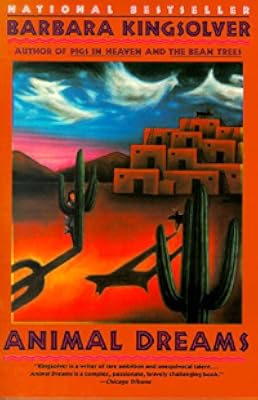
Animal Dreams
by Barbara Kingsolver
On This Page
Description
From Barbara Kingsolver, the acclaimed author of Flight Behavior, The Lacuna, The Bean Trees, and other modern classics, Animal Dreams is a passionate and complex novel about love, forgiveness, and one womans struggle to find her place in the world. At the end of her rope, Codi Noline returns to her Arizona home to face her ailing father, with whom she has a difficult, distant relationship. There she meets handsome Apache trainman Loyd Peregrina, who tells her, If you want sweet dreams, show more youve got to live a sweet life.Filled with lyrical writing, Native American legends, a tender love story, and Codis quest for identity, Animal Dreams is literary fiction at its very best. show lessTags
Recommendations



















Member Recommendations
Aquila I can't really say what links these books in my mind, it's just something about the way they make me feel.
Member Reviews
The plot centers on Codi Noline, who, after a long absence, returns to her tiny hometown of Grace, Arizona. She comes back to care for her ailing father and to reconnect with her sister, Hallie, who is involved in political activism in Nicaragua. Through her journey, Codi confronts her past, her sense of belonging, and her role within her community and family.
Kingsolver is not afraid to voice her concerns about the environment. The novel includes a plotline about the local river being poisoned by a mining company, reflecting on how industrial actions impact local ecosystems and communities.
Codi's battle with her cultural and personal identities is at the heart of this. She grapples with feelings of displacement and the desire to belong show more somewhere, which is mirrored in her relationship with Grace and its inhabitants.
The story explores family dynamics, especially the sisterly bond and her father's complicated relationship. There's a strong undercurrent of healing, both personal and communal, as characters confront their pasts and work towards reconciliation.
Kingsolver's prose is lyrical yet accessible, with a strong sense of place that brings Grace, Arizona, to life. She uses her background in biology to enrich her descriptions of the natural world, making it almost a character in itself. Her storytelling weaves personal narratives with broader social and ecological issues, creating a tapestry that is both intimate and expansive.
I found the integration of so many themes somewhat heavy-handed or the pace uneven at times. The novel's strengths lie in its character development and its poignant, poetic handling of human and environmental connections. Kingsolver's ability to make readers care about the fate of both her characters and the land they inhabit is remarkable.
I recommend it for readers who appreciate novels that blend personal drama with broader socio-political commentary. It's particularly appealing if you're interested in stories about community, environmental issues, and the intricate process of personal healing show less
Kingsolver is not afraid to voice her concerns about the environment. The novel includes a plotline about the local river being poisoned by a mining company, reflecting on how industrial actions impact local ecosystems and communities.
Codi's battle with her cultural and personal identities is at the heart of this. She grapples with feelings of displacement and the desire to belong show more somewhere, which is mirrored in her relationship with Grace and its inhabitants.
The story explores family dynamics, especially the sisterly bond and her father's complicated relationship. There's a strong undercurrent of healing, both personal and communal, as characters confront their pasts and work towards reconciliation.
Kingsolver's prose is lyrical yet accessible, with a strong sense of place that brings Grace, Arizona, to life. She uses her background in biology to enrich her descriptions of the natural world, making it almost a character in itself. Her storytelling weaves personal narratives with broader social and ecological issues, creating a tapestry that is both intimate and expansive.
I found the integration of so many themes somewhat heavy-handed or the pace uneven at times. The novel's strengths lie in its character development and its poignant, poetic handling of human and environmental connections. Kingsolver's ability to make readers care about the fate of both her characters and the land they inhabit is remarkable.
I recommend it for readers who appreciate novels that blend personal drama with broader socio-political commentary. It's particularly appealing if you're interested in stories about community, environmental issues, and the intricate process of personal healing show less
In a letter to Codi, Hallie writes, "'What keeps you going isn't some fine destination but just the road you're on, and the fact that you know how to drive.'" This is not a love story as the back of the book may have you believe. Sure, people fall in and out of love within its pages, but this book is really about understanding oneself amid a lifetime of memories and secrets...the risks we take not only when we cheat ourselves, but when we find ourselves, too. I read this for the first time two years ago to the month, needing it for the same reasons even though I've changed a lot, and this time got even a little more from it (which is why we should all read our favorite books multiple times!). I'm not going into a deeply personal show more reflection here in a public forum, but I think this is a loving book for people who've got some reckoning to do, spanning the greater good of the social and physical world to the individual soul. show less
4.5, I almost started crying multiple times on the bus because of the way Codie's relationship with her sister was described. Kingsolver's description of making up your own childhood backstory that doesn't accurately reflect what happened and having a shared family history only your sister understands was SO good. Even though I'm still not the biggest fan of literary fiction, this book was so solid that I just had to love it, it feels like a comfort book that I could come back to in a couple years.
This is a wonderful book. It does what many stories try to do: it simply tells a person's life, a snippet of time in the grand scheme of things, and in the process touches on some larger truth. Something that helps a reader with a new perspective, a new thing to think about.
Many stories try to do this. Most fail to do it thoroughly.
But Animal Dreams does it. It is pierced through with sorrow and love and loss and growth, all wrapped up in one special town that most see as a place to move from. Many have left Grace; few return.
And yet Codi comes back, the prodigal daughter, suitcase heavy with fear, alienation, loneliness, and aimlessness. She is un-rooted, and tugged by memories she can and cannot remember. This is a story of finding show more oneself, of coming together inside your own skin. Of becoming.
Codi holds most of the pages, but some of the most devastating passages are from the few chapters told from her father's point of view. He is how she could be. How we all can be, if we feel but don't let it out, if we hide behind histories long past but still capable of wounding.
My favorite paragraph: "...people's dreams are made out of what they do all day. The same way a dog that runs after rabbits will dream of rabbits. It's what you do that makes your soul, not the other way around."
I'll be reading more Kingsolver. show less
Many stories try to do this. Most fail to do it thoroughly.
But Animal Dreams does it. It is pierced through with sorrow and love and loss and growth, all wrapped up in one special town that most see as a place to move from. Many have left Grace; few return.
And yet Codi comes back, the prodigal daughter, suitcase heavy with fear, alienation, loneliness, and aimlessness. She is un-rooted, and tugged by memories she can and cannot remember. This is a story of finding show more oneself, of coming together inside your own skin. Of becoming.
Codi holds most of the pages, but some of the most devastating passages are from the few chapters told from her father's point of view. He is how she could be. How we all can be, if we feel but don't let it out, if we hide behind histories long past but still capable of wounding.
My favorite paragraph: "...people's dreams are made out of what they do all day. The same way a dog that runs after rabbits will dream of rabbits. It's what you do that makes your soul, not the other way around."
I'll be reading more Kingsolver. show less
This complex novel powerfully and movingly explores themes of love and grief, the difficult ties among family members, the bonds that can exist among people of shared cultures, and the responsibilities that humans have toward the earth. Codi Noline, a woman in her early thirties, returns to her home town of Grace, Arizona to attend to her physician father who is experiencing the onset of Alzheimer’s disease. Grace is a small town in the desert populated by people with deep Hispanic roots and by native people. It is known for its orchards that are the livelihood of many and for a copper mine that is largely defunct but still in limited operation.
Before arriving in Grace Codi has seen off her sister, Hallie, who has departed for show more Nicaragua where she will work as an agronomist assisting the rural population in improving their farming practices. Nicaragua has recently been liberated from a right wing junta’s control, but is under episodic attacks by the Contras supported by the US government. Codi and Hallie are extremely close. They were raised in Grace by their widowed father who was emotionally distant and remote from them. Growing up both girls felt like outsiders in Grace because of their intellect and height. Their father was constantly pushing them to demonstrate their superiority over their peers. Homer is driven to this by his belief that his family was never accepted by the locals; a result he claims of having relocated to Grace from Illinois.
Unlike her driven younger sister, Codi is adrift. She believes she has nothing of value to offer and is despairing of finding physical, vocational or emotional roots anywhere. She trained to be a doctor, but quit the profession during her internship. She was living in Tucson, working as a clerk in a convenience store and living with a doctor boyfriend who she wasn’t particularly close to. Codi takes a temporary teaching job in the Grace High School and moves in with a girl from her school years and her family.
Codi reveals that she had been pregnant as a teenager after a shallow sexual liaison with Loyd (with the missing “l”), an Apache schoolmate. Loyd was not aware of the pregnancy. Codi carried the baby secretly and lost it by miscarriage, burying it along a river bank behind her home. Her father was aware of this but never spoke of it or offered either support or reprobation.
Codi becomes reacquainted with Loyd who has matured and found employment as a railway engineer. Codi grows more attracted to Loyd and they start a love affair. Loyd is closely connected with the native people on the nearby reservation and through him she learns of the deep respect that the native culture holds for the earth. While they are watching a ceremony on the reservation Loyd explains that the native people see themselves as “guests” on the earth who must behave respectfully toward their “host” and leave the land unharmed from their stay on it. In contrast, the Anglo sense of the earth is that humans are entitled to use it for their gain without regard to the consequences of their actions. This difference is seen in a catastrophe that is unfolding in Grace. The mining company is trying to extract the last bit of copper from the mine tailings by introducing chemicals that enter the river and subsequently are poisoning the orchards. Codi discovers this and brings it to the attention of the townspeople. The devastation will be made worse by the company’s plan to divert the run off by damming the river, an act that will deprive the town of any water. The women of the town, with the scientific background provided by Codi, undertake a grass-roots campaign to draw attention to the environmental depravation. They gain enough public attention to cause the company to cease its practices.
Codi has a difficult relationship with her father who is in and out of lucidity. He has been so reserved and remote that there is no close bond between Codi and he. His insistence on high standards of behavior for the sisters Codi feels is the cause of their feelings of isolation from their peers. An interesting passage metaphorically shows Homer’s attempts at manipulating the natural nature of his daughters. He is an amateur photographer whose technique is to take pictures of natural objects and by manipulating the images in the dark room turn them into visages they are not.
Homer had always intimated that the lack of acceptance of the family was because they were seen as outsiders from another state. Codi finds out that this is not true. While Homer had been in Illinois for medical training, Grace was his hometown. His family had ties there dating back hundreds of years. His perception of being shunned stemmed from his resentment that it was the low social standing of his family that drew the disdain of others. In reaction, he works to make himself and his daughters superior.
Codi sees herself as having no deep connections to anyone or any place. Her low self-esteem leads to despair that she will ever make productive contributions to anything. Her self-loathing is so ingrained that she doesn't see the value she is bringing to her students, to the town’s fight against the polluter or to Loyd. She is blind to how much she is respected and loved. She is deeply drawn to Loyd who is clear that he wants a permanent relationship, but she repeatedly tells him she will not stay in Grace beyond the school year.
Codi savors the letters she is receiving from Hallie in Nicaragua. Hallie’s letters are a source of advice aimed at Codi to realize her value and worth to others. Then she receives the shocking news that Hallie has been kidnapped by the Contras and later murdered. This is so devastating that Codi determines to move on at the invitation of her former boyfriend to join him in Colorado. In her flight she begins to realize that she has found a place where she’s loved and valued. Hallie’s life has brought to Codi finally to the understanding that it’s how you live your life that determines your place in the world. Hallie said, “The very least you can do in your life is to figure out what you hope for. And the most you can do is to live inside that hope.” Codi realizes that Hallie's life reinforces what Loyd told her when they were talking about what animals dream about – they dream about what they do every day. And it’s what you do every day that enriches your soul and creates value in your life.
It is amazing to see how such diverse themes are woven so seamlessly into this fine novel. Kingsolver uses this forlorn locale to show how rich the cultural bonds of people can be. She clearly is intimately familiar with this region of the country (as she is with Appalachia in other works) and the setting adds depth to the ideas she conveys. Her training and sensibility as a scientist and an environmentalist and ecologist marvelously informs this work as it does in Flight Behavior and Prodigal Summer. show less
Before arriving in Grace Codi has seen off her sister, Hallie, who has departed for show more Nicaragua where she will work as an agronomist assisting the rural population in improving their farming practices. Nicaragua has recently been liberated from a right wing junta’s control, but is under episodic attacks by the Contras supported by the US government. Codi and Hallie are extremely close. They were raised in Grace by their widowed father who was emotionally distant and remote from them. Growing up both girls felt like outsiders in Grace because of their intellect and height. Their father was constantly pushing them to demonstrate their superiority over their peers. Homer is driven to this by his belief that his family was never accepted by the locals; a result he claims of having relocated to Grace from Illinois.
Unlike her driven younger sister, Codi is adrift. She believes she has nothing of value to offer and is despairing of finding physical, vocational or emotional roots anywhere. She trained to be a doctor, but quit the profession during her internship. She was living in Tucson, working as a clerk in a convenience store and living with a doctor boyfriend who she wasn’t particularly close to. Codi takes a temporary teaching job in the Grace High School and moves in with a girl from her school years and her family.
Codi reveals that she had been pregnant as a teenager after a shallow sexual liaison with Loyd (with the missing “l”), an Apache schoolmate. Loyd was not aware of the pregnancy. Codi carried the baby secretly and lost it by miscarriage, burying it along a river bank behind her home. Her father was aware of this but never spoke of it or offered either support or reprobation.
Codi becomes reacquainted with Loyd who has matured and found employment as a railway engineer. Codi grows more attracted to Loyd and they start a love affair. Loyd is closely connected with the native people on the nearby reservation and through him she learns of the deep respect that the native culture holds for the earth. While they are watching a ceremony on the reservation Loyd explains that the native people see themselves as “guests” on the earth who must behave respectfully toward their “host” and leave the land unharmed from their stay on it. In contrast, the Anglo sense of the earth is that humans are entitled to use it for their gain without regard to the consequences of their actions. This difference is seen in a catastrophe that is unfolding in Grace. The mining company is trying to extract the last bit of copper from the mine tailings by introducing chemicals that enter the river and subsequently are poisoning the orchards. Codi discovers this and brings it to the attention of the townspeople. The devastation will be made worse by the company’s plan to divert the run off by damming the river, an act that will deprive the town of any water. The women of the town, with the scientific background provided by Codi, undertake a grass-roots campaign to draw attention to the environmental depravation. They gain enough public attention to cause the company to cease its practices.
Codi has a difficult relationship with her father who is in and out of lucidity. He has been so reserved and remote that there is no close bond between Codi and he. His insistence on high standards of behavior for the sisters Codi feels is the cause of their feelings of isolation from their peers. An interesting passage metaphorically shows Homer’s attempts at manipulating the natural nature of his daughters. He is an amateur photographer whose technique is to take pictures of natural objects and by manipulating the images in the dark room turn them into visages they are not.
Homer had always intimated that the lack of acceptance of the family was because they were seen as outsiders from another state. Codi finds out that this is not true. While Homer had been in Illinois for medical training, Grace was his hometown. His family had ties there dating back hundreds of years. His perception of being shunned stemmed from his resentment that it was the low social standing of his family that drew the disdain of others. In reaction, he works to make himself and his daughters superior.
Codi sees herself as having no deep connections to anyone or any place. Her low self-esteem leads to despair that she will ever make productive contributions to anything. Her self-loathing is so ingrained that she doesn't see the value she is bringing to her students, to the town’s fight against the polluter or to Loyd. She is blind to how much she is respected and loved. She is deeply drawn to Loyd who is clear that he wants a permanent relationship, but she repeatedly tells him she will not stay in Grace beyond the school year.
Codi savors the letters she is receiving from Hallie in Nicaragua. Hallie’s letters are a source of advice aimed at Codi to realize her value and worth to others. Then she receives the shocking news that Hallie has been kidnapped by the Contras and later murdered. This is so devastating that Codi determines to move on at the invitation of her former boyfriend to join him in Colorado. In her flight she begins to realize that she has found a place where she’s loved and valued. Hallie’s life has brought to Codi finally to the understanding that it’s how you live your life that determines your place in the world. Hallie said, “The very least you can do in your life is to figure out what you hope for. And the most you can do is to live inside that hope.” Codi realizes that Hallie's life reinforces what Loyd told her when they were talking about what animals dream about – they dream about what they do every day. And it’s what you do every day that enriches your soul and creates value in your life.
It is amazing to see how such diverse themes are woven so seamlessly into this fine novel. Kingsolver uses this forlorn locale to show how rich the cultural bonds of people can be. She clearly is intimately familiar with this region of the country (as she is with Appalachia in other works) and the setting adds depth to the ideas she conveys. Her training and sensibility as a scientist and an environmentalist and ecologist marvelously informs this work as it does in Flight Behavior and Prodigal Summer. show less
between 4 and 4.5. i think i need to do a reread of all of her work because in my memory this is the one i liked the least and it is *so good* so what does that say about all the others?
i started this book without my full attention, which is too bad, because there's a lot here and it's just so well done, and i'm disappointed in myself for missing some of it.
she's so good. this is beautiful. her language is great. the surface story - about self-perception and fitting in and finding your family and your people, finding yourself in unexpected places and maybe even out of wreckage - is fantastic and enough all on its own. but the book goes so much deeper even than that, and talks (as she always must, and i love her for it) about more global show more issues. this one is about nicaragua and the contras and how the us government funded them. and the pueblo and navajo and their views on so much, especially their love and respect for the land and history. in contrast, of course, to the white people's view of it.
it took me a little while to get into this but i really think that was just me, and once i did i loved it. except i guess i'm not entirely sure why loyd would have fallen for codi in the first place, but otherwise this was just great.
"Memory is a complicated thing, a relative to truth but not its twin."
"She said, 'You can't let your heart go bad like that, like sour milk. There's always the chance you'll want to use it later.'"
"You learn to read so you can identify the reality in which you live, so that you can become a protagonist of history rather than a spectator."
"Family constellations are fixed things. They don't change just because you've learned the names of the stars." show less
i started this book without my full attention, which is too bad, because there's a lot here and it's just so well done, and i'm disappointed in myself for missing some of it.
she's so good. this is beautiful. her language is great. the surface story - about self-perception and fitting in and finding your family and your people, finding yourself in unexpected places and maybe even out of wreckage - is fantastic and enough all on its own. but the book goes so much deeper even than that, and talks (as she always must, and i love her for it) about more global show more issues. this one is about nicaragua and the contras and how the us government funded them. and the pueblo and navajo and their views on so much, especially their love and respect for the land and history. in contrast, of course, to the white people's view of it.
it took me a little while to get into this but i really think that was just me, and once i did i loved it. except i guess i'm not entirely sure why loyd would have fallen for codi in the first place, but otherwise this was just great.
"Memory is a complicated thing, a relative to truth but not its twin."
"She said, 'You can't let your heart go bad like that, like sour milk. There's always the chance you'll want to use it later.'"
"You learn to read so you can identify the reality in which you live, so that you can become a protagonist of history rather than a spectator."
"Family constellations are fixed things. They don't change just because you've learned the names of the stars." show less
This book was captivating. Kingsolver has a rare gift of painting emotion with every word. She does not spend pages writing detailed descriptions of a character's face; she spends a novel intertwining characters personalities. You can feel the passion, the heavy sadness; you can see the world in which this story lives. She wrote so beautifully of Native American life, modern city life, loss in many ways (loss of body, mind, feeling, family) but also of gaining all those things back in a true-to-life format.
I could not put this book down. It is the story of Cosima [Codi] returning to her small, environmentally-threatened town of Grace, Arizona. Where she must deal with her distant father's worsening Alzheimer's, seeing the high-school show more sweetheart whose baby she miscarried without his knowledge and confront the rush of long-lost memories of childhood that consume her. It is the story of loss, of re-discovering a place she thought was lost to her, family secrets coming to light..
The story is also told through the eyes of Cosima's ailing father, Homero. His sections are brief but poetic, beautifully pained, delicate and encompassing.
Favorite quotes of the book:
1). "You don't ask questions of an attic"
2.) "[...] There was a roaring in my ears and I lost track of what they were saying. I believe it was the physical manifestation of unbearable grief."
3). "The flowers were beaten down, their bent-over heads bejeweled with diamond droplets like earring on sad, rich widows" show less
I could not put this book down. It is the story of Cosima [Codi] returning to her small, environmentally-threatened town of Grace, Arizona. Where she must deal with her distant father's worsening Alzheimer's, seeing the high-school show more sweetheart whose baby she miscarried without his knowledge and confront the rush of long-lost memories of childhood that consume her. It is the story of loss, of re-discovering a place she thought was lost to her, family secrets coming to light..
The story is also told through the eyes of Cosima's ailing father, Homero. His sections are brief but poetic, beautifully pained, delicate and encompassing.
Favorite quotes of the book:
1). "You don't ask questions of an attic"
2.) "[...] There was a roaring in my ears and I lost track of what they were saying. I believe it was the physical manifestation of unbearable grief."
3). "The flowers were beaten down, their bent-over heads bejeweled with diamond droplets like earring on sad, rich widows" show less
Members
- Recently Added By
Published Reviews
ThingScore 75
Barbara Kingsolver is one of an increasing number of American novelists who are trying to rewrite the political, cultural and spiritual relationships between our country's private and public spheres.
added by jlelliott
Lists

Top Five Books of 2013
1,562 works; 721 members

Female Author
1,234 works; 67 members

Best Books With Sisters
130 works; 30 members

Banned or Challenged Books
400 works; 40 members

Top Five Books of 2016
795 works; 228 members

NPRs audience picks: 100 best beach reads
105 works; 12 members

The American West
18 works; 2 members

SHOULD Read Books!
354 works; 9 members

Blue Pyramid 1,276 Best Books of All Time
1,248 works; 32 members

Literary Travelogue of the United States Challenge
133 works; 6 members

Books We Couldn't Put Down
443 works; 197 members

School Made Us Read It
380 works; 196 members
Author Information

48+ Works 99,233 Members
Barbara Kingsolver was born on April 8, 1955 in Annapolis, Maryland and grew up in Eastern Kentucky. As a child, Kingsolver used to beg her mother to tell her bedtime stories. She soon started to write stories and essays of her own, and at the age of nine, she began to keep a journal. After graduating with a degree in biology form De Pauw show more University in Indiana in 1977, Kingsolver pursued graduate studies in biology and ecology at the University of Arizona in Tucson. She earned her Master of Science degree in the early 1980s. A position as a science writer for the University of Arizona soon led Kingsolver into feature writing for journals and newspapers. Her articles have appeared in a number of publications, including The Nation, The New York Times, and Smithsonian magazines. In 1985, she married a chemist, becoming pregnant the following year. During her pregnancy, Kingsolver suffered from insomnia. To ease her boredom when she couldn't sleep, she began writing fiction Barbara Kingsolver's first fiction novel, The Bean Trees, published in 1988, is about a young woman who leaves rural Kentucky and finds herself living in urban Tucson. Since then, Kingsolver has written other novels, including Holding the Line, Homeland, and Pigs in Heaven. In 1995, after the publication of her essay collection High Tide in Tucson: Essays from Now or Never, Kingsolver was awarded an Honorary Doctorate of Letters from her alma mater, De Pauw University. Her latest works include The Lacuna and Flight Behavior. Barbara's nonfiction book, Animal, Vegetable, Miracle was written with her family. This is the true story of the family's adventures as they move to a farm in rural Virginia and vow to eat locally for one year. They grow their own vegetables, raise their own poultry and buy the rest of their food directly from farmers markets and other local sources. (Bowker Author Biography) show less
Some Editions
Awards and Honors
Awards
Distinctions
Series
Belongs to Publisher Series
Work Relationships
Is contained in
Has as a student's study guide
Common Knowledge
- Canonical title
- Animal Dreams
- Original publication date
- 1990 (1e édition originale américaine, HarperCollins Publishers, New York) (1e édition originale américaine, HarperCollins Publishers, New York); 2002-04-03 (1e traduction et édition française, Littérature étrangère, Rivages) (1e traduction et édition française, Littérature étrangère, Rivages); 2003-10-03 (Réédition française, Poche, Littérature étrangère, Rivages) (Réédition française, Poche, Littérature étrangère, Rivages)
- People/Characters
- Codi Noline; Hallie Noline; Doc Homer
- Important places
- Arizona, USA; Grace, Arizona, USA (fictional town); Central America (correspondence); Nicaragua (correspondence)
- Epigraph*
- /
- Dedication
- In memory of Ben Linder
- First words
- His two girls are curled together like animals whose habit is to sleep underground, in the smallest space possible.
- Last words
- (Click to show. Warning: May contain spoilers.)For an instant it hangs above us, empty and bright, and then it rises like a soul.
- Blurbers
- Bernikow, Louise; Le Guin, Ursula K.; Cryer, Dan
- Original language*
- Anglais (Etats-Unis) (Etats-Unis)
- Canonical DDC/MDS
- 813.54
- Canonical LCC
- PS3561.I496
*Some information comes from Common Knowledge in other languages. Click "Edit" for more information.
Classifications
Statistics
- Members
- 6,018
- Popularity
- 2,126
- Reviews
- 80
- Rating
- (4.03)
- Languages
- 6 — English, French, German, Italian, Spanish, Swedish
- Media
- Paper, Audiobook, Ebook
- ISBNs
- 41
- ASINs
- 19