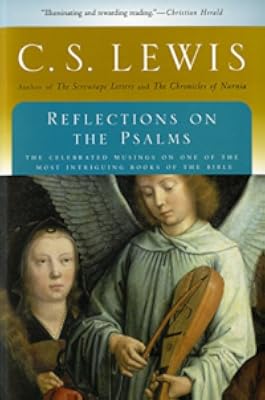
Reflections on the Psalms
by C. S. Lewis
On This Page
Description
In one of his most enlightening works, C. S. Lewis shares his ruminations on both the form and the meaning of selected psalms. In the introduction he explains, "I write for the unlearned about things in which I am unlearned myself." Consequently, he takes on a tone of thoughtful collegiality as he writes on one of the Bible's most elusive books. Characteristically graceful and lucid, Lewis cautions us that the psalms were originally written as songs that should now be read in the spirit of show more lyric poetry rather than as doctrinal treatises or sermons. Drawing from daily life as well as the literary world, Lewis begins to reveal the mystery that often shrouds the psalms. show lessTags
Recommendations


Member Reviews
I enjoy Lewis's religious writings immensely--something which I always find a bit perplexing since I do not consider myself religious and often have very little or no real understanding of the doctrine or scriptures he is discussing. But he writes about difficult concepts well, and I usually leave his books with some sense that I've understood something I didn't before. Often I get insight into the world from his musings, too (in this book, chapter five sparked some useful thinking about the rampant commercialism of Christmas). There's no doubt that Lewis sometimes comes off super pompous and I often want to smack him upside the head and remind him that not everyone is a white, male, educated, protestant from Britain, but there's worth show more to be found here if you can accept and see past the fact that he will always sound very much like he's only talking to other people just like him. show less
Just when I think I've discovered my favorite Jack Lewis book, I go and find another one. This book took me ages to read because I simply did not want it to end. I haven't savored a text like this since reading Hugo's Les Miserables.
Like most pieces of art that make a lasting impact on me, this book raised my blood pressure a bit - made me nervous. I have never learned anything from comfort. While I can say that perhaps Lewis and I don't share identical beliefs, he has forced me (by being so incredibly humble) to his perspective. This is, after all, Jack Lewis. If anyone else had suggested some of what Mr. Lewis suggests in this small Bible study, this book quite possibly would never have seen the light of day. But like all good works, show more this book mades you read it in its entirety - you must let Jack finish his reasons for not equating himself with a fundamentalist - for even, in his own words, envying them - to find at the end of it all a truly fundamental conclusion. But Jack isn't fundamental because he's fundamental, he's fundamental by reason. That might not make a lot of sense to a Lewis outsider, but I believe anyone familiar with his work will know what I mean. Where Paul (an "outsider")is the Jew appealing to the gentile on Mars Hill, Lewis is the gentile who reasons from even further outside the ring to find the same conclusion - to deny that he found it fundamentally - but at heart to be operating from the same fundamental thinking that drives all good theology. That is, he divides what he reads in the Word based on what has been concluded or revealed about the Person of God Himself. That it is a faith conclusion, and it ultimately drives his reasoning.
Without giving too much away, I will say that Lewis breaks down his study of the Psalms into brilliant, tidy divisions that give a wholistic view of their pattern and importance rather than dividing them by chronology. While some of his themes have been covered before, he ventures to places I have never seen anyone else go before. His extensive knowledge and background in ancient myths adds a fascinating depth here as he is able at a glance to remark on the differences in these Hebrew mindsets compared with their pagan contemporaries. This added flavor - which highlighted how Jewish texts were completely unique - was one of my favorite things about this book and offered so many rich surprises. Indeed, a lack of understanding in this particular field is why so many Christian scholars miss much of what the Spirit was doing. Jack showed me once again that the Spirit's Poetry is incomparable.
While many would be fearful to read Lewis' suggestion that the Psalmist is actually possibly sinning in some of his warmonger type rantings, this notion of dividing what is strictly human from what is strictly God and driving back towards the ultimate question of the Spirit's purpose in preserving whatever has been written is essential to any really strong theological foundation.
Lewis steps away from the Book, turns it around several ways - reads it again and again - and sees beauty that I in my more prosaic form of fundamentalism would have failed to see if not forced by a humbler heart than my own. This would be the heart of Jack Lewis. Thank God he was brave enough to make his deepest quandries (those we have all shared in secretly) public. He has, for a few pages, given me a glance behind his eyes and into a mind different than my own - which is the point.
I have a different - much larger - much wider - much more beautiful view of the Psalms. Thanks to Jack, they have increased. I have decreased.
Good Books don't get much better than that. show less
Like most pieces of art that make a lasting impact on me, this book raised my blood pressure a bit - made me nervous. I have never learned anything from comfort. While I can say that perhaps Lewis and I don't share identical beliefs, he has forced me (by being so incredibly humble) to his perspective. This is, after all, Jack Lewis. If anyone else had suggested some of what Mr. Lewis suggests in this small Bible study, this book quite possibly would never have seen the light of day. But like all good works, show more this book mades you read it in its entirety - you must let Jack finish his reasons for not equating himself with a fundamentalist - for even, in his own words, envying them - to find at the end of it all a truly fundamental conclusion. But Jack isn't fundamental because he's fundamental, he's fundamental by reason. That might not make a lot of sense to a Lewis outsider, but I believe anyone familiar with his work will know what I mean. Where Paul (an "outsider")is the Jew appealing to the gentile on Mars Hill, Lewis is the gentile who reasons from even further outside the ring to find the same conclusion - to deny that he found it fundamentally - but at heart to be operating from the same fundamental thinking that drives all good theology. That is, he divides what he reads in the Word based on what has been concluded or revealed about the Person of God Himself. That it is a faith conclusion, and it ultimately drives his reasoning.
Without giving too much away, I will say that Lewis breaks down his study of the Psalms into brilliant, tidy divisions that give a wholistic view of their pattern and importance rather than dividing them by chronology. While some of his themes have been covered before, he ventures to places I have never seen anyone else go before. His extensive knowledge and background in ancient myths adds a fascinating depth here as he is able at a glance to remark on the differences in these Hebrew mindsets compared with their pagan contemporaries. This added flavor - which highlighted how Jewish texts were completely unique - was one of my favorite things about this book and offered so many rich surprises. Indeed, a lack of understanding in this particular field is why so many Christian scholars miss much of what the Spirit was doing. Jack showed me once again that the Spirit's Poetry is incomparable.
While many would be fearful to read Lewis' suggestion that the Psalmist is actually possibly sinning in some of his warmonger type rantings, this notion of dividing what is strictly human from what is strictly God and driving back towards the ultimate question of the Spirit's purpose in preserving whatever has been written is essential to any really strong theological foundation.
Lewis steps away from the Book, turns it around several ways - reads it again and again - and sees beauty that I in my more prosaic form of fundamentalism would have failed to see if not forced by a humbler heart than my own. This would be the heart of Jack Lewis. Thank God he was brave enough to make his deepest quandries (those we have all shared in secretly) public. He has, for a few pages, given me a glance behind his eyes and into a mind different than my own - which is the point.
I have a different - much larger - much wider - much more beautiful view of the Psalms. Thanks to Jack, they have increased. I have decreased.
Good Books don't get much better than that. show less
The thing I love most about this little book is the speculative nature of it, which Lewis owns from the first sentence: "This is not a work of scholarship." He's conjecturing based on his knowledge of ancient cultures and the context of the whole Bible. I'm not sure about some of his conclusions, but he isn't either. He asks questions such as, did the inspired writers always know what they penned was inspired? Do the psalmists ever sin with their words (cursing their enemies, etc) and if so, what use are such writings to the Christian (i.e. why does God want us to read them?).
Lewis compares and contrasts often: other ancient works of similar literary genre to the psalms, the ancient Jewish perspective to the Christian perspective. He show more references specific psalms as well as the book in general to muse about topics like death, joy, praise, nature, the Law, and the Messianic "second meanings." I would not start a reader here to discover his nonfiction work, but for those of us who enjoy spending time with his humble, honest reflections on any topic, this book is certainly worthwhile. show less
Lewis compares and contrasts often: other ancient works of similar literary genre to the psalms, the ancient Jewish perspective to the Christian perspective. He show more references specific psalms as well as the book in general to muse about topics like death, joy, praise, nature, the Law, and the Messianic "second meanings." I would not start a reader here to discover his nonfiction work, but for those of us who enjoy spending time with his humble, honest reflections on any topic, this book is certainly worthwhile. show less
My interest in Lewis' spiritual writings is deepened with each one I read. Reflections on the Psalms only bolstered that confidence. Despite his usual disclaimer regarding his theological pedigree, he illuminates the great themes and purpose of the Psalms to bring new light to understanding. Moving from "Judgement' in the Psalms, he progresses through 'cursings,' death,' nature, and other narrations of his extended reflection to finally teach, really, a word about allegorical meanings.
Of particular interest is his treatment of Melchizedek, who drifts into view as priest and king in Genesis and is highligted in Psalm 10. This mysterious man assumes a superiority accepted by Abraham, the father of the faith, without question. Lewis show more describes him as a "numinous figure" who God provided with unforgettable impressiveness, "...the idea of a priesthood, not Pagan but a priesthood to the one God, far earlier than the Jewish priesthood which descends fro Aaron...somehow superior to Abraham's vocation."
This is a book I will re-read. show less
Of particular interest is his treatment of Melchizedek, who drifts into view as priest and king in Genesis and is highligted in Psalm 10. This mysterious man assumes a superiority accepted by Abraham, the father of the faith, without question. Lewis show more describes him as a "numinous figure" who God provided with unforgettable impressiveness, "...the idea of a priesthood, not Pagan but a priesthood to the one God, far earlier than the Jewish priesthood which descends fro Aaron...somehow superior to Abraham's vocation."
This is a book I will re-read. show less
I enjoyed C S Lewis's insights about the Psalms. He tackles head-on the obvious elephants in the room, like the cursings and bashings of babies, and his discussions on what it means to 'praise the lord' and 'the sweetness of the law'
(Note, he is writing as a Christian in the 1950s, some of the discussions of Jews are more supersessionist than make comfortable reading to secular multiculturalists.)
(Note, he is writing as a Christian in the 1950s, some of the discussions of Jews are more supersessionist than make comfortable reading to secular multiculturalists.)
Best known as the author of the Chronicles of Narnia and several book on Christian apologetics, C.S. Lewis here takes a variety of "reflections" on themes in Psalms, not as an expert but as a companion reading alongside.
Each chapter focuses on one aspect of the Psalms, starting with what Lewis considers the hardest ones - vengeance, for example, and cursing - broken down topically in an almost random way. The final three chapters are closely intertwined, discussing "second meanings" when perhaps the author is talking about more than he actually meant and readers are interpreting it differently in literature, Scripture in general, and then finally the Psalms. Though not my favorite Lewis, Psalms is one of my favorite parts of Scripture show more so it was fun to get an idea of what Lewis thought of these topics (definitely have your own translation with you, as he refers to specific verses throughout often without quoting them or expanding much on them). show less
Each chapter focuses on one aspect of the Psalms, starting with what Lewis considers the hardest ones - vengeance, for example, and cursing - broken down topically in an almost random way. The final three chapters are closely intertwined, discussing "second meanings" when perhaps the author is talking about more than he actually meant and readers are interpreting it differently in literature, Scripture in general, and then finally the Psalms. Though not my favorite Lewis, Psalms is one of my favorite parts of Scripture show more so it was fun to get an idea of what Lewis thought of these topics (definitely have your own translation with you, as he refers to specific verses throughout often without quoting them or expanding much on them). show less
While it can be difficult to follow at times, I found this book to be interesting and thought provoking. C.S. Lewis helps to provide some different perspectives on interpreting the Psalms, such as in relation to the New Testament, nature, and so forth. Overall, definitely worth reading.
Members
- Recently Added By
Author Information

C. S. (Clive Staples) Lewis, "Jack" to his intimates, was born on November 29, 1898 in Belfast, Ireland. His mother died when he was 10 years old and his lawyer father allowed Lewis and his brother Warren extensive freedom. The pair were extremely close and they took full advantage of this freedom, learning on their own and frequently enjoying show more games of make-believe. These early activities led to Lewis's lifelong attraction to fantasy and mythology, often reflected in his writing. He enjoyed writing about, and reading, literature of the past, publishing such works as the award-winning The Allegory of Love (1936), about the period of history known as the Middle Ages. Although at one time Lewis considered himself an atheist, he soon became fascinated with religion. He is probably best known for his books for young adults, such as his Chronicles of Narnia series. This fantasy series, as well as such works as The Screwtape Letters (a collection of letters written by the devil), is typical of the author's interest in mixing religion and mythology, evident in both his fictional works and nonfiction articles. Lewis served with the Somerset Light Infantry in World War I; for nearly 30 years he served as Fellow and tutor of Magdalen College at Oxford University. Later, he became Professor of Medieval and Renaissance English at Cambridge University. C.S. Lewis married late in life, in 1957, and his wife, writer Joy Davidman, died of cancer in 1960. He remained at Cambridge until his death on November 22, 1963. (Bowker Author Biography) show less
Some Editions
Work Relationships
Is contained in
Is abridged in
Common Knowledge
- Canonical title
- Reflections on the Psalms
- Original title
- Reflections on the Psalms
- Original publication date
- 1958
- People/Characters
- David
- Dedication
- To Austin and Katharine Farrer
- First words
- This is not a work of scholarship.
- Last words
- (Click to show. Warning: May contain spoilers.)And that would be strange indeed; unless of course the fish were destined to become, one day, a land animal.
- Original language
- English
Classifications
Statistics
- Members
- 3,937
- Popularity
- 4,007
- Reviews
- 28
- Rating
- (3.97)
- Languages
- 13 — Czech, Dutch, English, Finnish, French, German, Hungarian, Italian, Japanese, Polish, Portuguese, Spanish, Swedish
- Media
- Paper, Audiobook, Ebook
- ISBNs
- 44
- UPCs
- 1
- ASINs
- 50