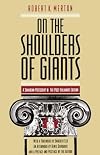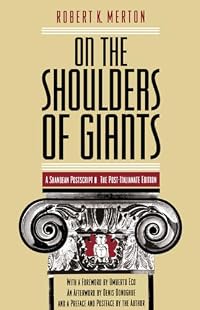
On the Shoulders of Giants: A Shandean Postscript
by Robert K. Merton
On This Page
Description
With playfulness and a large dose of wit, Robert Merton traces the origin of Newton's aphorism, "If I have seen farther, it is by standing on the shoulders of giants." Using as a model the discursive and digressive style of Sterne's Tristram Shandy, Merton presents a whimsical yet scholarly work which deals with the questions of creativity, tradition, plagiarism, the transmission of knowledge, and the concept of progress. "This book is the delightful apotheosis of donmanship: Merton parodies show more scholarliness while being faultlessly scholarly; he scourges pedantry while brandishing his own abstruse learning on every page. The most recondite and obscure scholarly squabbles are transmuted into the material of comedy as the ostensible subject is shouldered to one side by yet another hobby horse from Merton's densely populated stable. He has created a jeu d'esprit which is profoundly suggestive both in detail and as a whole."--Sean French, Times Literary Supplement show lessTags
Recommendations






























Member Reviews
What is true of every book is especially so in the case of Robert K. Merton’s On the Shoulders of Giants. Or, to quote its complete title On the Shoulders of Giants: A Shandean Postscript. The Post-Italianate Edition, with a foreword by Umberto Eco, an Afterword by Denis Donoghue, and a Preface and Postface by the Author. Or, to use the acronym Merton invents for it, OTSOG. I’ve cited all three variants to convey a flavor of what you’ll find in this book. Some will savor the humor, while others will be annoyed by what strikes them as intellectual snobbery. Hence the evocation of the truth universally acknowledged about books in general: you’ll either enjoy it or you won’t. In the case of this book, you’ll either hate it or show more think it’s one of the best books you’ve ever read. No moral superiority is ascribed to those who belong to either group.
You’ll know after a few pages to which group you belong. Well, a few pages of Merton. My copy begins with a foreword by Umberto Eco, a translation of his foreword to the Italian edition. It’s vintage Eco, but I think I’d have enjoyed it more if it had appeared as an afterword (perhaps in place of that by Denis Donoghue, which in its attempt to render homage both to Merton’s thesis and style, didn’t quite rise to the level of Merton himself).
If you find yourself smiling, even laughing, in Merton’s first few pages and continue to read the entire book, you’ll find both a spoof of scholarship and a serious example of indefatigable scholarly sleuthing. In its narrowest sense, it investigates the antecedents of the phrase referred to in the title, usually attributed to Isaac Newton, and its Wirkungsgeschichte. However, it soon becomes clear that there is a broader issue, the relative value of ancient and modern learning.
Along the way, the reader is introduced to the Parvus-complex, the palimpsestic syndrome, and ghost-writing in reverse (as well as a closely-related phenomenon, anticipatory plagiarism).
Merton characterizes the whole thing as “Shandean” for his indulgence in digression, magnificently exemplified by Lawrence Sterne’s Tristram Shandy. But Merton’s employment of Shandyism is not only for comic effect. Instead, it pulls back the curtain to show that scholarly inquiry often follows a zig-zag course rarely visible when the results are published. So for anyone with academic interests, this book is more than entertaining: it’s also a chance to see “how to scholar.” Compared with an ordinary scholarly tome, the effect is like the difference between dining in a fine restaurant and being invited to stand at the elbow of a master chef as he creates what is offered.
Merton spent his life investigating the social dimension of knowledge production (“science”). This book is the fruit of that career. It’s rich in allusion and citation (just don’t test me on all this). Did I mention that it’s entertaining? I even guffawed while reading the index. show less
You’ll know after a few pages to which group you belong. Well, a few pages of Merton. My copy begins with a foreword by Umberto Eco, a translation of his foreword to the Italian edition. It’s vintage Eco, but I think I’d have enjoyed it more if it had appeared as an afterword (perhaps in place of that by Denis Donoghue, which in its attempt to render homage both to Merton’s thesis and style, didn’t quite rise to the level of Merton himself).
If you find yourself smiling, even laughing, in Merton’s first few pages and continue to read the entire book, you’ll find both a spoof of scholarship and a serious example of indefatigable scholarly sleuthing. In its narrowest sense, it investigates the antecedents of the phrase referred to in the title, usually attributed to Isaac Newton, and its Wirkungsgeschichte. However, it soon becomes clear that there is a broader issue, the relative value of ancient and modern learning.
Along the way, the reader is introduced to the Parvus-complex, the palimpsestic syndrome, and ghost-writing in reverse (as well as a closely-related phenomenon, anticipatory plagiarism).
Merton characterizes the whole thing as “Shandean” for his indulgence in digression, magnificently exemplified by Lawrence Sterne’s Tristram Shandy. But Merton’s employment of Shandyism is not only for comic effect. Instead, it pulls back the curtain to show that scholarly inquiry often follows a zig-zag course rarely visible when the results are published. So for anyone with academic interests, this book is more than entertaining: it’s also a chance to see “how to scholar.” Compared with an ordinary scholarly tome, the effect is like the difference between dining in a fine restaurant and being invited to stand at the elbow of a master chef as he creates what is offered.
Merton spent his life investigating the social dimension of knowledge production (“science”). This book is the fruit of that career. It’s rich in allusion and citation (just don’t test me on all this). Did I mention that it’s entertaining? I even guffawed while reading the index. show less
A brilliant skewering of shoddy scholarship. Merton traces the origins of an aphorism often credited to Isaac Newton and brilliantly uncovers a history of misattributions, misquotations,and other scholarly laziness stretching back to the 12th century. A masterpiece of pedantry, Merton goes so far as to examine 12th century artistic representations of dwarves positioned on the shoulders of giants (he finds 4 examples!) and whether they sit or stand.
A study in the history of science and the sociology of knowledge constructed from an amusing assemblage of impossible ironies, paradoxes, and conundra. Can intentions be plagiarized? Are dwarves weightier when sitting, standing, or leaning? How did they get up there anyway? What is the etymology of “finagle”? Behind the wordplay and erudite shenanigans is an earnest examination of the dispute between the ancients and the moderns at a critical juncture in the development of European thought, as the greater and lesser minds of the 16th & 17th c. come to the realization that achieving the future requires kicking away the ladders of the past.
An entertaining account and model of historical methodology.
a real jewel for those with an antiquarian bent
This book caused me to lower my opinion of Merton.
Why are there not more books like this one? Otsog on, otsogers! Otsogify! Otsogify!
Members
- Recently Added By
Lists

Ten Books That Have Stayed With Me
160 works; 29 members

Michael Dirda's Desert Island Books
62 works; 5 members

Mustich's 1000 Books to Read Before You Die: A Life Changing List
1,001 works; 18 members

Michael Dirda's 100 Best Comic Novels
100 works; 1 member
Author Information
56+ Works 939 Members
Some Editions
Awards and Honors
Common Knowledge
- Original publication date
- 1965
- People/Characters
- Isaac Newton; John Bartlett; Bernard of Chartres; Robert Burton; Didacus Stella; John of Salisbury (show all 7); Lucan
- Dedication
- For
The Effable Three
Stephanie
Robert C.
Vanessa
And
Their Ineffable Fifteen - First words
- Dear Bud,
I sit here working away on a series of lectures I am doomed to give next spring on the sociology of science. - Last words
- (Click to show. Warning: May contain spoilers.)I thank the Muse for having led me instead to the sweet innocence and honesty of OTSOG.
- Blurbers
- Knopf, Alfred A.; Trilling, Lionel; Barzun, Jacques; Peyre, Henri; Gould, Stephen Jay; Brophy, Brigid (show all 10); Piel, Gerard; Eco, Umberto; Edel, Leon; Wildavsky, Aaron
Classifications
Statistics
- Members
- 225
- Popularity
- 144,288
- Reviews
- 8
- Rating
- (4.31)
- Languages
- English, German, Italian, Spanish
- Media
- Paper
- ISBNs
- 8
- ASINs
- 6