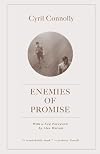
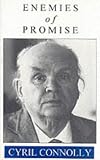
Enemies of Promise
by Cyril Connolly
On This Page
Description
The autobiography of literary figure Cyril Connolly, providing insight into his upper-class upbringing and life at Eton and Oxford, together with advice on how to avoid the pitfalls that await the would-be writer. First published in 1938.Tags
Recommendations

























Member Recommendations
Member Reviews
This is a unique combination of autobiography and literary criticism, with a dash of ideas. It is also a commentary on writers and the art of writing. A book that can be dipped into as there are interesting bits on every page.
On the upside, the next time anyone complains about how The Literary Establishment has always forced people to write in single genres and thus distorted the Genius Writer, I can point to one more book as showing what rubbish that statement is. On the downside, I now know why this is more cult classic and less just classic. I was led to expect much more.
I thought the first section by far the most interesting. Connolly's understanding of literature, and particularly literary history, was ahead of its time and light years ahead of most contemporary polemicists, who continue to insist that there's some everlasting ideal of literature and that we'll only get to that if we [insert your least favorite literary trend here; I go with 'write show more memoirs'.] Connolly knew the truth: literary trends are entirely reactive. Naturalism was followed by modernism, which was followed by various anti-modernist reactions, which were followed by 'post-modernism,' which is now being followed by various returns to either a) sincerity or b) modernist technique. Each movement--other than naturalism, for me--will produce a few books worth reading. Cyril read everything of his time, it seems, and his simple categories still work today, as we swing between 'vernacular' (naturalism, anti-modernism, sincerity) and 'mandarin' (decadence, modernism, post-modernism, neo-modernism). And he comes up with some odd pairings; for instance, Maugham, Joyce and Lawrence, all of whom were fixated on the word 'grey.' On the 'vernacular' side, he splices together sentences by Orwell, Isherwood and Hemingway, which is a pretty convincing way of showing how dull they can be.
The second section describes the 'situation of the author,' and is fairly dull.
The third section is memoir meant to fulfill the rules laid down in part one. It doesn't succeed; I'd much rather read Powell's autobiography; four times over I'd rather read Powell's Dance to the Music of Time. But that's mainly because I don't really think high school is a formative experience for most people; it might have been for Connolly, but that doesn't come through all that much. I should probably re-read it, though.
Special bonus marks for recognizing that 18th century prose was the high point of English literature. show less
I thought the first section by far the most interesting. Connolly's understanding of literature, and particularly literary history, was ahead of its time and light years ahead of most contemporary polemicists, who continue to insist that there's some everlasting ideal of literature and that we'll only get to that if we [insert your least favorite literary trend here; I go with 'write show more memoirs'.] Connolly knew the truth: literary trends are entirely reactive. Naturalism was followed by modernism, which was followed by various anti-modernist reactions, which were followed by 'post-modernism,' which is now being followed by various returns to either a) sincerity or b) modernist technique. Each movement--other than naturalism, for me--will produce a few books worth reading. Cyril read everything of his time, it seems, and his simple categories still work today, as we swing between 'vernacular' (naturalism, anti-modernism, sincerity) and 'mandarin' (decadence, modernism, post-modernism, neo-modernism). And he comes up with some odd pairings; for instance, Maugham, Joyce and Lawrence, all of whom were fixated on the word 'grey.' On the 'vernacular' side, he splices together sentences by Orwell, Isherwood and Hemingway, which is a pretty convincing way of showing how dull they can be.
The second section describes the 'situation of the author,' and is fairly dull.
The third section is memoir meant to fulfill the rules laid down in part one. It doesn't succeed; I'd much rather read Powell's autobiography; four times over I'd rather read Powell's Dance to the Music of Time. But that's mainly because I don't really think high school is a formative experience for most people; it might have been for Connolly, but that doesn't come through all that much. I should probably re-read it, though.
Special bonus marks for recognizing that 18th century prose was the high point of English literature. show less
The book addresses the situation of "writers of promise"-- that is to say, it's a book about writing for writers who are neither beginners nor satisfied merely to make a living from their work (even when it's a very good living). What does it take, Connolly wonders in the first chapter, to write a book "that will hold good for ten years afterwards"?
Part 1, "Predicament," discusses the hazards that entangle every aspect of writing, placing a special emphasis on style and the continual shifts in literary fashion that sweep respected and even popular works into the dustbin of obscurity. His elucidation of style is fascinating and makes great sense to me (perhaps at least partly because it resonates powerfully with my recent reading in ms show more of the revised edition of Delany's Jewel-Hinged Jaw, which Wesleyan will be publishing next spring.) Some of it is a bit dated, and obviously its scope is restricted to early twentieth-century English literature, but there's much here to interest writers and critics today.
Part 2, "The Charlock's Shade," analyzes "the conditions which govern the high rate of mortality among contemporary writers"-- specifically politics, daydreams, conversation, drink and other narcotics, the "clarion call of journalism" (which includes writing reviews), worldly success, sex with its obsessions, and the ties of duty and domesticity. And he begins by citing Samuel Butler: "What ruins young writers is over-production. The need for money is what causes overproduction." His analysis, of course, is (unconsciously) gendered. Though women writers face the same obstacles men writers face, their resources and internal obstacles tend to be different from those of men writers, and these create differences it doesn't occur to Connolly to attend to.
Part 3, which is fully half of the book, "A Georgian Boyhood," is autobiography that culminates with an intense, almost novelistic description and analysis of his years at Eton. (His schoolmate George Orwell appears as a figure that haunts its margins.) It is only after finishing Part 3 and returning to the first two parts of the book that one realizes that an unstated reason for Connolly's writing the book must have been his need to explain to himself the dissipation of his own "promise" as a writer (ironically, of course, since the book was reprinted in 1948 and then again another 60 years later).
I recommend this book to writers with ambition, and anyone interested in the writing life. show less
Part 1, "Predicament," discusses the hazards that entangle every aspect of writing, placing a special emphasis on style and the continual shifts in literary fashion that sweep respected and even popular works into the dustbin of obscurity. His elucidation of style is fascinating and makes great sense to me (perhaps at least partly because it resonates powerfully with my recent reading in ms show more of the revised edition of Delany's Jewel-Hinged Jaw, which Wesleyan will be publishing next spring.) Some of it is a bit dated, and obviously its scope is restricted to early twentieth-century English literature, but there's much here to interest writers and critics today.
Part 2, "The Charlock's Shade," analyzes "the conditions which govern the high rate of mortality among contemporary writers"-- specifically politics, daydreams, conversation, drink and other narcotics, the "clarion call of journalism" (which includes writing reviews), worldly success, sex with its obsessions, and the ties of duty and domesticity. And he begins by citing Samuel Butler: "What ruins young writers is over-production. The need for money is what causes overproduction." His analysis, of course, is (unconsciously) gendered. Though women writers face the same obstacles men writers face, their resources and internal obstacles tend to be different from those of men writers, and these create differences it doesn't occur to Connolly to attend to.
Part 3, which is fully half of the book, "A Georgian Boyhood," is autobiography that culminates with an intense, almost novelistic description and analysis of his years at Eton. (His schoolmate George Orwell appears as a figure that haunts its margins.) It is only after finishing Part 3 and returning to the first two parts of the book that one realizes that an unstated reason for Connolly's writing the book must have been his need to explain to himself the dissipation of his own "promise" as a writer (ironically, of course, since the book was reprinted in 1948 and then again another 60 years later).
I recommend this book to writers with ambition, and anyone interested in the writing life. show less
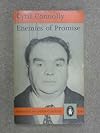
Would be tempted to add in an extra star of sympathy for labouring under the single most unsympathetic cover in the entire Penguin oeuvre. But, sorry, not even that redeems it.
Ratings
Members
- Recently Added By
Lists

Mustich's 1000 Books to Read Before You Die: A Life Changing List
1,001 works; 18 members
Author Information

116+ Works 1,759 Members
Cyril Connolly (1903-74), one of the most influential critics of his time, wrote for such publications as the New Statesman, the Observer, and the Sunday Times. He is the author of many books, including The Rock Pool and The Unquiet Grave
Some Editions
Awards and Honors
Series
Belongs to Publisher Series
Penguin Modern Classics (1573)
Common Knowledge
- Canonical title
- Enemies of Promise
- Original publication date
- 1938; 1948 (New introduction by Cyril Connolly) (New introduction by Cyril Connolly)
- Epigraph
- 'Quando sovviemmi di cotanta speme'
('When I remember so much hope', from Leopardi's 'To Silvia') - Dedication
- To Logan Pearsall Smith
- First words
- This is the time of year when wars break out and when a broken glass betrays the woodland to the vindictive sun.
Classifications
- Genres
- Nonfiction, Literature Studies and Criticism, Biography & Memoir
- DDC/MDS
- 820.900912 — Literature & rhetoric English & Old English literatures English and Old English (Anglo-Saxon) literatures History, description, critical appraisal of works in more than one form
- LCC
- PR471 .C65 — Language and Literature English English Literature By period Modern 20th century
- BISAC
Statistics
- Members
- 307
- Popularity
- 103,862
- Reviews
- 4
- Rating
- (3.88)
- Languages
- English, Italian, Spanish
- Media
- Paper
- ISBNs
- 9
- ASINs
- 7