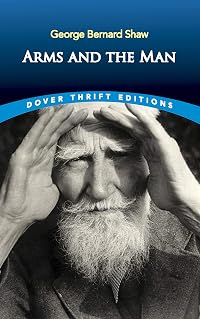
Arms and the Man
by George Bernard Shaw
On This Page
Description
Arms and the Man was George Bernard Shaw's first commercially successful play. It is a comedy about idealized love versus true love. A young Serbian woman idealizes her war-hero fiance and thinks the Swiss soldier who begs her to hide him a terrible coward. After the war she reverses her opinions, though the tangle of relationships must be resolved before her ex-soldier can conclude the last of everyone's problems with Swiss exactitude.The play premiered to an enthusiastic reception. Only show more one man booed Shaw at the end, to which Shaw replied: "My dear fellow, I quite agree with you, but what are we two against so many?"
. show less
Tags
Recommendations

















Member Reviews
War: Not All It’s Cracked Up to Be
George Bernard Shaw was a playwright (and critic, let’s not forget) possessing penetrating insight and the ability to express himself with the driest wit imaginable. His comedies often are riotous flurries of sharp dialogue, almost too much and too fast to fully comprehend at first hearing. Which makes the printed play an asset either before or after seeing a play like Arms and the Man. If you have the druthers, see it first, if you can, and follow up by reading it.
In Arms and the Man, Shaw satirizes war; that is the glory we attribute to it and the men who engage in the fighting. Though more than a hundred years old, it’s really a play for our times, when it feels as if we Americans are show more fetishizing the military (i.e., the flag protests about the protests, and the like).
Shaw sets the action near the end of the Serbo-Bulgarian War of 1885 (actually November 14 to November 28, a short affair indeed, which might be why he chose it). The play opens with young Bulgarian Raina Petkoff gushing over the excitement and drama of war, and in particular the reported heroic calvary charge led by her fiancé, Sergius Saranoff. Suddenly, the war comes to her doorstep in the form of the fleeing Swiss mercenary (on the Serb side) Captain Bluntschli. Much witty exchange ensues in which Bluntschli disabuses Raina of her notions of glamor and informs her that Saranoff’s charge was an act of supreme foolhardiness; that the Serbs had no ammo at hand saved him and his men. Eventually, Raina and her mother hide and then spirit Bluntschli out to safety. Her father and Saranoff return and in addition to being quite idiotic, Saranoff proves to be a strutting popinjay of a man. Soon Raina and Saranoff become disenchanted with each other. Saranoff finds the very saucy servant girl more to his liking, while Raina finds herself drawn to her “chocolate-cream soldier.” All’s well that ends well, but not before both war and the fickle nature of human romance gets thoroughly skewered.
This was Shaw’s first big success and he was present on opening night. Called onto the stage, he received the praise of the audience and, reportedly, the boos of one heckler. Shaw’s reported to have remarked to the man, "My dear fellow, I quite agree with you, but what are we two against so many?" And, apparently, Shaw wasn’t kidding, as he felt himself reduced to a writer of sparkling trifles. show less
George Bernard Shaw was a playwright (and critic, let’s not forget) possessing penetrating insight and the ability to express himself with the driest wit imaginable. His comedies often are riotous flurries of sharp dialogue, almost too much and too fast to fully comprehend at first hearing. Which makes the printed play an asset either before or after seeing a play like Arms and the Man. If you have the druthers, see it first, if you can, and follow up by reading it.
In Arms and the Man, Shaw satirizes war; that is the glory we attribute to it and the men who engage in the fighting. Though more than a hundred years old, it’s really a play for our times, when it feels as if we Americans are show more fetishizing the military (i.e., the flag protests about the protests, and the like).
Shaw sets the action near the end of the Serbo-Bulgarian War of 1885 (actually November 14 to November 28, a short affair indeed, which might be why he chose it). The play opens with young Bulgarian Raina Petkoff gushing over the excitement and drama of war, and in particular the reported heroic calvary charge led by her fiancé, Sergius Saranoff. Suddenly, the war comes to her doorstep in the form of the fleeing Swiss mercenary (on the Serb side) Captain Bluntschli. Much witty exchange ensues in which Bluntschli disabuses Raina of her notions of glamor and informs her that Saranoff’s charge was an act of supreme foolhardiness; that the Serbs had no ammo at hand saved him and his men. Eventually, Raina and her mother hide and then spirit Bluntschli out to safety. Her father and Saranoff return and in addition to being quite idiotic, Saranoff proves to be a strutting popinjay of a man. Soon Raina and Saranoff become disenchanted with each other. Saranoff finds the very saucy servant girl more to his liking, while Raina finds herself drawn to her “chocolate-cream soldier.” All’s well that ends well, but not before both war and the fickle nature of human romance gets thoroughly skewered.
This was Shaw’s first big success and he was present on opening night. Called onto the stage, he received the praise of the audience and, reportedly, the boos of one heckler. Shaw’s reported to have remarked to the man, "My dear fellow, I quite agree with you, but what are we two against so many?" And, apparently, Shaw wasn’t kidding, as he felt himself reduced to a writer of sparkling trifles. show less
I remember back to 1991 when the United States began bombing Iraq in what was then called the Persian Gulf War. (Is it now the first Iraq War?) I could not bear to watch it on television, so I sat on my living-room floor and sobbed and sobbed. I was pregnant with my second daughter, Laura, at the time, and I knew that pregnant mothers like me were suffering in a war that neither of us had any control over. I remember the jingoism and the puffed-up patriotism that allowed people to romanticize war, even in the end of the 20th century. Not long later, hundreds of misguided young men — including NFL football player Pat Tillman — joined the military in droves in a fit of patriotic fervor only to discover that war is always a tragedy and show more that young men die in old men’s wars.
If that foolish romanticization could happen in the 21st century, how much more was that true in the 19th? Years before Erich Maria Remarque’s All Quiet on the Western Front, Irish playwright George Bernard Shaw was sending up the war enthusiasts with this 1894 gem. Silly Raina Petkoff, daughter in the richest, best-connected family, romanticizes war and imagines that her fiancé, Captain Sergius Saranoff, will be a victorious hero, straight out of a Victorian melodrama. However, Raina hears a very different account of the nature of war from an escaping Swiss mercenary on the run from the Bulgarian-Russian forces. Shaw’s take on the real nature of courage will blow you away. show less
If that foolish romanticization could happen in the 21st century, how much more was that true in the 19th? Years before Erich Maria Remarque’s All Quiet on the Western Front, Irish playwright George Bernard Shaw was sending up the war enthusiasts with this 1894 gem. Silly Raina Petkoff, daughter in the richest, best-connected family, romanticizes war and imagines that her fiancé, Captain Sergius Saranoff, will be a victorious hero, straight out of a Victorian melodrama. However, Raina hears a very different account of the nature of war from an escaping Swiss mercenary on the run from the Bulgarian-Russian forces. Shaw’s take on the real nature of courage will blow you away. show less
War: Not All It’s Cracked Up to Be
George Bernard Shaw was a playwright (and critic, let’s not forget) possessing penetrating insight and the ability to express himself with the driest wit imaginable. His comedies often are riotous flurries of sharp dialogue, almost too much and too fast to fully comprehend at first hearing. Which makes the printed play an asset either before or after seeing a play like Arms and the Man. If you have the druthers, see it first, if you can, and follow up by reading it.
In Arms and the Man, Shaw satirizes war; that is the glory we attribute to it and the men who engage in the fighting. Though more than a hundred years old, it’s really a play for our times, when it feels as if we Americans are show more fetishizing the military (i.e., the flag protests about the protests, and the like).
Shaw sets the action near the end of the Serbo-Bulgarian War of 1885 (actually November 14 to November 28, a short affair indeed, which might be why he chose it). The play opens with young Bulgarian Raina Petkoff gushing over the excitement and drama of war, and in particular the reported heroic calvary charge led by her fiancé, Sergius Saranoff. Suddenly, the war comes to her doorstep in the form of the fleeing Swiss mercenary (on the Serb side) Captain Bluntschli. Much witty exchange ensues in which Bluntschli disabuses Raina of her notions of glamor and informs her that Saranoff’s charge was an act of supreme foolhardiness; that the Serbs had no ammo at hand saved him and his men. Eventually, Raina and her mother hide and then spirit Bluntschli out to safety. Her father and Saranoff return and in addition to being quite idiotic, Saranoff proves to be a strutting popinjay of a man. Soon Raina and Saranoff become disenchanted with each other. Saranoff finds the very saucy servant girl more to his liking, while Raina finds herself drawn to her “chocolate-cream soldier.” All’s well that ends well, but not before both war and the fickle nature of human romance gets thoroughly skewered.
This was Shaw’s first big success and he was present on opening night. Called onto the stage, he received the praise of the audience and, reportedly, the boos of one heckler. Shaw’s reported to have remarked to the man, "My dear fellow, I quite agree with you, but what are we two against so many?" And, apparently, Shaw wasn’t kidding, as he felt himself reduced to a writer of sparkling trifles. show less
George Bernard Shaw was a playwright (and critic, let’s not forget) possessing penetrating insight and the ability to express himself with the driest wit imaginable. His comedies often are riotous flurries of sharp dialogue, almost too much and too fast to fully comprehend at first hearing. Which makes the printed play an asset either before or after seeing a play like Arms and the Man. If you have the druthers, see it first, if you can, and follow up by reading it.
In Arms and the Man, Shaw satirizes war; that is the glory we attribute to it and the men who engage in the fighting. Though more than a hundred years old, it’s really a play for our times, when it feels as if we Americans are show more fetishizing the military (i.e., the flag protests about the protests, and the like).
Shaw sets the action near the end of the Serbo-Bulgarian War of 1885 (actually November 14 to November 28, a short affair indeed, which might be why he chose it). The play opens with young Bulgarian Raina Petkoff gushing over the excitement and drama of war, and in particular the reported heroic calvary charge led by her fiancé, Sergius Saranoff. Suddenly, the war comes to her doorstep in the form of the fleeing Swiss mercenary (on the Serb side) Captain Bluntschli. Much witty exchange ensues in which Bluntschli disabuses Raina of her notions of glamor and informs her that Saranoff’s charge was an act of supreme foolhardiness; that the Serbs had no ammo at hand saved him and his men. Eventually, Raina and her mother hide and then spirit Bluntschli out to safety. Her father and Saranoff return and in addition to being quite idiotic, Saranoff proves to be a strutting popinjay of a man. Soon Raina and Saranoff become disenchanted with each other. Saranoff finds the very saucy servant girl more to his liking, while Raina finds herself drawn to her “chocolate-cream soldier.” All’s well that ends well, but not before both war and the fickle nature of human romance gets thoroughly skewered.
This was Shaw’s first big success and he was present on opening night. Called onto the stage, he received the praise of the audience and, reportedly, the boos of one heckler. Shaw’s reported to have remarked to the man, "My dear fellow, I quite agree with you, but what are we two against so many?" And, apparently, Shaw wasn’t kidding, as he felt himself reduced to a writer of sparkling trifles. show less
An intriguing play that satirizes the glorification of the military hero. Especially by those members of society who haven't got the first idea of what war is like. This idealistic attitude towards war was prevalent in all of Europe during Shaw's writing of the play and ultimately led to WWI. Setting it in a far-off location (and the Bulgarian setting isn't particularly historically significant for the play; it could be any other country at war) was the author's way of masking direct criticism of the English Empire's militarism. It reminded me of "The Four Feathers" by A.E.W.Mason, a novel written in 1902, which shows how patriotic idealism can erroneously cause people to equate personal courage with military prowess. In the play, the show more heroic Saranoff is contrasted with the practical but courageous Captain Bluntschli, a Swiss mercenary. Couldn't help thinking of Kipling's iconic poem "If":
If you can keep your head when all about you
Are losing theirs and blaming it on you,
If you can trust yourself when all men doubt you,
But make allowance for their doubting too.
An interesting play, but the plot is very linear and most of the story plays with the same idea without really reaching a conclusion. show less
If you can keep your head when all about you
Are losing theirs and blaming it on you,
If you can trust yourself when all men doubt you,
But make allowance for their doubting too.
An interesting play, but the plot is very linear and most of the story plays with the same idea without really reaching a conclusion. show less
This is the only play I have read or seen by Shaw, but I must admit to enjoying it immensely. It is one of two plays I am tutoring undergraduates on this year, the other being Oliver Goldsmith's She Stoops to Conquer, both of which are very funny, but I think Shaw takes the cake for thoughtful social commentary. Whereas Goldsmith still buys into the dominant social discourse of his times, Shaw lacerates the war-mongering ethos of his 1890's audience while retaining great dramatic and humorous momentum.
The play is set during the Serbo-Bulgarian war of the 1880's, but this does not matter much to the plot. Shaw wrote the play without reference to any specific conflict; in fact, he did not even give his characters names, but filled in the show more blanks in the text after consulting one of his friends on recent historical conflicts. Raina Petkoff, daughter of a Bulgarian major, is betrothed to Sergius Saranoff, a rising star in the Bulgarian army and Shaw's representation of the overly-Byronic hero. When Sergius initiates a suicidal cavalry charge on the Serbian forces, he and his forces miraculously survive, as the Serbs ordered the wrong ammunition for their machine guns. The Serbs retreat through the Petkoff's home town, and one of their hired mercernaries, the Swiss officer Bluntschli, escapes by climbing the balcony to Raina's room. She manages to hide him from the advancing Bulgarian forces for reasons that are not initially clear, though an amatory grounds are hinted at. Bluntschli, who carries chocolates instead of ammunition, returns to the Petkoff's house after a peace treaty to thank Raina and to return her father's favourite coat. But Sergius and Major Petkoff also arrive, leading to intrigue and confusion...
Shaw, a practicing Socialist, is often accused of writing polemics and dressing them up in plays, but that does not seem true of this play, at least. The juxtaposition of Sergius, who believes in military glory, with Bluntschli, who views war pragmatically, is interesting and well handled. I also enjoyed the way Shaw deflates romantic views of love by, for instance, exposing the hypocrisy at the heart of Sergius and Raina's relationship, which, though supposed to be predicated on the ideal of the 'higher love', actually rests on empty emotions and deceit. Shaw also has things to say about class relationships, which aligns him with Goldsmith, but as mentioned above, Shaw seems much more perceptive concerning these issues.
The play is very funny, and has aged well. I look forward to reading more Shavian plays - God knows the man wrote enough of the things (more than 50!). show less
The play is set during the Serbo-Bulgarian war of the 1880's, but this does not matter much to the plot. Shaw wrote the play without reference to any specific conflict; in fact, he did not even give his characters names, but filled in the show more blanks in the text after consulting one of his friends on recent historical conflicts. Raina Petkoff, daughter of a Bulgarian major, is betrothed to Sergius Saranoff, a rising star in the Bulgarian army and Shaw's representation of the overly-Byronic hero. When Sergius initiates a suicidal cavalry charge on the Serbian forces, he and his forces miraculously survive, as the Serbs ordered the wrong ammunition for their machine guns. The Serbs retreat through the Petkoff's home town, and one of their hired mercernaries, the Swiss officer Bluntschli, escapes by climbing the balcony to Raina's room. She manages to hide him from the advancing Bulgarian forces for reasons that are not initially clear, though an amatory grounds are hinted at. Bluntschli, who carries chocolates instead of ammunition, returns to the Petkoff's house after a peace treaty to thank Raina and to return her father's favourite coat. But Sergius and Major Petkoff also arrive, leading to intrigue and confusion...
Shaw, a practicing Socialist, is often accused of writing polemics and dressing them up in plays, but that does not seem true of this play, at least. The juxtaposition of Sergius, who believes in military glory, with Bluntschli, who views war pragmatically, is interesting and well handled. I also enjoyed the way Shaw deflates romantic views of love by, for instance, exposing the hypocrisy at the heart of Sergius and Raina's relationship, which, though supposed to be predicated on the ideal of the 'higher love', actually rests on empty emotions and deceit. Shaw also has things to say about class relationships, which aligns him with Goldsmith, but as mentioned above, Shaw seems much more perceptive concerning these issues.
The play is very funny, and has aged well. I look forward to reading more Shavian plays - God knows the man wrote enough of the things (more than 50!). show less
A permissably distant War (the Third Balkan, I think) is the setting for this essay by Shaw. He takes generous swipes at 1) Military Glory, 2) differing valuations of wealth, according to circumstances, and 3) odd foreign habits, viewed from the British Isles of 1898. it is good fun
3.5*
Read in my Kindle omnibus edition of Shaw's plays.
As with many of Shaw's plays, I found the commentary and stage directions an important part of the experience - often as amusing (if not more so) than the dialogue.
This play had an interesting theme - the difference between ideals & appearance and reality. In particular, the contrast between a handsome young military man with no actual strategic or battle experience with a mercenary soldier fighting for the opposing side. The Swiss mercenary is viewed as uncouth not only for his service to the enemy but because he tells the truth rather than the romantic fiction of warfare.
The play wasn't as fun as some of Shaw's other plays but still worth reading; I would like to see a performance show more sometime. show less
Read in my Kindle omnibus edition of Shaw's plays.
As with many of Shaw's plays, I found the commentary and stage directions an important part of the experience - often as amusing (if not more so) than the dialogue.
This play had an interesting theme - the difference between ideals & appearance and reality. In particular, the contrast between a handsome young military man with no actual strategic or battle experience with a mercenary soldier fighting for the opposing side. The Swiss mercenary is viewed as uncouth not only for his service to the enemy but because he tells the truth rather than the romantic fiction of warfare.
The play wasn't as fun as some of Shaw's other plays but still worth reading; I would like to see a performance show more sometime. show less
Members
- Recently Added By
Lists

Books You Read During High School (For School)
301 works; 52 members

1890s
49 works; 6 members

Books With Body Parts in the Title
153 works; 9 members

Nobel Price Winners
222 works; 20 members

Stage Plays/Screenplays/Dialogues/Anything Dialogue-Storytelling Related
81 works; 2 members
r/acting on Reddit - Essential Plays
44 works; 2 members
1:28 p.m.'s 350 Stage Plays Challenge
94 works; 3 members

New Lifetime Reading Plan by Fadiman and Major
225 works; 5 members

Books You Read For University
184 works; 3 members
My Play Collection
769 works; 3 members

Next Plays / 2025
352 works; 1 member

el
1,139 works; 1 member
Author Information

Renowned literary genius George Bernard Shaw was born on July 26, 1856 in Dublin, Ireland. He later moved to London and educated himself at the British Museum while several of his novels were published in small socialist magazines. Shaw later became a music critic for the Star and for the World. He was a drama critic for the Saturday Review and show more later began to have some of his early plays produced. Shaw wrote the plays Man and Superman, Major Barbara, and Pygmalion, which was later adapted as My Fair Lady in both the musical and film form. He also transformed his works into screenplays for Saint Joan, How He Lied to Her Husband, Arms and the Man, Pygmalion, and Major Barbara. Shaw won the Nobel Prize for Literature in 1925. George Bernard Shaw died on November 2, 1950 at Ayot St. Lawrence, Hertfordshire, England. (Bowker Author Biography) show less
Some Editions
Series
Belongs to Publisher Series
Work Relationships
Is contained in
Has the adaptation
Is abridged in
Common Knowledge
- Canonical title*
- Helden
- Original title
- Arms and the Man
- Original publication date
- 1894 (performed) (performed); 1898 (printed) (printed)
- Related movies
- Helden (1958 | IMDb); Arms and the Man (1932 | IMDb)
- First words
- Raina! Raina! Why, where -- Heavens, child! are you out in the night air instead of in your bed?
- Last words
- (Click to show. Warning: May contain spoilers.)What a man! What a man!
*Some information comes from Common Knowledge in other languages. Click "Edit" for more information.
Classifications
Statistics
- Members
- 1,247
- Popularity
- 19,842
- Reviews
- 22
- Rating
- (3.83)
- Languages
- 6 — Catalan, Czech, English, French, German, Portuguese
- Media
- Paper, Audiobook, Ebook
- ISBNs
- 104
- UPCs
- 3
- ASINs
- 47