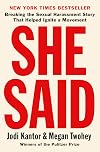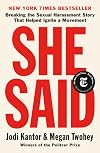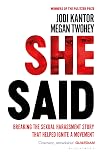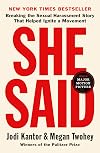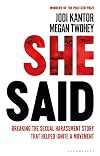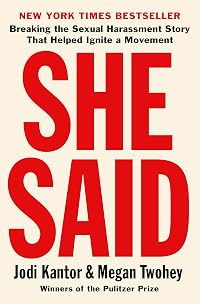
She Said: Breaking the Sexual Harassment Story That Helped Ignite a Movement
by Jodi Kantor, Megan Twohey
On This Page
Description
For many years, reporters had tried to get to the truth about Harvey Weinstein's treatment of women. Rumors of wrongdoing had long circulated. But in 2017, when Jodi Kantor and Megan Twohey began their investigation into the prominent Hollywood producer for the New York Times, his name was still synonymous with power. During months of confidential interviews with top actresses, former Weinstein employees, and other sources, many disturbing and long-buried allegations were unearthed, and a show more web of onerous secret payouts and nondisclosure agreements was revealed. These shadowy settlements had long been used to hide sexual harassment and abuse, but with a breakthrough reporting technique Kantor and Twohey helped to expose it. But Weinstein had evaded scrutiny in the past, and he was not going down without a fight. He employed a team of high-profile lawyers, private investigators, and other allies to thwart the investigation. When Kantor and Twohey were finally able to convince some sources to go on the record, a dramatic final showdown between Weinstein and the New York Times was set in motion. Nothing could have prepared Kantor and Twohey for what followed the publication of their initial Weinstein story on October 5, 2017. Within days, a veritable Pandora's box of sexual harassment and abuse was opened. Women all over the world came forward with their own traumatic stories. Over the next twelve months, hundreds of men from every walk of life and industry were outed following allegations of wrongdoing. But did too much change -- or not enough? Those questions hung in the air months later as Brett Kavanaugh was nominated to the Supreme Court, and Christine Blasey Ford came forward to testify that he had assaulted her decades earlier. Kantor and Twohey, who had unique access to Ford and her team, bring to light the odyssey that led her to come forward, the overwhelming forces that came to bear on her, and what happened after she shared her allegation with the world. show lessTags
Recommendations



















Member Reviews
Was it smart to wait so long to read this incredible investigative journalism classic? Maybe. What completely different feelings are evoked by the writers' recounting of the Weinstein crimes vs the Kavanaugh hearings - one big win, one big loss (with worse repercussions). The story of how the NYT writers persistently pursued former Weinstein employees and famous actresses, all petrified to go up against the powerful producer, and more than a few bound by settlements that forbade them from speaking up, is as classic an investigation as Watergate. Now, on to Ronan Farrow.
Fascinating. From the investigative work uncovering the vast history of Harvey Weinstein's sexual assaults on women to the powder keg of the ME TOO movement ignited by that work--fascinating. I'm almost sixty (I write the word because I find the number daunting) and fortunately have been quite liberal from a young age. Even so, gender stereotypes that served a male dominant power structure were deeply ingrained in me. Sure more women should be doctors but having a just a few around seemed satisfactory. Someday there will be more. Sure women should be directing major motion pictures--there are a couple. One day there will be more. Etc. And by extension, sexual abuse and harassment are bad but it doesn't happen that often and it will soon show more go away (and it's only done by strangers). Our culture has long been calcified by these conceits. I knew better. The smartest and most dedicated people I knew were mostly women. I was blessed to be considered a good listener and was stunned to find out how many women I knew had suffered abuse. Once I was married a whole new pipeline of second hand stories entered my life. The extent of such things is heartbreaking. Even knowing all this, I can still feel the box of stereotypes around me. Maybe I had just given up hope that serious change was possible in my lifetime. But the world feels different now. Sure it appears chaotic but that's what happens when you find that crack and push your way up through the ice. There have been advances before but the battles today for racial, gender, and Lgbtqi+ rights feel like they will not stop. I just have to see the fear on the faces of their oppressors to feel this way (fear is most often expressed as hate). So this book fascinates as a You Are There at the dawn of great possibilities. show less
I will not presume to be in any way capable of reviewing this brilliant book because it’s an extremely well written true account of the investigation and brings to light some systemic truths that we probably are well aware of, but haven’t seen discussed openly a lot. Instead, I think I’ll just share how I felt while reading it.
I’ve only lived in the US for less than a decade now and while I have a seen a Hollywood movie or two since childhood, I’ve never been much knowledgeable about the industry or its major players. So, when the Harvey Weinstein scandal broke out, all the names associated with it didn’t mean anything to me. The significance for me was mostly about the movement it created and the outpouring of stories we show more got to hear after that. It reinforced the fact that sexual harassment is rampant in the world, regardless of the industry or field you are in and what age you are. It’s all about power, and those who have it will exercise it in whatever way they can without fear of consequences because they know that the whole system is behind them. And while this book goes into a lot of detail about the investigation and the many women Kantor and Twohey spoke to, it also shows us the blatant disregard shown by so many other people towards these women and how all the sexual predation was just treated as matter of fact.
My singular emotion while reading this book was anger. And helplessness. Maybe some hope too, but I won’t say it was a lot. The way that Weinstein used his power, bullying tactics and promises of helping their career to harass and assault and overpower so many young women is appalling to read about. I would never judge the women for not coming out and sharing their stories because it’s always them who had a lot to lose and they have their right to self-preservation. It’s the other people I find fault with - those around Weinstein who helped him cover up all the incidents by forcing the women with watertight settlements and NDAs, who thought his behavior was okay as long as it wasn’t a liability to the company, who decided that it must be the women coming onto him for a chance to go ahead in their careers, the high profile lawyers like David Boies, Gloria Allred and Lisa Bloom who feel completely justified in the way they defended Weinstein and shamed and blamed the women and the journalists covering the story. These are people even I have admired, watched documentaries about their work on marriage equality and women’s rights, and now to realize that powerful people always seem to support those in power - I just can’t describe the horror I’m feeling. If you’ve followed any of the twitter trends on the day of this book’s release, you must have seen the very enlightening (and loathsome) memo that Lisa Bloom wrote to Weinstein about how they can frame a narrative to victim blame and showcase him as an old man trying to understand the ever changing social mores. It really was an eye opener and I don’t think I will ever implicitly trust any “popular” activist again, especially lawyers.
The last section of the book also goes into some detail about the Kavanaugh hearings and Dr. Ford’s testimony, particularly how she felt in the weeks leading up to the day and how her life has irrevocably changed since then. It just makes me furious that nothing fundamental has really has changed since the years after Anita Hill and women have to still weigh their safety and career prospects vs the possibility of telling their story and maybe getting some vindication and justice. And I’m currently feeling even more hopeless because between the few hours when I finished this book and I’m writing this review, the New York Times published excerpts from another book with corroborating evidence for other allegations against Kavanaugh. And it’s really exhausting to see that while Dr. Ford has to deal with death threats, this man will be on the Supreme Court for most of our lifetime.
To conclude, I just wanna say thank you to all the women who came forward to tell their story, putting their livelihoods and privacy on the line, Jodi Kantor and Megan Twohey for their incessant desire to bring this story to light in its entirety while facing off the whole bully machine of Weinstein, and everyone else at NYT who made this possible. I highly recommend this book to everyone who wants to know more about this brilliant piece of investigative journalism and support women in their fight for equality and right to work without being harassed. show less
I’ve only lived in the US for less than a decade now and while I have a seen a Hollywood movie or two since childhood, I’ve never been much knowledgeable about the industry or its major players. So, when the Harvey Weinstein scandal broke out, all the names associated with it didn’t mean anything to me. The significance for me was mostly about the movement it created and the outpouring of stories we show more got to hear after that. It reinforced the fact that sexual harassment is rampant in the world, regardless of the industry or field you are in and what age you are. It’s all about power, and those who have it will exercise it in whatever way they can without fear of consequences because they know that the whole system is behind them. And while this book goes into a lot of detail about the investigation and the many women Kantor and Twohey spoke to, it also shows us the blatant disregard shown by so many other people towards these women and how all the sexual predation was just treated as matter of fact.
My singular emotion while reading this book was anger. And helplessness. Maybe some hope too, but I won’t say it was a lot. The way that Weinstein used his power, bullying tactics and promises of helping their career to harass and assault and overpower so many young women is appalling to read about. I would never judge the women for not coming out and sharing their stories because it’s always them who had a lot to lose and they have their right to self-preservation. It’s the other people I find fault with - those around Weinstein who helped him cover up all the incidents by forcing the women with watertight settlements and NDAs, who thought his behavior was okay as long as it wasn’t a liability to the company, who decided that it must be the women coming onto him for a chance to go ahead in their careers, the high profile lawyers like David Boies, Gloria Allred and Lisa Bloom who feel completely justified in the way they defended Weinstein and shamed and blamed the women and the journalists covering the story. These are people even I have admired, watched documentaries about their work on marriage equality and women’s rights, and now to realize that powerful people always seem to support those in power - I just can’t describe the horror I’m feeling. If you’ve followed any of the twitter trends on the day of this book’s release, you must have seen the very enlightening (and loathsome) memo that Lisa Bloom wrote to Weinstein about how they can frame a narrative to victim blame and showcase him as an old man trying to understand the ever changing social mores. It really was an eye opener and I don’t think I will ever implicitly trust any “popular” activist again, especially lawyers.
The last section of the book also goes into some detail about the Kavanaugh hearings and Dr. Ford’s testimony, particularly how she felt in the weeks leading up to the day and how her life has irrevocably changed since then. It just makes me furious that nothing fundamental has really has changed since the years after Anita Hill and women have to still weigh their safety and career prospects vs the possibility of telling their story and maybe getting some vindication and justice. And I’m currently feeling even more hopeless because between the few hours when I finished this book and I’m writing this review, the New York Times published excerpts from another book with corroborating evidence for other allegations against Kavanaugh. And it’s really exhausting to see that while Dr. Ford has to deal with death threats, this man will be on the Supreme Court for most of our lifetime.
To conclude, I just wanna say thank you to all the women who came forward to tell their story, putting their livelihoods and privacy on the line, Jodi Kantor and Megan Twohey for their incessant desire to bring this story to light in its entirety while facing off the whole bully machine of Weinstein, and everyone else at NYT who made this possible. I highly recommend this book to everyone who wants to know more about this brilliant piece of investigative journalism and support women in their fight for equality and right to work without being harassed. show less
Oh. My gosh. What a terrific (and difficult) book. It is equivalent to [All the President's Men] in its scope, its research, and its honesty. The details of what both authors did in order to elicit the trust with the women who appeared in their story is much of the book. It is painful and honest and unnerving that so many women were harmed, all in the same way, and yet none felt safe enough to speak out for years.
Kantor and Twohey also delve into the legal phenomenon of Non-Disclosure Agreements as a mainstay in keeping these deeds unpunished and unspoken. The women who were interviewed had been pressured to sign them so that yes, they got money for what they went through, but they were never, ever, able to tell anyone, not even a show more mother or a husband or a therapist. I would like to see some reckoning for the lawyers who pushed these NDAs, as they further harmed the women who had already been sexually abused.
Like "President's Men," the authors are terrific writers who know how to craft a longer story that makes this the only book to read (well, almost) until the end. And raising a toast to the women who spoke then and who are speaking now. You are making a difference in the world. show less
Kantor and Twohey also delve into the legal phenomenon of Non-Disclosure Agreements as a mainstay in keeping these deeds unpunished and unspoken. The women who were interviewed had been pressured to sign them so that yes, they got money for what they went through, but they were never, ever, able to tell anyone, not even a show more mother or a husband or a therapist. I would like to see some reckoning for the lawyers who pushed these NDAs, as they further harmed the women who had already been sexually abused.
Like "President's Men," the authors are terrific writers who know how to craft a longer story that makes this the only book to read (well, almost) until the end. And raising a toast to the women who spoke then and who are speaking now. You are making a difference in the world. show less
An engrossing, disturbing, and timely read, She Said recounts the experiences of two New York Times reporters—Jodi Kantor and Megan Twohey—who published a major exposé of film producer Harvey Weinstein's long history of sexual harassment and abuse. I found the details of how journalists piece together a major story like this fascinating, and appreciated the attention Kantor and Twohey gave to the experiences of women and to the systems that conspire to gag them. The second part of the book, focusing on Christine Blasey Ford and the Kavanaugh hearings, is less engaging because Kantor and Twohey were not as involved. There's an inevitable distance there, and I don't think the authors were as blunt as they could have been in show more underscoring why the two stories played out differently. Harvey Weinstein was finally toppled because his ability to serve up money-generating, Oscar-winning movies was fading; Brett Kavanaugh sits on the Supreme Court of the United States because he has powerful connections and the ability to adjudicate in their favour. show less
There are few new revelations in this book if the reader has followed the national reporting on Harvey Weinstein. On the other hand, the book provides a gripping account of how two persistent reporters, the authors Jodi Kantor and Megan Twohey, gradually unraveled the story of Weinstein's misdeeds. Even more important is the recounting of the reporters' attempts to break the silence of the victims, to get them on the record so that the article could be published.
Rather than threats or emotional blackmail, the reporters used empathy to lure the victims out of the darkness and silence so many non-disclosure agreements had created. The authors also show how a cottage industry of lawyers profited from the victims' misery. Lisa Bloom in show more particular comes in for a drubbing as the reporters document her attempts, however slimy, to get Harvey Weinstein off the hook. The memo she sent to Weinstein is quoted as length and is devastating to Bloom's credentials as an advocate for women. show less
Rather than threats or emotional blackmail, the reporters used empathy to lure the victims out of the darkness and silence so many non-disclosure agreements had created. The authors also show how a cottage industry of lawyers profited from the victims' misery. Lisa Bloom in show more particular comes in for a drubbing as the reporters document her attempts, however slimy, to get Harvey Weinstein off the hook. The memo she sent to Weinstein is quoted as length and is devastating to Bloom's credentials as an advocate for women. show less
I’ve been trying to think about what to write in this review for hours now and I just don’t know… The absolute anguish I felt reading this is so large I can’t quite put it into words.
Kantor and Twohey are phenomenal journalists, and you can feel the meticulousness of their reporting in every measured word. I really recommend reading this one in tandem with Farrow’s Catch and Kill – they excellently supplement one another, with one crucial difference: Farrow in his book takes a look at NBC and Matt Lauer personally, and Kantor and Twohey cover in detail the Kavanaugh accusation by Dr. Ford. She Said is also poses a lot of very hard-hitting questions about far-reaching consequences, both good and bad, for women who decide to show more speak out about sexual harassment.
It makes you feel a bit bleak about the state of things, and about how slowly we change as a species, and, you know, about all the sexism, but it does have its heartwarming parts. The last chapter is especially strong. All in all, incredible work. show less
Kantor and Twohey are phenomenal journalists, and you can feel the meticulousness of their reporting in every measured word. I really recommend reading this one in tandem with Farrow’s Catch and Kill – they excellently supplement one another, with one crucial difference: Farrow in his book takes a look at NBC and Matt Lauer personally, and Kantor and Twohey cover in detail the Kavanaugh accusation by Dr. Ford. She Said is also poses a lot of very hard-hitting questions about far-reaching consequences, both good and bad, for women who decide to show more speak out about sexual harassment.
It makes you feel a bit bleak about the state of things, and about how slowly we change as a species, and, you know, about all the sexism, but it does have its heartwarming parts. The last chapter is especially strong. All in all, incredible work. show less
Members
- Recently Added By
Lists

thought provoking
15 works; 1 member

feminism & gender studies
17 works; 1 member
Author Information
6+ Works 1,281 Members
Jodi Kantor, a New York Times correspondent, is the author of The Obama's. She has been covering the Obama's since 2007. Jodi began her journalism career at Slate.com in 1998. She later she became the Arts & Leisure editor of the New York Times. Kantor is a recipient of a Columbia Young Alumni Achievement Award. (Bowker Author Biography)

3 Works 880 Members
Some Editions
Awards and Honors
Awards
Distinctions
The Guardian Book of the Day (2019-09-18)
Work Relationships
Common Knowledge
- People/Characters
- Harvey Weinstein
- Related movies
- Untouchable (2019 | IMDb)
- Canonical DDC/MDS
- 364.153092
- Canonical LCC
- HD6060.K36
Classifications
- Genres
- Sexuality and Gender Studies, General Nonfiction, Nonfiction, Biography & Memoir
- DDC/MDS
- 364.153092 — Society, government, & culture Social problems and social services Crime Criminal offenses Offenses against the person Sex offenses Standard subdivisions History, geographic treatment, biography Biography
- LCC
- HD6060 .K36 — Social sciences Industries. Land use. Labor Industries. Land use. Labor Labor. Work. Working class Classes of labor
- BISAC
Statistics
- Members
- 838
- Popularity
- 32,833
- Reviews
- 30
- Rating
- (4.26)
- Languages
- 6 — Chinese, Dutch, English, French, Spanish, Swedish
- Media
- Paper, Audiobook, Ebook
- ISBNs
- 25
- ASINs
- 7