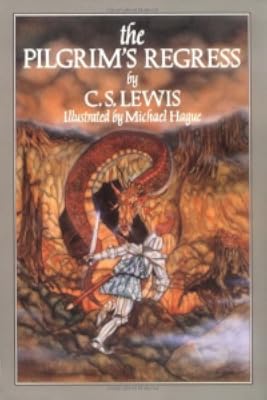
The Pilgrim's Regress: An Allegorical Apology for Christianity Reason and Romanticism
by C. S. Lewis
On This Page
Description
The first book written by C. S. Lewis after his conversion, The Pilgrim's Regress is, in a sense, a record of Lewis' own search for meaning and spiritual satisfaction that eventually led him to Christianity. It is the story of John and his odyssey to an enchanting island that has created in him an intense longing, a mysterious, sweet desire. John's pursuit of this desire takes him through adventures with such people as Mr. Enlightenment, Media Halfways, Mr. Mammon, Mother Kirk, Mr. Sensible, show more and Mr. Humanist and through such cities as Thrill and Eschropolis, as well as the Valley of Humiliation. Though the dragons and giants here are different from those in Bunyan's The Pilgrim's Progress, Lewis' allegory performs the same function of enabling the author to say in fable form what would otherwise have demanded a full-length philosophy of religion. show lessTags
Recommendations










Member Reviews
The Pilgrim's Regress, first published in 1933, was C. S. Lewis's first book after becoming a Christian. It is a fiercely personal allegory of one man's search for the beauty he glimpses faintly from a far distance. The longing for this beauty is a dreadful, consuming thing, and yet no one who has experienced it would give it up.
As a boy, John lives among a people who fear the Landlord and his list of rules, enforced by the Stewards. One day the lease is up for John's uncle George and he has to go meet the Landlord face to face. They never see him again, and John never forgets the terror of that moment when his uncle's mask slips. John, brought up in these narrow ways, longs for the beauty he sees far in the distance: an Island with a show more many-turreted castle. He disobeys the rules and goes into the forbidden forest, and eventually sets out on his own to travel the wide world. He starts out with nothing but his desire, and though he meets with many strange folk and learns of many ideas and theologies, never is that piercing hunger satisfied.
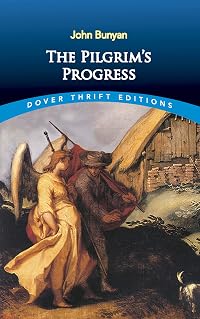
Like its great model, The Pilgrim's Progress, this book features a cast of characters named for their defining trait: Virtue, Wisdom, Mr Sensible, Enlightenment, Halfways, Reason, Contemplation, Humanist, Broad, etc. While John Bunyan's tale focuses mainly on Christian's journey through life as a believer, Lewis's story goes a little further back and tells of the journey to even reach the point of conversion.
It is fascinating to trace the ideas here that develop in Lewis's later books. The idea of masks that everyone wears in John's home country, for example, reminds me so much of the veil Orual wears in Till We Have Faces. Or the dragon John must fight at the end, the clothes he must tear off to make the dive into the pool—I couldn't help but think of Eustace in The Voyage of the Dawn Treader. And there are so many other later themes and ideas that are hinted at here.
Why is this such a personal story? The last Lewis title I read was Surprised By Joy, where he describes his journey to conversion and the sweet and terrible desire for Joy that led him on and finally broke down his resistance. When he fights against Reason, her sword against his neck, his thought of pushing her off the precipice but knowing he would fall with her—it reads so strongly in light of Lewis's own experiences. The book is replete with quotations and allusions from classical literature and Scripture; it is as if all of it came alive and fit itself together for him once he surrendered to the Landlord.
All the same, I cannot help but note the focus on John's heroics and efforts, with the Landlord cast as a background figure—behind everything, sure, but secondary to the experiences of John. It is not an inaccurate picture of our experience, perhaps, but it certainly is not the whole story. Though a slim little volume, this packs a punch. In the foreword Lewis admits that in some places he lost his temper. It is fairly clear that he has specific individuals in mind in certain caricatures.
I did not read this quickly; it wanted thinking about, and I'm sure I didn't grasp the half of what he is saying. But his prose is always a pleasure to read, even when it's drawing from deep philosophical wells I'm not sure I fathom. What a pen the man had.
Has not every object which fancy and sense suggested for the desire, proved a failure, confessed itself, after trial, not to be what you wanted? Have you not found by elimination that this desire is the perilous siege in which only One can sit? show less
As a boy, John lives among a people who fear the Landlord and his list of rules, enforced by the Stewards. One day the lease is up for John's uncle George and he has to go meet the Landlord face to face. They never see him again, and John never forgets the terror of that moment when his uncle's mask slips. John, brought up in these narrow ways, longs for the beauty he sees far in the distance: an Island with a show more many-turreted castle. He disobeys the rules and goes into the forbidden forest, and eventually sets out on his own to travel the wide world. He starts out with nothing but his desire, and though he meets with many strange folk and learns of many ideas and theologies, never is that piercing hunger satisfied.
Like its great model, The Pilgrim's Progress, this book features a cast of characters named for their defining trait: Virtue, Wisdom, Mr Sensible, Enlightenment, Halfways, Reason, Contemplation, Humanist, Broad, etc. While John Bunyan's tale focuses mainly on Christian's journey through life as a believer, Lewis's story goes a little further back and tells of the journey to even reach the point of conversion.
It is fascinating to trace the ideas here that develop in Lewis's later books. The idea of masks that everyone wears in John's home country, for example, reminds me so much of the veil Orual wears in Till We Have Faces. Or the dragon John must fight at the end, the clothes he must tear off to make the dive into the pool—I couldn't help but think of Eustace in The Voyage of the Dawn Treader. And there are so many other later themes and ideas that are hinted at here.
Why is this such a personal story? The last Lewis title I read was Surprised By Joy, where he describes his journey to conversion and the sweet and terrible desire for Joy that led him on and finally broke down his resistance. When he fights against Reason, her sword against his neck, his thought of pushing her off the precipice but knowing he would fall with her—it reads so strongly in light of Lewis's own experiences. The book is replete with quotations and allusions from classical literature and Scripture; it is as if all of it came alive and fit itself together for him once he surrendered to the Landlord.
All the same, I cannot help but note the focus on John's heroics and efforts, with the Landlord cast as a background figure—behind everything, sure, but secondary to the experiences of John. It is not an inaccurate picture of our experience, perhaps, but it certainly is not the whole story. Though a slim little volume, this packs a punch. In the foreword Lewis admits that in some places he lost his temper. It is fairly clear that he has specific individuals in mind in certain caricatures.
I did not read this quickly; it wanted thinking about, and I'm sure I didn't grasp the half of what he is saying. But his prose is always a pleasure to read, even when it's drawing from deep philosophical wells I'm not sure I fathom. What a pen the man had.
Has not every object which fancy and sense suggested for the desire, proved a failure, confessed itself, after trial, not to be what you wanted? Have you not found by elimination that this desire is the perilous siege in which only One can sit? show less
Great allegory, journeying east towards conversion drawn by the transcendent desire God has placed in our hearts, straying at times in the northland of cold intellectualism and in the southland of hedonism and overly romantic philosophies. John travels with Vertue, himself representing the passion and desire of man, Vertue representing the conscience and oughtness within man, and it is said that the two cannot complete the journey apart from one another, though they are driven apart at one juncture. Following conversion at the futherest Eastern point, John and Vertue learn that the way home (to the end fulfillment of John's inner longing) is to travel back the entire length of the journey to the furtherest Western point, though as they show more retrace their path, it appears drastically different as they see it as it actually is. So many great images are seen along the way, though the reading does get a bit thick once or twice, particularly as Wisdom and History explain their philosophies. show less
This originally appeared at The Irresponsible Reader.
---
A BIT OF PERSONAL HISTORY (feel free to skip)
Back in '91 or '92, I saw a copy of The Pilgrim's Regress on a bookstore shelf. I was in a "read everything by Lewis you can get your hands on phase," so I instantly picked it up. But the back of the book talked about it as the modern equivalent of Bunyan's The Pilgrim's Progress in a way that I figured I should read Bunyan before it.
It took me a little while to track down the Bunyan (the toilsome times before online bookshops), and by the time I worked my way through it, the bookstore didn't have that copy any more and I was distracted by other things.
I've often thought about trying this book since then—but it wasn't until I started show more thinking about this project that I finally combined ambition with general curiosity.
WHAT'S THE PILGRIM'S REGRESS ABOUT?
This modern-retelling of The Pilgrim's Progressis an allegory about a man named John on his journey from childhood exposure to religion in Puritania to an Island of pleasure. Along the way, he has to deal with several physical, spiritiual and itellectual challenges to take him away from his journey (pretty much like Bunyan's Christian).
This was the first thing that Lewis wrote after his conversion, and it's considered to be an intellectual biography of that journey.
Basically, think Bunyan for the early 20th Century and you've got it.
A COUPLE OF THINGS THAT HELPED ME
Early on, John encounters a "brown girl" who distracts him from his interest in—or at least pursuing that interest. They begin a sexual relationship, which goes awry and causes some serious problems for John (actually, that entire relationship from her introduction on is a serious problem.) I was pretty sure that Lewis wasn't making any kind of ethnic characterization or anything, but it's hard to shake the feeling. Thankfully, reading this blog post by a Lewis expert made me feel so much better (and shows I was on the right path in general with it). I'd explain it, but Dr. Hurd does it better.
The other thing that helped was the afterword that Lewis wrote for the Third Edition, ten years after the original publication. He points to some flaws, or at least things he could've done better. I agreed with most of his self-diagnosis, and at least one point, his explanation made me understand an aspect of the book (and, yes, he was right to critique himself).
So, while I'm glad for the additional things that helped me appreciate the book, I trust that with very little effort, I could find more. I shouldn't have to look to these kinds of things to appreciate a book. To gain a better understanding, sure. But to move me from "meh" to "okay, that wasn't that bad/objectional" should come from the text itself—not from others.
SO, WHAT DID I THINK ABOUT THE PILGRIM'S REGRESS?
It's been almost a century since this was first published, and I cannot decide if it's a good thing or not that so many of the characters and ideas John encounters are still relevant and identifiable (although some details may have altered a bit). The reader can see that these intellectual movements are nothing new—sadly, many of them haven't been forgotten. One of the best things about reading theological works written generations before me is wondering exactly what the author is targeting (or why they're bothering)—but the ideas that Lewis wants to confront are still in his readers' lives. Probably even more than they were for him.
The beginning of the book seemed promising with an uncaring and cold clergy, parents who were off the mark, and so on—I thought John's journey would lead us to a correction of or confrontation with these things. But no, we get the brown girl and then things go far from where I thought we were going. Naturally, I don't mind that—but I would've appreciated something more definitive. That's personal taste, though.
Like many allegories, particularly Bunyan's, there is nothing subtle about The Pilgrim's Regress. That doesn't mean it's not good, or that it's so clear always that there's no thinking involved, but, wow—it does tend to feel like it's hitting you with a brick when John encounters a new person/idea.
Am I glad that I read this? Yes. So I can see Lewis' development as a writer, to satisfy a certain curiosity in general, and to cross off a decades-old item from my "To Read List." For people who don't have at least two of those motivations to pick this up, I can't really recommend it. I'm not sure I really can for those who do have those motivations—but it satisfies those particular itches.
Is this bad? By no means. It's not good either. I did particularly enjoy certain lines, scenes, or encounters. I thought some of the ways that Lewis framed the better alternatives to be refreshing and helpful. But overall this really did nothing for me. show less
---
A BIT OF PERSONAL HISTORY (feel free to skip)
Back in '91 or '92, I saw a copy of The Pilgrim's Regress on a bookstore shelf. I was in a "read everything by Lewis you can get your hands on phase," so I instantly picked it up. But the back of the book talked about it as the modern equivalent of Bunyan's The Pilgrim's Progress in a way that I figured I should read Bunyan before it.
It took me a little while to track down the Bunyan (the toilsome times before online bookshops), and by the time I worked my way through it, the bookstore didn't have that copy any more and I was distracted by other things.
I've often thought about trying this book since then—but it wasn't until I started show more thinking about this project that I finally combined ambition with general curiosity.
WHAT'S THE PILGRIM'S REGRESS ABOUT?
This modern-retelling of The Pilgrim's Progressis an allegory about a man named John on his journey from childhood exposure to religion in Puritania to an Island of pleasure. Along the way, he has to deal with several physical, spiritiual and itellectual challenges to take him away from his journey (pretty much like Bunyan's Christian).
This was the first thing that Lewis wrote after his conversion, and it's considered to be an intellectual biography of that journey.
Basically, think Bunyan for the early 20th Century and you've got it.
A COUPLE OF THINGS THAT HELPED ME
Early on, John encounters a "brown girl" who distracts him from his interest in—or at least pursuing that interest. They begin a sexual relationship, which goes awry and causes some serious problems for John (actually, that entire relationship from her introduction on is a serious problem.) I was pretty sure that Lewis wasn't making any kind of ethnic characterization or anything, but it's hard to shake the feeling. Thankfully, reading this blog post by a Lewis expert made me feel so much better (and shows I was on the right path in general with it). I'd explain it, but Dr. Hurd does it better.
The other thing that helped was the afterword that Lewis wrote for the Third Edition, ten years after the original publication. He points to some flaws, or at least things he could've done better. I agreed with most of his self-diagnosis, and at least one point, his explanation made me understand an aspect of the book (and, yes, he was right to critique himself).
So, while I'm glad for the additional things that helped me appreciate the book, I trust that with very little effort, I could find more. I shouldn't have to look to these kinds of things to appreciate a book. To gain a better understanding, sure. But to move me from "meh" to "okay, that wasn't that bad/objectional" should come from the text itself—not from others.
SO, WHAT DID I THINK ABOUT THE PILGRIM'S REGRESS?
It's been almost a century since this was first published, and I cannot decide if it's a good thing or not that so many of the characters and ideas John encounters are still relevant and identifiable (although some details may have altered a bit). The reader can see that these intellectual movements are nothing new—sadly, many of them haven't been forgotten. One of the best things about reading theological works written generations before me is wondering exactly what the author is targeting (or why they're bothering)—but the ideas that Lewis wants to confront are still in his readers' lives. Probably even more than they were for him.
The beginning of the book seemed promising with an uncaring and cold clergy, parents who were off the mark, and so on—I thought John's journey would lead us to a correction of or confrontation with these things. But no, we get the brown girl and then things go far from where I thought we were going. Naturally, I don't mind that—but I would've appreciated something more definitive. That's personal taste, though.
Like many allegories, particularly Bunyan's, there is nothing subtle about The Pilgrim's Regress. That doesn't mean it's not good, or that it's so clear always that there's no thinking involved, but, wow—it does tend to feel like it's hitting you with a brick when John encounters a new person/idea.
Am I glad that I read this? Yes. So I can see Lewis' development as a writer, to satisfy a certain curiosity in general, and to cross off a decades-old item from my "To Read List." For people who don't have at least two of those motivations to pick this up, I can't really recommend it. I'm not sure I really can for those who do have those motivations—but it satisfies those particular itches.
Is this bad? By no means. It's not good either. I did particularly enjoy certain lines, scenes, or encounters. I thought some of the ways that Lewis framed the better alternatives to be refreshing and helpful. But overall this really did nothing for me. show less
Allegory similar in style to Pilgrim's Progress, although the language is much less dated. A little obscure in places but worth reading nonetheless. Lewis's philosophy of life is shown clearly by the people his hero meets and talks to.
In some ways this is a double allegory; it is an allegory of C.S. Lewis' spiritual journey to Christianity and it is an allusive allegory to Bunyan's Pilgrim's Progress. Whereas Bunyan's book shows a steady, if slow, march to conversion and faith in God, C.S. shows he started in a Christian home, move far away to agnosticism and atheism and then returned to Christianity.
Given knowledge of Bunyan's book and the facts of Lewis' life and conversion, the allegory is understandable; without this, the book would be confusing and meaningless. With the keys to the allegory, the book is entertaining and clever; without the keys the reader is left wondering what all the symbols mean. With the background information, one can glean Lewis' view of show more the Church of England, agnosticism, atheism, and other philosophies. I recommend reading a biography of Lewis, even his Wikipedia article before you read this book.
I only give the book three stars, average, because its appeal is so narrow. Yet because Lewis is such a towering literary, philosophical, and Christian figure, it will have enduring value. show less
Given knowledge of Bunyan's book and the facts of Lewis' life and conversion, the allegory is understandable; without this, the book would be confusing and meaningless. With the keys to the allegory, the book is entertaining and clever; without the keys the reader is left wondering what all the symbols mean. With the background information, one can glean Lewis' view of show more the Church of England, agnosticism, atheism, and other philosophies. I recommend reading a biography of Lewis, even his Wikipedia article before you read this book.
I only give the book three stars, average, because its appeal is so narrow. Yet because Lewis is such a towering literary, philosophical, and Christian figure, it will have enduring value. show less
An autobiographical allegory inspired by John Bunyan’s The Pilgrim’s Progress that describes Lewis’s journey from atheist to Christian. It centers around the idea of a desire that nothing in this world can satisfy, which you might recognize from a well-known quote from Mere Christianity. There were a lot of characters and situations that represented different schools of philosophy which I didn’t really understand, but the parts that talked about the Landlord (God) all made sense to me and I just read the rest as a journey story at surface level.
I find this both stimulating for its ideas and
interesting for its imagery. I often ask myself
whether I am more Mr. Broad or Mr. Angular.
interesting for its imagery. I often ask myself
whether I am more Mr. Broad or Mr. Angular.
Members
- Recently Added By
Lists

Top Five Books of 2014
1,064 works; 398 members

1930s
262 works; 5 members
Author Information

534+ Works 523,679 Members
C. S. (Clive Staples) Lewis, "Jack" to his intimates, was born on November 29, 1898 in Belfast, Ireland. His mother died when he was 10 years old and his lawyer father allowed Lewis and his brother Warren extensive freedom. The pair were extremely close and they took full advantage of this freedom, learning on their own and frequently enjoying show more games of make-believe. These early activities led to Lewis's lifelong attraction to fantasy and mythology, often reflected in his writing. He enjoyed writing about, and reading, literature of the past, publishing such works as the award-winning The Allegory of Love (1936), about the period of history known as the Middle Ages. Although at one time Lewis considered himself an atheist, he soon became fascinated with religion. He is probably best known for his books for young adults, such as his Chronicles of Narnia series. This fantasy series, as well as such works as The Screwtape Letters (a collection of letters written by the devil), is typical of the author's interest in mixing religion and mythology, evident in both his fictional works and nonfiction articles. Lewis served with the Somerset Light Infantry in World War I; for nearly 30 years he served as Fellow and tutor of Magdalen College at Oxford University. Later, he became Professor of Medieval and Renaissance English at Cambridge University. C.S. Lewis married late in life, in 1957, and his wife, writer Joy Davidman, died of cancer in 1960. He remained at Cambridge until his death on November 22, 1963. (Bowker Author Biography) show less
Some Editions
Work Relationships
Is contained in
THE CHRISTIAN COLLECTION. 9 Books including: Mere Christianity; Screwtape Letters; Miracles; The Great Divorce; Pilgrim's Recess; The Problem Of Pain ... (Timeless Wisdom Collection Book 1016) by C. S. Lewis
Was inspired by
Common Knowledge
- Canonical title
- The Pilgrim's Regress: An Allegorical Apology for Christianity Reason and Romanticism
- Original title
- The Pilgrim's Regress
- Alternate titles*
- Das Schloss und die Insel
- Original publication date
- 1933
- Epigraph
- As cold waters to a thirsty soul,
so is good news from a far country.
-Proverbs
[Wade Annotated Edition] All joy (as distinct from mere pleasure, still more amusement) emphasizes our pilgrim status: always reminds, beckons, awakes desire. Our best havings are wantings.
C. S. LEWIS, LETTE... (show all)R DATED NOVEMBER 5, 1954 - Dedication
- to Arthur Greeves
- First words
- I dreamed of a boy who was born in the land of Puritania and his name was John.
[Note on the Wade Center Copy of The Pilgrim's Regress] On 18 June 1937, C. S. Lewis inscribed his name and the date in a copy of The Pilgrim's Regress that he had carefully annotated for one of his students.
[Editor's Preface] This edition of The Pilgrim's Regress, produced in collaboration with the Marion E. Wade Center of Wheaton College, contains nearly five hundred page notes, including the definitions of unusual term... (show all)s, translations from a half-dozen foreign languages, identifications of key characters, and cross-references to other works by C. S. Lewis.
[Editor's Introduction] The year 2013 marked a half century since the death of C. S. Lewis in 1963.
[Afterword to the Third Edition] On re-reading this book ten years after I wrote it, I find its chief faults to be those two which I myself least easily forgive in the books of other men: needles obscurity and an uncharitabl... (show all)e temper. - Last words
- (Click to show. Warning: May contain spoilers.)'Sorrow it is they call
This cup: whence my lip,
Woe's me, never in all
My endless days must sip.'
(Click to show. Warning: May contain spoilers.)[Note on the Wade Center Copy of The Pilgrim's Regress] Fortunately, that time is now, and we are grateful to the C. S. Lewis Company, Jon Port of Eerdmans, and Lewis scholar David C. Downing for the realization of The Pilgrim's Regress" Wade Annotated Edition.
(Click to show. Warning: May contain spoilers.)[Editor's Introduction] Despite its limitations, which Lewis himself recognized, The Pilgrim's Regress remains a seminal text for readers of Lewis -- a rollicking satire on modern cultural fads, a vivid account of contemporary spiritual dangers, and an illuminating tale for a whole new generation of pilgrims.
(Click to show. Warning: May contain spoilers.)[Afterword to the Third Edition] I was attempting to generalise, not to tell people about my own life.
C. S. LEWIS - Original language*
- Englisch
*Some information comes from Common Knowledge in other languages. Click "Edit" for more information.
Classifications
Statistics
- Members
- 3,138
- Popularity
- 5,559
- Reviews
- 24
- Rating
- (3.67)
- Languages
- 12 — Chinese, Czech, Danish, Dutch, English, English (Middle), German, Italian, Polish, Spanish, Swedish, Portuguese (Portugal)
- Media
- Paper, Audiobook, Ebook
- ISBNs
- 40
- ASINs
- 37