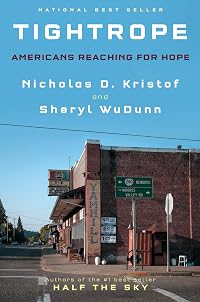
Tightrope: Americans Reaching for Hope
by Nicholas D. Kristof, Sheryl WuDunn
On This Page
Description
The Pulitzer Prize-winning authors of the acclaimed, best-selling Half the Sky now issue a plea—deeply personal and told through the lives of real Americans—to address the crisis in working-class America, while focusing on solutions to mend a half century of governmental failure.With stark poignancy and political dispassion, Tightrope draws us deep into an "other America." The authors tell this story, in part, through the lives of some of the children with whom Kristof grew up, in rural show more Yamhill, Oregon, an area that prospered for much of the twentieth century but has been devastated in the last few decades as blue-collar jobs disappeared. About one-quarter of the children on Kristof's old school bus died in adulthood from drugs, alcohol, suicide, or reckless accidents. And while these particular stories unfolded in one corner of the country, they are representative of many places the authors write about, ranging from the Dakotas and Oklahoma to New York and Virginia. But here too are stories about resurgence, among them: Annette Dove, who has devoted her life to helping the teenagers of Pine Bluff, Arkansas, as they navigate the chaotic reality of growing up poor; Daniel McDowell, of Baltimore, whose tale of opioid addiction and recovery suggests that there are viable ways to solve our nation's drug epidemic. These accounts provide a picture of working-class families needlessly but profoundly damaged as a result of decades of policy mistakes. With their superb, nuanced reportage, Kristof and WuDunn have given us a book that is both riveting and impossible to ignore. show less
Tags
Recommendations


















Member Reviews
I am a long-time reader of Nicholas Kristof's articles in the New York Times and I have read Half the Sky by Kristof and his wife Sheryl WuDunn. I was interested in their newest book Tightrope. A few weeks ago while waiting for a talk at a local library, I picked up Tightrope from the new books shelf and started reading. The next day, I went out to a local bookstore and bought the book.
Yet those kids ended up riding into a cataclysm, as working-class communities disintegrated across America, felled by lost jobs, broken families and despair.~ from Tightrope by Kristof and WuDunn
Tightrope is a deeply personal book; Kristof writes about the kids who were on the bus he took to school, people who were his neighbors and friends, and what show more became of them. One of out four died from drugs, suicide, alcohol, recklessness, drugs, and obesity. One is homeless and one is in prison for life. And yet Kristof left that bus and became a Pulitzer Prize winning journalist. Their stories become the vehicle to ask the hard questions about what has happened in America.
What went wrong? What goes right for the kids who end up successful? Who, or what, is to blame? And most importantly, what can we do prevent people from falling off the narrow tightrope?
After breaking my heart, and reading the lofty goals that could change the lives of Americans, I was pleased the Appendix shared "10 Steps You Can Take in the Next Ten Minutes to Make a Difference." Political and social change takes time. But these steps are within our personal control.
We have blamed the poor for their poverty, criminalized addiction, threw troubled kids out of school, allowed health care and sound education to become an option only for the wealthy, watched children grow up with food insecurity, and punished people rather than give them the tools to be contributing members of society.
Americans need to change their minds and their policies. Kristof and WuDunn share success stories of successful local programs that have changed lives and which could be adopted on a larger scale.
"Pull yourself up by your bootstraps," after all, originally meant "do the impossible."
Some of us were lucky with parents who offered a firm foundation, teachers who took an interest and encouraged us; some of us had opportunities for education, vocational training, or qualified for the military. When a child has none of these advantages--no boots with straps to pull--their chances of success are slim.
Americans need to shrug off the paradigm of blame.
The paramount lesson of our exploration was the need to fix the escalators and create more of them to spread opportunity, restore people's dignity and spark their ingenuity.~from Tightrope by Kristof and WuDunn show less
Yet those kids ended up riding into a cataclysm, as working-class communities disintegrated across America, felled by lost jobs, broken families and despair.~ from Tightrope by Kristof and WuDunn
Tightrope is a deeply personal book; Kristof writes about the kids who were on the bus he took to school, people who were his neighbors and friends, and what show more became of them. One of out four died from drugs, suicide, alcohol, recklessness, drugs, and obesity. One is homeless and one is in prison for life. And yet Kristof left that bus and became a Pulitzer Prize winning journalist. Their stories become the vehicle to ask the hard questions about what has happened in America.
What went wrong? What goes right for the kids who end up successful? Who, or what, is to blame? And most importantly, what can we do prevent people from falling off the narrow tightrope?
After breaking my heart, and reading the lofty goals that could change the lives of Americans, I was pleased the Appendix shared "10 Steps You Can Take in the Next Ten Minutes to Make a Difference." Political and social change takes time. But these steps are within our personal control.
We have blamed the poor for their poverty, criminalized addiction, threw troubled kids out of school, allowed health care and sound education to become an option only for the wealthy, watched children grow up with food insecurity, and punished people rather than give them the tools to be contributing members of society.
Americans need to change their minds and their policies. Kristof and WuDunn share success stories of successful local programs that have changed lives and which could be adopted on a larger scale.
"Pull yourself up by your bootstraps," after all, originally meant "do the impossible."
Some of us were lucky with parents who offered a firm foundation, teachers who took an interest and encouraged us; some of us had opportunities for education, vocational training, or qualified for the military. When a child has none of these advantages--no boots with straps to pull--their chances of success are slim.
Americans need to shrug off the paradigm of blame.
The paramount lesson of our exploration was the need to fix the escalators and create more of them to spread opportunity, restore people's dignity and spark their ingenuity.~from Tightrope by Kristof and WuDunn show less
This book should be required reading. It's insightful, depressing, yet still ultimately hopeful. Pulitzer Prize winning couple write a gut wrenching account of how America has ultimately failed it's people in the last half century through the lens of author Nicholas D. Kristof's hometown, Yamhill and a few other US locations. From a broken education, prison, health system and more; the authors explain how the system used to be, how it is now, and what can be done to fix it to bring the United States back up to speed with the rest of the industrialized first world countries. There are lots of personal stories and photos that really hammer down HOW these policies really affect many Americans. It is very depressing but at the same time the show more authors make sure to highlight social programs that people have started to combat issues of addiction, homelessness, and college education. It's an enlightening and ultimately inspiring book. Do yourself a favor and read this book before you vote! Then pass on this book to everyone you know!!!! show less
First, if you read a review or synopsis of this book and think, "I've read books like this" - if you've read Dopesick, Evicted, The New Jim Crow, Educated, Beyond These Walls, or similar books, don't bother reading this book. Those are all better, if different and more focused, treatments of the problems discussed here.
Tightrope: Americans Reaching for Hope outlines a number of serious problems facing poor people in America. Topics include their struggles in schools, their difficulties accessing medical and mental health treatment, the criminal justice system, and family structure. Most of these are discussed through the lens of Yamhill, Oregon, where Nicholas Kristof grew up. While the personal stories are well-told, the discussions of show more problems don't go into particular depth and could be better referenced. However, that isn't my main problem with the book.
The authors go very, very far out of their way to come across as middle-of-the-road, politically. Almost every problem is followed by "This isn't exclusively liberal or conservative", and every helpful government program is followed by a helpful privately-run nonprofit, funded by individuals. In some cases, particular political actions are called out, but this is relatively rare and usually focuses on recent (post-Trump) actions. This approach tends to portray history as a series of events that just happened. There are statements like "Because of abortion politics, family planning is toxic", which neatly sidestep the people deliberately tying contraception to abortion.
I think they're doing this in an effort to appeal to people on the political right as well as the left, but I don't understand why - Nicholas Kristof works for the New York Times, so it's unlikely that the book gains much traction in conservative circles. The solutions offered by the book tend to be presented as "if we compromise and find middle ground, we can solve this problem," but many of their proposals - greater access to birth control and comprehensive sex education, universal healthcare, raising the minimum wage - are things that the left has tried to pass for years while the right has been vehemently opposed.
The proposals chosen and the support presented for them are somewhat arbitrary as well. "End child homelessness" sounds nice, but Housing First-style programs, briefly mentioned elsewhere in the book, have worked in many cities to end all homelessness. There's no reason to continue with the voucher approaches presented here. The goal of increasing high school graduation rates by requiring students to stay in school until 18 is interesting, but why support it by citing high graduation rates in Ireland and Finland, where students are only required to attend through the age of 16?
In short, the authors paint a portrait of poor Americans struggling through life, knowing that their parents or grandparents had it better, but half of the hopeful stories they offer (nonprofit founder forced to declare personal bankruptcy to keep the doors open, the military as the closest thing to a social safety net) are even more depressing. The solutions they offer have the sense of "well, maybe this isn't the best we could do, but at least it's something..."
Finally, the reduction of America into black people and white people is both puzzling and disappointing. Asian and Hispanic people are rarely mentioned and Native Americans, for the most part, are relegated to a footnote at the end of Chapter 14. show less
Tightrope: Americans Reaching for Hope outlines a number of serious problems facing poor people in America. Topics include their struggles in schools, their difficulties accessing medical and mental health treatment, the criminal justice system, and family structure. Most of these are discussed through the lens of Yamhill, Oregon, where Nicholas Kristof grew up. While the personal stories are well-told, the discussions of show more problems don't go into particular depth and could be better referenced. However, that isn't my main problem with the book.
The authors go very, very far out of their way to come across as middle-of-the-road, politically. Almost every problem is followed by "This isn't exclusively liberal or conservative", and every helpful government program is followed by a helpful privately-run nonprofit, funded by individuals. In some cases, particular political actions are called out, but this is relatively rare and usually focuses on recent (post-Trump) actions. This approach tends to portray history as a series of events that just happened. There are statements like "Because of abortion politics, family planning is toxic", which neatly sidestep the people deliberately tying contraception to abortion.
I think they're doing this in an effort to appeal to people on the political right as well as the left, but I don't understand why - Nicholas Kristof works for the New York Times, so it's unlikely that the book gains much traction in conservative circles. The solutions offered by the book tend to be presented as "if we compromise and find middle ground, we can solve this problem," but many of their proposals - greater access to birth control and comprehensive sex education, universal healthcare, raising the minimum wage - are things that the left has tried to pass for years while the right has been vehemently opposed.
The proposals chosen and the support presented for them are somewhat arbitrary as well. "End child homelessness" sounds nice, but Housing First-style programs, briefly mentioned elsewhere in the book, have worked in many cities to end all homelessness. There's no reason to continue with the voucher approaches presented here. The goal of increasing high school graduation rates by requiring students to stay in school until 18 is interesting, but why support it by citing high graduation rates in Ireland and Finland, where students are only required to attend through the age of 16?
In short, the authors paint a portrait of poor Americans struggling through life, knowing that their parents or grandparents had it better, but half of the hopeful stories they offer (nonprofit founder forced to declare personal bankruptcy to keep the doors open, the military as the closest thing to a social safety net) are even more depressing. The solutions they offer have the sense of "well, maybe this isn't the best we could do, but at least it's something..."
Finally, the reduction of America into black people and white people is both puzzling and disappointing. Asian and Hispanic people are rarely mentioned and Native Americans, for the most part, are relegated to a footnote at the end of Chapter 14. show less
Heartbreaking and maddening and inspiring. The authors do a fine job of showing the difficult lives of a somewhat random subset of Americans facing very rough lives, caused by both their own frailties and by issues way outside their own control. All of the people are depicted in a very personal way, but especially the many people that Kristof grew up with and went to school with who didn’t survive the awful things that happened to them and well as the awful mistakes they themselves made. It’s easy to say “it’s society’s fault” and it’s easy to say “it’s poor people’s own faults” but the authors show what a tangled mess it really is, and how some social changes could really help (imperfect) people do much better, show more and thus be able to contribute back. show less
We Are Better Than This, Yes?
In the past few years, books have appeared about America’s working poor and just plain poor, not to mention America’s drift to the right and our current populist phenomenon, some better than others. Kristof and WuDunn’s book is among the best on these topics for a couple of reasons.
The authors offer personal stories of Nicholas’ boyhood friends, boys and girls with whom he rode the bus to school and played with. These are real people who once had futures, who the author knew as nice people, some brighter than others, people like you probably grew up with, if you lived in a small town, or in the middle class part of town, if you came from a working class family. In other words, these are ordinary show more Americans, and they ran into a buzzsaw by virtue of birth, or job loss, or illness and lack of medical care, or bad care, and a myriad of others problems. They might look like deadbeats to some, people who made their problems; in reality, they are like us, you, me, the Kristofs, and bad decisions and an equal dose of circumstances crushed them.
Then the authors use these stories of what happened to these people, many of whom are either now dead or destitute, to explain what’s happening in America’s communities, how dysfunctional family lives, drugs, violence, excess incarceration levels, job losses, and unwanted pregnancies account not just for the plight in his hometown of Yamhill, Oregon, but of that in small towns and inner cities across America. These authors examine how millions of Americans devolved into the situations devouring them, both through their own means the compounding effect of lack of meaningful, consistent, research-based solutions to the overarching factors affecting them.
What’s more, they explore programs, although small, that are working to turn around lives, and based on this, offer a number of suggestions that could break the current cycle of despair and early dead. That’s where the hope comes in, that there are ways, many proven, that can lift many people up. The challenge, however, and it’s a huge one, is getting Americans to recognize we face a collective problem. This isn’t, as too many of us believe, simply an issue of personal responsibility. The authors acknowledge that personal responsibility plays a role here. However, they argue very effectively, based on research and in dollars and lives to be saved, that there’s a collective, national responsibility, too. If we would heed even a bit of what they have to say, if our leaders, both in government and business, would listen, if we could embrace the idea of shared responsibility, then we as individuals and as a country would ultimately be better off. It boils down to: are we better than this, better than the way we now are ignoring the issue of poverty in America, or blaming it solely on the poor? The solution rests with us. show less
In the past few years, books have appeared about America’s working poor and just plain poor, not to mention America’s drift to the right and our current populist phenomenon, some better than others. Kristof and WuDunn’s book is among the best on these topics for a couple of reasons.
The authors offer personal stories of Nicholas’ boyhood friends, boys and girls with whom he rode the bus to school and played with. These are real people who once had futures, who the author knew as nice people, some brighter than others, people like you probably grew up with, if you lived in a small town, or in the middle class part of town, if you came from a working class family. In other words, these are ordinary show more Americans, and they ran into a buzzsaw by virtue of birth, or job loss, or illness and lack of medical care, or bad care, and a myriad of others problems. They might look like deadbeats to some, people who made their problems; in reality, they are like us, you, me, the Kristofs, and bad decisions and an equal dose of circumstances crushed them.
Then the authors use these stories of what happened to these people, many of whom are either now dead or destitute, to explain what’s happening in America’s communities, how dysfunctional family lives, drugs, violence, excess incarceration levels, job losses, and unwanted pregnancies account not just for the plight in his hometown of Yamhill, Oregon, but of that in small towns and inner cities across America. These authors examine how millions of Americans devolved into the situations devouring them, both through their own means the compounding effect of lack of meaningful, consistent, research-based solutions to the overarching factors affecting them.
What’s more, they explore programs, although small, that are working to turn around lives, and based on this, offer a number of suggestions that could break the current cycle of despair and early dead. That’s where the hope comes in, that there are ways, many proven, that can lift many people up. The challenge, however, and it’s a huge one, is getting Americans to recognize we face a collective problem. This isn’t, as too many of us believe, simply an issue of personal responsibility. The authors acknowledge that personal responsibility plays a role here. However, they argue very effectively, based on research and in dollars and lives to be saved, that there’s a collective, national responsibility, too. If we would heed even a bit of what they have to say, if our leaders, both in government and business, would listen, if we could embrace the idea of shared responsibility, then we as individuals and as a country would ultimately be better off. It boils down to: are we better than this, better than the way we now are ignoring the issue of poverty in America, or blaming it solely on the poor? The solution rests with us. show less
We Are Better Than This, Yes?
In the past few years, books have appeared about America’s working poor and just plain poor, not to mention America’s drift to the right and our current populist phenomenon, some better than others. Kristof and WuDunn’s book is among the best on these topics for a couple of reasons.
The authors offer personal stories of Nicholas’ boyhood friends, boys and girls with whom he rode the bus to school and played with. These are real people who once had futures, who the author knew as nice people, some brighter than others, people like you probably grew up with, if you lived in a small town, or in the middle class part of town, if you came from a working class family. In other words, these are ordinary show more Americans, and they ran into a buzzsaw by virtue of birth, or job loss, or illness and lack of medical care, or bad care, and a myriad of others problems. They might look like deadbeats to some, people who made their problems; in reality, they are like us, you, me, the Kristofs, and bad decisions and an equal dose of circumstances crushed them.
Then the authors use these stories of what happened to these people, many of whom are either now dead or destitute, to explain what’s happening in America’s communities, how dysfunctional family lives, drugs, violence, excess incarceration levels, job losses, and unwanted pregnancies account not just for the plight in his hometown of Yamhill, Oregon, but of that in small towns and inner cities across America. These authors examine how millions of Americans devolved into the situations devouring them, both through their own means the compounding effect of lack of meaningful, consistent, research-based solutions to the overarching factors affecting them.
What’s more, they explore programs, although small, that are working to turn around lives, and based on this, offer a number of suggestions that could break the current cycle of despair and early dead. That’s where the hope comes in, that there are ways, many proven, that can lift many people up. The challenge, however, and it’s a huge one, is getting Americans to recognize we face a collective problem. This isn’t, as too many of us believe, simply an issue of personal responsibility. The authors acknowledge that personal responsibility plays a role here. However, they argue very effectively, based on research and in dollars and lives to be saved, that there’s a collective, national responsibility, too. If we would heed even a bit of what they have to say, if our leaders, both in government and business, would listen, if we could embrace the idea of shared responsibility, then we as individuals and as a country would ultimately be better off. It boils down to: are we better than this, better than the way we now are ignoring the issue of poverty in America, or blaming it solely on the poor? The solution rests with us. show less
In the past few years, books have appeared about America’s working poor and just plain poor, not to mention America’s drift to the right and our current populist phenomenon, some better than others. Kristof and WuDunn’s book is among the best on these topics for a couple of reasons.
The authors offer personal stories of Nicholas’ boyhood friends, boys and girls with whom he rode the bus to school and played with. These are real people who once had futures, who the author knew as nice people, some brighter than others, people like you probably grew up with, if you lived in a small town, or in the middle class part of town, if you came from a working class family. In other words, these are ordinary show more Americans, and they ran into a buzzsaw by virtue of birth, or job loss, or illness and lack of medical care, or bad care, and a myriad of others problems. They might look like deadbeats to some, people who made their problems; in reality, they are like us, you, me, the Kristofs, and bad decisions and an equal dose of circumstances crushed them.
Then the authors use these stories of what happened to these people, many of whom are either now dead or destitute, to explain what’s happening in America’s communities, how dysfunctional family lives, drugs, violence, excess incarceration levels, job losses, and unwanted pregnancies account not just for the plight in his hometown of Yamhill, Oregon, but of that in small towns and inner cities across America. These authors examine how millions of Americans devolved into the situations devouring them, both through their own means the compounding effect of lack of meaningful, consistent, research-based solutions to the overarching factors affecting them.
What’s more, they explore programs, although small, that are working to turn around lives, and based on this, offer a number of suggestions that could break the current cycle of despair and early dead. That’s where the hope comes in, that there are ways, many proven, that can lift many people up. The challenge, however, and it’s a huge one, is getting Americans to recognize we face a collective problem. This isn’t, as too many of us believe, simply an issue of personal responsibility. The authors acknowledge that personal responsibility plays a role here. However, they argue very effectively, based on research and in dollars and lives to be saved, that there’s a collective, national responsibility, too. If we would heed even a bit of what they have to say, if our leaders, both in government and business, would listen, if we could embrace the idea of shared responsibility, then we as individuals and as a country would ultimately be better off. It boils down to: are we better than this, better than the way we now are ignoring the issue of poverty in America, or blaming it solely on the poor? The solution rests with us. show less
Kristof and WuDunn look at what's wrong with America from the bottom, through the lens of working class people, most of them people who Kristof grew up with and ent to school with. Coincidentally, I read Thomas Friedman's "Thank You For Being Late" while reading "Tightrope". Tightrope is the better book, perhaps for Kristof and WuDunn it is personal. The focus is on white working class people, with side trips to hear the stories of homeless veterans and African-Americans in the South. There are, thankfully, no stereotypes in these pages; the authors see and record the humanity of the people who are data points in the decline of the American working class, in the suicide and overdose statistics, in the sense of resentment which is their show more legacy. The authors look at the larger picture, at what decisions and policies contribute to the current sense of crisis (before Covid-19 swept the true problems off the stage). They do not score points off one party or politician but rather focus on what can be done to improve things for the children and the grandchildren of the friends whose tragic stories they tell. This is a moving and important work of compassion and journalism. show less
Members
- Recently Added By
Published Reviews
Poor and working-class Americans start out with countless disadvantages, and the social safety net that ought to help them recover from missteps has been systematically slashed by 50 years of mean-spirited social policy — even as corporations and the wealthy have enjoyed steadily growing government subsidies and a steadily more permissive regulatory environment. ... The intended audience for show more “Tightrope” isn’t clear. The authors inform us that their main goal is to “tell stories” rather than explore “policy alternatives,” because only storytelling is likely to convince conservatives that the woes of the working class can’t just be chalked up to personal irresponsibility. On these points, conservatives are unlikely to be persuaded, and liberals are unlikely to require persuasion. show less
added by Lemeritus
Historically, economic crisis breeds fear and vulnerability to manipulation by authoritarians among groups perceiving a loss of power; racism is indeed rife in a country built on white supremacy. But “Tightrope” catches what many analyses miss about struggling communities across color lines: an undercurrent of self-hatred, in which people blame themselves for bad outcomes and are loath to show more ask for a “handout.” ... “Tightrope” thus concludes that America’s true exceptionalism is our lack of concern for one another. ... “Tightrope”’s greatest strength is its exaltation of the common person’s voice, bearing expert witness to troubles that selfish power has wrought. show less
added by Lemeritus
Tightrope is a convincing argument that it's not too late to change the course of the nation. "We remain optimistic about what is possible," Kristof and WuDunn write. It's also an agonizing account of how apathy and cruelty have turned America into a nightmare for many of its less fortunate citizens. ... It's difficult to read, and it was surely difficult to write, but it feels — now more show more than ever — deeply necessary. show less
added by Lemeritus
Lists

Powell's 50 Books for 50 Years
50 works; 4 members
Author Information

6+ Works 4,635 Members
Nicholas D. Kristof shared a Pulitzer Prize with his wife in 1990 for their coverage for the New York Times of the Tiananmen democracy movement in China. He also coauthored China Wakes: The Struggle for the Soul of a Rising Power. Kristof has served as Times bureau chief in Hong Kong, Beijing, and Tokyo. He lives with his wife in New York City. show more (Publisher Provided) Nicholas D. Kristof was born on April 27, 1959 in Chicago Illinois. He graduated from Harvard College in 1981 and then won a Rhodes scholarship to Oxford, where he studied law and graduated with first class honors. He joined The New York Times in 1984, where he has held numerous positions including correspondent, columnist, bureau chief, and Associate Managing Editor. Kristof and his wife, Sheryl WuDunn, won a Pulitzer Prize in 1990 for their coverage of China's Tiananmen Square democracy movement. He won a second Pulitzer Prize in 2006 for commentary on genocide in Darfur. Kristof and WuDunn have written numerous books including A Path Appears: Transforming Lives, Creating Opportunity; Half the Sky: Turning Oppression into Opportunity for Women Worldwide; Thunder from the East: Portrait of a Rising Asia, and China Wakes: The Struggle for the Soul of a Rising Power. (Bowker Author Biography) show less

5 Works 4,582 Members
All Editions
Some Editions
Awards and Honors
Awards
Distinctions
Notable Lists
Common Knowledge
- Original publication date
- 2020
- Epigraph
- Be sure when you step/ Step with care and great tact/ And remember that Life's a Great Balancing Act. - Dr. Seuss, 'Oh, the Places You'll Go!'
- Dedication
- For Ladis and Jane, David and Alice, who nurtured us. For Darrell, Sirena and Sandra, who shaped us. For Gregory, Geoffrey and Caroline, who exhausted us and enriched us. / And for all those passing through the inferno who sp... (show all)oke to us honestly about their struggles so that the public might understand and support wiser policies.
- First words
- Dee Knapp was asleep when her husband, Gary, stumbled drunkenly into their white frame house after a night out drinking.
- Quotations
- America now lags behind its peer countries in health care and high-school graduation rates while suffering greater violence, poverty and addiction. This dysfunction damages all Americans: it undermines our nation’s competit... (show all)iveness, especially as growing economies like China’s are fueled by much larger populations and by rising education levels, and may erode the well-being of our society for decades to come. The losers are not just those at the bottom of society, but all of us.
Overall, the Social Progress Index ranks the United States number 26 in well-being of citizens, behind all the other members of the G7 as well as significantly poorer countries like Portugal and Slovenia, and America is one o... (show all)f just a handful of countries that have fallen backward. “Despite spending more on healthcare than any other country in the world, the US has health outcomes comparable to Ecuador, while the US school system is producing results on par with Uzbekistan,” the 2018 Social Progress Index concluded.
One mechanism by which pain on the bottom is transmitted throughout the nation is the political system. Some 60 million Americans live in a rural America that is suffering, and the U.S. political architecture gives the frustr... (show all)ations of these rural Americans disproportionate political influence. They have particular weight in the Senate, where each state has two senators, so a Wyoming voter has sixty-eight times as much clout in choosing a senator as a California voter. This baked-in bias in the Senate and Electoral College in favor of small, rural states will continue to give rural voters outsize influence for the foreseeable future, and rural America has for decades endured economic decline and social turmoil that have left voters angry and disillusioned. The political consequences are visible: Working-class Americans helped elect President Trump. The reasons they backed Trump were complicated and sometimes included nativism, racism and sexism, but about 8 million of these voters had supported Barack Obama in 2012. Many cast ballots for Trump as a primal scream of desperation because they felt forgotten, neglected and scorned by traditional politicians.
When life expectancy declined in Russia, just as it has in America today, that was a sign of systemic troubles that patriotic rhetoric could no longer conceal. It should have been a wake-up call, just as America’s declining... (show all) life expectancy today should be our own alarm bell.
The people in the top 0.1 percent did fantastically well after 1980, those in the top 1 percent did very well, those below them in the top 10 percent enjoyed incomes growing at the same pace as the economy and those in the bo... (show all)ttom 90 percent all lost ground—their incomes grew more slowly than the overall economy—during the last four decades. The Wall Street bonus pool at the end of each year exceeds the combined annual earnings of all Americans working full-time at the federal minimum wage.
When decent jobs disappear, the loss is not just economic but has consequences for self-esteem, family structure, substance abuse, hopelessness and even child abuse. One study found that for each percentage point increase in ... (show all)the unemployment rate in a county, the incidence of child neglect rose by 20 percent.
More than a century ago, Theodore Roosevelt described a similar crisis: “Exactly as the special interests of cotton and slavery threatened our political integrity before the Civil War, so now the great special business inte... (show all)rests too often control and corrupt the men and methods of government for their own profit….The absence of effective State, and, especially, national, restraint upon unfair money-getting has tended to create a small class of enormously wealthy and economically powerful men, whose chief object is to hold and increase their power. The prime need is to change the conditions which enable these men to accumulate power.”
There’s not much room for scrappy, bright kids whose parents don’t have a book in the house and are indifferent to schooling. College entrance may be based on metrics that seem meritocratic, like board scores and grades, ... (show all)but consider that 77 percent of kids in the top quartile of incomes graduate from college, compared to 9 percent of kids in the bottom quartile.
Today 15 percent of black students attend “apartheid schools,” in which at most 1 percent of the student body is white, and they graduate at lower rates than in integrated schools. Black students are on average two grade ... (show all)levels behind white students, and kids in poor districts are four grade levels behind those in rich districts. “Quietly and subtly, the opponents of integration have won,” writes Rucker C. Johnson in his book Children of the Dream, about school integration.
there are the incentives for economic development awarded by states and local areas, often never made public. Oregon awarded Nike $2 billion for five hundred jobs, or $4 million per job. Meanwhile, Louisiana paid $15 million ... (show all)for each of fifteen jobs with Valero Energy. In 2013, Washington State granted Boeing subsidies worth $8.7 billion over sixteen years, the largest subsidy in history for a company. By late April 2016, Boeing had laid off 5,600 workers.
It is difficult to imagine a more self-defeating strategy. Federal, state, county and city governments incur vast costs in running jails and prisons. Sometimes these costs are “recovered” from the prisoners, thus fuelling... (show all) the latter’s cycle of poverty and desperation. The criminal records attached to the poor through imprisonment make it even harder for them to find jobs, housing, stability and self-sufficiency. Families are destroyed, children are left parentless and the burden on governments mounts….In the United States, it is poverty that needs to be arrested, not the poor simply for being poor.
Our political system responds to large donors, so politicians create benefits for the rich, who then reward the politicians who created them.
As hostility toward government spread in America, there have been determined efforts to cut taxes, particularly for the wealthy, and then “starve the beast”—using reduced revenue to justify cuts in services for the disa... (show all)dvantaged. This is both disingenuous and cruel, as well as out of step with the advanced world.
Repeated psychology experiments have shown that fear makes us more conservative in our political beliefs, and Richard Nixon seized upon the fears in 1968 when he ran for president with coded dog whistles playing on white appr... (show all)ehensions of black unrest. This “southern strategy” turned the South into a GOP bastion, and the fearmongering has often extended into social policies as well. Welfare was portrayed as handouts to lazy blacks, and immigration as a threat to American culture and jobs. The lack of social-support policies then led to a certain despair and disintegration of traditional communities, amplifying fears that traditional values were being lost and pushing states that once had progressive streaks, like Iowa and Oklahoma, firmly into the Republican camp.
Our international competitiveness is damaged because the American economy has created a Hobbesian world in which life is “solitary, poor, nasty, brutish and short.” As the business writer Steven Pearlstein put it: “What... (show all) began as a useful corrective has, 25 years later, become a morally corrupting and self-defeating economic dogma that threatens the future of American capitalism….Our current prosperity is not sustainable because it is not producing the kind of society that most of us desire.”
there’s far more anger at perceived welfare abuses than at larger subsidies for private jets. The resentment is more visceral when it is people around them who are bending rules and benefiting unfairly.
The government failed him, blamed him and jailed him. A couple of generations ago, the United States rewarded veterans by affording them education and housing benefits. More recently, the United States helped get veterans hoo... (show all)ked on drugs and then incarcerated them.
Purdue was later convicted of a felony for fraudulently marketing its opioids by downplaying the risk of addiction. The company was vigorously defended by Rudy Giuliani, and its $600 million fine was negligible compared to t... (show all)he $35 billion that it is estimated to have earned from OxyContin. Individual executives from Purdue were also convicted and made to pay substantial fines, but they never served a day of jail time. Purdue was allowed to continue selling opioids, and the Sackler family is now worth $13 billion.
Without much discussion, we have created a two-tier justice system. If you shoplift at the grocery store, you can be carted off to jail. But if you steal tens of millions of dollars from the tax authorities or fraudulently pe... (show all)ddle dangerous drugs from a corporate suite, you’ll be hailed for your business savvy.
Crackdowns on small-time drug offenders in the United States devastated many low-income families, especially in African-American communities, and the resulting felony records left black men in particular less employable and l... (show all)ess marriageable. The United States has spent more than $1 trillion on the war on drugs, money spent locking up two-bit users rather than educating children. The war on drugs has been perhaps the worst single policy mistake of the last half century.
Outpatient substance abuse assistance costs about $4,700 a year; incarceration costs five times as much, according to the National Institute on Drug Abuse. It says that a dollar invested in addiction treatment programs saves ... (show all)$12 in reduced crime and court costs, plus health-care savings.
Over the last fifty years, poverty has come to be seen not just as an economic failing but also as a moral one, prompting a pervasive suspicion that the poor are secretly living cushy lives on government benefits. A Pew poll ... (show all)found that wealthy Americans mostly agreed that “poor people today have it easy because they can get government benefits without doing anything in return.”
Humans are moved to help individuals, not to address structural problems.
America’s health care system is neither healthy, caring, nor a system. —WALTER CRONKITE, former anchor for CBS Evening News
The bottom line is that since 1970 we have seen American exceptionalism in health care in multiple ways: we lack universal care, we spend more on health and we get worse results.
Rent control doesn’t increase the supply and tends to constrict it because people don’t give up bargain apartments, and developers are wary of building if they think their returns will be held down. In some cities, owners... (show all) can also convert rentals to unregulated condominiums. Meanwhile, rent control tends to increase demand, so you have more people competing for fewer apartments.
Everyone knows that there are government housing programs for the poor, like Section 8 (costing $30 billion annually), but few Americans realize that in recent years we have spent more than twice as much on subsidizing housin... (show all)g for mostly affluent homeowners ($71 billion annually through mortgage interest deductions and other benefits).
Poverty is the mother of crime. —MARCUS AURELIUS
private prisons lobby for harsher sentences to increase their occupancy rates and improve their profitability. The two largest for-profit prison companies have devoted $25 million to lobbying.
It turns out that when communities of any race lose jobs and self-esteem, people are more likely to soothe themselves with narcotics, drift into crime and suffer family breakdown. And it doesn’t much help to hear Horatio Al... (show all)ger pieties about personal responsibility from those who have made it.
Same-sex couples seem to have slightly better outcomes for their kids than heterosexual couples, perhaps because no gay couple ever had a child by mistake.
One of the most infuriating elements of American myopia about investing in at-risk kids is that politicians often insist that they don’t have the funds to pay for social services—but they somehow find the resources to pay... (show all) for prisons later on. Republican lawmakers don’t want to pay for $500 IUDs for low-income women, so they pay $17,000 for Medicaid births. They don’t want to pay to reduce lead poisoning, even though that means paying for special-education classes for years to come; one study by the Pew Research Center found that every dollar invested in large-scale efforts to reduce lead poisoning saves $17 in public money later on.
It’s perhaps telling that the United States for years was, embarrassingly, the only country in the world besides Somalia and South Sudan that had not ratified the Convention on the Rights of the Child. That has now changed:... (show all) the United States is the only nation that hasn’t bothered to ratify it. Maybe that’s a symbolic matter, but here’s something profoundly real: children make up almost one-third of Americans living in poverty, and on any given night some 115,000 children are homeless in the world’s most powerful country.
While poor Americans may have a color TV and access to hospital emergency rooms, they also have a life expectancy similar to that of Mongolia, a homicide rate higher than in Rwanda and an incarceration rate that is the highes... (show all)t in the world. What we found everywhere in our journey, in white communities or black ones, in cities or rural areas, was that the defining ethos of life in the homes of kids like Emmanuel is disorder, dysfunction, despair and danger.
political scientists have found that even in a democracy, inequality awards the wealthy not only with more wealth but also with more political power. The rich then use this power to consolidate their own wealth. The upshot is... (show all) that the more urgent economic justice becomes, the less likely it is to be pursued. - Last words
- (Click to show. Warning: May contain spoilers.)We can shore up the American dream so that the children today climbing aboard the Number 6 school bus - and skipping into schools all across the country - achieve more of the dreams that animate them, so that this truly becomes, in Woody Guthrie's vision "a land made for you and me."
- Blurbers
- Westover, Tara
- Canonical DDC/MDS
- 306.0973
- Canonical LCC
- HN59.2
Classifications
- Genres
- Sociology, Nonfiction, General Nonfiction, Economics, Politics and Government, History
- DDC/MDS
- 306.0973 — Society, government, & culture Social sciences, sociology & anthropology Social Behavior - Dating, Marriage, Divorce Social history North America United States
- LCC
- HN59.2 — Social sciences Social history and conditions. Social problems. Social reform Social history and conditions. Social problems. By region or country
- BISAC
Statistics
- Members
- 459
- Popularity
- 66,479
- Reviews
- 23
- Rating
- (4.15)
- Languages
- English, Polish
- Media
- Paper, Audiobook, Ebook
- ISBNs
- 10
- ASINs
- 2