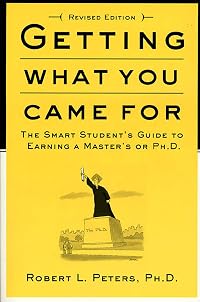
Getting What You Came For: The Smart Student's Guide to Earning an M.A. or a Ph.D.
by Robert Peters
On This Page
Description
Is graduate school right for you?Should you get a master's or a Ph.D.?
How can you choose the best possible school?
This classic guide helps students answer these vital questions and much more. It will also help graduate students finish in less time, for less money, and with less trouble.
Based on interviews with career counselors, graduate students, and professors, Getting What You Came For is packed with real-life experiences. It has all the advice a student will need not only to survive show more but to thrive in graduate school, including: instructions on applying to school and for financial aid; how to excel on qualifying exams; how to manage academic politics—including hostile professors; and how to write and defend a top-notch thesis. Most important, it shows you how to land a job when you graduate.
. show less
Tags
Recommendations


Member Reviews
Chock full of useful advice, though the title's a bit misleading: this book would be much more useful to someone first setting out to look at graduate schools, not someone who is already there. I also had to stop reading at the blanket statement that teaching too much in graduate school is bad for you and your career because you might be "branded as a teacher" (rather than a researcher). The book may have been intended for a larger audience, but I think it would be most useful for someone who is planning to get a PhD in the sciences in preparation for a primarily research-based career.
Helpful, but I wouldn't call it indispensable. Definitely slanted more towards students pursuing graduate work in the sciences; as a humanities student, I felt like a lot of the book didn't apply to me (about getting into labs, etc). Also, quite dated. Recommends that you get a computer with a modem and at least 1 gb in memory, for example, and doesn't even touch upon the myriad of online sources available today. Perhaps if a revised edition came out in the next few years, I would give that a better review, but this one definitely shows its age.
An interesting read at primarily academia-tracked grad school. Also very much in the early stages of the internet.
I enjoyed the book, although it showed a very different track to the one I took prior to and during graduate school. I don't intend to go on for a PhD and I'm not certain whether or not this book has been updated, but I would recommend this to people on the academic grad school track
I enjoyed the book, although it showed a very different track to the one I took prior to and during graduate school. I don't intend to go on for a PhD and I'm not certain whether or not this book has been updated, but I would recommend this to people on the academic grad school track
indispensable. must read before applying to grad school. Totally sensible and well informed.
“This is an excellent book. I don’t know how Robert Peters was able to assemble all this highly relevant and valuable information after only one pass through the system known as graduate school, but he has produced a definitive piece of work.” – Dr. Gene Woodruff, Dean of the Graduate School, University of Washington, Seattle, President of the Association of Graduate Schools, Chairman of the GRE Board
suggestions on managing a course of graduate study
Ratings
Members
- Recently Added By
Author Information
1 Work 608 Members
Classifications
- Genres
- Nonfiction, General Nonfiction
- DDC/MDS
- 378.24 — Society, government, & culture Education Higher education (Tertiary education) Academic degrees and costume; College colors Degrees for completion of courses
- LCC
- LB2371.4 .P48 — Education Theory and practice of education Theory and practice of education Higher education Graduate education
- BISAC
Statistics
- Members
- 611
- Popularity
- 47,801
- Reviews
- 6
- Rating
- (3.65)
- Languages
- English
- Media
- Paper, Ebook
- ISBNs
- 3
- ASINs
- 4