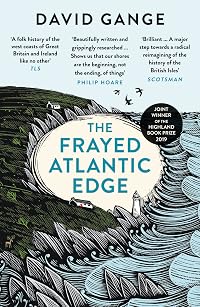
The Frayed Atlantic Edge
by David Gange
On This Page
Description
Over the course of a year, leading historian and nature writer David Gange kayaked the weather-ravaged coasts of Atlantic Britain and Ireland from north to south: every cove, sound, inlet, island. The idea was to travel slowly and close to the water: in touch with both the natural world and the histories of communities on Atlantic coastlines. The story of his journey is one of staggering adventure, range and beauty. For too long, Gange argues, the significance of coasts has been show more underestimated, and the potential of small boats as tools to make sense of these histories rarely explored. This book seeks to put that imbalance right. Paddling alone in sun and storms, among dozens of whales and countless seabirds, Gange and his kayak travelled through a Shetland summer, Scottish winter and Irish spring before reaching Wales and Cornwall. Sitting low in the water, as did millions in eras when coasts were the main arteries of trade and communication, Gange describes, in captivating prose and loving detail, the experiences of kayaking, coastal living and historical discovery. Drawing on the archives of islands and coastal towns, as well as their vast poetic literatures in many languages, he shows that the neglected histories of these stunning regions are of real importance in understanding both the past and future of the whole archipelago. It is a history of Britain and Ireland like no other. show lessTags
Recommendations












Member Reviews
The book is at its best when recounting snippets of history often unearthed from his conversations with islanders and coastal dwellers. The passages in which he presents the literature of the area (forming a group of Atlanticists as he calls them, Atlantic thinkers, east side at least..), and quotes from them, are less interesting - and it's a fine line to tread between the two. Some areas come off less well than others. Cornwall, for example, is an almost non-stop rehash of its poets, which is fine, but outside the remit, at least as far as I am concerned, or at least, what he does less well.
I suspect that simply, after such an epic journey, he has more affection for places he writes his own experiences as opposed to relying on others. show more Bardsey above Cornwall for example, Havera above Mull. Skellig Michael above Land’s End.
The blend, like a Scotch whisky, works really well when he gets it right.. for example, quoting from Charles Edwardes ‘The Island In The Currents’ of Enlli, off the Llyn peninsula (Bardsey):
“A slow old man, with much grizzled hair to his head and chin, and the signs of recent breakfast about his mouth, came towards us with a scythe. ‘I am the king,’ he said quietly...and then with a differential little bow, he went to cut grass.”
He recounts his interviews with islanders.. the ‘modern sceptic’ he begins, surely doubts the story that 20,000 saints are buried here, but the experience of those who work ‘this preposterous charnel pit’ belies incredulous assumptions:
“It is all bones underneath, nothing but bones. I have seen them myself, indeed. Thee were women with hair eighteen inches long, and child’s, and man’s, in such heaps as you could not believe. And their teeth, oh indeed, I never did see such full mouths of them.”
But overall it’s an inspirational book. There are some wonderfully written passages and many fascinating anecdotes. And I am inspired myself, albeit not by kayak, but with the mountain bike, running shoes, dog, tent and van to go to retrace the journey (by land) and investigate some of these places. show less
I suspect that simply, after such an epic journey, he has more affection for places he writes his own experiences as opposed to relying on others. show more Bardsey above Cornwall for example, Havera above Mull. Skellig Michael above Land’s End.
The blend, like a Scotch whisky, works really well when he gets it right.. for example, quoting from Charles Edwardes ‘The Island In The Currents’ of Enlli, off the Llyn peninsula (Bardsey):
“A slow old man, with much grizzled hair to his head and chin, and the signs of recent breakfast about his mouth, came towards us with a scythe. ‘I am the king,’ he said quietly...and then with a differential little bow, he went to cut grass.”
He recounts his interviews with islanders.. the ‘modern sceptic’ he begins, surely doubts the story that 20,000 saints are buried here, but the experience of those who work ‘this preposterous charnel pit’ belies incredulous assumptions:
“It is all bones underneath, nothing but bones. I have seen them myself, indeed. Thee were women with hair eighteen inches long, and child’s, and man’s, in such heaps as you could not believe. And their teeth, oh indeed, I never did see such full mouths of them.”
But overall it’s an inspirational book. There are some wonderfully written passages and many fascinating anecdotes. And I am inspired myself, albeit not by kayak, but with the mountain bike, running shoes, dog, tent and van to go to retrace the journey (by land) and investigate some of these places. show less
Unlike Spielvogel's Aleut kajak journey to prove that migration via this route was possible for early humans, this book doesn't reveal, to me at least, exactly why the kajaker's perspective is necessary for the scientific assessment of this coastline. The historical insights are mostly taken from literature, linguistic and political activism, and an ocean-bound approach isn't liable to change the author's mindset to that of a storm-beaten shorelander of centuries ago. Besides, the voyage(s) itself / themselves remain(s) underestimated and underexposed thrughout the book. And the crucial scientific insight that British history-writing is more land- and London-centred than history actually was and that an alternative vision should be put show more forth is sensible, but the arguments are based too often on individuals, their fights and their poems, which are (really well!) analysed in detail, but this is done in a way that suggests that they are historical artefacts, not unlike the remains of old dwellings, that serve to back up the author's theories. They are, however, fictional and very personal accounts of place-lore, and thus don't qualify as proof for anything. show less
Ratings
Members
- Recently Added By
Lists

TLL Reading List
9 works; 1 member
Author Information
6+ Works 125 Members
Awards and Honors
Classifications
- Genres
- Travel, Nonfiction, Science & Nature, General Nonfiction, Biography & Memoir
- DDC/MDS
- 914.1048612 — History & geography Geography & travel Geography of and travel in Europe British Isles, UK, Great Britain, Scotland, Ireland subdivisions and modified standard subdivisions Travel; guidebooks 1837- Victoria & Windsors 2000- 2000-2019 2010-2019
- LCC
- DA668 .G36 — History of Europe, Asia, Africa and Oceania Great Britain History of Great Britain England
- BISAC
Statistics
- Members
- 100
- Popularity
- 323,627
- Reviews
- 2
- Rating
- (3.77)
- Languages
- English
- Media
- Paper, Ebook
- ISBNs
- 4