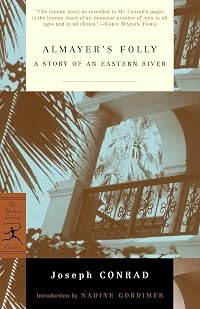
Almayer's Folly
by Joseph Conrad
On This Page
Description
A young Dutch trader, Kaspar Almayer, marries Captain Lingard's adopted Malay daughter in the hopes of one day inheriting the captain's wealth. He moves to Borneo to run Lingard's trading post there, but while the captain is frittering away his fortune on a hopeless treasure hunt, Almayer's ventures fail, one after the other. In the hotpot of isolation, colonialism and frustrated desire, naming Almayer's true folly becomes complicated..
Tags
Recommendations









































Member Recommendations

Member Reviews
I love Joseph Conrad. Everything is so vivid. His words are like painting before photography. Detailed as if under a spotlight with an array of colors and shades that make each image extraordinary. I think back to different scenes from his books as if they were paintings I once saw. The first time this happened was at the beginning of HEART OF DARKNESS when the narrator describes the descent of dusk over London and the Thames—that vanishing light is forever fixed in my mind. I think reading Conrad as a youngster formed just how I read—I tend to read slowly—inspiring a love for cerebral cinematography that can absorb time versus quick TV images that don’t last. Each story is a journey through someone’s personal struggles show more representing great big themes: colonization, alienation, isolation. Set against giant landscapes, the sea or mysterious lands or both, that dwarf our struggles. His characters are clear and sharp and strongly driven by a tangled crosshatch of motivations. English not his native language, Conrad takes to it like a religious convert. I hold an extra appreciation for that. His sentences can sometimes be very long but they submerge you into the story and I never feel there is anything that should be cut. What I don’t like is that he can come off as racist. The great Chinua Echebe famously took Joseph Conrad to task for this. With Conrad’s mind formed in the 19th century, difficult to escape the limitations of his era. His view of non-white cultures is often dismissive and diminishing—at the same time he doesn’t speak very well of anybody. There are great forces that pit us against each other. We are all flailing helplessly beneath a limitless sky—fighting over the stones at our feet.
That long-windedness aside—I enjoyed reading Conrad’s first book Allmayer’s Folly as a template for the rest of his writing. It stands on its own—creating a vivid backwater world of corrupt traders and broken dreams. Vivid in my memory—the story takes place entirely on a river until near the end when some seek escape by following the river to the sea and stand upon a triangle slip of coast facing the unknown. Solid Conrad. show less
That long-windedness aside—I enjoyed reading Conrad’s first book Allmayer’s Folly as a template for the rest of his writing. It stands on its own—creating a vivid backwater world of corrupt traders and broken dreams. Vivid in my memory—the story takes place entirely on a river until near the end when some seek escape by following the river to the sea and stand upon a triangle slip of coast facing the unknown. Solid Conrad. show less
This has been sitting on my shelves for many years, either unread or completely forgotten: I returned to it after reading Ocean Sea and wondering where Baricco got the name "Almayer". As Kennewell says, it's a beautifully written little book, sometimes a touch too poetic, perhaps, but it isn't too easy for a modern reader to identify with the subject-matter.
The main "problem" with the book is, of course, that the particular act of folly on which the tragic plot depends is Almayer allowing himself to be persuaded into marrying Lingard's Malay adopted daughter. On one level, the book exposes itself to a simplistic racist interpretation: Almayer provokes his own destruction by abandoning the standards expected of him as a white man and show more making an inter-racial marriage.
However, there's a lot more to it than this. Conrad makes it clear that Almayer was acting from greed and ambition. He marries to get his hands on his father-in-law's treasure, and believes he will be able to ditch his "native wife" later on. Mrs Almayer's nastiness comes from the nature of her upbringing and the way she's been treated by white people (including Lingard and Almayer), not from her race. Nina decides that she would rather identify as Malay than as a person of mixed race, again because of the contempt she gets from white people. Much of the story is told from the point of view of non-white characters, and the Orang Blanda (Hollanders) are never seen as characters the reader can identify with. So it isn't quite the simple racist narrative it appears to be at first sight, but it does perhaps lend itself to more subtle racist interpretations (people of different races shouldn't/can't live together, etc.). show less
The main "problem" with the book is, of course, that the particular act of folly on which the tragic plot depends is Almayer allowing himself to be persuaded into marrying Lingard's Malay adopted daughter. On one level, the book exposes itself to a simplistic racist interpretation: Almayer provokes his own destruction by abandoning the standards expected of him as a white man and show more making an inter-racial marriage.
However, there's a lot more to it than this. Conrad makes it clear that Almayer was acting from greed and ambition. He marries to get his hands on his father-in-law's treasure, and believes he will be able to ditch his "native wife" later on. Mrs Almayer's nastiness comes from the nature of her upbringing and the way she's been treated by white people (including Lingard and Almayer), not from her race. Nina decides that she would rather identify as Malay than as a person of mixed race, again because of the contempt she gets from white people. Much of the story is told from the point of view of non-white characters, and the Orang Blanda (Hollanders) are never seen as characters the reader can identify with. So it isn't quite the simple racist narrative it appears to be at first sight, but it does perhaps lend itself to more subtle racist interpretations (people of different races shouldn't/can't live together, etc.). show less
Conrad's prose is beautiful. His understanding of human nature is complete. Almayer's Folly is a tragic tale of hopes thwarted by the hardship of life and the weak spirit of one man. Almayer's Folly is the name given to the house built by the titular hero to house his family and demonstrate his wealth and success. It is also the theme of his life - from presuming he would inherit the fortune of his boss by marrying his adopted daughter, to thinking he could throw that daughter off when he no longer needed her, and his belief that his position as the only white man on the east coast of Malaysia would secure his fortunes. He is a weak man, who can't rid himself of the angry woman who has been forced to marry, can't prevent his father in show more law from taking his own daughter from him, and ultimately can't make reparation with his only child. In the middle is a love story, told simply and perfectly. It's only a short book, but it properly filled my brain. show less
The language that describes landscapes is dense and rich; the themes of alienation in the externally and inwardly destructive colonial psyche are ripe for further analysis. Perhaps, if I cared enough, I would be interested to note Conrad's Polish heritage and the obsession with Englishness that Almayer has in this book. Conrad is cynical about Almayer (who is Dutch) and the English, but he cannot imagine his Malay characters as anything but savages. Every so often when it feels like he might be able to get past that, he appears to run into a wall--like a conceptual block--and the narrative pulls back to describe how a Malay character was behaving in a way that was typical to his or her race; that is, in a "savage", remote and show more inscrutable manner. For all the beauty of the language in certain parts of this slim novel, and the complexity of the ideas submerged in the straightforward narrative, the book is ultimately tedious, small-minded, and mean-spirited. This is because of Conrad's orientalism, which despite his talent and skill in crafting a sentence, renders him without imagination. A novel cannot succeed on repetitions of stereotypes. show less
The thing is that neither Almayer, his daughter, Nina, or his wife fit in. Neither does his would-be partner, Dain. Everyone lacks connection in this short novel. But none more than Almayer himself. He is a misfit in the most literal sense of the word. Uncomfortable with the natives, his family, or his sponsor, he lives his life adrift. As the novel puts it when describing the building of his new house on the first page, the decay has set in even as it is being built. And Almayer all but rushes to that eventual fate, while those around him disintegrate and disappear from the text and our consciousness.
Almayer’s Folly is Conrad’s first novel. Although I’ve read several of Conrad’s novels, I’m not confident enough to definitely rank this among his other works. I do think it shows an earlier stage in his narrative skills than some of his later, better known works.
Like other Conrad stories, it places colonialism at the center, along with colonialism’s related themes of race, class, and the kinds of dreams that colonialism affords. Kasper Almayer is a Dutch trader in nineteenth century Borneo. His dreams are entwined with the promise of treasure, his hopes for and love for his daughter, and of course the rewards of wealth and status.
His dreams and his folly are synonymous. The locals refer to the pretentious house that show more Almayer has had built, as the future home of a dream life, as his folly. But it’s the whole package that really seems to be the folly — a white man {“the only white man on the east coast”) hoping to find and/or make something of himself in the colonial world that he couldn’t accomplish elsewhere.
Those hopes are understandable when fueled by a vision of opportunity in an undeveloped land and by simple naivety. The colonial world isn’t a blank canvas — it’s just one that is unfamiliar enough that it’s hard to read and easy to misread. In particular, Almayer’s dedication to and hopes for his daughter run up against some hard realities. She is his daughter by way of a business-like marriage to a Malay wife. She is “half white” among the Malays, no matter that she is his daughter, and she is half Malay to herself. What’s more, like any daughter but especially one at a colonial crossroads, she has a mind and will of her own that is inevitably at odds with her father’s dreams.
Neither his daughter nor the colonial world they inhabit is going to fall into line for Almayer.
The book itself takes some time to get going. Probably the first quarter of the book is exposition — stage setting and backfilling for the story that finally joins the present tense. From there on, Conrad’s narrative is compelling. There are twists and turns, although they follow a pattern that lets your mind run a little bit ahead of the story. Not necessarily a bad thing, since so much of what Conrad conveys is more a dawning realization of Almayer’s folly than just a resolution of events. show less
Like other Conrad stories, it places colonialism at the center, along with colonialism’s related themes of race, class, and the kinds of dreams that colonialism affords. Kasper Almayer is a Dutch trader in nineteenth century Borneo. His dreams are entwined with the promise of treasure, his hopes for and love for his daughter, and of course the rewards of wealth and status.
His dreams and his folly are synonymous. The locals refer to the pretentious house that show more Almayer has had built, as the future home of a dream life, as his folly. But it’s the whole package that really seems to be the folly — a white man {“the only white man on the east coast”) hoping to find and/or make something of himself in the colonial world that he couldn’t accomplish elsewhere.
Those hopes are understandable when fueled by a vision of opportunity in an undeveloped land and by simple naivety. The colonial world isn’t a blank canvas — it’s just one that is unfamiliar enough that it’s hard to read and easy to misread. In particular, Almayer’s dedication to and hopes for his daughter run up against some hard realities. She is his daughter by way of a business-like marriage to a Malay wife. She is “half white” among the Malays, no matter that she is his daughter, and she is half Malay to herself. What’s more, like any daughter but especially one at a colonial crossroads, she has a mind and will of her own that is inevitably at odds with her father’s dreams.
Neither his daughter nor the colonial world they inhabit is going to fall into line for Almayer.
The book itself takes some time to get going. Probably the first quarter of the book is exposition — stage setting and backfilling for the story that finally joins the present tense. From there on, Conrad’s narrative is compelling. There are twists and turns, although they follow a pattern that lets your mind run a little bit ahead of the story. Not necessarily a bad thing, since so much of what Conrad conveys is more a dawning realization of Almayer’s folly than just a resolution of events. show less
After a bit of a slow start and being nagged by thoughts that this story seemed oddly familiar to me (even though I have never read anything by Conrad before now), I found this to be a rather interesting read. Conrad has a bit of the romantic in him, which comes through in this story. Conrad does a wonderful job capturing the exotic nature of a steamy tropical jungle in the Dutch East Indies, giving the feeling of separation from the rest of the world. This is kind of an anti-adventure story, given that Almayer’s attempts to gain wealth have been on-going for more than 20 years. Almayer’s continued attempts are those of a man obsessed and no longer in touch with reality, not the enthusiasm of adventuring heroes. The title is an apt show more one. Almayer’s life is one filled with folly, which seems to have started when he agreed to marry Lingard’s adopted Malay daughter. Every aspect of Almayer’s life is one of misdirection, lack of respect and unrewarding toil. Even the house he built on the river as a showcase for his dreamed of wealth is an unfinished ruin. Conrad’s attack on colonialism/resource-based imperialism runs counter to what one usually expects in an exotic adventure story. Conrad does a wonderful job charting Almayer’s decline. for this very reason, this is a rather dark story of human ruin. For a first novel, I found it to be rather well written, without any of the awkwardness or teething pains of a first time author. show less
Members
- Recently Added By
Lists

Conrad ranked
16 works; 2 members
Author Information

729+ Works 91,312 Members
Joseph Conrad is recognized as one of the 20th century's greatest English language novelists. He was born Jozef Konrad Nalecz Korzeniowski on December 3, 1857, in the Polish Ukraine. His father, a writer and translator, was from Polish nobility, but political activity against Russian oppression led to his exile. Conrad was orphaned at a young age show more and subsequently raised by his uncle. At 17 he went to sea, an experience that shaped the bleak view of human nature which he expressed in his fiction. In such works as Lord Jim (1900), Youth (1902), and Nostromo (1904), Conrad depicts individuals thrust by circumstances beyond their control into moral and emotional dilemmas. His novel Heart of Darkness (1902), perhaps his best known and most influential work, narrates a literal journey to the center of the African jungle. This novel inspired the acclaimed motion picture Apocalypse Now. After the publication of his first novel, Almayer's Folly (1895), Conrad gave up the sea. He produced thirteen novels, two volumes of memoirs, and twenty-eight short stories. He died on August 3, 1924, in England. (Bowker Author Biography) show less
Some Editions
Series
Belongs to Publisher Series
Work Relationships
Is contained in
Has the adaptation
Common Knowledge
- Canonical title
- Almayer's Folly
- Original title
- Almayer's Folly: A Story of an Eastern River
- Original publication date
- 1895
- People/Characters
- Kaspar Almayer; Nina Almayer; Dain; Babalatchi; Lakamba; Captain Lingard (show all 7); Mrs. Almayer
- Important places
- Batavia, Dutch East Indies; Makassar, Indonesia; Sambir, Borneo
- Related movies
- Almayer's Folly (2011 | IMDb)
- Dedication
- To the memory of T.B.
- First words
- Kaspar! Makan!
- Last words
- (Click to show. Warning: May contain spoilers.)The Compassionate!
- Original language
- English
Classifications
Statistics
- Members
- 938
- Popularity
- 28,521
- Reviews
- 22
- Rating
- (3.74)
- Languages
- 15 — Catalan, Danish, Dutch, English, Finnish, French, German, Irish, Hungarian, Italian, Norwegian (Bokmål), Norwegian, Polish, Spanish, Swedish
- Media
- Paper, Audiobook, Ebook
- ISBNs
- 145
- UPCs
- 2
- ASINs
- 55