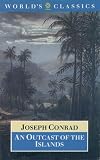
An Outcast of the Islands
by Joseph Conrad
On This Page
Description
An Outcast of the Islands is Joseph Conrad's second novel, first published in 1896 and inspired by Conrad's time as mate of the steamer The Vigar. Fleeing from scandal in Singapore, the disreputable Peter Willems hides out in a native village, only to betray his protectors in his lust for the daughter of the chief. The story features Tom Lingard and other characters who are also in Conrad's Almayer's Folly of 1895 and The Rescue of 1920..
Tags
Recommendations






































Member Reviews
Enjoyable novel that exposes self-deception as the origin of the downfall of most of the characters. None of them has much that is redeemable about themselves, Europeans or Malays.
The tropical setting permeates every chapter. Nature is an overpowering force that slowly strangles judgement, hope and sanity. The descriptions of nature's moods and atmosphere are an outstanding feature. They speak to the murky and underhand behaviour of men and women, black and white who eke out a living in isolation and in diminishing hopes
The tropical setting permeates every chapter. Nature is an overpowering force that slowly strangles judgement, hope and sanity. The descriptions of nature's moods and atmosphere are an outstanding feature. They speak to the murky and underhand behaviour of men and women, black and white who eke out a living in isolation and in diminishing hopes
I managed to read this without knowing how it ends which certainly adds to the dramatic tension. Conrad is clever in how he connects what is happening in the natural world to what is happening in the world of human nature: the section on the coming of the typhoon storm is so realistic. The apparent racism ("superiority of the white race") is said with a lot of irony. The locals seem a lot smarter than the whites: they just lack the technology. There are no heroes here, except maybe for Aissa. However, unlike the official view, I found I warmed to Willems more than Almayer or Lingard. I haven't read Almayer's Folly so I imagine Conrad deals with him in that book.
Re-read from the boat days, I had forgotten how good this was. The tale is not only layered with Conrad's usual descriptions of sailors and ne'er do wells, but also his ready analysis of race/class is present in a very modern form. The existence of 'whiteness' is at the heart of this tale from the turn of the last century.
Conrad followed up his first novel, Almayer's Folly, with this, An Outcast of the Islands. While it lacks the concentrated sense of devastation of the soul and all aspirations that appear in Almayer's Folly, Outcast yields its own bleak rewards. It reintroduces Tom Lingard and Kaspar Almayer but focuses on a degenerate failed businessman, Peter Willems, whose greatest talent, as with many other Conradian characters, is self deception and the ability to rationalize betrayal. He is the worst of the lot, although there are no redeemable characters among the others either. Certainly not the equally self deceived Lingard and Almayer. Nor the broken women who attach themselves to Willems, Joanna, his wife, or Aissa, his Malay mistress.
Yet I'm show more not sure that these concerns are even at the heart of the novel. More than anything else, Conrad has composed a work that almost perfectly captures the atmosphere of the tropics and Southeast Asia. The storms, the smells, the damp heat, the blazing sun, and mist laden forests at early morning ring more true than any other description of the region I've encountered. Sometimes, he might even venture into purple prose (I like some purple prose) but not really. For the panorama he describes has meaning above and behind its mere realistic depiction. When Willems contemplates his own disappearance into this landscape, it's more than simply a fear of death. It is a crushing of the spirit, the isolation of the soul, and the helpless search for the last word of the novel, which escapes from Almayer's own lips. And to think that Conrad had achieved such a complete worldview with only his second book.
One other note. Conrad makes great use of multiple perspectives and points of view in this work, anticipating his even more intense employment of narrative experimentation in works such as Lord Jim. It's not an objective point of view, because secrets remain and revelations don't occur unless the differing cast of characters decide to let us in on things. We are not only seeing into Willems but also Almayer, Lingard, Aissa, and even briefly into a handful of others. show less
Yet I'm show more not sure that these concerns are even at the heart of the novel. More than anything else, Conrad has composed a work that almost perfectly captures the atmosphere of the tropics and Southeast Asia. The storms, the smells, the damp heat, the blazing sun, and mist laden forests at early morning ring more true than any other description of the region I've encountered. Sometimes, he might even venture into purple prose (I like some purple prose) but not really. For the panorama he describes has meaning above and behind its mere realistic depiction. When Willems contemplates his own disappearance into this landscape, it's more than simply a fear of death. It is a crushing of the spirit, the isolation of the soul, and the helpless search for the last word of the novel, which escapes from Almayer's own lips. And to think that Conrad had achieved such a complete worldview with only his second book.
One other note. Conrad makes great use of multiple perspectives and points of view in this work, anticipating his even more intense employment of narrative experimentation in works such as Lord Jim. It's not an objective point of view, because secrets remain and revelations don't occur unless the differing cast of characters decide to let us in on things. We are not only seeing into Willems but also Almayer, Lingard, Aissa, and even briefly into a handful of others. show less
Lingard vs Willems: a latter day Spy vs Spy.
If I didn't know that HEART OF DARKNESS was next up on DailyLit.com, this would be the all time most depressing Conrad novel.
The plot goes through multitudinous convolutions involving a cast of thoroughly mostly unfathomable and unlikable characters.
The incredible depictions of nature, notably the river, redeem the book from obscurity, as well the (unintended?) humor
in awaiting the arrival of Willems wife.
If I didn't know that HEART OF DARKNESS was next up on DailyLit.com, this would be the all time most depressing Conrad novel.
The plot goes through multitudinous convolutions involving a cast of thoroughly mostly unfathomable and unlikable characters.
The incredible depictions of nature, notably the river, redeem the book from obscurity, as well the (unintended?) humor
in awaiting the arrival of Willems wife.
Conrad writ small. Think of this as a sketch for [b:Heart of Darkness|4900|Heart of Darkness (Green Integer)|Joseph Conrad|http://photo.goodreads.com/books/1165482062s/4900.jpg|2877220] to think the best of it. As is often the case in Conrad, men are flawed and the protagonist tumbles down a slippery slope, women are monstrous or associated with man's internal monster/savages (i.e., non-white people), savages abound and are sly and disgusting in their primativeness, and the not-very-heroic hero is subsumed by the darkness. Only here, there's more racism and less narration that stays close to the narrator. The segments where the non-white natives talk among themselves serve as not-very-convincing exposition. Ah, well. Conrad got better show more with practice. show less
"An Outcast of the Islands" is typical Conrad, both in its structure and content. The interpenetration of man and nature is constant. The novel is a dark journey, but a rewarding one. In it, Conrad sharpened his tools and forged his craft.
Members
- Recently Added By
Lists

Folio Society
831 works; 49 members
Author Information

Joseph Conrad is recognized as one of the 20th century's greatest English language novelists. He was born Jozef Konrad Nalecz Korzeniowski on December 3, 1857, in the Polish Ukraine. His father, a writer and translator, was from Polish nobility, but political activity against Russian oppression led to his exile. Conrad was orphaned at a young age show more and subsequently raised by his uncle. At 17 he went to sea, an experience that shaped the bleak view of human nature which he expressed in his fiction. In such works as Lord Jim (1900), Youth (1902), and Nostromo (1904), Conrad depicts individuals thrust by circumstances beyond their control into moral and emotional dilemmas. His novel Heart of Darkness (1902), perhaps his best known and most influential work, narrates a literal journey to the center of the African jungle. This novel inspired the acclaimed motion picture Apocalypse Now. After the publication of his first novel, Almayer's Folly (1895), Conrad gave up the sea. He produced thirteen novels, two volumes of memoirs, and twenty-eight short stories. He died on August 3, 1924, in England. (Bowker Author Biography) show less
All Editions
Some Editions
Series
Belongs to Publisher Series
Airmont Classics (113)
Work Relationships
Common Knowledge
- Original title
- An Outcast of the Islands
- Original publication date
- 1896
- People/Characters
- Willems; Captain Lingard; Joanna Willems; Hudig; Kaspar Almayer; Aissa (show all 10); Babalatchi; Lakamba; Mrs. Almayer; Nina Almayer
- Important places
- Makassar, Indonesia; Sambir, Borneo
- Related movies
- Outcast of the Islands (1951 | IMDb)
- First words
- When he stepped off the straight and narrow path of his peculiar honesty, it was with an inward assertion of unflinching resolve to fall back again into the monotonous but safe stride of virtue as soon as his little excursion... (show all) into the wayside quagmires had produced the desired effect.
- Original language
- English
Classifications
Statistics
- Members
- 886
- Popularity
- 30,658
- Reviews
- 9
- Rating
- (3.62)
- Languages
- 8 — English, French, German, Hungarian, Italian, Norwegian, Spanish, Swedish
- Media
- Paper, Audiobook, Ebook
- ISBNs
- 112
- ASINs
- 66