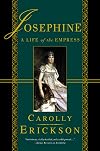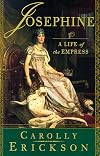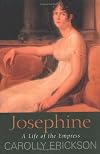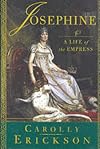
Josephine: A Life of the Empress
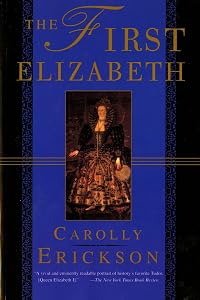
by Carolly Erickson
On This Page
Description
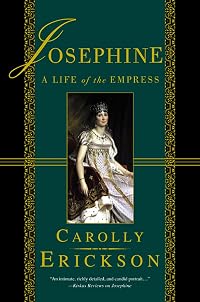
When, in 1804, Josephine Bonaparte knelt before her husband Napoleon to receive the imperial diadem, few in the vast crowd of onlookers were aware of the dark secrets hidden behind the imperial facade. To her subjects, she appeared to be the most favored woman in France: alluring, wealthy, and with the devoted love of a remarkable husband who was the conqueror of Europe. In actuality, Josephine's life was far darker: her celebrated allure was fading, her wealth was compromised by massive show more debt, and her marriage was corroded by infidelity and abuse. Josephine's life story was as turbulent as the age-an era of revolution and social upheaval, frenzied hedonism and the guillotine. With telling psychological depth, Erickson brings the complex, charming, ever resilient Josephine to life, carrying us from the sensual richness of her childhood in the tropics to her final lonely days at Malmaison. show lessTags
Recommendations




Member Reviews
This biography charts the unlikely rise and ignominious decline of the woman who would become Josephine, Empress of France. Born to an unlucky and soon to be impoverished family on the island of Martinique, she would survive hurricanes and ever-present fevers and eventually immigrate to France to marry a wealthy relation.
Her first marriage was blighted and left her with two children and an uncertain living which only became more uncertain as the Revolution swept France. But she would endure and survive, escaping the guillotine by the skin of her teeth and go on to become a social force in high society. So influential and well loved was she that a certain dashing young officer would court her passionately.
Her marriage to Napoleon was show more unfortunately also fraught with unhappiness and cruelty. Plagued throughout her life by illness and unable to bear him a son, she would face the embarrassment of being set aside for a younger, more fertile woman.
Josephine's life story is almost too fantastical to be believed. I was captivated from beginning to end. show less
Her first marriage was blighted and left her with two children and an uncertain living which only became more uncertain as the Revolution swept France. But she would endure and survive, escaping the guillotine by the skin of her teeth and go on to become a social force in high society. So influential and well loved was she that a certain dashing young officer would court her passionately.
Her marriage to Napoleon was show more unfortunately also fraught with unhappiness and cruelty. Plagued throughout her life by illness and unable to bear him a son, she would face the embarrassment of being set aside for a younger, more fertile woman.
Josephine's life story is almost too fantastical to be believed. I was captivated from beginning to end. show less
I'm sorry... but what the hell?
I read three of this author's histories back when I was a teenager looking for something to read in the school library. I read her biographies on Anne Boleyn, Elizabeth I, and Marie Antoinette. I remember enjoying these books back then though now I am more selective about my history books. I came across this book by chance and remembered enjoying her so I thought... hey, why not and I have never read a biography of Josephine so here's my chance.
Immediately, from the first chapter, things felt off. The book read more like a novel in some places, and if the author had wanted to do a novel about Josephine, I'd be game for it. But this was supposed to be a biography... and the author was putting in too many of show more her personal thoughts/speculation here, i.e. the feelings and inner thoughts of various members of Josephine's family or friends even though there was no way to know these thoughts. I wanted more fact, instead of the author ruminating on how or what Josephine was certain to, or must have thought or felt about this or that.
I did learn some things about Josephine, but this book overall was meh and I think this will be the last book I read by this author.
If any of my fellow readers would like to recommend a quality biography on Josephine, I'm all ears. show less
I read three of this author's histories back when I was a teenager looking for something to read in the school library. I read her biographies on Anne Boleyn, Elizabeth I, and Marie Antoinette. I remember enjoying these books back then though now I am more selective about my history books. I came across this book by chance and remembered enjoying her so I thought... hey, why not and I have never read a biography of Josephine so here's my chance.
Immediately, from the first chapter, things felt off. The book read more like a novel in some places, and if the author had wanted to do a novel about Josephine, I'd be game for it. But this was supposed to be a biography... and the author was putting in too many of show more her personal thoughts/speculation here, i.e. the feelings and inner thoughts of various members of Josephine's family or friends even though there was no way to know these thoughts. I wanted more fact, instead of the author ruminating on how or what Josephine was certain to, or must have thought or felt about this or that.
I did learn some things about Josephine, but this book overall was meh and I think this will be the last book I read by this author.
If any of my fellow readers would like to recommend a quality biography on Josephine, I'm all ears. show less
Excellent book but not exactly easy reading. Since I listen to audiobooks I made it through... I don't think I could have finished the hard copy version, so much detail. Interesting and thorough, however, so if you like deep dive books into nobility this is a good one.
Audiobook note :excellent narrator
Audiobook note :excellent narrator
This biography is probably among the worst that I have read. It reads like a novel, which isn’t necessarily a bad thing, but in this case, it fails to provide a convincing portrait of Josephine.
Carolly Erickson covers Josephine’s life from the great storm of her childhood in Martinique to her death. At times, her portrayal of Josephine as sweet, generous, grateful, and natural is at odds with the calculating promiscuous woman she also attempts to show. She doesn’t debate either view, but instead attempts to combine them and it comes out a bit strange. The book reads like a tabloid at times, not using Josephine’s own words but those of her observers. Josephine’s letters are occasionally used, but not often enough, especially show more when Erickson boldly states what Josephine was thinking or how she felt. As ostensibly history, I feel that a biography should state where these impressions are coming from, or if they’re the biographer’s imagining, since they are not fact. The sources are largely in French, which does make sense, but prevents me from researching further in order to discover the truth.
I found I didn’t like Erickson’s Josephine; despite protestations of strength she comes across as weak-willed, jealous, and whiny. That may well be how she was, but overall I didn’t like her much. I preferred Sandra Gulland’s Josephine, since while her trilogy is historical fiction, it uses more source material and provides a view of a Josephine harassed in every way but still true to herself, jealous but attempting to deal with her husband’s infidelity. That isn’t necessarily the truth either, but I preferred it. Also of note is the fact that Gulland maintains that Josephine never had the numerous affairs that Erickson ascribes to her. The evidence for these affairs is in fact scanty, and until more is found we’ll probably never know whether or not Josephine was loyal to Napoleon.
In addition, this book is only 350 pages long and doesn’t delve into any of the issues of the time, merely grazes over them in an attempt for a summary.
I think I will seek out a more scholarly account of Josephine since I don’t trust this one. I prefer a biography to be written more as a history, dealing with conflicting viewpoints and attempting to discern the truth, rather than a popular account that reads like a novel and challenges nothing. Very disappointing.
http://chikune.com/blog/?p=10 show less
Carolly Erickson covers Josephine’s life from the great storm of her childhood in Martinique to her death. At times, her portrayal of Josephine as sweet, generous, grateful, and natural is at odds with the calculating promiscuous woman she also attempts to show. She doesn’t debate either view, but instead attempts to combine them and it comes out a bit strange. The book reads like a tabloid at times, not using Josephine’s own words but those of her observers. Josephine’s letters are occasionally used, but not often enough, especially show more when Erickson boldly states what Josephine was thinking or how she felt. As ostensibly history, I feel that a biography should state where these impressions are coming from, or if they’re the biographer’s imagining, since they are not fact. The sources are largely in French, which does make sense, but prevents me from researching further in order to discover the truth.
I found I didn’t like Erickson’s Josephine; despite protestations of strength she comes across as weak-willed, jealous, and whiny. That may well be how she was, but overall I didn’t like her much. I preferred Sandra Gulland’s Josephine, since while her trilogy is historical fiction, it uses more source material and provides a view of a Josephine harassed in every way but still true to herself, jealous but attempting to deal with her husband’s infidelity. That isn’t necessarily the truth either, but I preferred it. Also of note is the fact that Gulland maintains that Josephine never had the numerous affairs that Erickson ascribes to her. The evidence for these affairs is in fact scanty, and until more is found we’ll probably never know whether or not Josephine was loyal to Napoleon.
In addition, this book is only 350 pages long and doesn’t delve into any of the issues of the time, merely grazes over them in an attempt for a summary.
I think I will seek out a more scholarly account of Josephine since I don’t trust this one. I prefer a biography to be written more as a history, dealing with conflicting viewpoints and attempting to discern the truth, rather than a popular account that reads like a novel and challenges nothing. Very disappointing.
http://chikune.com/blog/?p=10 show less
Truth be told, this book is a lot more like a novel than a history book, which probably isn't good if you are looking for some solid, impartial, historical facts, but which is great if you just want to get an idea about Josephine and her life, and you don't already know much about French history.
[full review here: http://spacebeer.blogspot.com/2005/08/bonjour.html ]
[full review here: http://spacebeer.blogspot.com/2005/08/bonjour.html ]
I really enjoyed this. I'm not a Josephine expert by any means but the writing style is more like a novel and less like a non-fiction work.
When I got this book I thought it was historical fiction, when it arrived it said it was a biography. So I thought ok but even as I was reading it I wasn't sure if it was a novel or a biography, it definitely reads like a novel.
I guess I didn't know much about Josephine when I started this book but I always thought that Napoleon & Josephine had this great love story but according to this book that’s not the case.
It was ok it did read like a novel at first then got a bit boring towards the end where I just wanted it to be over.
I guess I didn't know much about Josephine when I started this book but I always thought that Napoleon & Josephine had this great love story but according to this book that’s not the case.
It was ok it did read like a novel at first then got a bit boring towards the end where I just wanted it to be over.
Members
- Recently Added By
Author Information

49+ Works 8,800 Members
Carolly Erickson (born 1943) is an author of historical fiction and non-fiction. She lives in Hawaii. She is a historian and the author of The Hidden Diary of Marie Antoinette, The First Elizabeth, Great Catherine, Alexandra and many other prize-winning works of fiction and nonfiction. She earned her doctorate in history from Columbia University. show more (Bowker Author Biography) show less
Common Knowledge
- Canonical title
- Josephine: A Life of the Empress
- Original title
- Josephine
- Original publication date
- 1999-03-31
- People/Characters
- Empress Josephine; Napoleon Bonaparte; Charles, Captain Hippolyte; Beauharnais, Général Prince Eugène Rose de; Beauharnais, Hortense Eugénie Cécile de
- Important places
- Palais des Tuileries, Paris, France; Château de Malmaison, Rueil-Malmaison, Île-de-France, France
- First words
- There was a stillness in the heavy, humid air, and smoke from the cooking fires rose slowly straight upward into the cloudy sky a long way before drifting off sharply to the north.
- Last words
- (Click to show. Warning: May contain spoilers.)But Josephine's children and grandchildren remembered her with great fondness, as did all those who had known her and served her, and in the little church of Rueil, where so many had gathered to remember her on that June day, Hortense and Eugene put up a monument to their mother, a sculpted image of her as she was in her prime, with sweet, timid features and hands clasped in an attitude of hope.
- Original language
- English US
Classifications
- Genres
- Nonfiction, Biography & Memoir, History, General Nonfiction
- DDC/MDS
- 920 — History & geography Biographies, Genealogy, Healdry Biographies
- LCC
- DC216.1 .E75 — History of Europe, Asia, Africa and Oceania France – Andorra – Monaco History of France Modern, 1515- Revolutionary and Napoleonic period, 1789-1815
- BISAC
Statistics
- Members
- 288
- Popularity
- 111,717
- Reviews
- 10
- Rating
- (3.54)
- Languages
- English, Italian
- Media
- Paper, Audiobook, Ebook
- ISBNs
- 20
- ASINs
- 5