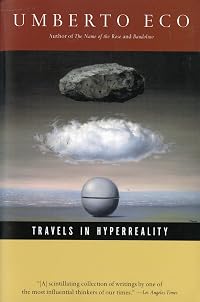
Travels in Hyper Reality: Essays
by Umberto Eco
On This Page
Description
A "scintillating collection" of essays on Disneyland, medieval times, and much more, from the author of Foucault's Pendulum (Los Angeles Times). Collected here are some of Umberto Eco's finest popular essays, recording the incisive and surprisingly entertaining observations of his restless intellectual mind. As the author puts it in the preface to the second edition: "In these pages, I try to interpret and to help others interpret some 'signs.' These signs are not only words, or images; they show more can also be forms of social behavior, political acts, artificial landscapes." From Disneyland to holography and wax museums, Eco explores America's obsession with artificial reality, suggesting that the craft of forgery has in certain cases exceeded reality itself. He examines Western culture's enduring fascination with the middle ages, proposing that our most pressing modern concerns began in that time. He delves into an array of topics, from sports to media to what he calls the crisis of reason. Throughout these travels-both physical and mental-Eco displays the same wit, learning, and lively intelligence that delighted readers of The Name of the Rose and Foucault's Pendulum. Translated by William Weaver show lessTags
Recommendations

Member Recommendations
Member Reviews
Ritka eklektikus tanulmánykötet ez, és alighanem csak némi eco-i logikai-szemiotikai bűvészmutatvánnyal lehet a részeit egyetlen szálra felfűzni. Ez az „egyetlen szál” legyen mondjuk az Új Középkor eszméje, az a vélekedés, hogy a modern kor megismétel egyes, a középkorra jellemző tendenciákat – mindenekelőtt azzal, hogy kapcsolódási pontok híján a középkorban is végletesen elkülönült az ún. (latin nyelvű) magaskultúra és a (nemzeti nyelvű) populáris kultúra, és úgy fest, ez az elkülönülés a XX. század második, és a XXI. század első felében is tetten érhető*. Eco pedig abban a legjobb, ahogy a populáris és az elitkultúrát összeköti, leginkább azzal, hogy megpróbálja show more mindkettőt egységes kritériumrendszer alapján vizsgálni. Így fordulhat elő, hogy akár Szent Tamásról, akár a fociról beszél, ugyanolyan logikai mértékegységek alapján kategorizálja őket. Talán ezért is tűnik kissé olybá, mintha egy vásári mutatványt látnánk: amikor egy triviálisnak tűnő jelenséget (mondjuk egy televíziós műsort) ilyen komplex vizsgálatnak vetnek alá, az olvasóban felébredhet a gyanú, hogy itt ágyúval lőnek verébre. Arról nem is beszélve, hogy ilyenkor az, ami eddig egyszerűnek látszott, hirtelen végtelenül összetetté és bonyolulttá válik – mintha az elemzés nem azért lenne szükséges, hogy megértsünk valamit, hanem hogy homályba burkolja azt, ami világos. Azt hiszem, ezért tűnik úgy, mintha Eco folyton tréfálkozna velünk**, holott ez a módszer véresen komoly, és szerintem nagyon nagy szolgálatot tesz a mester azzal, hogy utat tör valamiféle fúziós, egyetemes kultúraértékelés felé. (Már ha létezhet ilyen egyáltalán…) Viszont sajnos a kötet legnagyobb hibája is erre a szándékra vezethető vissza: bár az esszék konklúziói abszolút értékállóak, de maguk a populizmusokra felhozott példák törvényszerű módon iszonyatosan elavultak mára – sőt, jelentős részük már akkor ismeretlen lehetett a magyar olvasónak, amikor e könyvet lefordították (pl. az olasz televíziózás jelentős személyiségei). Ez néhány tanulmányt szinte az élvezhetetlenség határára sodor, és lövésem sincs, hogy a kiadó miért nem lábjegyzetelte meg alaposan az egészet. Amúgy meg nagyon fontos válogatás.
* Persze ha jobban megkaparjuk, ez a jelenség akár az összes kor jellemzője is lehet, de hát akkor ne kapargassuk.
** Meg persze azért, mert Eco ettől függetlenül valóban folyton tréfálkozik velünk. Hála Istennek, mert ő az egyik legjobb humorú esszéista ezen a földtekén. show less
* Persze ha jobban megkaparjuk, ez a jelenség akár az összes kor jellemzője is lehet, de hát akkor ne kapargassuk.
** Meg persze azért, mert Eco ettől függetlenül valóban folyton tréfálkozik velünk. Hála Istennek, mert ő az egyik legjobb humorú esszéista ezen a földtekén. show less
The first thing to say about this text, is that it is really a series of unrelated polemics, op-eds, musings and intellectual ponderings that would have done better to be separated out and sold in like collections, not shoved together and bound like spouses' unknown partners thrown together at a high school reunion.
I mention that first because whilst Eco does elude to the book being an eclectic mix, it is probably a little more eclectic and a little less cohesive than one might have hoped for. Perhaps this is testament to his versatility or perhaps it is testament to the greed of publishers - I assume the latter. I couldn't help but feel that the beginning of this book was a significantly less desirable attempt to cast the show more Euro-philosopher's eye Westward with rather dire results.
Perhaps the greatest charm of this work is the Italian philosopher's weltanschauung (as opposed to the French philosophers'). As per fashion, alcohol, car design and architecture, so philosophy presents itself differently in the mind. Eco seemed rather more human and witty at times, something Baudrillard could never be accused of, and this resonates a certain sympathetic tone in the reader's chest.
One very small downside to this text is just how dated it is, and whilst in purely philosophical terms that isn't a problem, in historical discourse it is. Clearly Eco was commenting on events fresh in the lives of late '60s, '70s Italians and that rather comes across like reading an old newspaper you found stuffed in the wall. The work then becomes something of a historical curiosity rather than a work of philosophy, which is a shame.
All in all 'Travels in Hyperreality' represents a noble spoke on the wheel of postmodernist discourse and theory and without it we would, no doubt be worse off. show less
I mention that first because whilst Eco does elude to the book being an eclectic mix, it is probably a little more eclectic and a little less cohesive than one might have hoped for. Perhaps this is testament to his versatility or perhaps it is testament to the greed of publishers - I assume the latter. I couldn't help but feel that the beginning of this book was a significantly less desirable attempt to cast the show more Euro-philosopher's eye Westward with rather dire results.
Perhaps the greatest charm of this work is the Italian philosopher's weltanschauung (as opposed to the French philosophers'). As per fashion, alcohol, car design and architecture, so philosophy presents itself differently in the mind. Eco seemed rather more human and witty at times, something Baudrillard could never be accused of, and this resonates a certain sympathetic tone in the reader's chest.
One very small downside to this text is just how dated it is, and whilst in purely philosophical terms that isn't a problem, in historical discourse it is. Clearly Eco was commenting on events fresh in the lives of late '60s, '70s Italians and that rather comes across like reading an old newspaper you found stuffed in the wall. The work then becomes something of a historical curiosity rather than a work of philosophy, which is a shame.
All in all 'Travels in Hyperreality' represents a noble spoke on the wheel of postmodernist discourse and theory and without it we would, no doubt be worse off. show less
Umberto Eco (who died only in February 2016) scored a major popular hit in the English-speaking world with his historical mystery novel The Name of the Rose filmed with Sean Connery in the lead role and released in 1986 (the same year as this collection was published in English).
Eco was a leading Italian intellectual, undoubtedly highly intelligent, whose interests covered medieval philosophy and aesthetics, literary criticism, media studies, semiotics and anthropology. As a novelist, he was almost the type of the hyper-rational post-modernist of the era.
This selection of translated essays has all the hall marks of the commercial exploitation of a cultural phenomenon at a particular time and place alongside a major movie and just before show more a second popular (if less interesting) novel, Foucault's Pendulum (1988).
The collection is, in fact, scrappy without context or introduction, glossed from journalistic and other writings between the mid-1960s and the early 1980s - sometimes insightful, often obscure and, equally often, I am afraid, deadly dull unless you are already a specialist.
The intellect is on display but sometimes it is just far too clever-clever and, of course, the passing of three decades has made semiotics seem a little, well, obvious. If anything, semiotic hyper-intellectualism increasingly looks like a tired game that elicits a 'so what?'
Many of the concerns of the period - to be expected from pieces written for the educated Italian middle class of the day - no longer concern us, notably the idiocies of Italian 1970s Leftism, the dying days of serious university Marxist theory and fashionable figures like McLuhan.
This is not to say that the essays are worthless, far from it, but they are almost (taken as a whole) antiquarian, mostly interesting to specialists in intellectual history or to other hyper-intellectuals.
Beneath all the superficial cleverness are some solid and sensible ideas, especially about the foolishness of late Marxist revolutionary terrorism, semiotics (which we rather take for granted nowadays), power as Foucault saw it and the shoddy thinking of other polemical intellectuals.
What I think I would rather have seen was an introduction to his ideas on specific areas - medieval thought, mass communication, the hyperreal and politics - that was more coherently presented or at least had some thoughtful introduction by another intellectual who could interpret Eco for us.
In the end, one comes to the conclusion that there is a) Eco the novelist and b) Eco the public and academic intellectual. Although there are connections between the two for a biographer to unpick, it is best just to enjoy the novels without the intellectual paraphrenalia.
Eco was an important and stimulating force in Italian society and culture and a serious contributor to every field he studied. If anything, simply dumping a selection of writings without context on the English-speaking public did him a grave disservice. He may have deserved better. show less
Eco was a leading Italian intellectual, undoubtedly highly intelligent, whose interests covered medieval philosophy and aesthetics, literary criticism, media studies, semiotics and anthropology. As a novelist, he was almost the type of the hyper-rational post-modernist of the era.
This selection of translated essays has all the hall marks of the commercial exploitation of a cultural phenomenon at a particular time and place alongside a major movie and just before show more a second popular (if less interesting) novel, Foucault's Pendulum (1988).
The collection is, in fact, scrappy without context or introduction, glossed from journalistic and other writings between the mid-1960s and the early 1980s - sometimes insightful, often obscure and, equally often, I am afraid, deadly dull unless you are already a specialist.
The intellect is on display but sometimes it is just far too clever-clever and, of course, the passing of three decades has made semiotics seem a little, well, obvious. If anything, semiotic hyper-intellectualism increasingly looks like a tired game that elicits a 'so what?'
Many of the concerns of the period - to be expected from pieces written for the educated Italian middle class of the day - no longer concern us, notably the idiocies of Italian 1970s Leftism, the dying days of serious university Marxist theory and fashionable figures like McLuhan.
This is not to say that the essays are worthless, far from it, but they are almost (taken as a whole) antiquarian, mostly interesting to specialists in intellectual history or to other hyper-intellectuals.
Beneath all the superficial cleverness are some solid and sensible ideas, especially about the foolishness of late Marxist revolutionary terrorism, semiotics (which we rather take for granted nowadays), power as Foucault saw it and the shoddy thinking of other polemical intellectuals.
What I think I would rather have seen was an introduction to his ideas on specific areas - medieval thought, mass communication, the hyperreal and politics - that was more coherently presented or at least had some thoughtful introduction by another intellectual who could interpret Eco for us.
In the end, one comes to the conclusion that there is a) Eco the novelist and b) Eco the public and academic intellectual. Although there are connections between the two for a biographer to unpick, it is best just to enjoy the novels without the intellectual paraphrenalia.
Eco was an important and stimulating force in Italian society and culture and a serious contributor to every field he studied. If anything, simply dumping a selection of writings without context on the English-speaking public did him a grave disservice. He may have deserved better. show less
Unlike Eco's other works but his musings on tight blue jeans and the movie Casablanca were worth the money. Overall, it was a reasonable page-turner except the titular essay which was unfortunately proved to be a drag for me. I am now going to check his other essay collection on language and cognition.
Three stars for being obviously well crafted, but it seems like Eco is far more in love with, figuratively speaking, the sound of his own voice more so than he is with making a coherent point.
I've read the portuguese translation of this book. Excellent, should be mandatory in all graduation courses.
Occasional writings may be very readable on or around the occasion i.c. or in a given time period, but collections of such writings often result in tedious reads one has to drag through. Travels in hyperreality by Umberto Eco is such a collection of dead wood, that someone pasted an enticing new title on. A selection of readings from the 70s and 80s, this volume did me nothing.
Members
- Recently Added By
Lists

Italian Literature
558 works; 42 members
Author Information

504+ Works 115,357 Members
Umberto Eco was born in Alessandria, Italy on January 5, 1932. He received a doctorate of philosophy from the University of Turin in 1954. His first book, Il Problema Estetico in San Tommaso, was an extension of his doctoral thesis on St. Thomas Aquinas and was published in 1956. His first novel, The Name of the Rose, was published in 1980 and won show more the Premio Strega and the Premio Anghiar awards in 1981. In 1986, it was adapted into a movie starring Sean Connery. His other works include Foucault's Pendulum, The Island of the Day Before, Baudolino, The Prague Cemetery, and Numero Zero. He also wrote children's books and more than 20 nonfiction books including Serendipities: Language and Lunacy. He taught philosophy and then semiotics at the University of Bologna. He also wrote weekly columns on popular culture and politics for L'Espresso. He died from cancer on February 19, 2016 at the age of 84. (Bowker Author Biography) show less
Some Editions
Series
Belongs to Publisher Series
Work Relationships
Is contained in
Has as a student's study guide
Common Knowledge
- Canonical title
- Travels in Hyper Reality: Essays
- Original title
- Sette anni di desiderio
- Alternate titles
- Faith In Fakes
- Original publication date
- 1984
- Important places
- California, USA; Florida, USA; Brazil; Italy
- First words
- Two very beautiful naked girls are crouched facing each other.
- Quotations
- The real hero is always a hero by mistake; he dreams of being an honest coward like everybody else.
- Last words
- (Click to show. Warning: May contain spoilers.)Shouldn't the designers of future expositions confront again the problem of Mohammed and the Mountain?
- Original language
- Italian
Classifications
- Genres
- Nonfiction, Literature Studies and Criticism
- DDC/MDS
- 854.914 — Literature & rhetoric Italian, Romanian & related literatures Italian essays 1900- 20th Century 1945-1999
- LCC
- PQ4865 .C6 .T7 — Language and Literature French, Italian, Spanish and Portuguese literatures Italian literature Individual authors, 1961-2000
- BISAC
Statistics
- Members
- 2,511
- Popularity
- 7,663
- Reviews
- 18
- Rating
- (3.54)
- Languages
- 12 — Dutch, English, Estonian, Finnish, French, German, Hungarian, Italian, Spanish, Swedish, Turkish, Portuguese (Portugal)
- Media
- Paper, Ebook
- ISBNs
- 40
- ASINs
- 24