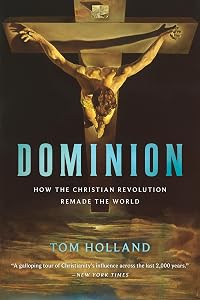
Dominion: How the Christian Revolution Remade the World
by Tom Holland
On This Page
Description
"Christianity is the most enduring and influential legacy of the ancient world, and its emergence is the single most transformative development in Western history. [This book] explores what it was that made Christianity so revolutionary and why, in a West that has become increasingly doubtful of religion's claims, so many of its instincts remain irredeemably Christian. Today, the West remains utterly saturated by Christian assumptions. Our morals and ethics are not universal. Instead, they show more are the fruits of a very distinctive civilization. Concepts such as secularism, liberalism, science, and homosexuality are deeply rooted in a Christian seedbed. From Babylon to the Beatles, Saint Michael to #MeToo, Dominion tells the story of how Christianity transformed the world" -- inside front jacket flap. show lessTags
Recommendations






Member Reviews
This book sets out to chart the development of the whole corpus of Western thought and social development through the prism of Christian theology. That sounds like a pretty tall order, and for a while I had doubts about the whole project. The author explores this theme by recapitulating the history of belief in the ancient world and then recounting a fairly detailed history of the early church.
I was beginning to have doubts about the book, and only the fairly easy style kept me reading through the early chapters - after all, if I'd wanted to read early church history, I'd have gone looking for it - but then I got to Chapter 5, on 'Charity', and I began to see signs of an exploration of the origin of the concept in Christian teaching. show more Though I have to say that I reached the end of the chapter and thought "Why is it that so many people on the political Christian Right proclaim their faith and yet do not show signs of following these precepts?". Answer came there none.
If I have a criticism of the book, this is it: each theme is discussed, but Holland keeps to his strict historical progression. Concepts such as charity, science or the abolition of slavery are discussed as they arise in their historical context, but they are not followed through as topics up to the present day as individual strands. Instead, the reader has to continue through the book until the strand re-emerges in a new historical context.
I detected one gap in the story; I expected to find some discussion of the Morton Hypothesis, the idea that different strands of Christianity as practised in different countries led to pre-eminence in either the arts (Catholicism) or the sciences (Protestantism). Still, in more than five hundred pages, there is enough to be going on with.
Nonetheless, the thesis remains sound: that there are enough paradoxes, contradictions and inconsistencies within the Bible for scholars and theologians over the centuries to have exposed entire areas where both sides of any modern social or philosophical argument that you care to mention can be supported by different arguments within Christian theology.
Just when you think that the book is going to close with no firm conclusion, just another story of a movement in human thought, Holland shifts focus to his own story, drawing on a favourite aunt who was also his godmother. He also speaks of his own childhood and the questioning that led him away from belief and instead into enquiry. In his case, it was dinosaurs; why they evolved, why they disappeared, why we still see them in the world today, but only as birds, and why a benevolent God should send an asteroid to smash into the Mesozoic Earth and sentence so many non-sentient species to extinction. My story is similar, though in my case it was spaceships and rockets; it seems that when my primary school teachers talked about Jesus and God and Heaven, I kept asking difficult questions about satellites. My mother was asked to try to curb my curiosity. That she didn't is probably the reason why I ultimately shared Holland's thirst for enquiry.
That spirit of enquiry ultimately won over my opinion of this book; there are so many asides, snippets of information thrown into the narrative, and historical stories that fell fairly neatly into place that I was won over, though I remain a bit troubled that in so many instances, Holland leads the reader just so far and then expects them to finish the journey to a conclusion on their own, at least where individual strands of thought are concerned. But the overall thesis, that irrespective of any one person's beliefs, the basis of Western society and thought is influenced by Christianity, remains. show less
I was beginning to have doubts about the book, and only the fairly easy style kept me reading through the early chapters - after all, if I'd wanted to read early church history, I'd have gone looking for it - but then I got to Chapter 5, on 'Charity', and I began to see signs of an exploration of the origin of the concept in Christian teaching. show more Though I have to say that I reached the end of the chapter and thought "Why is it that so many people on the political Christian Right proclaim their faith and yet do not show signs of following these precepts?". Answer came there none.
If I have a criticism of the book, this is it: each theme is discussed, but Holland keeps to his strict historical progression. Concepts such as charity, science or the abolition of slavery are discussed as they arise in their historical context, but they are not followed through as topics up to the present day as individual strands. Instead, the reader has to continue through the book until the strand re-emerges in a new historical context.
I detected one gap in the story; I expected to find some discussion of the Morton Hypothesis, the idea that different strands of Christianity as practised in different countries led to pre-eminence in either the arts (Catholicism) or the sciences (Protestantism). Still, in more than five hundred pages, there is enough to be going on with.
Nonetheless, the thesis remains sound: that there are enough paradoxes, contradictions and inconsistencies within the Bible for scholars and theologians over the centuries to have exposed entire areas where both sides of any modern social or philosophical argument that you care to mention can be supported by different arguments within Christian theology.
Just when you think that the book is going to close with no firm conclusion, just another story of a movement in human thought, Holland shifts focus to his own story, drawing on a favourite aunt who was also his godmother. He also speaks of his own childhood and the questioning that led him away from belief and instead into enquiry. In his case, it was dinosaurs; why they evolved, why they disappeared, why we still see them in the world today, but only as birds, and why a benevolent God should send an asteroid to smash into the Mesozoic Earth and sentence so many non-sentient species to extinction. My story is similar, though in my case it was spaceships and rockets; it seems that when my primary school teachers talked about Jesus and God and Heaven, I kept asking difficult questions about satellites. My mother was asked to try to curb my curiosity. That she didn't is probably the reason why I ultimately shared Holland's thirst for enquiry.
That spirit of enquiry ultimately won over my opinion of this book; there are so many asides, snippets of information thrown into the narrative, and historical stories that fell fairly neatly into place that I was won over, though I remain a bit troubled that in so many instances, Holland leads the reader just so far and then expects them to finish the journey to a conclusion on their own, at least where individual strands of thought are concerned. But the overall thesis, that irrespective of any one person's beliefs, the basis of Western society and thought is influenced by Christianity, remains. show less
Summary: A history of Christianity describing its cultural and moral impact over two millenia from its shocking beginnings in a crucifixion.
Perhaps one of the most staggering observations Tom Holland makes in this massive book comes near the beginning:
“That a man who had himself been crucified might be hailed as a god could not help but be seen by people everywhere across the Roman world as scandalous, obscene, grotesque. The ultimate offensiveness, though, was to one particular people: Jesus’ own” (p. 6).
Whatever one thinks of Christianity, accounting for its rise, spread, and cultural impact is not easy to explain. The “scandal of the cross,” that its central figure, who died one of the most ignominious deaths, is revered show more and worshipped as “Lord” by nearly a third of the world’s population, is difficult to account for.
Tom Holland moves from these beginnings to explore the milieu within which Christianity arose and how one might account for its spread. He notes the radical inclusiveness of Paul’s message, cutting across ethnic and class distinctions and challenging the claims of empire. From here, he traces a sprawling history, from the early doctrinal controversies and councils all the way to the Beatles’ assertion that “all we need is love.”
The book does far more than chronicle the rise and spread of Christianity. It argues for the moral and cultural influence of Christian faith, a heritage he claims we continue to live off of in our secular age. However the history is not merely one of compelling ideas and exemplary moral figures, though we encounter much of this. We also encounter ruthless political and church leaders who extend the church’s influence by human might or detract from it by their corruption.
For example, consider the history of slavery and the church’s equivocal witness. Opposition to slavery can be traced back to Gregory of Nyssa:
“Gregory was moved by the existence of slavery not just to condemn the extremes of wealth and poverty but to define the institution itself as an unpardonable offence against God. Human nature, so he preached, had been constituted by its Creator as something free. As such, it was literally priceless. ‘Not all the universe would constitute an adequate payment for the soul o£ a mortal,’?” (p. 142).
Yet for centuries, the church assented and even offered theological defenses of slavery. But leaders of the same church, from Wilberforce in England to the abolitionists in the U.S. appealed to both creation and the gospel as a basis for eliminating slavery. Often, when the church failed to act, its sharpest critics, such as Nietzsche, use the church’s teaching to call out its failures.
The parade of figures to which he introduces us is breathtaking. One of those whose story I’d not known was Elizabeth of Hungary, a princess who dressed as a beggar and served under a tyrannical abbot. She alternated time between a kitchen and a hospital, caring for the poor. She died at twenty-four. Because of the reports of miracles, the church elevated her to sainthood. Her name was on the hospital where I was born.
Holland makes a compelling case for the impact of Christianity on cultures, from hospitals and universities, to the end of apartheid in South Africa. But I wonder if he stretches the case at times, such as in his discussion of Marxism. Yes, some have argued it a Christian heresy. However, its vile destructiveness in so many places makes me question that.
I also wrestled to keep the thread of his argument in the rapid succession of so many people and events. Despite the book’s size, this is actually not a large book considering the expanse of history Holland tries to cover. And in the modern period, he jumps from 1916 and Tolkien’s work to the Sixties, and then to the present. Inevitably, he must be selective. For example, he says nothing of Karl Barth or Reinhold Niebuhr. The latter deeply influenced George Kennan, the architect of the West’s policy of containment that brought the eventual fall of communism.
I think part of the problem is that the narrative proceeded by a series of vignettes, breaking up narrative continuity. Holland gets away with this by writing so well. However, based on what I’d heard, I expected a more compelling argument. Instead, I got one vignette after another. Each was engaging, and on reflection, they make a cumulative the case for Christian influence to this day. But what this pointed up to me was how hard it is to do what Holland attempts.
At the same time, his narrative and its implications do raise important questions in an era we call “post Christian.” Particularly, I wonder how long can we live off a Christian “legacy” before we exhaust it? And what then? show less
Perhaps one of the most staggering observations Tom Holland makes in this massive book comes near the beginning:
“That a man who had himself been crucified might be hailed as a god could not help but be seen by people everywhere across the Roman world as scandalous, obscene, grotesque. The ultimate offensiveness, though, was to one particular people: Jesus’ own” (p. 6).
Whatever one thinks of Christianity, accounting for its rise, spread, and cultural impact is not easy to explain. The “scandal of the cross,” that its central figure, who died one of the most ignominious deaths, is revered show more and worshipped as “Lord” by nearly a third of the world’s population, is difficult to account for.
Tom Holland moves from these beginnings to explore the milieu within which Christianity arose and how one might account for its spread. He notes the radical inclusiveness of Paul’s message, cutting across ethnic and class distinctions and challenging the claims of empire. From here, he traces a sprawling history, from the early doctrinal controversies and councils all the way to the Beatles’ assertion that “all we need is love.”
The book does far more than chronicle the rise and spread of Christianity. It argues for the moral and cultural influence of Christian faith, a heritage he claims we continue to live off of in our secular age. However the history is not merely one of compelling ideas and exemplary moral figures, though we encounter much of this. We also encounter ruthless political and church leaders who extend the church’s influence by human might or detract from it by their corruption.
For example, consider the history of slavery and the church’s equivocal witness. Opposition to slavery can be traced back to Gregory of Nyssa:
“Gregory was moved by the existence of slavery not just to condemn the extremes of wealth and poverty but to define the institution itself as an unpardonable offence against God. Human nature, so he preached, had been constituted by its Creator as something free. As such, it was literally priceless. ‘Not all the universe would constitute an adequate payment for the soul o£ a mortal,’?” (p. 142).
Yet for centuries, the church assented and even offered theological defenses of slavery. But leaders of the same church, from Wilberforce in England to the abolitionists in the U.S. appealed to both creation and the gospel as a basis for eliminating slavery. Often, when the church failed to act, its sharpest critics, such as Nietzsche, use the church’s teaching to call out its failures.
The parade of figures to which he introduces us is breathtaking. One of those whose story I’d not known was Elizabeth of Hungary, a princess who dressed as a beggar and served under a tyrannical abbot. She alternated time between a kitchen and a hospital, caring for the poor. She died at twenty-four. Because of the reports of miracles, the church elevated her to sainthood. Her name was on the hospital where I was born.
Holland makes a compelling case for the impact of Christianity on cultures, from hospitals and universities, to the end of apartheid in South Africa. But I wonder if he stretches the case at times, such as in his discussion of Marxism. Yes, some have argued it a Christian heresy. However, its vile destructiveness in so many places makes me question that.
I also wrestled to keep the thread of his argument in the rapid succession of so many people and events. Despite the book’s size, this is actually not a large book considering the expanse of history Holland tries to cover. And in the modern period, he jumps from 1916 and Tolkien’s work to the Sixties, and then to the present. Inevitably, he must be selective. For example, he says nothing of Karl Barth or Reinhold Niebuhr. The latter deeply influenced George Kennan, the architect of the West’s policy of containment that brought the eventual fall of communism.
I think part of the problem is that the narrative proceeded by a series of vignettes, breaking up narrative continuity. Holland gets away with this by writing so well. However, based on what I’d heard, I expected a more compelling argument. Instead, I got one vignette after another. Each was engaging, and on reflection, they make a cumulative the case for Christian influence to this day. But what this pointed up to me was how hard it is to do what Holland attempts.
At the same time, his narrative and its implications do raise important questions in an era we call “post Christian.” Particularly, I wonder how long can we live off a Christian “legacy” before we exhaust it? And what then? show less
I loved Tom Holland’s *In The Shadows of the Sword* and had read so many positive reviews or mentions of this book I was quite excited to actually read it. What a disappointment!
At the very end of the book Holland’s writes about his childhood connection to Christianity, his drifting away and his recent return instigated by his repulsion from the lack of firm moral foundation in the atheistic world he embraced in his youth. That section was actually quite moving and well written. My sense from reading this conclusion, is that the book was written backwards (more on this below).
There are so many flawed argument is this book, many of which are mentioned in other reviews. So I will only summarize the core problems here:
1. Holland show more cherry-picks to make his case, he doesn’t really present a compelling argument
2. He is so intent on showing the uniqueness of Christianity’s morality, he ignores the same ideas appearing elsewhere and earlier (Buddha lived 6 centuries before Jesus to give just one example)
3. Christianity is one element and an important one of Western civilization, but many of the ideas he claims come from Christianity actually come from those other cultural threads that form the tapestry of European culture and ideas. Others are ideas that are products of very particular social, political and economic forces.
To take just one example that illustrates these three points: Holland hammers at the idea of crucifixion being a “slave punishment” and the god Jesus dying by crucifixion is the unique source of the modern idea of “revolution of the oppressed”. That’s a quite bold claim.
If Holland had stuck to the more modest claim that Christianity promoted a concern for all people and particularly the poor (again, not something at all unique) I wouldn’t criticize him. But he hammers the point over and over that this is a *uniquely* Christian idea that spilled into the modern era. He explicitly ties the French Revolution to heretical movements like the Lollards, seemingly because Jesus and Paul were, in his view, class-based “revolutionaries”.
Of course, this is nonsense. First he just lightly touches on the fact that for nearly two millennia slavery was considered perfectly normal by Christians. Moreover today capitalism, rather than socialism is more mainstream throughout the Christian world. Bringing a few exceptions to this rule is cherry picking.
Next, Holland ignores these same ideas outside the Christian world. For example, the slave revolution of Spartacus occurred a century before Christianity. Who inspired Spartacus if this is a uniquely Christian thing?
Finally, the examples he gives (e.g. the Lollards) were products of particular and local social, economic and political forces, which Holland only briefly touches on or underplays. The claim that they were inspired by “unique” Christian ideas is a stretch, since their opponents were equally Christian and shared the same Christian values and ideas. Rather, a simpler explanation is that since all sides lived inside a world saturated with Christian ideas and symbols, it is perfectly natural that they re-purposed these as arguments for and against their behaviors.
Going back to my claim that this book was written backwards: Since Holland wants to justify his return to Christianity, he makes strong claims that all “good” things uniquely come from Christianity and wouldn’t become standard behavior in society if it weren’t for Christianity. Since he is steeped in the Enlightenment’s obsession with “morality” and in the current Anglo-sphere “progressive” value system, he wants to show all morally “good” stuff (i.e stuff “progressives” value) uniquely comes from Christianity, and all morally “bad” stuff are a result of abandoning Christianity.
The irony is that his focus on the “Universal” and “morality” and his attempt to make these the defining core of Christianity, blinds him to the best reason he should embrace Christianity. That reason has nothing to do with morals *per se*. Rather, Christianity (like other cultures with a transcendent core) provides grounding, community and a sense of the sacred, all three of which are sorely lacking in the utter narcissism of the contemporary post-modern world. And since as he notes at the end of the book, Christianity is the culture he grew up in and feels at home in, it’s particularly suited for him.
In conclusion, this book is an apologia and a poorly argued and not very well thought out one at that. Like others of this genre, it gets repetitive and boring. Given Holland’s great skill at popular history writing, this is a shame. And worst of all, he misses the mark of what he is arguing for. show less
At the very end of the book Holland’s writes about his childhood connection to Christianity, his drifting away and his recent return instigated by his repulsion from the lack of firm moral foundation in the atheistic world he embraced in his youth. That section was actually quite moving and well written. My sense from reading this conclusion, is that the book was written backwards (more on this below).
There are so many flawed argument is this book, many of which are mentioned in other reviews. So I will only summarize the core problems here:
1. Holland show more cherry-picks to make his case, he doesn’t really present a compelling argument
2. He is so intent on showing the uniqueness of Christianity’s morality, he ignores the same ideas appearing elsewhere and earlier (Buddha lived 6 centuries before Jesus to give just one example)
3. Christianity is one element and an important one of Western civilization, but many of the ideas he claims come from Christianity actually come from those other cultural threads that form the tapestry of European culture and ideas. Others are ideas that are products of very particular social, political and economic forces.
To take just one example that illustrates these three points: Holland hammers at the idea of crucifixion being a “slave punishment” and the god Jesus dying by crucifixion is the unique source of the modern idea of “revolution of the oppressed”. That’s a quite bold claim.
If Holland had stuck to the more modest claim that Christianity promoted a concern for all people and particularly the poor (again, not something at all unique) I wouldn’t criticize him. But he hammers the point over and over that this is a *uniquely* Christian idea that spilled into the modern era. He explicitly ties the French Revolution to heretical movements like the Lollards, seemingly because Jesus and Paul were, in his view, class-based “revolutionaries”.
Of course, this is nonsense. First he just lightly touches on the fact that for nearly two millennia slavery was considered perfectly normal by Christians. Moreover today capitalism, rather than socialism is more mainstream throughout the Christian world. Bringing a few exceptions to this rule is cherry picking.
Next, Holland ignores these same ideas outside the Christian world. For example, the slave revolution of Spartacus occurred a century before Christianity. Who inspired Spartacus if this is a uniquely Christian thing?
Finally, the examples he gives (e.g. the Lollards) were products of particular and local social, economic and political forces, which Holland only briefly touches on or underplays. The claim that they were inspired by “unique” Christian ideas is a stretch, since their opponents were equally Christian and shared the same Christian values and ideas. Rather, a simpler explanation is that since all sides lived inside a world saturated with Christian ideas and symbols, it is perfectly natural that they re-purposed these as arguments for and against their behaviors.
Going back to my claim that this book was written backwards: Since Holland wants to justify his return to Christianity, he makes strong claims that all “good” things uniquely come from Christianity and wouldn’t become standard behavior in society if it weren’t for Christianity. Since he is steeped in the Enlightenment’s obsession with “morality” and in the current Anglo-sphere “progressive” value system, he wants to show all morally “good” stuff (i.e stuff “progressives” value) uniquely comes from Christianity, and all morally “bad” stuff are a result of abandoning Christianity.
The irony is that his focus on the “Universal” and “morality” and his attempt to make these the defining core of Christianity, blinds him to the best reason he should embrace Christianity. That reason has nothing to do with morals *per se*. Rather, Christianity (like other cultures with a transcendent core) provides grounding, community and a sense of the sacred, all three of which are sorely lacking in the utter narcissism of the contemporary post-modern world. And since as he notes at the end of the book, Christianity is the culture he grew up in and feels at home in, it’s particularly suited for him.
In conclusion, this book is an apologia and a poorly argued and not very well thought out one at that. Like others of this genre, it gets repetitive and boring. Given Holland’s great skill at popular history writing, this is a shame. And worst of all, he misses the mark of what he is arguing for. show less
I was really looking forward to a work that could explain how the idiosyncrasies of Christianity have consciously and unconsciously shaped contemporary Western thought. That's not what this book does. Its central conceit is to claim many of the great intellectual advances of history for Christianity. My knowledge of antiquity is such that I had to give Holland the benefit of the doubt regarding times where my scholarship is patchy. The closer it moved to the present, however, the more suspicious I got. There's a lot of intellectual sleight of hand, running along the lines, if a great thing happened and Christians were adjacent to it, then that counts as a great Christian achievement. It becomes quite ludicrous at the end, including show more making an argument for GW Bush as a great Christian statesmen, shocked and affronted by the brutality of the Islamic world. This is a long-winded, lazy apologia for Christianity. It may preach to its choir, but for any serious-minded and skeptical reader it should have the opposite of its intended effect. show less
I just finished this historian's thesis and I must say, its intriguing! Its premise is that Western culture has been in a "fishbowl" of Christian thought for nearly two thousand years, regardless of our traditional or belief. From civil rights, equality, to ideas of justice, according to Holland, it can theoretically be traced back to the writings of the Gospels and Paul's letters. Holland goes from the pre-Christian lives of the Romans/Greeks, to the present day. It is enlightening. If you are a student of history, its a page-turner in my opinion.
This is a big book; as it seeks to take us all the way from Xerxes crossing the Hellespont in 479 BC to AD 2017, Harvey Weinstein and the #metoo movement, it has to be. Tom Holland is a gifted and experienced writer, however, and this is a sure-footed and entertaining ride through the history of the Western world, a history that could have been a whole lot bigger.
Inevitably there are sweeping statements and huge selectivity but that is a virtue as much as a vice, even when your favourites are missing. His ability to make allusions and backward and forward references are a delight that enhances the reading experience. Examples would include a series of references to Pilgrim’s Progress when talking about the Puritans, without ever show more mentioning Bunyan, and his statements about Winstanley the Digger of whom he writes that his “foes might dismiss him as a dreamer; but he was not the only one” and that his hope was that someday others would join the Diggers “and the world would be as one” (350). These references to John Lennon are later justified when he tells us that Lennon came to live in time where the Diggers digged on St George’s Hill.
What Holland does is to choose stories, either unfamiliar but relevant ones or familiar ones that he has spun a little, to typify the periods about which he writes. The penultimate chapter takes us from 1967 to 2014 by talking only about the Beatles, Martin Luther King, Live Aid, Milingo, Tutu, Bush, Iraq and ISIS, so one can see how superficial such a work is in danger of being.
Holland writes at times very personally and wants us to know where he is coming from. Typical of many in this country perhaps, he grew up going to Sunday School and getting some sort of watered-down gospel from family and friends but rejected it all before he was old enough to grow a beard. As the years have gone by, however, he has thought about things a little more maturely and wonders if, in fact, he is more of a Christian than he ever realised. His previous works on Persians, Romans and Greeks leave him in no doubt that on the whole these people had a ‘complete lack of any sense that the poor or the weak might have the slightest intrinsic value’. That disturbs him. Why? His conclusion is not that his concern is due to his human nature but that it is the result of the impact of Christianity on Western civilisation. What he aims to do in the book then is,
to trace the course of what one Christian, writing in the third century AD, termed ‘the flood-tide of Christ’: how the belief that the Son of the one God of the Jews had been tortured to death on a cross came to be so enduringly and widely held that today most of us in the West are dulled to just how scandalous it originally was.
The book seeks to explore what made Christianity so “subversive and disruptive”, how it came to saturate the Latin mind and why – for good or ill – the West, despite itself, retains its instincts.
The book is in three equal parts: The first, antiquity, covers the period up to Boniface and the conversion of the Germans. We then go, via Christendom, from Boniface to the Jesuits in China. The final section begins with the Diggers.
It is in this final section that Holland has his work cut out, even with the very broad definition of Christianity with which he is working. When dealing with Marx, he writes,
For a self-professed materialist, he was oddly prone to seeing the world as the Church Fathers had once done: as a battleground between cosmic forces of good and evil… If, as he insisted, he offered his followers a liberation from Christianity, then it was one that seemed eerily like a recalibration of it.
Holland is hardly the first to see parallels between communism and the gospel; the fact that Richard Dawkins prefers church bells to the cry of Allahu Akbar is entirely subjective, as Holland himself almost admits. The only strength in such arguments is their accumulative one as together they appear to support what, at best, can only ever be a contentious hypothesis.
Holland is constantly hampered by his almost unquestioning commitment to the current scholarly consensus but he does have some few insights that you will enjoy and find stimulating. Do read the book if you can; it will rouse your thinking as well as raising useful questions in your mind. show less
Inevitably there are sweeping statements and huge selectivity but that is a virtue as much as a vice, even when your favourites are missing. His ability to make allusions and backward and forward references are a delight that enhances the reading experience. Examples would include a series of references to Pilgrim’s Progress when talking about the Puritans, without ever show more mentioning Bunyan, and his statements about Winstanley the Digger of whom he writes that his “foes might dismiss him as a dreamer; but he was not the only one” and that his hope was that someday others would join the Diggers “and the world would be as one” (350). These references to John Lennon are later justified when he tells us that Lennon came to live in time where the Diggers digged on St George’s Hill.
What Holland does is to choose stories, either unfamiliar but relevant ones or familiar ones that he has spun a little, to typify the periods about which he writes. The penultimate chapter takes us from 1967 to 2014 by talking only about the Beatles, Martin Luther King, Live Aid, Milingo, Tutu, Bush, Iraq and ISIS, so one can see how superficial such a work is in danger of being.
Holland writes at times very personally and wants us to know where he is coming from. Typical of many in this country perhaps, he grew up going to Sunday School and getting some sort of watered-down gospel from family and friends but rejected it all before he was old enough to grow a beard. As the years have gone by, however, he has thought about things a little more maturely and wonders if, in fact, he is more of a Christian than he ever realised. His previous works on Persians, Romans and Greeks leave him in no doubt that on the whole these people had a ‘complete lack of any sense that the poor or the weak might have the slightest intrinsic value’. That disturbs him. Why? His conclusion is not that his concern is due to his human nature but that it is the result of the impact of Christianity on Western civilisation. What he aims to do in the book then is,
to trace the course of what one Christian, writing in the third century AD, termed ‘the flood-tide of Christ’: how the belief that the Son of the one God of the Jews had been tortured to death on a cross came to be so enduringly and widely held that today most of us in the West are dulled to just how scandalous it originally was.
The book seeks to explore what made Christianity so “subversive and disruptive”, how it came to saturate the Latin mind and why – for good or ill – the West, despite itself, retains its instincts.
The book is in three equal parts: The first, antiquity, covers the period up to Boniface and the conversion of the Germans. We then go, via Christendom, from Boniface to the Jesuits in China. The final section begins with the Diggers.
It is in this final section that Holland has his work cut out, even with the very broad definition of Christianity with which he is working. When dealing with Marx, he writes,
For a self-professed materialist, he was oddly prone to seeing the world as the Church Fathers had once done: as a battleground between cosmic forces of good and evil… If, as he insisted, he offered his followers a liberation from Christianity, then it was one that seemed eerily like a recalibration of it.
Holland is hardly the first to see parallels between communism and the gospel; the fact that Richard Dawkins prefers church bells to the cry of Allahu Akbar is entirely subjective, as Holland himself almost admits. The only strength in such arguments is their accumulative one as together they appear to support what, at best, can only ever be a contentious hypothesis.
Holland is constantly hampered by his almost unquestioning commitment to the current scholarly consensus but he does have some few insights that you will enjoy and find stimulating. Do read the book if you can; it will rouse your thinking as well as raising useful questions in your mind. show less
A history of the influence of Christianity on the world, starting with St. Paul and ending in the second decade of the 21st century. Holland's point was even atheistic revolutionaries were arguing firmly in the Christian tradition. The chapters each started with a vignette of a certain date in history, some well known, some less obvious. These vignettes are vivid, usually richly biographical, leading into discussion of ideas. St. Paul's letters were responsible for the organization of the early Church, establishing the community of believers. The apostolic writers later codified belief. The Romans lent the hierarchical structure of the Roman church, establishing a single catechism that defined and defeated heresies. The legend of St. show more Martin of Tours, a Roman cavalryman of the late empire, established monasticism and the veneration of relics. Pope Gregory VII strengthened the papacy, forcing the Germanic Holy Roman Emperor Otto to do penance in the snow. Martin Luther rebelled against the Church hierarchy, establishing the idea of a personal relationship of people with God, without the mediation of the clergy. These ideas led to brutal wars, but even as sects and revolutionaries proliferated, the structural ideas of individual freedom of conscience remained through the upheaval of the late 20th century, and appear as a foundation of fascist, capitalist and communist thought. show less
Members
- Recently Added By
Published Reviews
ThingScore 50
Did Christianity make the western mind — or was it the other way round?
Nobody can accuse Tom Holland of shying away from big subjects. Dominion is nothing less than a history of Christianity with an underlying theme. The subtitle says it all. It is dedicated to the idea that Christianity has formed the western mind, not just in its moral and intellectual conventions but in their opposites, show more such as atheism or the natural sciences.
An argument so paradoxical provokes thought, whether one agrees with it or not. This one is sustained with all the breadth, originality and erudition that we have come to associate with Holland’s writing. The technique is a sort of literary pointillism. An incident, an image, an individual, a place are presented as capturing the spirit of an epoch. They coalesce to form a pattern which Holland presents as revealing the contribution of Christianity to the modern world.
Over the centuries, Christianity has stood for many inconsistent things and for many things which the ‘western mind’ has rejected. It has favoured both peace and war, authority and anarchy, freedom and despotism, individualism and collectivism, often at the same time. It was for centuries a consistent enemy of liberty of conscience, scientific investigation, social and gender equality and unconventional sexuality. These things all reflect its fundamental conservatism, an inevitable feature of a creed that has at its heart a historic revelation of truth based on authority rather than empirical enquiry. So the notion that it has ‘made’ the western mind calls for a rather selective view of both Christianity and the western mind.
What is the essence of Christianity? How many of the beliefs that we associate with it are really no more than the ephemeral social prejudices of people who happened to be Christians? Holland does not in terms answer these questions. But his answers are implicit in his narrative. The essence of Christianity, he suggests, is the nobility of suffering, the moral equality of human beings and the empire of love. This is a defensible view, although hardly a complete one. These three things have indeed been among the basic aspirations of Christianity. The problem is that Dominion is a work of history, not moral theology. It is not always easy to trace essential Christian values through the alternating highs and lows of Christian history.
Holland’s starting point is Christianity’s conquest of the Roman world before the conversion of Constantine, i.e. at a time when it did not have the support of government or social convention, and was certainly not the way to worldly fame or fortune. This was when Christianity developed its basic corpus of doctrine and moral precept. How was it able to sweep the civilised world? The key figure is St Paul, the Jew who transformed Christianity from a Jewish sect to a universal faith, the teacher and orator who skilfully adapted the message to the audience wherever he went.
Of course, experience varied. But there are three common and closely connected themes. In the first place, Christianity’s emphasis on the moral equality of men was fundamental. It offered an escape from the mental and emotional constraints of an intensely hierarchical society. This was particularly attractive to the humble, urban groups from whom early Christian communities were mainly recruited. Secondly, it promised personal salvation and eternal life on conditions that were within every individual’s personal control. The hardships of the world were the more bearable for being just a phase of human existence. Thirdly, there was a significant element of mysticism, at a time when the worship of the man-gods of the ancient world seemed emotionally unsatisfying to growing numbers of people. The soil had been prepared by a variety of mystical sects, some home-grown, others adopted from Indo-Iranian models such as Mithraism and Zoroastrianism.
Yet many of the things which explained the spread of Christianity in its first three centuries were found to be extremely inconvenient once it became an established religion. Christianity has always been a didactic creed, claiming to be a collective embodiment of truth. It could hardly have made so many converts otherwise. But from the 4th to the 18th century, it was also a creed of government which both sustained authority and was sustained by it. If this had not happened, it would probably not have survived. It would have lost all coherence, disintegrating into a mass of warring sects, each with its own beliefs, as it had already begun to do in the 2nd and 3rd centuries. But the price of coherence was high. Christianity was transformed from a religion into something more, namely a church characterised by a high degree of organisation and considerable coercive power.
The promise of personal salvation was still there. So too were the moral equality of human beings and the message of love, albeit in a rather attenuated form. But Christianity acquired a hardening sense of hierarchy, and a growing suspicion of alternative routes to truth which did not depend on the mediation of an organised church. Thus mysticism, which had been an important element of early Christian practice, was frozen out. It seemed to offer a direct connection to God which was too varied and personal to be encompassed by a single organised and homogeneous faith.
More significantly for the development of the modern mind, empirical science was viewed with hostility as another alternative route to truth, especially when — as with cosmology or anthropology — it touched on the myths of creation which almost all religions have claimed as their own. Galileo, Bruno and Darwin all discovered this to their cost. These attitudes survived the break-up of the universal church in the 16th century. But they have not survived the decline of religion itself, which has been one of the most notable developments of the western mind since the 19th century.
The ‘western mind’ is too large a concept for any one thing to have ‘made’ it. But on any view, a rejection of revealed authority and a belief in empirical enquiry are a fundamental part of the ‘western mind’ as it has developed since the 17th century. It is difficult to accept that Christianity has contributed anything to that. It may even have hindered it.
What Christianity has always contributed is something equally important but more limited: a framework of moral values which is fundamental to our ability to live together as social animals. But in this, Christianity is not unique. All religions that are not just inward-looking sects have this character-istic in common. And the moral framework is generally very similar in all of them. The same is true of most purely secular theories of social obligation.
Voltaire once told the Prince of Prussia that ‘if God did not exist, it would be necessary to invent him’. What he meant by this was that without a religious under-pinning, no moral code could retain its power over the human mind, and human societies would disintegrate. The experience of the increasingly agnostic 20th century has undermined this view. It would probably be truer to say that the western mind made Christianity, rather than the other way round. And the western mind is in the process of discarding it, now that its practical utility as a foundation of social existence is no longer so obvious.
Religious feeling will not die, even in an age of belligerent secularism. It is too basic a part of human instinct. But religion is in the process of reverting to the worship of nature and of humankind itself, notions surprisingly close to the religions of the ancient world that Christianity supplanted.
Should we rejoice? I think that Tom Holland would say not, and I am inclined to agree. Christianity may be founded on myth, but it is a beautiful and uplifting myth which expresses some fundamental truths about ourselves. It has also given rise to some of the noblest literary and artistic expressions of the human mind. The myths which seem likely to replace it will not necessarily be as benign. Even Christianity’s organisational framework, its buildings, its hierarchies and its ministers, which many regard as its most expendable features, represent a form of human sociability more attractive than the atomistic social models offered by more personal styles of religious practice. show less
Nobody can accuse Tom Holland of shying away from big subjects. Dominion is nothing less than a history of Christianity with an underlying theme. The subtitle says it all. It is dedicated to the idea that Christianity has formed the western mind, not just in its moral and intellectual conventions but in their opposites, show more such as atheism or the natural sciences.
An argument so paradoxical provokes thought, whether one agrees with it or not. This one is sustained with all the breadth, originality and erudition that we have come to associate with Holland’s writing. The technique is a sort of literary pointillism. An incident, an image, an individual, a place are presented as capturing the spirit of an epoch. They coalesce to form a pattern which Holland presents as revealing the contribution of Christianity to the modern world.
Over the centuries, Christianity has stood for many inconsistent things and for many things which the ‘western mind’ has rejected. It has favoured both peace and war, authority and anarchy, freedom and despotism, individualism and collectivism, often at the same time. It was for centuries a consistent enemy of liberty of conscience, scientific investigation, social and gender equality and unconventional sexuality. These things all reflect its fundamental conservatism, an inevitable feature of a creed that has at its heart a historic revelation of truth based on authority rather than empirical enquiry. So the notion that it has ‘made’ the western mind calls for a rather selective view of both Christianity and the western mind.
What is the essence of Christianity? How many of the beliefs that we associate with it are really no more than the ephemeral social prejudices of people who happened to be Christians? Holland does not in terms answer these questions. But his answers are implicit in his narrative. The essence of Christianity, he suggests, is the nobility of suffering, the moral equality of human beings and the empire of love. This is a defensible view, although hardly a complete one. These three things have indeed been among the basic aspirations of Christianity. The problem is that Dominion is a work of history, not moral theology. It is not always easy to trace essential Christian values through the alternating highs and lows of Christian history.
Holland’s starting point is Christianity’s conquest of the Roman world before the conversion of Constantine, i.e. at a time when it did not have the support of government or social convention, and was certainly not the way to worldly fame or fortune. This was when Christianity developed its basic corpus of doctrine and moral precept. How was it able to sweep the civilised world? The key figure is St Paul, the Jew who transformed Christianity from a Jewish sect to a universal faith, the teacher and orator who skilfully adapted the message to the audience wherever he went.
Of course, experience varied. But there are three common and closely connected themes. In the first place, Christianity’s emphasis on the moral equality of men was fundamental. It offered an escape from the mental and emotional constraints of an intensely hierarchical society. This was particularly attractive to the humble, urban groups from whom early Christian communities were mainly recruited. Secondly, it promised personal salvation and eternal life on conditions that were within every individual’s personal control. The hardships of the world were the more bearable for being just a phase of human existence. Thirdly, there was a significant element of mysticism, at a time when the worship of the man-gods of the ancient world seemed emotionally unsatisfying to growing numbers of people. The soil had been prepared by a variety of mystical sects, some home-grown, others adopted from Indo-Iranian models such as Mithraism and Zoroastrianism.
Yet many of the things which explained the spread of Christianity in its first three centuries were found to be extremely inconvenient once it became an established religion. Christianity has always been a didactic creed, claiming to be a collective embodiment of truth. It could hardly have made so many converts otherwise. But from the 4th to the 18th century, it was also a creed of government which both sustained authority and was sustained by it. If this had not happened, it would probably not have survived. It would have lost all coherence, disintegrating into a mass of warring sects, each with its own beliefs, as it had already begun to do in the 2nd and 3rd centuries. But the price of coherence was high. Christianity was transformed from a religion into something more, namely a church characterised by a high degree of organisation and considerable coercive power.
The promise of personal salvation was still there. So too were the moral equality of human beings and the message of love, albeit in a rather attenuated form. But Christianity acquired a hardening sense of hierarchy, and a growing suspicion of alternative routes to truth which did not depend on the mediation of an organised church. Thus mysticism, which had been an important element of early Christian practice, was frozen out. It seemed to offer a direct connection to God which was too varied and personal to be encompassed by a single organised and homogeneous faith.
More significantly for the development of the modern mind, empirical science was viewed with hostility as another alternative route to truth, especially when — as with cosmology or anthropology — it touched on the myths of creation which almost all religions have claimed as their own. Galileo, Bruno and Darwin all discovered this to their cost. These attitudes survived the break-up of the universal church in the 16th century. But they have not survived the decline of religion itself, which has been one of the most notable developments of the western mind since the 19th century.
The ‘western mind’ is too large a concept for any one thing to have ‘made’ it. But on any view, a rejection of revealed authority and a belief in empirical enquiry are a fundamental part of the ‘western mind’ as it has developed since the 17th century. It is difficult to accept that Christianity has contributed anything to that. It may even have hindered it.
What Christianity has always contributed is something equally important but more limited: a framework of moral values which is fundamental to our ability to live together as social animals. But in this, Christianity is not unique. All religions that are not just inward-looking sects have this character-istic in common. And the moral framework is generally very similar in all of them. The same is true of most purely secular theories of social obligation.
Voltaire once told the Prince of Prussia that ‘if God did not exist, it would be necessary to invent him’. What he meant by this was that without a religious under-pinning, no moral code could retain its power over the human mind, and human societies would disintegrate. The experience of the increasingly agnostic 20th century has undermined this view. It would probably be truer to say that the western mind made Christianity, rather than the other way round. And the western mind is in the process of discarding it, now that its practical utility as a foundation of social existence is no longer so obvious.
Religious feeling will not die, even in an age of belligerent secularism. It is too basic a part of human instinct. But religion is in the process of reverting to the worship of nature and of humankind itself, notions surprisingly close to the religions of the ancient world that Christianity supplanted.
Should we rejoice? I think that Tom Holland would say not, and I am inclined to agree. Christianity may be founded on myth, but it is a beautiful and uplifting myth which expresses some fundamental truths about ourselves. It has also given rise to some of the noblest literary and artistic expressions of the human mind. The myths which seem likely to replace it will not necessarily be as benign. Even Christianity’s organisational framework, its buildings, its hierarchies and its ministers, which many regard as its most expendable features, represent a form of human sociability more attractive than the atomistic social models offered by more personal styles of religious practice. show less
added by AntonioGallo
Lists

Non-Fiction Worth Reading
1,015 works; 254 members

Top Five Books of 2021
604 works; 181 members

Will Durant's 100 Books: An Update
46 works; 4 members

Fake Top 100 Nonfiction
79 works; 3 members

Recommend the 20 best books you've read in the last five years
2,168 works; 601 members

Book wishlist
78 works; 1 member
Author Information

30+ Works 14,184 Members
Some Editions
Common Knowledge
- Alternate titles
- Dominion: How the Christian Revolution Remade the World
- Original publication date
- 2019-09-05
Classifications
- Genres
- Religion & Spirituality, History, Nonfiction, General Nonfiction
- DDC/MDS
- 270 — Religion History of Christianity History, geographic treatment, biography of Christianity
- LCC
- BR115 .C5 .H554 — Philosophy, Psychology and Religion Christianity Christianity Christianity in relation to special subjects
- BISAC
Statistics
- Members
- 1,744
- Popularity
- 12,645
- Reviews
- 29
- Rating
- (4.18)
- Languages
- 9 — Danish, Dutch, English, French, German, Polish, Portuguese, Spanish, Turkish
- Media
- Paper, Audiobook, Ebook
- ISBNs
- 30
- ASINs
- 11