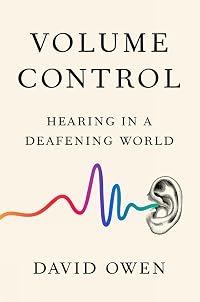
Volume Control: Hearing in a Deafening World
by David Owen
On This Page
Description
Our sense of hearing makes it easy to connect with the world and the people around us. The human system for processing sound is a biological marvel, an intricate assembly of delicate membranes, bones, receptor cells, and neurons. Yet many people take their ears for granted, abusing them with loud restaurants, rock concerts, and Q-tips. And then, eventually, most of us start to go deaf.Tags
Recommendations















Member Reviews
This is an excellent, well-rounded examination of hearing: how it works, what happens when it doesn’t, and the devices that can help people hear better. It also covers sign language, the deaf/Deaf community, and the struggle to bring affordable hearing aids to people who want them. This is one of those books that is exactly the right length and covers the topic in sufficient breadth to make you informed, but not overwhelmed. It’s written with sensitivity and warmth, and I would highly recommend it to pretty much everyone. You may not know someone with hearing loss, but someday that someone might be you, so it’s worth reading more about it.
Hearing gets no respect. We can imagine blindness by closing our eyes, but there’s no way to shut down our ears. And because they seem to bounce back after every abuse, from stereo speakers and earbuds to circular saws to motorcycles to rock concerts, we think we dodged a bullet and that we can take it.
But David Owen says that is not true. In Volume Control, he visits the experts, sees the experiments and the measurements, and shows that every incident causes irreversible damage. It often only starts to appear later, but plenty of people become hard of hearing in their prime years, with the prospect of a largely silent future. And every incident from fireworks to gunshots to power tools and kitchen appliances has the potential to show more plant permanent damage in our ears.
Unless they also develop tinnitus (he says it’s pronounced like tin-itis, with accents on the first two syllables). This constant hissing or ringing in the ears, 24/7, merits two chapters in the book. For one thing, it is far more common than we think. It can be so annoying it drives people to suicide. He makes it clear there is no cure, no specific ways to cause its onset, and usually leads to other hearing problems. Early diagnosis is too late. And it continues even when you’re totally deaf. Avoidance means avoiding shocks to your hearing, next to impossible in our world.
The whole book is rather downbeat this way. Damage is not repairable. Even with cochlear implants, hearing can only be restored to a low level. Our whole civilization operates not just on fossil fuels, but on loud noise. Meanwhile, our ears have evolved to pick out tiny noises in otherwise total silence. The coming together of those two states can only lead to permanent damage in hearing.
Our solutions range from nothing to pathetic. Owen points out that while glasses actually build up vision back to the perfect range, we have nothing to restore the quality of hearing. The result is while people have no problem employing glasses and changing them often, hearing aids are typically put off for a decade of annoying everyone else with “What?” and “Huh?” People who plunk for them often put them in a drawer after the first use, where they sit for years. Where glasses are stylish and become people’s signature identifier, hearing aids are pure stigma. So we hide them, if not in a drawer, at least behind the ear.
Hearing aids are a scam, as we all know, and which Owen confirms in no uncertain terms. They cost less than $100 to make, but we get charged $6000 for a pair. And all they are are miniaturized loudspeakers and tiny microphones. Manufacturers have lobbied states successfully, so that in most jurisdictions, customers cannot order or even adjust them themselves. Only a professional, licensed audiologist can turn up the volume. More reason not to go that route.
And because they don’t have a workaround for the loss of range we made the appointment for in the first place, all they can do is boost the volume to exploit the range we still have left. They do not restore the higher tones most people lose first, so everything remains distorted and difficult. They sound tinny and in general, worse than a lousy cellphone connection.
Instead, like most hi tech, all kinds of add-ons (bloatware) are offered, including a choice of constant sounds to cover the tinnitus, to even a personal alarm-clock only the wearer will hear. There are lots of color choices to complement glasses or clothing too, but nothing to restore hearing.
The book is quite comprehensive, delving into the differences of the deaf at birth from those who lose hearing early and those who lose it over a lifetime. He examines the history of sign language, and goes over the arguments of ASL vs vocal training. The conclusion is both are legitimate, full-featured languages and deserve the same respect.
One thing missing, and I can’t believe this myself, is that no one is using noise cancelling headphones to eliminate the single tone of tinnitus. Owen knows his is about 6000 Hertz, or cycles per second, but he doesn’t pursue Bose, which makes top of the line noise cancelling equipment, to program a unit with the inverse of 6000 Hz, which should, in theory, silence it. If that is a foolish notion, he should at least explain why, because noise cancelling headphones now offer masking noises to hide tinnitus, rather than zero them out. That is correct: noise cancelling headphones now offer additional noise to muffle noise. How wrong is that?
On the hearing aid front, there is modest hope, at least financially. Bose, which rates a lot of coverage in Volume Control, even to a profile of the founder, now sells a hearing aid it cannot by law call a hearing aid. It does of course perform exactly as a high-end hearing aid, with all the same components, but don’t call it a hearing aid. It’s a Hearphone. You wear it around your neck, and plug earbuds into it and your ears. It is rechargeable, stylish and carries no stigma because it looks like a music appliance. It has all kinds of adjustments for noisy restaurants, quiet rooms, traffic, cinemas, airplanes, loud conversation and on and on. And no audiologist is required to change the settings. You can do it on a phone app. Best of all — $500 to find out if it works for you. Beats the hell out of $6000.
There is an even greater important revelation in Volume Control, concerning the tiny hairs in our ears. Damage to them has long been blamed for increasing deafness and loss of range, as well as tinnitus. But we’ve been looking in the wrong place all this time, simply because the light was better under this lamppost. The real culprit apparently lies farther inside our skulls, where the synapses that transfer sounds to the neurons of our brains have shrunk back, no longer making the connection. It seems that when we apply too much noise, synapses disconnect rather than annoy our brains with painful, endless, not to mention useless sounds. Just like how we ignore a constant droning sound so we don’t even notice it, the brain physically disengages from harmful sound. This has big implications for actually restoring quality hearing, but it will take years to figure out.
Owen weaves his usual easy to read and digest text, filled with stories of people he knows, and in this case his own hearing issues. It is a fast and pleasant read, but most of all it is a critically important read. Volume Control offers really valuable information. Everyone needs to act on this information right away, from using earplugs, to turning down the volume, to educating children. The harm is gigantic. As Owen explains in comparing loss of sight and hearing, it is far more difficult to sit among friends and family and be unable to hear their stories, laugh at their jokes and (not) respond with your own, than to be blind but still participate in human social activity. The subtleties and cues from our irreparable hearing are taken for granted, and you don’t know what you’ve got till it’s gone.
David Wineberg show less
But David Owen says that is not true. In Volume Control, he visits the experts, sees the experiments and the measurements, and shows that every incident causes irreversible damage. It often only starts to appear later, but plenty of people become hard of hearing in their prime years, with the prospect of a largely silent future. And every incident from fireworks to gunshots to power tools and kitchen appliances has the potential to show more plant permanent damage in our ears.
Unless they also develop tinnitus (he says it’s pronounced like tin-itis, with accents on the first two syllables). This constant hissing or ringing in the ears, 24/7, merits two chapters in the book. For one thing, it is far more common than we think. It can be so annoying it drives people to suicide. He makes it clear there is no cure, no specific ways to cause its onset, and usually leads to other hearing problems. Early diagnosis is too late. And it continues even when you’re totally deaf. Avoidance means avoiding shocks to your hearing, next to impossible in our world.
The whole book is rather downbeat this way. Damage is not repairable. Even with cochlear implants, hearing can only be restored to a low level. Our whole civilization operates not just on fossil fuels, but on loud noise. Meanwhile, our ears have evolved to pick out tiny noises in otherwise total silence. The coming together of those two states can only lead to permanent damage in hearing.
Our solutions range from nothing to pathetic. Owen points out that while glasses actually build up vision back to the perfect range, we have nothing to restore the quality of hearing. The result is while people have no problem employing glasses and changing them often, hearing aids are typically put off for a decade of annoying everyone else with “What?” and “Huh?” People who plunk for them often put them in a drawer after the first use, where they sit for years. Where glasses are stylish and become people’s signature identifier, hearing aids are pure stigma. So we hide them, if not in a drawer, at least behind the ear.
Hearing aids are a scam, as we all know, and which Owen confirms in no uncertain terms. They cost less than $100 to make, but we get charged $6000 for a pair. And all they are are miniaturized loudspeakers and tiny microphones. Manufacturers have lobbied states successfully, so that in most jurisdictions, customers cannot order or even adjust them themselves. Only a professional, licensed audiologist can turn up the volume. More reason not to go that route.
And because they don’t have a workaround for the loss of range we made the appointment for in the first place, all they can do is boost the volume to exploit the range we still have left. They do not restore the higher tones most people lose first, so everything remains distorted and difficult. They sound tinny and in general, worse than a lousy cellphone connection.
Instead, like most hi tech, all kinds of add-ons (bloatware) are offered, including a choice of constant sounds to cover the tinnitus, to even a personal alarm-clock only the wearer will hear. There are lots of color choices to complement glasses or clothing too, but nothing to restore hearing.
The book is quite comprehensive, delving into the differences of the deaf at birth from those who lose hearing early and those who lose it over a lifetime. He examines the history of sign language, and goes over the arguments of ASL vs vocal training. The conclusion is both are legitimate, full-featured languages and deserve the same respect.
One thing missing, and I can’t believe this myself, is that no one is using noise cancelling headphones to eliminate the single tone of tinnitus. Owen knows his is about 6000 Hertz, or cycles per second, but he doesn’t pursue Bose, which makes top of the line noise cancelling equipment, to program a unit with the inverse of 6000 Hz, which should, in theory, silence it. If that is a foolish notion, he should at least explain why, because noise cancelling headphones now offer masking noises to hide tinnitus, rather than zero them out. That is correct: noise cancelling headphones now offer additional noise to muffle noise. How wrong is that?
On the hearing aid front, there is modest hope, at least financially. Bose, which rates a lot of coverage in Volume Control, even to a profile of the founder, now sells a hearing aid it cannot by law call a hearing aid. It does of course perform exactly as a high-end hearing aid, with all the same components, but don’t call it a hearing aid. It’s a Hearphone. You wear it around your neck, and plug earbuds into it and your ears. It is rechargeable, stylish and carries no stigma because it looks like a music appliance. It has all kinds of adjustments for noisy restaurants, quiet rooms, traffic, cinemas, airplanes, loud conversation and on and on. And no audiologist is required to change the settings. You can do it on a phone app. Best of all — $500 to find out if it works for you. Beats the hell out of $6000.
There is an even greater important revelation in Volume Control, concerning the tiny hairs in our ears. Damage to them has long been blamed for increasing deafness and loss of range, as well as tinnitus. But we’ve been looking in the wrong place all this time, simply because the light was better under this lamppost. The real culprit apparently lies farther inside our skulls, where the synapses that transfer sounds to the neurons of our brains have shrunk back, no longer making the connection. It seems that when we apply too much noise, synapses disconnect rather than annoy our brains with painful, endless, not to mention useless sounds. Just like how we ignore a constant droning sound so we don’t even notice it, the brain physically disengages from harmful sound. This has big implications for actually restoring quality hearing, but it will take years to figure out.
Owen weaves his usual easy to read and digest text, filled with stories of people he knows, and in this case his own hearing issues. It is a fast and pleasant read, but most of all it is a critically important read. Volume Control offers really valuable information. Everyone needs to act on this information right away, from using earplugs, to turning down the volume, to educating children. The harm is gigantic. As Owen explains in comparing loss of sight and hearing, it is far more difficult to sit among friends and family and be unable to hear their stories, laugh at their jokes and (not) respond with your own, than to be blind but still participate in human social activity. The subtleties and cues from our irreparable hearing are taken for granted, and you don’t know what you’ve got till it’s gone.
David Wineberg show less
This was a terrific book. I'm not sure how interesting it would be to a fully hearing person, but it was amazing to me as a hearing-impaired individual. Because it was recently published, it contained very relevant information for me.
Not all of what I read was making me very happy, though. In fact, I was fuming after I read the way that the hearing aid industry is ripping off people for the costs of hearing aids. I learned a lot more about alternatives to hearing aids, a product that my husband had been pushing me to try. Now those less expensive, self-programmable alternatives don't seem quite as strange. In fact, there is one product I'd really like to try. Maybe one day I'll have the chance.
I liked learning about the difference in show more the way hearing aids and cochlear implants work. Since I know personally about hearing aids, I think now I more fully understand what the sensation of a cochlear implant must be like. The experience sounds (no pun intended) quite different.
I was happily encouraged by the section about hearing research. I think I more fully understand what my hearing loss is really about (loss of connection to the auditory nerve rather than loss of hair cells). I was also intrigued by the discovery that loud noises which seem temporarily resolved after the fact then later in life can be the cause of hearing decline. I'm sorry that I was of the generation who paid no attention to hearing protection so now I'm suffering because of it. I liked the very last chapter about hearing protection and am glad to report that my grandchildren know exactly when it's time to don those sound-decreasing ear muffs.
This book was comprehensive, easy-to-read, and very informative. I recommend it mostly to those who are either hearing impaired or who interact with others who are hearing impaired. show less
Not all of what I read was making me very happy, though. In fact, I was fuming after I read the way that the hearing aid industry is ripping off people for the costs of hearing aids. I learned a lot more about alternatives to hearing aids, a product that my husband had been pushing me to try. Now those less expensive, self-programmable alternatives don't seem quite as strange. In fact, there is one product I'd really like to try. Maybe one day I'll have the chance.
I liked learning about the difference in show more the way hearing aids and cochlear implants work. Since I know personally about hearing aids, I think now I more fully understand what the sensation of a cochlear implant must be like. The experience sounds (no pun intended) quite different.
I was happily encouraged by the section about hearing research. I think I more fully understand what my hearing loss is really about (loss of connection to the auditory nerve rather than loss of hair cells). I was also intrigued by the discovery that loud noises which seem temporarily resolved after the fact then later in life can be the cause of hearing decline. I'm sorry that I was of the generation who paid no attention to hearing protection so now I'm suffering because of it. I liked the very last chapter about hearing protection and am glad to report that my grandchildren know exactly when it's time to don those sound-decreasing ear muffs.
This book was comprehensive, easy-to-read, and very informative. I recommend it mostly to those who are either hearing impaired or who interact with others who are hearing impaired. show less
This book club choice was much more wide ranging than I expected and very interesting. I wish I had read the section on hearing aids when I was trying to get my Mom to try hearings aids and she complained that they were way too expensive. As usual, she was completely right! This was a really comprehensive look at the causes of hearing loss and wide variety of ways it is "treated" and so many other angles on hearing loss that I had only marginally considered. It was also well-written and engaging and had a nice balance of personal stories and research. I learned alot and enjoyed learning it!
I dipped in and out of this book. I found a lot of information that was helpful to understanding hearing loss I learned a lot about genetic vs acquired hearing loss, the new technology that exists, the research that may lead to more solutions and the business models that keep hearing aids expensive. The book was mostly narrative, but included a laymen's explanation of the science as well.
A very good overview of the history, science, and treatment of hearing-related issues. The focus isn’t as narrow as the title suggests – it includes a fascinating amount of information about Deaf culture, including the American Sign Language / assistive devices debate, and it dishes the dirt on the hearing aid industry as well. This is a must read for anyone considering treatment options for hearing loss and for those looking to protect the hearing they already have.
Yes, once in a while I do read non-fiction. In this case, it's all about hearing. The causes of hearing loss, some helps for hearing loss, the ways people cope, the medical research, and so forth. All things hearing. It's a fairly extensive coverage of the topic of hearing.
The one big problem, I think is that there are no damn pictures! So we get extensive attempts to tell us in words about the physiological structures that enable us to hear, and the ways people try to mitigate hearing loss, both by gadgets, like hearing aids (what I'm doing), and by surgical means, like cochlear implants.
Well, ya know? A couple of pictures would really, really have helped me better to envision what's going on. Yes, I can Google it all, but why read show more the book then? I'm a bit disappointed in it all. Hence, I took a half * off the score because of the lack of pictures. show less
The one big problem, I think is that there are no damn pictures! So we get extensive attempts to tell us in words about the physiological structures that enable us to hear, and the ways people try to mitigate hearing loss, both by gadgets, like hearing aids (what I'm doing), and by surgical means, like cochlear implants.
Well, ya know? A couple of pictures would really, really have helped me better to envision what's going on. Yes, I can Google it all, but why read show more the book then? I'm a bit disappointed in it all. Hence, I took a half * off the score because of the lack of pictures. show less
Members
- Recently Added By
Published Reviews
ThingScore 100
“Volume Control: Hearing in a Deafening World” by New Yorker writer David Owen, is not just for those who are aging and contemplating hearing loss. It is the best primer I’ve ever read on sound and hearing, and full of advice for people of any age to consider if they want to preserve their ability to listen to music, carry on conversations in restaurants, be capable of accurately show more detecting sarcasm, or listen to the presidential debates (who’d want to lose that ability?). show less
added by kidzdoc
Lists

Science: Health & Medical
100 works; 1 member
Author Information

19+ Works 1,613 Members
David Owen is on the staffs of both The New Yorker and Golf Digest. A frequent contributor to The Atlantic Monthly, and the author of nine previous books, he lives in Washington, Connecticut. (Bowker Author Biography)
Awards and Honors
Common Knowledge
- Original publication date
- 2019
- Dedication
- For Ann
- First words
- When my mother's mother was in her early twenties, a century ago, a suitor took her duck hunting in a rowboat on a lake near Austin, Texas, where she grew up.
- Quotations
- The inability to hear well is fatiguing: straining to make out what people are saying, or relying on other senses to compensate, consumes mental resources that could be put to other uses, and largely for that reason, deafness... (show all) can cause or contribute to social isolation and cognitive decline, both of which making getting older, which is itself associated with hearing loss, seem worse than it does already.
Hearing problems are often aggravated by the human tendency to do nothing and hope for the best, usually while pretending that everything is fine.
The remarkable rotational range of an owl’s neck, approaching that of the demonically possessed character played by Linda Blair in The Exorcist, enables it to smoothly turn its head until a sound signal is perceived ... (show all)by both ears simultaneously, and its eyes, thereby, are aimed directly at the source, further sharpening its ability to precisely locate prey.
This difficulty in understanding speech against a background of noise is a nearly universal problem for people over a certain age, and the situation in which they are most to notice it is when they are eating out.
A human’s pinnae are relatively small, and, although some of us can wiggle our ears very slightly if we try really, really hard and practice a lot, we can’t significantly alter their shape or aim them.
Indeed, the mental exertion required to deduce meaning from diminished signals is one of the reasons that age-related hearing loss can have a devastating impact on the cognitive abilities, social engagement, and general well-... (show all)being of its sufferers.
Speaking louder to someone who’s having that kind of hearing trouble seldom helps much, because merely increasing the volume doesn’t cause the ear to pick up sounds it can’t hear at all.
The challenge with hearing aids is that every component has to be tiny, yet has to function ten hours a day on current drawn from a miniature battery that users expect to last at least a week.
“Hearing aids are orders of magnitude weaker than any other wireless device you’ll ever run into...a consequence of the fact that the entire device has to run for a week on a 1.45-volt battery the size of an aspirin table... (show all)t.” (Jason Galster)
Streptomycin was among the first modern antibiotics. It and several of its close relatives can be ototoxic—that is, they can damage hearing—and mostly for that reason they're seldom prescribed in the United States anymore... (show all).
The chemotherapy drugs cisplatin and carboplatin are also potentially ototoxic.
Quinine, OxyContin, Vicodin, aspirin, and scores of other drugs can be ototoxic; so can a long list of compounds commonly found in industrial workplaces, among them acrylonitrile, carbon monoxide, lead, styrene, and toluene, ... (show all)plus any number of pesticides and solvents—all of which ought to be avoided anyway, of course, but are often present in places where they shouldn't be.
Hearing and balance losses caused by antibiotics and chemicals are called sensorineural losses because they're characterized by damage to the (sensory) hair cells and the (neural) nerve cells that carry signals to the brain. Sensorineural hearing loss has other causes as well—including advancing age; certain viruses, like the flu; autoimmune disorders; Meniere's disease; and genetic bad luck. The biggest cause, by far, is overexposure to loud sound.
"Like all mammals, we are born with a population of sensory cells. There are only about fifteen thousand in an ear, and that is many, many fewer than the rods and cones in your eye, to say nothing of the neurons in the brain.... (show all) And you've got only about forty thousand nerve cells, which is an incredibly small number compared to the millions in the optic nerve. And they have to last your whole life."
When steroid treatment is begun within four weeks of onset, patients have an 80 percent chance of recovering at least some of their hearing. No one fully understands why steroids work—or, surprisingly, even whether they do.... (show all) The drugs have been referred to by some otologists as "holy water." But no one has proven that they don't work, and if I ever suddenly lose hearing I'll certainly demand that my own doctor prescribe them to me.
TODAY, MOST OF THE WORLD'S HEARING AIDS are made by six manufactures, just one of which is based in the United States: Starkey Hearing Technologies, a privately owned company, whose headquarters are in Eden Prairie, Minnesota... (show all). (The other five are Phonak, in Switzerland; Signia, in Singapore; and Octicon, ReSound, and Widex, all in Denmark.)
Adults whose thresholds are elevated 20 dB are still usually classified as having normal hearing. A mild loss is usually described as an elevation between 20 dB and 40 dB; moderate, between 40 dB and 70 dB; severe, between 70... (show all) dB and 90 dB; profound, 90 dB and beyond. - Last words
- (Click to show. Warning: May contain spoilers.)What were they thinking?
- Blurbers
- Barbara Kelley; Walter Isaacson; Elizabeth Kolbert; Leah Hager Cohen; Katherine Bouton
Classifications
Statistics
- Members
- 111
- Popularity
- 292,905
- Reviews
- 7
- Rating
- (3.83)
- Languages
- English
- Media
- Paper, Audiobook, Ebook
- ISBNs
- 6
- ASINs
- 2