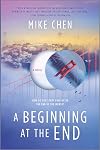
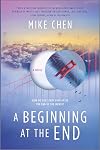
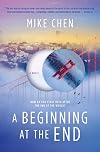
A Beginning at the End
by Mike Chen
On This Page
Description
Six years after a global pandemic wiped out most of the planet's population, the survivors are rebuilding the country, split between self-governing cities, hippie communes and wasteland gangs. Krista, Moira, Rob and Sunny are brought together by circumstance, and their lives begin to twine together. But when reports of another outbreak throw the fragile society into panic, the friends are forced to finally face everything that came before--and everything they still stand to lose. Because show more sometimes having one person is enough to keep the world going. show lessTags
Recommendations








Member Reviews
Rating: 4* of five
The Publisher Says: How do you start over after the end of the world?
Six years after a global pandemic wiped out most of the planet’s population, the survivors are rebuilding the country, split between self-governing cities, hippie communes and wasteland gangs.
In postapocalyptic San Francisco, former pop star Moira has created a new identity to finally escape her past—until her domineering father launches a sweeping public search to track her down. Desperate for a fresh start herself, jaded event planner Krista navigates the world on behalf of those too traumatized to go outside, determined to help everyone move on—even if they don’t want to. Rob survived the catastrophe with his daughter, Sunny, but lost his show more wife. When strict government rules threaten to separate parent and child, Rob needs to prove himself worthy in the city’s eyes by connecting with people again.
Krista, Moira, Rob and Sunny are brought together by circumstance, and their lives begin to twine together. But when reports of another outbreak throw the fragile society into panic, the friends are forced to finally face everything that came before—and everything they still stand to lose.
Because sometimes having one person is enough to keep the world going.
I RECEIVED A DRC FROM THE PUBLISHER VIA NETGALLEY. THANK YOU.
My Review: First, read this:
You're fully in the thick of this book's ethos with those two quotes.
Post-apocalyptic Britney Spears story, full of the expected drama, and all the better for it. The book was published very early in COVID times, so it really felt too on-the-nose for me to get much distance to do more than gibber incoherently at it. Author Chen's first novel, see below for Here and Now and Then's review, was a very good, if simplistic, rendering of an extremely complex story. In this sophomore effort, he's definitely learned from the crafting of a novel for sale to the public and applied those lessons. In the manner of telling, in the effort to craft sentences, every way this book shows the growth of an artist who listens and learns.
Many are the comparisons made between this book and the superficially similar Station Eleven...post-pandemic societies with survivors doing what people always do, muddling through as best they can to get their livings, as much like they always have as possible. This story's focus isn't on a complete collapse, as Station Eleven focuses on; instead it's more like this present moment, issues and hitches and ongoing crunches; then all Hell breaks loose.
That is where Author Chen shines in his craftsmanship. All the stuff you've read until now, thinking "hmmm is this actually worth going a-dystopianing?" snaps into focus. Author Chen does not stint. Because it's not the World that's ending again; it's the world of each character's own making.
In other words, Life Goes On.
That's the post-apocalyptic novel I want to read, and the one I got here. The one where we're talking about "Post Apocalyptic Stress Disorder" or PASD. I absolutely devoured it because each story, the Britney Spears one and the fatherhood-in-dystopia one, kept me fanning pages as fast as I could.
Author Chen is, it is clear, a father, and that makes his storytelling from a father's perspective. That is very much what I want to read. And, I hope, to read his work when he becomes a grandfather...though it's not likely I'll live that long...because it's a refreshing change to find a man telling the emotional story of his parenthood against this backdrop. show less
The Publisher Says: How do you start over after the end of the world?
Six years after a global pandemic wiped out most of the planet’s population, the survivors are rebuilding the country, split between self-governing cities, hippie communes and wasteland gangs.
In postapocalyptic San Francisco, former pop star Moira has created a new identity to finally escape her past—until her domineering father launches a sweeping public search to track her down. Desperate for a fresh start herself, jaded event planner Krista navigates the world on behalf of those too traumatized to go outside, determined to help everyone move on—even if they don’t want to. Rob survived the catastrophe with his daughter, Sunny, but lost his show more wife. When strict government rules threaten to separate parent and child, Rob needs to prove himself worthy in the city’s eyes by connecting with people again.
Krista, Moira, Rob and Sunny are brought together by circumstance, and their lives begin to twine together. But when reports of another outbreak throw the fragile society into panic, the friends are forced to finally face everything that came before—and everything they still stand to lose.
Because sometimes having one person is enough to keep the world going.
I RECEIVED A DRC FROM THE PUBLISHER VIA NETGALLEY. THANK YOU.
My Review: First, read this:
“See, relations are people with the same blood. But family, that's different. Family is about who gives you hope, who gets involved. And earns the right for forgiveness. Or at least starts down the path.”
–and–
As a community, we still emphasized the importance of familial ties but finally understood that the definition of family wasn't about blood or even who or what you'd lost. It was about what gave you hope and who was willing to get involved.
You're fully in the thick of this book's ethos with those two quotes.
Post-apocalyptic Britney Spears story, full of the expected drama, and all the better for it. The book was published very early in COVID times, so it really felt too on-the-nose for me to get much distance to do more than gibber incoherently at it. Author Chen's first novel, see below for Here and Now and Then's review, was a very good, if simplistic, rendering of an extremely complex story. In this sophomore effort, he's definitely learned from the crafting of a novel for sale to the public and applied those lessons. In the manner of telling, in the effort to craft sentences, every way this book shows the growth of an artist who listens and learns.
Many are the comparisons made between this book and the superficially similar Station Eleven...post-pandemic societies with survivors doing what people always do, muddling through as best they can to get their livings, as much like they always have as possible. This story's focus isn't on a complete collapse, as Station Eleven focuses on; instead it's more like this present moment, issues and hitches and ongoing crunches; then all Hell breaks loose.
That is where Author Chen shines in his craftsmanship. All the stuff you've read until now, thinking "hmmm is this actually worth going a-dystopianing?" snaps into focus. Author Chen does not stint. Because it's not the World that's ending again; it's the world of each character's own making.
In other words, Life Goes On.
That's the post-apocalyptic novel I want to read, and the one I got here. The one where we're talking about "Post Apocalyptic Stress Disorder" or PASD. I absolutely devoured it because each story, the Britney Spears one and the fatherhood-in-dystopia one, kept me fanning pages as fast as I could.
Author Chen is, it is clear, a father, and that makes his storytelling from a father's perspective. That is very much what I want to read. And, I hope, to read his work when he becomes a grandfather...though it's not likely I'll live that long...because it's a refreshing change to find a man telling the emotional story of his parenthood against this backdrop. show less
Six years after a flu epidemic wiped out 70% of the world’s population (wow, timely!) people are living behind breathing masks, marriage is now about safety not love, and a pop star’s father is obsessively trying to find her (you read that one right.) This was my second Mike Chen book and an interesting departure from the first one. I found myself most captivated by the psychological toll the flu epidemic would have taken on society, and this book focuses in on a small cast of characters as a father tries to keep custody of his daughter despite years of lies, a woman struggles for meaning in her life, and Moira, formerly Mojo, fights to find her true self. Recommended if you’re in the mood for a sci-fi read.
Please excuse show more typos/name misspellings. Entered on screen reader. show less
Please excuse show more typos/name misspellings. Entered on screen reader. show less
What comes after the pandemic?
It's not just a question I keep asking myself, it's also the central idea of Mike Chen's latest novel. Moira, Rob, and Krista all have their secrets. They've all done things they're not proud of in order to get by. They've all faced more than their fair share of trauma. And they've survived.
Most post-pandemic / post-apocalyptic fiction deals with a world wherein at least 99% of the population has been wiped out. Where survivors search for days, months, or even years before they discover anyone else who's made it. In this story, around 70% of the population has been lost. Much of society has been rebuilt in a fashion similar to Before.
In a way, humanity is already living in a post-apocalyptic era. In the show more fourteenth century, the Black Death wiped out half of Europe. Our ancestors were the survivors. They rose from the ashes of what was left behind and created the world all over again – more or less the way it was before.
Anyway, this is a fascinating character study. No villains. No heroes. Just real people doing what they have to – or what they think they have to – to get by. show less
It's not just a question I keep asking myself, it's also the central idea of Mike Chen's latest novel. Moira, Rob, and Krista all have their secrets. They've all done things they're not proud of in order to get by. They've all faced more than their fair share of trauma. And they've survived.
Most post-pandemic / post-apocalyptic fiction deals with a world wherein at least 99% of the population has been wiped out. Where survivors search for days, months, or even years before they discover anyone else who's made it. In this story, around 70% of the population has been lost. Much of society has been rebuilt in a fashion similar to Before.
In a way, humanity is already living in a post-apocalyptic era. In the show more fourteenth century, the Black Death wiped out half of Europe. Our ancestors were the survivors. They rose from the ashes of what was left behind and created the world all over again – more or less the way it was before.
Anyway, this is a fascinating character study. No villains. No heroes. Just real people doing what they have to – or what they think they have to – to get by. show less
Pandemic novels are kind of my jam, even when I'm living in the middle of one. (It's actually kind of reassuring that compared to [b:Station Eleven|20170404|Station Eleven|Emily St. John Mandel|https://i.gr-assets.com/images/S/compressed.photo.goodreads.com/books/1451446835l/20170404._SY75_.jpg|28098716] or even [b:The Last One|27245997|The Last One|Alexandra Oliva|https://i.gr-assets.com/images/S/compressed.photo.goodreads.com/books/1465634920l/27245997._SY75_.jpg|45572184], COVID-19 is small potatoes.) But Mr. Chen, author of the excellent time-travel novel [b:Here and Now and Then|36630924|Here and Now and Then|Mike Chen|https://i.gr-assets.com/images/S/compressed.photo.goodreads.com/books/1529346325l/36630924._SY75_.jpg|58394721], show more didn't want to write about near-total annihilation, instead he sets the story six years after about 70% of the global population is wiped out by a flu virus. After two years of quarantine, the survivors mostly live in "metros" -- the partially reclaimed areas of major cities, such as San Francisco, where most of the novel takes place. Others live in Reclaimed communes or as wandering "looter gangs."
Our main characters are a former teen pop star in hiding (Moira), an event planner who's still traumatized by her childhood with an alcoholic mother (Krista), and a single father (Rob) who's been lying to his now-7-year-old daughter (Sunny) about her mother's whereabouts. The novel examines how people, these specific people, but also people in general, can heal after such traumatic global and personal events. (Pretty much the entire population suffers from "Post-Apocalyptic Stress Disorder.") It focuses on how the family you make is more important (and potentially healthier) than your biological family. It's sweet, really, and overall I liked the novel, but it wasn't great.
The characters are all relatively sympathetic, but I wanted to smack some sense into the adults. They all make some DUMB decisions that affect other people (especially Rob). The plot overall moves kind of slowly until the last third of the book, when all of the sudden things start happening.
Most of my issues, however, come from the world building, because like I said, I read a lot of these pandemic-y books.
Pretty much overnight, the US government (maybe governments worldwide?) froze all personal and corporate assets. (Is that even constitutional?) And then hustled most of the survivors into quarantine camps in stadiums, prisons, etc., where they remained for TWO YEARS. Seriously? I don't even really understand the purpose of the quarantine camps. Some people, like Krista who had been exposed to her infected boyfriend, are seemingly immune, but others were apparently never exposed. There's a vaccine for the original virus, but most people still wear masks and gloves in public, air-purifying systems are used, etc. It's unclear if that's because of concerns about the virus mutating or because of PASD.
Now (2025) most people choose to live in the "metros" and pay taxes, trying to return to some type of normalcy. There's some farming in the outlying areas, but mostly they're living off of existing materials, because manufacturing will take 10 years to get restarted. (Again, reasons are a little unclear.) In the metros, the Family Stability Board can take away children from parents who are judged to be unstable (like Rob) and put into dormitories. Right, because that's so much better for a child. The migration of families from metros to Reclaimed is mentioned and makes sense. Personally, living in a Reclaimed commune sounds a lot more appealing.
Documents (excerpts from government reports, newspaper articles, online encyclopedia entries, etc.) are sprinkled throughout the novel. The placement and inclusion of these doesn't always make sense to me. There's a lot of focus on a "cult" whose members disappeared from various parts of California, but that, too, is hazy at best.
Basically, the world building here is weak, especially in comparison to other pandemic novels and to Mr. Chen's first novel.
In his acknowledgments, Mr. Chen writes, "In 2011 I told some writer friends that I had an idea for a book: What if the world didn't end--it just paused? Soon after came a very rough first draft about Krista, Rob, Moira, and Sunny in a rebuilding society. That manuscript took on many forms, first as a post-apocalyptic satire and then through massive story and tonal changes, this book was formed... My agent...then dusted off this old manuscript and had me mash it up with Station Eleven's structure and tone."
I think I would have preferred the post-apocalyptic satire. show less
Our main characters are a former teen pop star in hiding (Moira), an event planner who's still traumatized by her childhood with an alcoholic mother (Krista), and a single father (Rob) who's been lying to his now-7-year-old daughter (Sunny) about her mother's whereabouts. The novel examines how people, these specific people, but also people in general, can heal after such traumatic global and personal events. (Pretty much the entire population suffers from "Post-Apocalyptic Stress Disorder.") It focuses on how the family you make is more important (and potentially healthier) than your biological family. It's sweet, really, and overall I liked the novel, but it wasn't great.
The characters are all relatively sympathetic, but I wanted to smack some sense into the adults. They all make some DUMB decisions that affect other people (especially Rob). The plot overall moves kind of slowly until the last third of the book, when all of the sudden things start happening.
Most of my issues, however, come from the world building, because like I said, I read a lot of these pandemic-y books.
Pretty much overnight, the US government (maybe governments worldwide?) froze all personal and corporate assets. (Is that even constitutional?) And then hustled most of the survivors into quarantine camps in stadiums, prisons, etc., where they remained for TWO YEARS. Seriously? I don't even really understand the purpose of the quarantine camps. Some people, like Krista who had been exposed to her infected boyfriend, are seemingly immune, but others were apparently never exposed. There's a vaccine for the original virus, but most people still wear masks and gloves in public, air-purifying systems are used, etc. It's unclear if that's because of concerns about the virus mutating or because of PASD.
Now (2025) most people choose to live in the "metros" and pay taxes, trying to return to some type of normalcy. There's some farming in the outlying areas, but mostly they're living off of existing materials, because manufacturing will take 10 years to get restarted. (Again, reasons are a little unclear.) In the metros, the Family Stability Board can take away children from parents who are judged to be unstable (like Rob) and put into dormitories. Right, because that's so much better for a child. The migration of families from metros to Reclaimed is mentioned and makes sense. Personally, living in a Reclaimed commune sounds a lot more appealing.
Documents (excerpts from government reports, newspaper articles, online encyclopedia entries, etc.) are sprinkled throughout the novel. The placement and inclusion of these doesn't always make sense to me. There's a lot of focus on a "cult" whose members disappeared from various parts of California, but that, too, is hazy at best.
Basically, the world building here is weak, especially in comparison to other pandemic novels and to Mr. Chen's first novel.
In his acknowledgments, Mr. Chen writes, "In 2011 I told some writer friends that I had an idea for a book: What if the world didn't end--it just paused? Soon after came a very rough first draft about Krista, Rob, Moira, and Sunny in a rebuilding society. That manuscript took on many forms, first as a post-apocalyptic satire and then through massive story and tonal changes, this book was formed... My agent...then dusted off this old manuscript and had me mash it up with Station Eleven's structure and tone."
I think I would have preferred the post-apocalyptic satire. show less
A Beginning At The End by Mike Chen is a tale of humanity's survival following a slatewiper pandemic that killed off over two-thirds of the population. Those left either live in Metros (remnants of large cities), or out in 'Reclaimed Territory' (more like homesteaders, reclaiming areas away from the Metros). There are piratical gangs that prey on travellers too. Nearly a decade after the initial outbreak, a new evolution of the virus is threatening another pandemic.
In the midst of this, peoples' lives go on. Rob struggles to prove he is 'socially normal' or risks losing his daughter, Sunny. Moira has doubts about her upcoming wedding, that her deepest secret may be revealed, and her overbearing father may find her. Rob and Moira become show more acquainted with each other through Krista, the event planner working with Moira on her wedding. As the threat of a new pandemic begins to loom over them all, each begins to grow and change, learning who they really are, who they can trust, and what they value most. Each learns to accept their past and forgive themselves and others.
I adored Sunny! She's a very intelligent child, and certainly can be sure of herself. That leads her to some trouble later, as she's determined to find Krista's doctor uncle who she thinks has made/can make her mother better. She serves as a glue that begins binding this small group together. Her relationship with her da is great, and Sunny quickly wins over Moira and even Krista. I liked that, despite this being a post-apocalypse story, it's very much more people driven. It's just these few characters and how they are coping, as opposed to the much broader, less personal scope I've found in other post-apocalyptic fiction I've read. Not that I dislike those types of stories, but seeing the more personal impact was nice.
I felt the pacing was slow at times, especially for the first third to half of the book, but it wasn't a deterrent to me. Once they have to find Sunny, things really pick up, and we get a broader look at how society is functioning after the initial pandemic. I quite enjoyed visiting the campus reclaimed territory run by Narc, one of Moira's friends. I admit, I was confused by the MoJo story thread, as it really seemed minor key, overall. It didn't detract from the overall tale though!
Recommended, especially if you enjoy post-apocalyptic fiction!
***Many thanks to the Netgalley & Harlequin/Mira for providing an egalley in exchange for a fair and honest review. show less
In the midst of this, peoples' lives go on. Rob struggles to prove he is 'socially normal' or risks losing his daughter, Sunny. Moira has doubts about her upcoming wedding, that her deepest secret may be revealed, and her overbearing father may find her. Rob and Moira become show more acquainted with each other through Krista, the event planner working with Moira on her wedding. As the threat of a new pandemic begins to loom over them all, each begins to grow and change, learning who they really are, who they can trust, and what they value most. Each learns to accept their past and forgive themselves and others.
I adored Sunny! She's a very intelligent child, and certainly can be sure of herself. That leads her to some trouble later, as she's determined to find Krista's doctor uncle who she thinks has made/can make her mother better. She serves as a glue that begins binding this small group together. Her relationship with her da is great, and Sunny quickly wins over Moira and even Krista. I liked that, despite this being a post-apocalypse story, it's very much more people driven. It's just these few characters and how they are coping, as opposed to the much broader, less personal scope I've found in other post-apocalyptic fiction I've read. Not that I dislike those types of stories, but seeing the more personal impact was nice.
I felt the pacing was slow at times, especially for the first third to half of the book, but it wasn't a deterrent to me. Once they have to find Sunny, things really pick up, and we get a broader look at how society is functioning after the initial pandemic. I quite enjoyed visiting the campus reclaimed territory run by Narc, one of Moira's friends. I admit, I was confused by the MoJo story thread, as it really seemed minor key, overall. It didn't detract from the overall tale though!
Recommended, especially if you enjoy post-apocalyptic fiction!
***Many thanks to the Netgalley & Harlequin/Mira for providing an egalley in exchange for a fair and honest review. show less
This novel of the near future of 2025 has three interwoven strands and three main characters. There's Moira, formerly Mojo, the wildly popular teen rock star, who escaped her father's crushing hold on her ten years earlier and changed her identity. Then there's Krista, the financially strapped wedding planner whom Moira has hired to organize her wedding to Frank. And Rob, the single widowed dad of 7-year-old Sunny, who he's allowed to think her mother is still alive. Since a virulent flu decimated the world's population and sent civilization and technology backward, each of the three characters has struggled in his or her own way to deal with "PASD," a ptsd of the pandemic. As the story unfolds, Moira has decided to call off her wedding show more and her father has pulled out all the stops to find her. Krista continues to avoid all commitment, and decides to betray Moira's trust and turn her in for the huge reward. And Rob is threatened by Sunny's school that she will be taken away from him because she is acting out at school. Their separate crises end up bringing the three together, especially when Sunny disappears and they set off together to find her. Although not a mystery, this book is a page-turner for the suspense right up until the end. show less
Six-word review (1): Post-pandemic survivors navigate strange new world.
or
Six-word review (2): Pretty weak, but I liked it.
The striking thing about this sounds-like-a-first-novel-but-isn't is that it is set in the aftermath of an apocalyptic pandemic--but was published on January 14th, 2020, before anyone knew what was about to come down on us (unless author Mike Chen had some advance word that most of us never heard).
That was the hook that led me to download it for my Kindle and plunge through it in between a couple of pretty heavy tomes.
(What does it say about our time that a novel about a lethal global virus and the ensuing social upheaval is escapist reading?)
This story was very amateurish-sounding right from the start, and showing show more no evidence of a solid edit. Either of those two things usually makes me head straight for the exit. But in the special circumstances of September 2020, I persisted.
There are some good ideas here, such as how people adapt to being survivors after 70 percent of the U.S. population has succumbed to disease and what it's like to see familiar neighborhoods morph into alien territory. People suffer from something called "Post-Apocalyptic Stress Disorder" and form self-help groups modeled on AA to help them cope with the upheaval of their lives, personal losses, and the changed world.
People wear masks in this story, for their own protection (remember: this came out before February of 2020, and we had never heard of the covid-19 coronavirus then). As an aside, by the time I read it a month or so ago, I wondered: why didn't the CDC just tell people that masks were for their own protection? I'll bet most people would have bought that and worn them.
On the minus side, the main characters never gain dimensions. There are two women and a man, and even though the two women are nothing alike I had trouble remembering which was which because they had so little solidity. Worse yet, there's a little girl, one so flimsy that if the others are cardboard, she's made out of tissue paper, cutesy name and all. When she gets lost, I find myself hoping they never find her. Chen shouldn't feel too bad about that, though; even Stephen King can't write kid dialogue that doesn't make you gag.
There's also a lot of clumsy exposition. It can be hard to do well, I grant you that; but then, if we can't do it, we're not ready for prime time.
I did like the way the author endowed one of the two women with some impressive survival skills, including parkour.
The major conflicts right out of Writing 101, involving guarding old secrets, just never feel genuine, and the climactic chapter is downright cloying. Chen could have used a lot of help with the moment of supposed resolution, but his friends probably told him it was just great.
One annoying pimple on the chin of this novel is the author's obvious unawareness of the meaning of some words he uses repeatedly--and the fact that no editor came to his rescue by chopping them out. An example is "smirk," which Chen seems to think is the same as a pleased smile or a grin. Actually it's an irritatingly smug sort of smile, such as you see when someone has bested an opponent, and not anything pleasant or charming; and yet we have numerous instances such as this: "Her face lit up with a smirk." Some wrong word choices lead to bizarre imagery: "Moira stood poised, ... her legs coiled and ready."
And I'll bet the author has never actually lugged a cat carrier very far, never mind trying to run with it. The cat in the box ought to have suffered a concussion, at least, if not the equivalent of being tossed in a clothes dryer.
I'm not sorry I read it, and it was uncannily timely, with some well-thought insights for a plague-ridden planet. One nicely paranoia-inducing idea was of the government's absorbing the unclaimed funds from the millions of casualties. I also liked the resurgence of old technologies such as CDs. Nonetheless, I'm glad it didn't last any longer. I can't in good conscience give it much of a recommendation, and I won't be rushing to read his next book.
Nice try, though, Mike. You get points for doing it and daring to put it out there. It's not easy. And I did, after all, like it more than I didn't like it. show less
or
Six-word review (2): Pretty weak, but I liked it.
The striking thing about this sounds-like-a-first-novel-but-isn't is that it is set in the aftermath of an apocalyptic pandemic--but was published on January 14th, 2020, before anyone knew what was about to come down on us (unless author Mike Chen had some advance word that most of us never heard).
That was the hook that led me to download it for my Kindle and plunge through it in between a couple of pretty heavy tomes.
(What does it say about our time that a novel about a lethal global virus and the ensuing social upheaval is escapist reading?)
This story was very amateurish-sounding right from the start, and showing show more no evidence of a solid edit. Either of those two things usually makes me head straight for the exit. But in the special circumstances of September 2020, I persisted.
There are some good ideas here, such as how people adapt to being survivors after 70 percent of the U.S. population has succumbed to disease and what it's like to see familiar neighborhoods morph into alien territory. People suffer from something called "Post-Apocalyptic Stress Disorder" and form self-help groups modeled on AA to help them cope with the upheaval of their lives, personal losses, and the changed world.
People wear masks in this story, for their own protection (remember: this came out before February of 2020, and we had never heard of the covid-19 coronavirus then). As an aside, by the time I read it a month or so ago, I wondered: why didn't the CDC just tell people that masks were for their own protection? I'll bet most people would have bought that and worn them.
On the minus side, the main characters never gain dimensions. There are two women and a man, and even though the two women are nothing alike I had trouble remembering which was which because they had so little solidity. Worse yet, there's a little girl, one so flimsy that if the others are cardboard, she's made out of tissue paper, cutesy name and all. When she gets lost, I find myself hoping they never find her. Chen shouldn't feel too bad about that, though; even Stephen King can't write kid dialogue that doesn't make you gag.
There's also a lot of clumsy exposition. It can be hard to do well, I grant you that; but then, if we can't do it, we're not ready for prime time.
I did like the way the author endowed one of the two women with some impressive survival skills, including parkour.
The major conflicts right out of Writing 101, involving guarding old secrets, just never feel genuine, and the climactic chapter is downright cloying. Chen could have used a lot of help with the moment of supposed resolution, but his friends probably told him it was just great.
One annoying pimple on the chin of this novel is the author's obvious unawareness of the meaning of some words he uses repeatedly--and the fact that no editor came to his rescue by chopping them out. An example is "smirk," which Chen seems to think is the same as a pleased smile or a grin. Actually it's an irritatingly smug sort of smile, such as you see when someone has bested an opponent, and not anything pleasant or charming; and yet we have numerous instances such as this: "Her face lit up with a smirk." Some wrong word choices lead to bizarre imagery: "Moira stood poised, ... her legs coiled and ready."
And I'll bet the author has never actually lugged a cat carrier very far, never mind trying to run with it. The cat in the box ought to have suffered a concussion, at least, if not the equivalent of being tossed in a clothes dryer.
I'm not sorry I read it, and it was uncannily timely, with some well-thought insights for a plague-ridden planet. One nicely paranoia-inducing idea was of the government's absorbing the unclaimed funds from the millions of casualties. I also liked the resurgence of old technologies such as CDs. Nonetheless, I'm glad it didn't last any longer. I can't in good conscience give it much of a recommendation, and I won't be rushing to read his next book.
Nice try, though, Mike. You get points for doing it and daring to put it out there. It's not easy. And I did, after all, like it more than I didn't like it. show less
Members
- Recently Added By
Lists

Top Five Books of 2020
982 works; 350 members
Author Information

18+ Works 2,349 Members
Some Editions
Common Knowledge
- Original publication date
- 2020-01-14
- Dedication
- For Mandy, the strongest person I know.
- First words
- People were too scared for music tonight.
- Last words
- (Click to show. Warning: May contain spoilers.)Excerpt from the dissertation Un-Paused: The Greenwood Incident, Family, and Hope in a Post-MGS World by Sunny Donelly, University of Northern California, Class of 2040
- Blurbers
- Miller, Sam J.; Harrow, Alix E.; Molin, Meghan Scott; Parry, H. G.; Collins, Megan; Miller, Rowenna (show all 7); Shepherd, Peng
Classifications
Statistics
- Members
- 206
- Popularity
- 158,802
- Reviews
- 15
- Rating
- (3.41)
- Languages
- English
- Media
- Paper, Audiobook, Ebook
- ISBNs
- 10
- ASINs
- 2