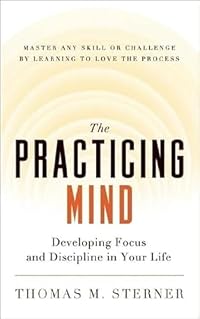
The Practicing Mind: Developing Focus and Discipline in Your Life
by Thomas M. Sterner
On This Page
Description
In those times when we want to acquire a new skill or face a formidable challenge we hope to overcome, what we need most are patience, focus, and discipline, traits that seem elusive or difficult to maintain. In this enticing and practical book, Thomas Sterner demonstrates how to learn skills for any aspect of life, from golfing to business to parenting, by learning to love the process. Early life is all about trial-and-error practice. If we had given up in the face of failure, repetition, show more and difficulty, we would never have learned to walk or tie our shoes. So why, as adults, do we often give up on a goal when at first we don't succeed? Modern life's technological speed, habitual multitasking, and promises of instant gratification don't help. But in his study of how we learn (prompted by his pursuit of disciplines such as music and golf), Sterner has found that we have also forgotten the principles of practice - the process of picking a goal and applying steady effort to reach it. The methods Sterner teaches show that practice done properly isn't drudgery on the way to mastery but a fulfilling process in and of itself, one that builds discipline and clarity. By focusing on "process, not product," you'll learn to live in each moment, where you'll find calmness and equanimity. This book will transform a sense of futility around learning something challenging into an attitude of pleasure and willingness. show lessTags
Recommendations

















Member Reviews
A folksy little tract on mindfulness, The Practicing Mind is about what one expects from a piano tuner who encourages formal exercises in moment-to-moment awareness without judgement. It could have been titled Music and Archery Lessons for the Budding Buddhist, without much loss. While its message is one I appreciate and Sterner is a reasonable writer, you are not going to get out of this book with at least one quote from a Star Wars character who, to our collective shock, is not Yoda. Sweet little book, all the same.
A folksy little tract on mindfulness, The Practicing Mind is about what one expects from a piano tuner who encourages formal exercises in moment-to-moment awareness without judgement. It could have been titled Music and Archery Lessons for the Budding Buddhist, without much loss. While its message is one I appreciate and Sterner is a reasonable writer, you are not going to get out of this book with at least one quote from a Star Wars character who, to our collective shock, is not Yoda. Sweet little book, all the same.
I recognize the irony in listening to a book on eliminating multi-tasking, slowing down to focus intensely, & making time to meditate while working.
That being said, I don't think I would have gotten a lot more out of this book if I had read it in complete silence in the most comfortable chair in the world. That's because the book doesn't really introduce new ideas or themes on the topic. And the bottom line, as always, is this: if I want to get better at stilling my mind, I just have to DO it.
I don't doubt the benefits of the changes the author proposes. Nor do I doubt that eliminating attachment would solve a whole lot of problems for a whole lot of people. But ultimately, I think I don't buy it. I can believe that this author, for show more example, may be much better than most at resisting materialism. But I don't believe he only lives in his house because of purely utilitarian purposes. While he surely chose a place close to work, in a safe neighborhood, within his budget, he still had tons of choices to make - how many bedrooms, how much yard, pool or no pool, attached garage, etc. - that in essence FORCED him to care about these things; that is, he became attached to these features. Even if they don't fully define his experience of living in that particular home, he liked certain features more than others, & would feel some loss if they disappeared without him choosing to leave them behind.
All that is the essence of why I struggle with this idea (which, I'm sure, he & countless others would tell me is exactly why I need to practice this): if I can't ever fully achieve it, why do it? To be more specific, HOW do I do it? This is the battle for me.
One idea in particular did appeal toe, though: the idea of Short. Meaning, when trying to incorporate something new or change something, make your practice of it short, thus attainable & tolerable. For example, if I commit to spending 15-30 minutes cleaning my home every day, it WILL be cleaner, & eventually may even be "clean." That lessens my boredom & takes some of the Sisyphian torture out of it. So I'll try it.
And maybe I can meditate while I'm doing that... show less
That being said, I don't think I would have gotten a lot more out of this book if I had read it in complete silence in the most comfortable chair in the world. That's because the book doesn't really introduce new ideas or themes on the topic. And the bottom line, as always, is this: if I want to get better at stilling my mind, I just have to DO it.
I don't doubt the benefits of the changes the author proposes. Nor do I doubt that eliminating attachment would solve a whole lot of problems for a whole lot of people. But ultimately, I think I don't buy it. I can believe that this author, for show more example, may be much better than most at resisting materialism. But I don't believe he only lives in his house because of purely utilitarian purposes. While he surely chose a place close to work, in a safe neighborhood, within his budget, he still had tons of choices to make - how many bedrooms, how much yard, pool or no pool, attached garage, etc. - that in essence FORCED him to care about these things; that is, he became attached to these features. Even if they don't fully define his experience of living in that particular home, he liked certain features more than others, & would feel some loss if they disappeared without him choosing to leave them behind.
All that is the essence of why I struggle with this idea (which, I'm sure, he & countless others would tell me is exactly why I need to practice this): if I can't ever fully achieve it, why do it? To be more specific, HOW do I do it? This is the battle for me.
One idea in particular did appeal toe, though: the idea of Short. Meaning, when trying to incorporate something new or change something, make your practice of it short, thus attainable & tolerable. For example, if I commit to spending 15-30 minutes cleaning my home every day, it WILL be cleaner, & eventually may even be "clean." That lessens my boredom & takes some of the Sisyphian torture out of it. So I'll try it.
And maybe I can meditate while I'm doing that... show less
Thomas Sterner’s book, ‘The Practicing Mind,’ is an excellent reminder of basic learning principles. The book consists of nine chapters of variable quality. However, the author admits his lessons are not new: we have known these principles for centuries. We need these books because we forget the principles.
The book is well-timed because modern culture prizes ‘results’ over ’process’; productivity over perfection, resulting in a culture where people often take shortcuts to achieve a desired output.
Thomas Sterner quotes a few excellent examples, notably from Japan, highlighting the difference between their approach and many Western practices. While he points out the differences between the two cultures, you will find many show more such differences within cultures. For instance, the apprenticeship culture in Germany focuses on proper learning.
The author reminds us that we must always adopt a practicing mind: as we grow and become experts, we forget a crucial lesson – that we can, and should, learn from anyone. He cites the curiosity of a child’s mind, reminding us that we lose our curiosity as we age and become ‘experts.’
The quality of the chapters is uneven, with some excellent and others mediocre. Read the book: the lessons within are excellent reminders that we must change our approach to learn well and find joy in learning and practicing. show less
The book is well-timed because modern culture prizes ‘results’ over ’process’; productivity over perfection, resulting in a culture where people often take shortcuts to achieve a desired output.
Thomas Sterner quotes a few excellent examples, notably from Japan, highlighting the difference between their approach and many Western practices. While he points out the differences between the two cultures, you will find many show more such differences within cultures. For instance, the apprenticeship culture in Germany focuses on proper learning.
The author reminds us that we must always adopt a practicing mind: as we grow and become experts, we forget a crucial lesson – that we can, and should, learn from anyone. He cites the curiosity of a child’s mind, reminding us that we lose our curiosity as we age and become ‘experts.’
The quality of the chapters is uneven, with some excellent and others mediocre. Read the book: the lessons within are excellent reminders that we must change our approach to learn well and find joy in learning and practicing. show less
Deals effectively with concepts such as present moment awareness and "beginner's mind." A decent introduction for those who haven't read widely on these topics, but doesn't add much for those who have. The author does provide some nice context on how he has applied these ideas in his own life, and I don't regret the 3 hour investment of time in living to the book, but I can't recommend it strongly to those who know something about these topics.
This is a book about behavior modification aimed at happiness and contentment. It advocates practices of attention, awareness, mindfulness, equanimity, and living in the moment. The author is a professional piano restorer and tuner, interestingly enough, and brings a thoroughly pragmatic and practical attitude to his recommendations. His approach is mostly secular, influenced by sports psychology. The behaviors advocated are applicable to most activities and situations, not just sports. The style and mood are serious, realistic, and far from simplistic, but the book is short and direct with no padding or digressions.
A short, simple, unpretentious and lucid guide to the application of certain key spiritual themes to the tasks of everyday living.
Members
- Recently Added By
Author Information
7 Works 529 Members
Common Knowledge
- Canonical title
- The Practicing Mind: Developing Focus and Discipline in Your Life
- Original publication date
- 2006
- Dedication
- This book is dedicated to the
gentle spirit of my mother
Margaret Sterner
You taught so many, so much
with so few words - Publisher's editor
- McDowell, Lin Bloom
Classifications
Statistics
- Members
- 495
- Popularity
- 60,619
- Reviews
- 10
- Rating
- (3.73)
- Languages
- English
- Media
- Paper, Audiobook, Ebook
- ISBNs
- 5
- UPCs
- 1
- ASINs
- 4