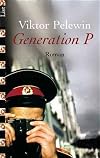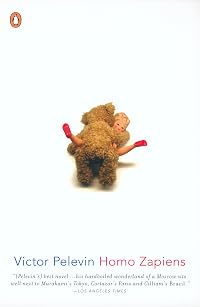
Homo Zapiens
by Viktor Pelevin
On This Page
Description
The collapse of the Soviet Union has opened up a huge consumer market, but how do you sell things to a generation that grew up with just one type of cola? When Tatarsky, a frustrated poet, takes a job as an advertising copywriter, he finds he has a talent for putting distinctively Russian twists on Western-style ads. But his success leads him into a surreal world of spin doctors, gangsters, drug trips, and the spirit of Che Guevera, who, by way of a Ouija board, communicates theories of show more consumer theology. A bestseller in Russia, Homo Zapiens displays the biting absurdist satire that has gained Victor Pelevin superstar status among today's Russian youth, disapproval from the conservative Moscow literary world, and critical acclaim worldwide. show lessTags
Recommendations


















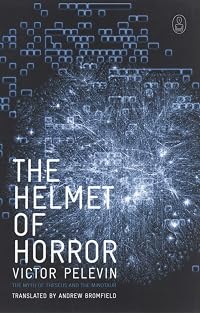
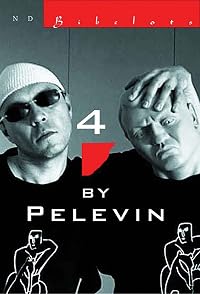
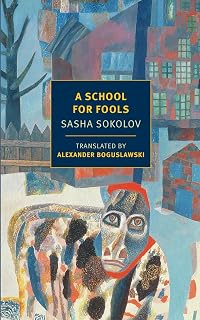
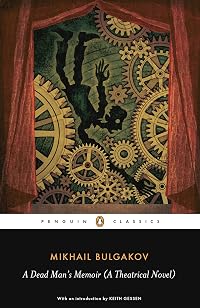










Member Recommendations

prezzey Russian literary fiction with speculative fiction elements. The best of both worlds!
Member Reviews
I love Victor Pelevin, but I somehow managed to miss this one when it came out. I only learned of its existence because a film adaptation premiered at the 2011 Toronto International Film Festival under the title Generation P. The film blew me away and was my favorite from that year's festival; Victor Ginzberg's film adaptation was magnificently faithful to a novel that, I find, was begging to be a weirdass film from the first page.
Homo Zapiens -- the title refers to a theorized new, devolved form of human being whose thoughts and reactions are largely governed by the television, even if, maybe especially if, what he's mostly doing is zapping to avoid commercials -- is Pelevin at his most gleefully nihilistic as he surveys the chaos that show more was Russia in the 90s. Not since The Exile: Sex Drugs and Libel in the New Russia have I seen this milieu so vividly depicted: blatant corruption at all levels of public and private life, gross materialism and drug abuse, vodka and cranky mysticism, all wrapped up in the Russian version of How to Get Ahead in Advertising; had hero Babylen Tartosky sprouted another head I would not have been surprised. But Pelevin has other, crazier ideas to play with, here.
Like the idea that at some point the mass media stopped reporting the news and started making it up -- even to inventing the politicians, who only exist as artfully computer-generated animations and carefully seeded urban legends (a cadre of ordinary-seeming ex-soldier types has the job of planting stories of seeing, e.g. Yeltsin or Berezhovsky in a grocery store or walking down the street). It's unclear whether or not we readers are expected to take this idea as true for this fictional world, or as just another whopper his co-workers and employers have laid on for Babylen's confusion or edification, and it's one of the amazing things about this novel that it ultimately doesn't matter if the reader believes it or not, if Babylen's superiors believe it or not, or if Babylen believes it or not.
Which is to say that Homo Zapiens, novel and film, messed with my head in all of the ways I most like having my head messed with. But if you're not familiar with the real world that inspired this phantasmagorical fake (or is it? Hmm?) one, do yourself a favor and have a look at The Exile, either the book I linked to above, or look at some of the archived "classic" issues from its original run as one of the bitchiest and most profane alternative newspapers the world has ever seen. Doing so will not only enrich your experience of reading or watching Homo Zapiens/Generation P, but will also give you a unique and completely compelling look at the world through the eyes of "two hairy-assed jerks" who had front row seats to watch the chaos, cannibalism and cockery of the collapse of the world's last great empire. show less
Homo Zapiens -- the title refers to a theorized new, devolved form of human being whose thoughts and reactions are largely governed by the television, even if, maybe especially if, what he's mostly doing is zapping to avoid commercials -- is Pelevin at his most gleefully nihilistic as he surveys the chaos that show more was Russia in the 90s. Not since The Exile: Sex Drugs and Libel in the New Russia have I seen this milieu so vividly depicted: blatant corruption at all levels of public and private life, gross materialism and drug abuse, vodka and cranky mysticism, all wrapped up in the Russian version of How to Get Ahead in Advertising; had hero Babylen Tartosky sprouted another head I would not have been surprised. But Pelevin has other, crazier ideas to play with, here.
Like the idea that at some point the mass media stopped reporting the news and started making it up -- even to inventing the politicians, who only exist as artfully computer-generated animations and carefully seeded urban legends (a cadre of ordinary-seeming ex-soldier types has the job of planting stories of seeing, e.g. Yeltsin or Berezhovsky in a grocery store or walking down the street). It's unclear whether or not we readers are expected to take this idea as true for this fictional world, or as just another whopper his co-workers and employers have laid on for Babylen's confusion or edification, and it's one of the amazing things about this novel that it ultimately doesn't matter if the reader believes it or not, if Babylen's superiors believe it or not, or if Babylen believes it or not.
Which is to say that Homo Zapiens, novel and film, messed with my head in all of the ways I most like having my head messed with. But if you're not familiar with the real world that inspired this phantasmagorical fake (or is it? Hmm?) one, do yourself a favor and have a look at The Exile, either the book I linked to above, or look at some of the archived "classic" issues from its original run as one of the bitchiest and most profane alternative newspapers the world has ever seen. Doing so will not only enrich your experience of reading or watching Homo Zapiens/Generation P, but will also give you a unique and completely compelling look at the world through the eyes of "two hairy-assed jerks" who had front row seats to watch the chaos, cannibalism and cockery of the collapse of the world's last great empire. show less
http://mowgliesq.com/2010/06/18/victor-pelevins-homo-zapiens/
Rare is the book that is as uproariously funny as it is profoundly terrifying, but Victor Pelevin’s Homo Zapiens is just that: a novel that unflinchingly dissects your dismal fate as a 21st century accumulator-consumer only to leave you laughing about it. Set in post-Soviet Moscow, the narrative follows the meteoric rise of Babylen, a regrettably-named poet-turned-copywriter. After the dissolution of the U.S.S.R. renders his job as translator of the Soviet Republics’ literatures obsolete, he slaves away in a tobacco stand until a classmate from the Literature Institute steers him into the advertising business. Babe proves a quick study, churning out such winning material show more as, “Do it yourself, motherfucker. Reebok.”- that is, when he’s not gripped by paranoia from his dabblings in Egyptology, Eastern mysticism and psychedelics. When he is promoted to do PR for the Russia government (an institution which, according to his superiors, does not exist in any physical sense), the nagging fears brought on by his acid tabs and ouija board come to the fore in a recherche climax. show less
Rare is the book that is as uproariously funny as it is profoundly terrifying, but Victor Pelevin’s Homo Zapiens is just that: a novel that unflinchingly dissects your dismal fate as a 21st century accumulator-consumer only to leave you laughing about it. Set in post-Soviet Moscow, the narrative follows the meteoric rise of Babylen, a regrettably-named poet-turned-copywriter. After the dissolution of the U.S.S.R. renders his job as translator of the Soviet Republics’ literatures obsolete, he slaves away in a tobacco stand until a classmate from the Literature Institute steers him into the advertising business. Babe proves a quick study, churning out such winning material show more as, “Do it yourself, motherfucker. Reebok.”- that is, when he’s not gripped by paranoia from his dabblings in Egyptology, Eastern mysticism and psychedelics. When he is promoted to do PR for the Russia government (an institution which, according to his superiors, does not exist in any physical sense), the nagging fears brought on by his acid tabs and ouija board come to the fore in a recherche climax. show less
In this magical-realist tale the the advertisment-writer hero realizes what's behind EVERYTHING, from TV ads to international politics. As in the Pelevin books usulal nothing and nobody is what it seems...
Generation "П", Поколение "П", Generation "P", Babylon, Homo Zapiens. All are titles of this curious work that propelled Pelevin to the top of Russian best-seller lists and into the world of global publishing. Starting from a fairly standard cliche about the the correlation of Pepsi to the aging post-Soviet middle-aged and Coca-Cola to the post-Soviet version of Gen X, this novel is like an encyclopedia of the early 1990's in Russia. It presents cliche after cliche and builds them into a drug induced ziggurat of analysis and parody.
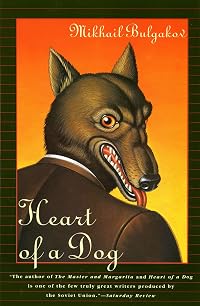
A post-soviet magic-realist tale of advertising excutives, westernisation and drugs. Wonderfully funny and orginal, with echoes of Bulgakov and the cruelty of will self.
Начинал еще в начале века читать, потом бросил. 2007 перечитал и совсем не понял по какой причине я ее бросал читать. После прочтения не могу смотреть телевизор.
Подарил Леша на д.р.
Подарил Леша на д.р.
Jan 11, 2008Russian
Members
- Recently Added By
Author Information

Some Editions
Awards and Honors
Awards
Distinctions
Series
Belongs to Publisher Series
Work Relationships
Is contained in
Common Knowledge
- Canonical title*
- Generation "П"
- Original title
- Generation П
- Alternate titles
- Generation P; Babylon; Homo Zapiens (US title) (US title)
- Original publication date
- 1999
- Important places
- Russia
- Epigraph*
- I'm sentimental, if you know what I mean;
I love the country but I can't stand the scene.
And I'm neither left or right.
I'm just staying home tonight,
getting lost in that hopeless little scree... (show all)n.
Leonard Cohen - Dedication
- To the Memory of the Middle Class
- First words*
- Когда-то в России и правда жило беспечальное юное поколение, которое улыбнулось лету, морю и солнцу - и выбрало "Пепси".
- Last words*
- (Click to show. Warning: May contain spoilers.)Ходили слухи, что был снят вариант этого клипа, где по дороге один за другим идут тридцать Татарских, но так это или нет, не представляается возможным установить.
- Original language
- Russian
*Some information comes from Common Knowledge in other languages. Click "Edit" for more information.
Classifications
- Genres
- General Fiction, Fiction and Literature
- DDC/MDS
- 813 — Literature & rhetoric American literature in English American fiction in English
- LCC
- PG3485 .E38 .G4613 — Language and Literature Slavic languages and literatures. Baltic languages. Albanian language Slavic. Baltic. Albanian Russian literature Individual authors and works 1961-2000
- BISAC
Statistics
- Members
- 683
- Popularity
- 42,140
- Reviews
- 7
- Rating
- (3.69)
- Languages
- 18 — Czech, Danish, English, Finnish, French, German, Greek, Hungarian, Italian, Japanese, Latvian, Lithuanian, Norwegian (Bokmål), Polish, Romanian, Russian, Spanish, Turkish
- Media
- Paper, Ebook
- ISBNs
- 53
- ASINs
- 7