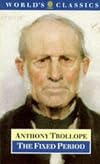
The Fixed Period
by Anthony Trollope
On This Page
Description
Published in 1882, this extraordinary novel--an exercise in Swiftian irony combined with a love story in a futuristic setting--is entirely uncharacteristic of Trollope's usual drawing room conversations and hunting scenes. Set in the 1980s, The Fixed Period describes an imaginary, antipodean ex-colony governed by a President who views himself as a benefactor of the human race, Orwellian double-speak and gunboat diplomacy. This is Trollope's strangest and most chilling novel.Tags
Recommendations























Member Reviews
Now we would look back at this book and call it science fiction; at the time it was published, it was considered a sort of utopian satire, like Erewhon or The Coming Race. It's weird to think that Anthony Trollope wrote science fiction, and there's nothing about his literary fiction that leaves me thinking he'd be particularly good at it. (George Eliot and Charles Dickens, though, I think would be capable of writing smashing sf novels for very different reasons.) I read it for the same reason I always pick up a nineteenth-century novel: it features a scientist. The narrator of The Fixed Period is John Neverbend, a social scientist and reformer who's worked out that if you euthanize everyone when they turn 67, society will be better off. show more As it is, one-third of the population contributes nothing! But as the death of the first man approaches in 1980, folks start to think that what seemed great in the abstract when the law was passed back in 1950 might not be so awesome when it's your friend or dad or neighbor who's got to be killed.
It's kind of a dull book, but where Trollope succeeds is in writing a narrator completely sure of his own righteousness. Neverbend just sees the world differently than other people, through the lens of rationality and statistics and the national interest. (The novel takes place on the independent former British colony of Britannula, which I think is in the vicinity of Australia and New Zealand.) Neverbend's plan is overturned, both by the people of Britannula and the British government, but he never sees why. Up until the very end, he is comparing himself to people like Galileo and Socrates, as scientific reformers who people didn't understand in their own age. Neverbend just doesn't get it, and he never will; his way of thinking is incommensurable with everyone else's, and in keeping this stubborn man (mostly) sympathetic throughout is where The Fixed Period's greatest success lies. You understand why Neverbend thinks what he does, even as you understand what he cannot: why everyone else thinks as they do. show less
It's kind of a dull book, but where Trollope succeeds is in writing a narrator completely sure of his own righteousness. Neverbend just sees the world differently than other people, through the lens of rationality and statistics and the national interest. (The novel takes place on the independent former British colony of Britannula, which I think is in the vicinity of Australia and New Zealand.) Neverbend's plan is overturned, both by the people of Britannula and the British government, but he never sees why. Up until the very end, he is comparing himself to people like Galileo and Socrates, as scientific reformers who people didn't understand in their own age. Neverbend just doesn't get it, and he never will; his way of thinking is incommensurable with everyone else's, and in keeping this stubborn man (mostly) sympathetic throughout is where The Fixed Period's greatest success lies. You understand why Neverbend thinks what he does, even as you understand what he cannot: why everyone else thinks as they do. show less
Not quite what you would expect from Trollope: this late work is a satirical fantasy, set 100 years in the future (1979-1980!) in an imaginary former British colony in the South Pacific. It's obviously meant to be alluding to things like Gulliver's travels, Erewhon and More's Utopia, but the scenario calls W.S Gilbert to mind much more readily than Swift: The government of the young republic has enacted a rational, benevolent and enlightened new law that imposes compulsory euthanasia on everyone who reaches the age of 68 (Trollope was 67 when he wrote this!). Everything goes very smoothly, until they get to the point when the first person should be "deposited" in the new college prior to the humane ending of his life...
The silly plot show more and the little futuristic touches (cricket matches with steam-powered catapults, etc.) would have been ideal for a G&S operetta: apart from cricketers, we also get various peers and the Royal Navy. Throw in a few pirates and some bridesmaids, and we've practically got a full set of G&S choruses. On the other hand, there's a lot of rather unfortunately-prescient reference to crematorium ovens, invoking quite a different set of associations.
What makes it especially Trollopean is the way the story is tied to the viewpoint of President Neverbend, a reasonable, humane man, but stubborn in his conviction that the Fixed Period will be the salvation of mankind, if he can only get beyond the purely domestic problem that the first person to be killed is his best friend, the father of the girl his son wants to marry. Male stubbornness is a Trollope speciality, of course, and we have the inevitable scenes where Neverbend has to submit to bedtime lectures from his wife, just like Grantly, Proudie and all the rest. Seeing these from the first-person viewpoint, watching how Neverbend tries to resolve common-sense and friendship with his convictions, is a fascinating process. I believe this is the only Trollope novel written in the first person: it is very effective. show less
The silly plot show more and the little futuristic touches (cricket matches with steam-powered catapults, etc.) would have been ideal for a G&S operetta: apart from cricketers, we also get various peers and the Royal Navy. Throw in a few pirates and some bridesmaids, and we've practically got a full set of G&S choruses. On the other hand, there's a lot of rather unfortunately-prescient reference to crematorium ovens, invoking quite a different set of associations.
What makes it especially Trollopean is the way the story is tied to the viewpoint of President Neverbend, a reasonable, humane man, but stubborn in his conviction that the Fixed Period will be the salvation of mankind, if he can only get beyond the purely domestic problem that the first person to be killed is his best friend, the father of the girl his son wants to marry. Male stubbornness is a Trollope speciality, of course, and we have the inevitable scenes where Neverbend has to submit to bedtime lectures from his wife, just like Grantly, Proudie and all the rest. Seeing these from the first-person viewpoint, watching how Neverbend tries to resolve common-sense and friendship with his convictions, is a fascinating process. I believe this is the only Trollope novel written in the first person: it is very effective. show less
Not your normal Trollope book. On a fictional island in the vicinity of New Zealand, and deals with euthanasia as a radical solution to the problem of the aged. Now the oldest colonist is approaching the final year problems arrive. The President is a true believer. His friend, Crasweller the oldest colonist doesn't want to die. Crasweller's daughter doesn't want to lose her father. The President's son is in love with Crasweller's daughter and begins to fight his father. Despite everything the Presidents belief that it is the right thing never wavers.
Ratings
Members
- Recently Added By
Lists

Books Read in 2014
2,343 works; 89 members
Author Information

344+ Works 50,540 Members
Anthony Trollope was born in London, England on April 24, 1815. In 1834, he became a junior clerk in the General Post Office, London. In 1841, he became a deputy postal surveyor in Banagher, Ireland. He was sent on many postal missions ending up as a surveyor general in the post office outside of London. His first novel, The Macdermots of show more Ballycloran, was published in 1847. His other works included Castle Richmond, The Last Chronicle of Barset, Lady Anna, The Two Heroines of Plumplington, and The Noble Jilt. He died after suffering from a paralytic stroke on December 6, 1882. (Bowker Author Biography) show less
Some Editions
Series
Belongs to Publisher Series
Work Relationships
Common Knowledge
- Canonical title
- The Fixed Period
- Original publication date
- 1882
- Important places
- Britannula
- First words
- It may be doubted whether a brighter, more prosperous, and specially more orderly colony than Britannula was ever settled by British colonists.
- Quotations
- I never knew a decent woman who wasn't an Episcopalian.
- Last words
- (Click to show. Warning: May contain spoilers.)Then I left him, and went down to complete my manuscript.
Classifications
Statistics
- Members
- 216
- Popularity
- 151,084
- Reviews
- 3
- Rating
- (2.88)
- Languages
- English
- Media
- Paper, Ebook
- ISBNs
- 32
- ASINs
- 6