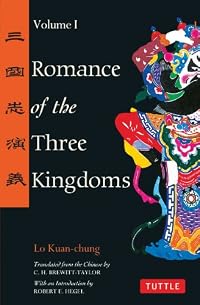
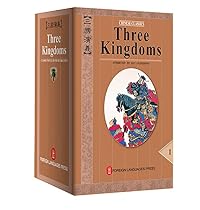
Romance of the Three Kingdoms, Vol. 1
by Lo Kuan-chung.
Romance of the Three Kingdoms (Tuttle Publishing) (1)
On This Page
Description
Written sometime in the fourteenth-century, "Romance of the Three Kingdoms" by the famed Chinese writer and playwright Luo Guanzhong, is one of the Four Great Classical Novels of Chinese literature and its influence in China and East Asia can be, compared to Shakespeare in England and Europe. This popular tale is remarkable for its length at 800,000 words and its impressive cast of nearly one thousand dramatic characters. The story, which contains elements of true historical accounts mixed show more with myth and legend, is set during the tumultuous end of the Han dynasty in 169 AD and ends with the reunification of the country in 280 AD. This time was, known as the "Three Kingdoms" period in Chinese history and is famous for the battles waged by feudal lords and their loyal retainers as they fought with each other to either replace the fading Han dynasty or restore it to its former power. The story follows hundreds of characters during this time of unrest and conflict and focuses on the politics, diplomacy, and struggle for power of the time. This edition follows the translation of C. H. Brewitt-Taylor. show lessTags
Recommendations











Member Reviews
Battles, rivalry, espionage, subterfuge, love, filial honour, tradition, strategies, mysticism, kingdoms, suicide, plots, intrigue, betrayal, loyalty, cunning, wisdom, wealth, corruption, conquest, weaponry, tactics, plots, debauchery, virtue, memorials, poetry… if any of these are what you’re looking for in a novel then The Romance of the Three Kingdoms might interest you.
Most of those do interest me and Romance did not disappoint. For the most part, this 1360 page epic held me in its grasp not too loosely at all. At times, yes, it was all a bit much, but the story ebbs and flows as unpredictably as the fates of the three kingdoms. Just hanging in there for a couple of the brief chapters and I was back into it again.
The writing is show more amazing for being nigh on 500 years old. The translation isn’t perfect, but it certainly isn’t as laborious as I’d have expected in an ancient epic. It’s very readable. The first line (below) sets the stage masterfully. Structurally, it’s a vast saga of the Shu (Han), Wu and Wei kingdoms who vie for power right until the very last 100 pages. But within this huge storm of power, there are literally hundreds of smaller stories that range from the fantastic, to the criminal, to the romantic, to the downright gruesome.
And some of the characters I won’t forget in a hurry: Liu Pei (also, confusingly, known as Yuan Te) the spurned Han Emperor; his fantastically wise advisor Kung Ming (also, confusingly, known as Chuko Liang) who no one can outwit in battle or in magic; the tryannical and traitorous Tsao Tsao who plays a central role in making the Wei kingdom a real player in the political realm; Kuan Yu who is so innured to fear that he plays a board game while a surgeon scrapes an infection off a bone in his arm. That some of these are not more well-known in the west is a telling sign of our ethnocentricity.
In terms of its influence it ranks up there alongside Shakespeare, the Bible and Harry Potter. You can’t interpret any subsequent text in Chinese culture without reference to it and that goes for a large part of East Asian literature too. In fact, there’s a Korean proverb that says something like you can’t talk about life until you’ve read it. Well, I have now so…
I’ve rated it “superb” because of this legacy of influence and also because it has given me a completely new perspective on China, revealing the nation to me like nothing I’ve ever read from there. I now want to watch some films or read other novels that have been influenced by or based on it. And next time I meet someone from China, I’m looking forward to talking about it and its influence in their country.
It won’t be everyone’s cup of tea though. Unless you are really into military history, you’ll probably find the endless descriptions of battles and conflict quite tedious. There are so many characters you have to just abandon any hope of remembering any more than a handful and that may prove daunting. And there’s a fair bit of gore: “The arrow hit Hsiahou Tun full in the left eye. he shrieked, and putting up his head, pulled out the arrow and with it the eye. “Essence of my father, blood of my mother, I cannot throw this away,” cried he, and he put the eye into the mouth and swallowed it.”
Finally, my translation (Brewitt-Taylor) is cram full of typos: “I have been slam [slain] by that dastard [bastard] Sun Hsun” and “Lu Hsun knows the rat [art] of war even as did Sun Wu.” Many of these seem to be because the editors seems to have relied on OCR of the text at some point which could interpret an unclear “slain” as “slam.” They probably scanned the original translation, which was done in the ’20s, did the OCR and ran a spell-check and thought, that’ll do. Shame they didn’t actually read it.
Glad I did though. show less
Most of those do interest me and Romance did not disappoint. For the most part, this 1360 page epic held me in its grasp not too loosely at all. At times, yes, it was all a bit much, but the story ebbs and flows as unpredictably as the fates of the three kingdoms. Just hanging in there for a couple of the brief chapters and I was back into it again.
The writing is show more amazing for being nigh on 500 years old. The translation isn’t perfect, but it certainly isn’t as laborious as I’d have expected in an ancient epic. It’s very readable. The first line (below) sets the stage masterfully. Structurally, it’s a vast saga of the Shu (Han), Wu and Wei kingdoms who vie for power right until the very last 100 pages. But within this huge storm of power, there are literally hundreds of smaller stories that range from the fantastic, to the criminal, to the romantic, to the downright gruesome.
And some of the characters I won’t forget in a hurry: Liu Pei (also, confusingly, known as Yuan Te) the spurned Han Emperor; his fantastically wise advisor Kung Ming (also, confusingly, known as Chuko Liang) who no one can outwit in battle or in magic; the tryannical and traitorous Tsao Tsao who plays a central role in making the Wei kingdom a real player in the political realm; Kuan Yu who is so innured to fear that he plays a board game while a surgeon scrapes an infection off a bone in his arm. That some of these are not more well-known in the west is a telling sign of our ethnocentricity.
In terms of its influence it ranks up there alongside Shakespeare, the Bible and Harry Potter. You can’t interpret any subsequent text in Chinese culture without reference to it and that goes for a large part of East Asian literature too. In fact, there’s a Korean proverb that says something like you can’t talk about life until you’ve read it. Well, I have now so…
I’ve rated it “superb” because of this legacy of influence and also because it has given me a completely new perspective on China, revealing the nation to me like nothing I’ve ever read from there. I now want to watch some films or read other novels that have been influenced by or based on it. And next time I meet someone from China, I’m looking forward to talking about it and its influence in their country.
It won’t be everyone’s cup of tea though. Unless you are really into military history, you’ll probably find the endless descriptions of battles and conflict quite tedious. There are so many characters you have to just abandon any hope of remembering any more than a handful and that may prove daunting. And there’s a fair bit of gore: “The arrow hit Hsiahou Tun full in the left eye. he shrieked, and putting up his head, pulled out the arrow and with it the eye. “Essence of my father, blood of my mother, I cannot throw this away,” cried he, and he put the eye into the mouth and swallowed it.”
Finally, my translation (Brewitt-Taylor) is cram full of typos: “I have been slam [slain] by that dastard [bastard] Sun Hsun” and “Lu Hsun knows the rat [art] of war even as did Sun Wu.” Many of these seem to be because the editors seems to have relied on OCR of the text at some point which could interpret an unclear “slain” as “slam.” They probably scanned the original translation, which was done in the ’20s, did the OCR and ran a spell-check and thought, that’ll do. Shame they didn’t actually read it.
Glad I did though. show less
I liked how the good and the bad guys are ambiguous but in the end the 'good' guys fail, cause most books like to have the good guys always win
only read 50 pages...o my.. maybe a classic ... but too many names to follow and so forth. I need a structure - a little bit please!
It was a struggle to keep track of who is who.
Ratings
Members
- Recently Added By
Author Information

Very little is known about Lo the man, and even the extent of his participation in the works bearing his name is in some doubt. All we can say for certain is that he lived during the transition from Yuan to Ming dynasties, hailed from T'ai-yuan (in Shansi Province), and spent at least part of his adult life in Hangchow. There, he authored three show more dramas, one of which survives, and worked on two historical narratives that eventually became the famous fiction masterpieces "Outlaws of the Marsh" and "Romance of the Three Kingdoms". Traditionally, Lo is given as the first author of the "Romance of the Three Kingdoms", whereas he is listed as secondary author after Shih Nai-an for "Outlaws of the Marsh". However, it seems probable that he was actually the primary writer of both. He based the first on the historical work "Account of the Three Kingdoms", about events following the breakup of the Han empire (168--265), and based the second on storyteller's material compiled by Shih about a legendary band of outlaws active during the reign of Hui-tsung in the Northern Sung (1101-1125). Nevertheless, in deference to tradition, "Outlaws of the Marsh" will be discussed under the entry for Shih Nai-an. Lo's main contribution to Chinese literature in the Three Kingdoms epic is in taking incidents recorded in history and long borrowed by the storytelling tradition, and molding them into a coherent chronological narrative. In the process, he attempts to sift out the patently false or exaggerated elements while maintaining liveliness and artistic interest. His goal seems to have been to reach a wide reading audience with his lessons, while not pandering to vulgar cravings for Taoist magicians' stunts or Buddhist popular proofs of retribution in the workings of history. Instead, he invites his readers to reflect on how ambition affects different human characters at a time when the stakes are very high---a dynastic title is the prize. Lo's is a complex vision of reality; his heroes are not rigidly black or white, and virtue is not necessarily rewarded. But his universe is not without laws, and his portrayal of events illustrates the Confucian belief that one's actions determine the outcome of events. According to a younger contemporary, Lo was a shy and retiring man. Perhaps his personal modesty is mirrored by the style of his great narrative, which is generally lacking in rhetorical flourish, but yet not highly colloquial---a kind of simplified classical Chinese. With his plain style and sober attention to historical fact, the result could have been a dry chronicle; but such was Lo's passion for his subject, and his ability to achieve character that generations of Chinese readers have seen the Three Kingdoms period through his eyes and even today admire his heroes and hate his villains. (Bowker Author Biography) show less
All Editions
Series

Work Relationships
Is contained in
Common Knowledge
- Important places
- China
- Important events
- Three Kingdoms Era; 3rd century
- Disambiguation notice
- This is Volume 1 of an abridged 2-part version of Romance of Three Kingdoms. please don't combine it with unabridged versions or Volume 1 of 3 or 4 Volume sets.
Classifications
- Genres
- Fiction and Literature, General Fiction, Historical Fiction
- DDC/MDS
- 895.1346 — Literature & rhetoric Asian Literature Literatures of East and Southeast Asia Chinese Chinese fiction Song, Yuan, Ming, Qing dynasties 960–1912 Ming dynasty 1368–1644
- LCC
- PL2690 .S3 .E53 — Language and Literature Languages and literatures of Eastern Asia, Africa, Oceania Languages of Eastern Asia, Africa, Oceania Chinese language and literature Chinese literature Individual authors and works
- BISAC
Statistics
- Members
- 370
- Popularity
- 84,447
- Reviews
- 4
- Rating
- (4.20)
- Languages
- Chinese, Dutch, English, Korean
- Media
- Paper, Ebook
- ISBNs
- 6