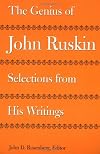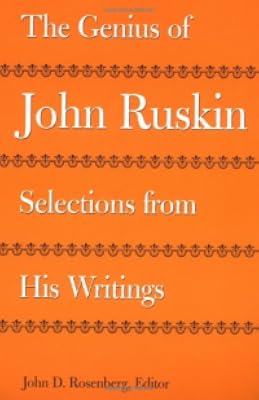
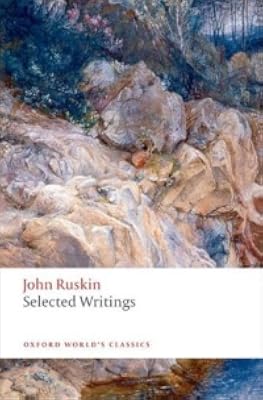
The Genius of John Ruskin: Selections from His Writings (Victorian Literature and Culture Series)
by John Ruskin
153 Members (3.56)
On This Page
Description
No figure among the Victorians surpasses John Ruskin in magnitude of genius, modernity of message, or mastery of prose. Yet for the first half-century after his death in 1900, his genius lay largely undiscovered. First published in 1963, John D. Rosenberg's The Genius of John Ruskin aimed to make Ruskin's ideas and writings accessible to the modern reader, and it quickly became a classic. Long out of print, this important anthology is now available with a new foreword by Herbert F. Tucker show more and an expanded and updated bibliography by the author that takes into account recent Ruskin scholarship. show lessTags
Recommendations


















Member Reviews
Members
- Recently Added By
Author Information

499+ Works 9,085 Members
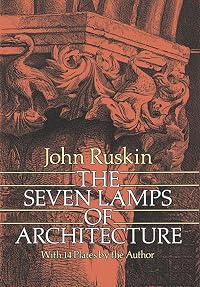
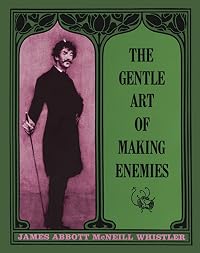
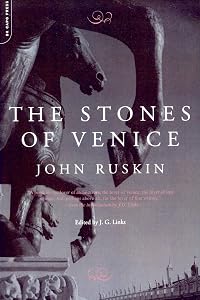
Ruskin was one of the most influential man of letters of the nineteenth century. An only child, Ruskin was born in Surrey. He attended Christ Church, Oxford, from 1839 to 1842. His ties to his parents, especially his mother, were very strong, and she stayed with him at Oxford until 1840, when, showing ominous signs of consumption, he left for a show more long tour of Switzerland and the Rhineland with both parents. His journeys to France, Germany, and, especially, Italy formed a great portion of his education. Not only did these trips give him firsthand exposure to the art and architecture that would be the focus of much of his long career; they also helped shape what he felt was his main interest, the study of nature. Around this time Ruskin met the landscape artist J. M. W. Turner, for whose work he had developed a deep admiration and whom he lauded in his Modern Painters (1843). In 1848 Ruskin married Euphemia (Effie) Gray, a distant cousin 10 years his junior. This relationship has been the focus of much scholarship, for six years later the marriage was annulled on the grounds of nonconsummation, and in 1855 Effie married John Everett Millais, the Pre-Raphaelite painter and an acquaintance of Ruskin. During the years 1849--52, Ruskin lived in Venice, where he pursued a course of architectural studies, publishing The Seven Lamps of Architecture (1849) and where he began The Stones of Venice (1851--53). It was also during this period that Ruskin's evangelicalism weakened, leading finally to his "unconversion" at Turin in 1858. His subsequent interest in political economy was clearly stated when, echoing his "hero," Carlyle, Ruskin remarked in the last volume of Modern Painters that greed is the deadly principle that guides English life. In a series of essays in Cornhill Magazine attacking the "pseudo-science" of political economists like J. S. Mill, David Ricardo, and Thomas Malthus, Ruskin argues that England should base its "political economy" on a paternalistic, Christian-based doctrine instead of on competition. The essays were not well received, and the series was canceled short of completion, but Ruskin published the collected essays in 1862 as Unto This Last. At the same time, he renewed his attacks on the political economists in Fraser's Magazine, later publishing these essays as Munera Pulveris (1872). From about 1862 until his death, Ruskin unsuccessfully fought depression. He was in love with Rose La Touche, whom he met when she was 11 and he 41. When she turned 18, Ruskin proposed, but the her parents opposed the marriage, and religious differences (she was devout; Ruskin was at this time a freethinker) kept them from ever marrying. La Touche died in 1875, insane, and three years later Ruskin experienced the first of seven attacks of madness that would plague him over the next 10 years. By 1869 Ruskin had accepted the first Slade Professorship of Fine Art at Oxford, begun his serial Fors Clavigera, been sued and found guilty of libel for his attack on Whistler in Fors Clavigera (he was fined a farthing), and resigned his professorship. Ruskin's work was instrumental in the formation of art history as a modern discipline. A capable artist, he complemented his technical understanding of art with insightful analysis and passionately held social ideals. His social writings are of interest today primarily as artifacts of the age, but his art criticism still holds an important place, especially in his appreciation of Turner. There is a vast number of works on Ruskin. From a literary standpoint, John Rosenberg's study, although dated because of many of its assumptions, is still an outstanding book. Jay Fellows's work is interesting and has caused much controversy among Ruskin scholars. (Bowker Author Biography) show less
Classifications
- Genres
- Nonfiction, Literature Studies and Criticism, Fiction and Literature
- DDC/MDS
- 828.809 — Literature & rhetoric English & Old English literatures English miscellaneous writings 1837-1899 Individual authors
- LCC
- PR5252 .R64 — Language and Literature English English Literature 19th century , 1770/1800-1890/1900
- BISAC
Statistics
- Members
- 153
- Popularity
- 214,627
- Rating
- (3.56)
- Languages
- English, German
- Media
- Paper
- ISBNs
- 5
- ASINs
- 6