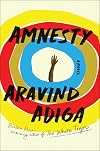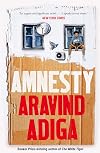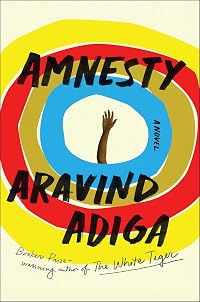
Amnesty
by Aravind Adiga
On This Page
Description
"Danny--formerly Dhananjaya Rajaratnam--is an illegal immigrant in Sydney, Australia, denied refugee status after he fled from Sri Lanka. Working as a cleaner, living out of a grocery storeroom, for three years he's been trying to create a new identity for himself. And now, with his beloved vegan girlfriend, Sonja, with his hidden accent and highlights in his hair, he is as close as he has ever come to living a normal life. But then one morning, Danny learns a female client of his has been show more murdered. The deed was done with a knife, at a creek he'd been to with her before; and a jacket was left at the scene, which he believes belongs to another of his clients--a doctor with whom Danny knows the woman was having an affair. Suddenly Danny is confronted with a choice: Come forward with his knowledge about the crime and risk being deported? Or say nothing, and let justice go undone? Over the course of this day, evaluating the weight of his past, his dreams for the future, and the unpredictable, often absurd reality of living invisibly and undocumented, he must wrestle with his conscience and decide if a person without rights still has responsibilities. Propulsive, insightful, and full of Aravind Adiga's signature wit and magic, Amnesty is both a timeless moral struggle and a universal story with particular urgency today"-- show lessTags
Recommendations





















Member Reviews
3.5 Danny, in his words, is a brown person living invisibly in Sydney, Australia. He is an illegal immigrant from Sri Lanka who left due to government abuse and came to Australia on a student visa with the encouragement of a shady money-making university that only wanted more money after he arrived. He leaves uni, and tries to seek asylum, but also abdicates his visa and passport. He manages to live under the radar of the Australian equivalent to ICE and evade deportation for 4 years. He becomes a Legendary Cleaner, cleaning various homes and flats for cash and taking pride in his work. He also works in a small grocery and lives in the stockroom with the white owner, Tommo taking a cut of all his pay. Just the daily fear and threat his show more lives with is harrowing enough. Australia's laws seem to be much stricter than the US, having penalties for those who employ illegals and having widespread outreach for "tattle" hotlines to report suspects. "Idealism and corruption flowed side by side in Sydney like parallel streams of sewage. White people would be lecturing you on your rights all the way to the deportation vehicle." Danny is sharp and smart - he blends in well with the vanity of bleached hair tips and doesn't take unnecessary risks or break any laws, but works hard and keeps his head down. His girlfriend Sonja is a bright spot in his life and starts to make him feel like part of something. The hardship of this lifestyle is conveyed well and with humor surprisingly, because Danny is so easy-going. However there is a plot twist. When one of his cleaning clients is murdered, Danny thinks he knows who did it. He spent a lot of time with the dead woman and her lover who was also a client. He became an unwitting part of of their love triangle. Now to share his knowledge puts his own life in jeopardy. The action takes place in a single day and Danny debates with himself to "dob in" or not the man he suspects who can just as easily "dob in" Danny as an illegal. Watching Danny debate his conscience, weigh his options, and share the backstory of what drove him from Sri Lanka makes for a very compelling, empathetic read. show less
Aravind Adiga can tell such a dark story while simultaneously charming the reader. Danny, a Sri Lankan living beyond his visa expiration in Australia, works his way into the reader's heart. As witness to a murder, he must choose whether to report what he knows, risking deportation, or not to report. As he struggles with the decision, the reader must endure the disturbing, shameful details of the immigrant life of perpetual fear. All credit to Adiga for being an outstanding storyteller and being able to convey the painful ambivalence of moral dilemma. .
In Amnesty, Aravind Adiga tells the story of Dhananjaya Rajaratnam, a Sri Lankan Tamil from Batticaloa, the most beautiful and mysterious city on the Sri Lankan coast, famous for its magical lagoon with its singing fish. Danny returns to Batticaloa after working for a year as a motel clerk in Dubai — wearing a suit to work! — and finds himself suspected and tortured by local police for involvement in the Tamil Tigers. Danny hops a flight to Sydney on a student visa, decides that diploma mill for foreigners seeking citizenship is too expensive, and files a futile petition for asylum. Danny chooses life as an illegal immigrant: Asylum follows him through his four years in Australia. This is a classic immigration story, but set in show more Australia and with an apparently middle class immigrant.
Asylum contains many wonderful touches. Danny pretends to be vegetarian, so that he can find a girlfriend through the online app VeggieDate, but he yearns for mutton, pork, and chicken; he takes two stuffed pandas to bed in his storeroom bedroom above a small grocery store in Glebe; he divides Sydney suburbs into thick bum — working class — and thin bum — Yuppie. He supports himself as a Legendary Cleaner who never wears a face mask to avoid frightening clients. Most of all, Danny strives to look as Australian and as unobtrusive as possible, especially fearing the wealthy and middle class icebox Indians and the Tamils in Australia legally, thinking that they will immediately identify him as illegal.
Adiga interjects many poignant touches into Asylum. Danny ruefully prides himself as honest, reliable, and intelligent. He finds some comfort in downtown Sydney, with its polyglot, multiracial crowds, and panics in Sydney’s white suburbs, where he fears identification as illegal. Danny works hard at assimilating, or at least at what he believes is assimilating: he takes care not to pronounce the “p” in “receipt”, he takes notes on the different types of rugby, he highlights his hair. In the end, Danny must choose between his own uprightness and his life in Australia.
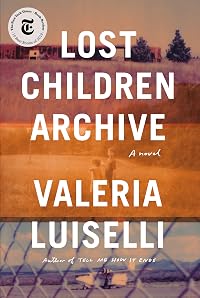
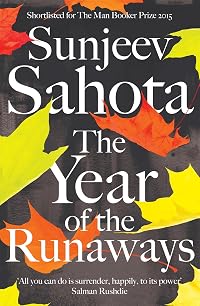
Asylum provides a different perspective on immigration than other excellent recent novels such as Mohsin Hamid's Exit West, Sunjeev Sahota's The Year of the Runaways, Valeria Luiselli's Lost Children Archive, and Yuri Herrera's Signs Proceeding the End of the World. I’ve read four of Aravind Adiga’s five novels, and all feature transparently lucid prose, what feels like effortless writing, and characters and situations that veer between utmost seriousness and cockeyed humor. Asylum ranks with Adiga’s best. 4.5 stars show less
Asylum contains many wonderful touches. Danny pretends to be vegetarian, so that he can find a girlfriend through the online app VeggieDate, but he yearns for mutton, pork, and chicken; he takes two stuffed pandas to bed in his storeroom bedroom above a small grocery store in Glebe; he divides Sydney suburbs into thick bum — working class — and thin bum — Yuppie. He supports himself as a Legendary Cleaner who never wears a face mask to avoid frightening clients. Most of all, Danny strives to look as Australian and as unobtrusive as possible, especially fearing the wealthy and middle class icebox Indians and the Tamils in Australia legally, thinking that they will immediately identify him as illegal.
Adiga interjects many poignant touches into Asylum. Danny ruefully prides himself as honest, reliable, and intelligent. He finds some comfort in downtown Sydney, with its polyglot, multiracial crowds, and panics in Sydney’s white suburbs, where he fears identification as illegal. Danny works hard at assimilating, or at least at what he believes is assimilating: he takes care not to pronounce the “p” in “receipt”, he takes notes on the different types of rugby, he highlights his hair. In the end, Danny must choose between his own uprightness and his life in Australia.
Asylum provides a different perspective on immigration than other excellent recent novels such as Mohsin Hamid's Exit West, Sunjeev Sahota's The Year of the Runaways, Valeria Luiselli's Lost Children Archive, and Yuri Herrera's Signs Proceeding the End of the World. I’ve read four of Aravind Adiga’s five novels, and all feature transparently lucid prose, what feels like effortless writing, and characters and situations that veer between utmost seriousness and cockeyed humor. Asylum ranks with Adiga’s best. 4.5 stars show less
This novel drags out the terrible journey of Danny, undocumented house cleaner of Sydney, Australia, from his home in Sri Lanka to Dubai, back home again, and then as the victim of a scam that leaves him without a path to citizenship under the country's harsh laws. The plot unfolds beautifully in the details of Danny's travels and travails, how he was taken advantage of everywhere he went, but the story of this one particular day drags. Danny has been cultivated by a woman and her lover whose homes he cleans immaculately, earning him the nickname “Legendary Cleaner”. Radha and Prakash take Danny under their wing, and Radha promises to assist with his citizenship quest and to help him to avoid arrest and deportation, but the couple show more argue violently and share a gambling problem, and on the day that Radha is murdered, Danny must decide what course of action to take, if any. As the day drags on and Prakash and Danny play cat-and-mouse, Danny's entire story is revealed in its misery. It's a moving and disturbing book, just what you'd expect from this celebrated author, but the structure weakens the reward for the reader.
Quotes: "For the other illegals, shame was an atmospheric force, pressing down from outside; in him, it bubbled up from within."
"Prakash had that terrible look of a hungover fortysomething-year-old, now at the stage of his life where drinking depletes some permanent reserve of strength inside. An instinct is sitting here, not a man." show less
Quotes: "For the other illegals, shame was an atmospheric force, pressing down from outside; in him, it bubbled up from within."
"Prakash had that terrible look of a hungover fortysomething-year-old, now at the stage of his life where drinking depletes some permanent reserve of strength inside. An instinct is sitting here, not a man." show less
It's not easy to read this book at a time when we know that there are people in our cities who are excluded from government assistance programs...
Amnesty, Aravind Adiga's fifth novel, is set in Sydney. Its central character is a Tamil called Dhananjaya (Danny) Rajaratnam, a would-be Australian citizen from Sri Lanka. His undocumented status comes to the fore when trying to describe it. He bears physical proof of torture in Sri Lanka because authorities thought he was a terrorist returning from Dubai, but he is not deemed a refugee because he came to Australia by plane, not in a people-smuggler's boat. He came as a student in one of those dubious colleges that have (I hope) since been shut down because their marketing model had nothing show more to do with education. It was to provide a route for would-be migrants to Australia to come here ostensibly as students, to defer and extend studies for as long as possible while accruing points towards citizenship. The college fees were monstrously high, and these so-called students in non-existent courses had to work in the kind of jobs that nobody wants to do, in order to get by. If they continued to pay the fees, all they got was a dubious certificate, of no value in the employment market at all.
Danny is aware before he leaves Sri Lanka that his student visa is a citizenship scam, but when he realises that it's also a different kind of scam that doesn't enhance his employment prospects, he is in a bind. He has used his father's life savings to get here and he has no money to get home. He stops paying the fees, overstays his student visa, and thus becomes an illegal immigrant. When the story opens, he has been in Sydney for four years, living in a storeroom, and exploited by anyone (including his own countrymen) who knows his status and can dob him in to the authorities. He works as a cleaner, paying a 'commission' to his landlord to maintain his silence. He lives under the radar, without Medicare, without ID, and without a bank account, and he was worked hard to blend invisibly into Sydney's multicultural mix.
However...
One of his clients is murdered, and Danny knows who did it. Over the course of a day, the novel traces his dilemma: if he says nothing, the perpetrator gets away with it, but if he reports it, he will be deported as an illegal immigrant. As the blurb says:
To read the rest of my review please visit https://anzlitlovers.com/2020/04/05/amnesty-by-aravind-adiga/ show less
Amnesty, Aravind Adiga's fifth novel, is set in Sydney. Its central character is a Tamil called Dhananjaya (Danny) Rajaratnam, a would-be Australian citizen from Sri Lanka. His undocumented status comes to the fore when trying to describe it. He bears physical proof of torture in Sri Lanka because authorities thought he was a terrorist returning from Dubai, but he is not deemed a refugee because he came to Australia by plane, not in a people-smuggler's boat. He came as a student in one of those dubious colleges that have (I hope) since been shut down because their marketing model had nothing show more to do with education. It was to provide a route for would-be migrants to Australia to come here ostensibly as students, to defer and extend studies for as long as possible while accruing points towards citizenship. The college fees were monstrously high, and these so-called students in non-existent courses had to work in the kind of jobs that nobody wants to do, in order to get by. If they continued to pay the fees, all they got was a dubious certificate, of no value in the employment market at all.
Danny is aware before he leaves Sri Lanka that his student visa is a citizenship scam, but when he realises that it's also a different kind of scam that doesn't enhance his employment prospects, he is in a bind. He has used his father's life savings to get here and he has no money to get home. He stops paying the fees, overstays his student visa, and thus becomes an illegal immigrant. When the story opens, he has been in Sydney for four years, living in a storeroom, and exploited by anyone (including his own countrymen) who knows his status and can dob him in to the authorities. He works as a cleaner, paying a 'commission' to his landlord to maintain his silence. He lives under the radar, without Medicare, without ID, and without a bank account, and he was worked hard to blend invisibly into Sydney's multicultural mix.
However...
One of his clients is murdered, and Danny knows who did it. Over the course of a day, the novel traces his dilemma: if he says nothing, the perpetrator gets away with it, but if he reports it, he will be deported as an illegal immigrant. As the blurb says:
Danny must wrestle with his conscience and decide if a person without rights nevertheless has responsibilities.
To read the rest of my review please visit https://anzlitlovers.com/2020/04/05/amnesty-by-aravind-adiga/ show less
Aravind Adiga is one of my favorite authors. His books "The White Tiger" and "Last Man in Tower" are masterpieces of tension and storytelling - they are among the best books I have ever read. Unfortunately, "Amnesty" was not as good.
The book's protagonist is a quirky man living on the fringes of society, a typical character for Adiga. Danny is a contract domestic cleaner who believes one of his former employers has been murdered by her boyfriend. The book follows the course of Danny's day as he struggles with whether to inform the police and risk deportation or remain quiet.
The bulk of the book is spent in flashback as Danny recalls how the employer and her boyfriend treated him, took him on day trips, and treated him like a pet, a show more relationship Danny did not mind because they paid him for his companionship. Adiga treats us to many of Danny's inner thoughts, such as his opinions about past life events in Sri Lanka, other immigrant populations (both documented and undocumented), and Australia's wasteful and hedonistic ways. The gimmick of going through hour-by-hour in Danny's day works because it is filled out with flashbacks.
As a character, it was hard not to sympathize with Danny. He had been tortured in Sri Lanka for political reasons, trained as a hotel worker in Dubai, worked hard in Australia, and still failed to receive asylum. I enjoyed the snippets and slices of life about undocumented and documented immigrants as he saw them, but there wasn't enough to keep me interested.
The ending of the book, a sort of epilogue written in the form of a news article, was quite a letdown. But in truth, I thought the whole of the book was not as intriguing as Adiga's past works. show less
The book's protagonist is a quirky man living on the fringes of society, a typical character for Adiga. Danny is a contract domestic cleaner who believes one of his former employers has been murdered by her boyfriend. The book follows the course of Danny's day as he struggles with whether to inform the police and risk deportation or remain quiet.
The bulk of the book is spent in flashback as Danny recalls how the employer and her boyfriend treated him, took him on day trips, and treated him like a pet, a show more relationship Danny did not mind because they paid him for his companionship. Adiga treats us to many of Danny's inner thoughts, such as his opinions about past life events in Sri Lanka, other immigrant populations (both documented and undocumented), and Australia's wasteful and hedonistic ways. The gimmick of going through hour-by-hour in Danny's day works because it is filled out with flashbacks.
As a character, it was hard not to sympathize with Danny. He had been tortured in Sri Lanka for political reasons, trained as a hotel worker in Dubai, worked hard in Australia, and still failed to receive asylum. I enjoyed the snippets and slices of life about undocumented and documented immigrants as he saw them, but there wasn't enough to keep me interested.
The ending of the book, a sort of epilogue written in the form of a news article, was quite a letdown. But in truth, I thought the whole of the book was not as intriguing as Adiga's past works. show less
The premise of 'Amnesty' is cohesively relevant to modern times where the plight of undocumented/illegal/overstayers has now been thrust into the limelight in a pandemic stricken world. It's a bold challenge, by implication, to Immigration policies and westerners who boldly argue that "overstaying is a crime." Adiga, acting as the devil's advocate, flips the rhetoric:
'what is unfair? Overstaying? Or exploiting third-world communities and families to part with their lives' savings with the bait of acquiring Permanent Residential status in a new country and then working in tandem with governments to scam the newcomers for their taxes and then showing them the door? After all, how is the west supposed to realize the finances for paying show more skyrocketing amounts of welfare and superannuation?'
But while Adiga is bold in inquiry, he is convoluted in narration. The book is set over a one day period, and while the author has expressively lent it the feel of a fast paced flick with time divisions-it is anything but swift. The protagonist Danny, the undocumented migrant, comes across as a child stuck in an adult's body. Secondary characters are equally flat and one-dimensional with character development being null. By the third page, 'Amnesty' becomes a marathon to finish and not because Danny the man-child is constantly lost in delusion. The words, while flowing, do not coagulate to form any imagery. If anything, only the ending delivers a punch but this too smacks of decay given the entire novel promises potential but delivers none.
Overall, while 'Amnesty' is relevant to our times Adiga's prose rubbishes whatever he set out to achieve with it. A highly disappointing read. show less
'what is unfair? Overstaying? Or exploiting third-world communities and families to part with their lives' savings with the bait of acquiring Permanent Residential status in a new country and then working in tandem with governments to scam the newcomers for their taxes and then showing them the door? After all, how is the west supposed to realize the finances for paying show more skyrocketing amounts of welfare and superannuation?'
But while Adiga is bold in inquiry, he is convoluted in narration. The book is set over a one day period, and while the author has expressively lent it the feel of a fast paced flick with time divisions-it is anything but swift. The protagonist Danny, the undocumented migrant, comes across as a child stuck in an adult's body. Secondary characters are equally flat and one-dimensional with character development being null. By the third page, 'Amnesty' becomes a marathon to finish and not because Danny the man-child is constantly lost in delusion. The words, while flowing, do not coagulate to form any imagery. If anything, only the ending delivers a punch but this too smacks of decay given the entire novel promises potential but delivers none.
Overall, while 'Amnesty' is relevant to our times Adiga's prose rubbishes whatever he set out to achieve with it. A highly disappointing read. show less
Members
- Recently Added By
Lists

Fiction : Australia
17 works; 1 member

Fiction: Asia
85 works; 2 members
Author Information

5+ Works 12,901 Members
Awards and Honors
Awards
Common Knowledge
- Canonical title
- Amnesty
- Original publication date
- 2020
- People/Characters
- Dhananjaya "Danny" Rajaratnam; Sonja Tran
- Important places
- Australia; Sri Lanka
- Dedication
- For Mark Greif
To thank him for twenty-two years of friendship - First words
- All of the coastline of Sri Lanka is indented, mysterious, and beautiful—but no place is more mysterious than Batticaloa.
- Last words
- (Click to show. Warning: May contain spoilers.)(For real estate news, see pages 2–5; property ads, 8–11.)
Classifications
Statistics
- Members
- 320
- Popularity
- 99,269
- Reviews
- 19
- Rating
- (3.18)
- Languages
- Dutch, English, Italian
- Media
- Paper, Audiobook, Ebook
- ISBNs
- 21
- ASINs
- 4