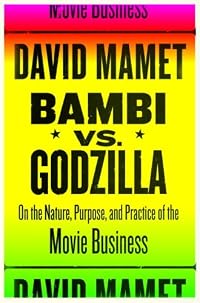
Bambi vs. Godzilla: On the Nature, Purpose, and Practice of the Movie Business
by David Mamet
On This Page
Description
Playwright and screenwriter Mamet gives us a subversive inside look at Hollywood from the perspective of a filmmaker who has always played the game his own way. Who really reads the scripts at the film studios? How is a screenplay like a personals ad? Whose opinion matters when revising a screenplay? Why are there so many producers listed in movie credits? And what do those producers do, anyway? Refreshingly unafraid to offend, Mamet provides hilarious, surprising, and bracingly forthright show more answers to these and other questions about virtually every aspect of filmmaking, from concept to script to screen. He covers topics ranging from "How Scripts Got So Bad" to the oxymoron of "Manners in Hollywood." He takes us step-by-step through some of his favorite movie stunts and directorial tricks, and demonstrates that it is craft and crew, not stars and producers, that make great films.--From publisher description. show lessTags
Recommendations





Member Reviews
This essay is a scathing review of the movie industry. I could not get past page 192 if you literally lit a fire under my behind. David Mamet's opinionated nature comes through loud and clear; to the point that it is painfully obvious that he is writing about particular people without ever actually naming them. I just could not read any more of that poor person getting so thoroughly lampooned.
I do however agree with his position on the audition though. A jury cannot decide what an audience will like, only an audience can do that. Which is why the movie industry is so hit and miss. For example The Mortal Instruments: City of Bones. There are those who love the movie cast and want none other, and those like me who hated Jonathan show more Reese-Myers as Valentine and can't wait for the TV reboot.
While Mr. Mamet does make some valid arguments he gets more than a little preachy, and, at the end of the day, too bombastic for me to bother finishing the essay. show less
I do however agree with his position on the audition though. A jury cannot decide what an audience will like, only an audience can do that. Which is why the movie industry is so hit and miss. For example The Mortal Instruments: City of Bones. There are those who love the movie cast and want none other, and those like me who hated Jonathan show more Reese-Myers as Valentine and can't wait for the TV reboot.
While Mr. Mamet does make some valid arguments he gets more than a little preachy, and, at the end of the day, too bombastic for me to bother finishing the essay. show less
I'm a David Mamet fan - of his films, that is. Some of them I list among my favorites, in my top 100: The Untouchables, 1987; The Spanish Prisoner, 1997; Heist, 2001. I've never seen one of his stage plays, but I've seen at least one film made from them (Glengarry Glen Ross, 1992), and perhaps a second if you count About Last Night... (1986, based on his play Sexual Perversity in Chicago).* So I appreciate the fact that the guy can obviously write. A quick check of his IMDb page shows me he's writing and producing a show called The Unit. I'll have to check it out. He's been working in the movie business, off and on, for about 30 years. So when I saw this book, Bambi vs. Godzilla, I was immediately curious as to what he had to say.
Having show more read it, I can't say I was completely disappointed, but I can't say I got what I was hoping for either. Too frequent diatribes about all sorts of topics having very little to do with the movie business (heavy stuff like politics, our President, the war in Iraq, etc.) literally pepper the text. But if you wait long enough, you get to some real gems that quench the thirst of any movie aficionado curious to learn tricks of the trade. For example: he goes into some detail about how a good editor can use bits of film that catch actors' expressions or poses before the snap of the clapboard and after the "cut" if they need to slightly alter the mood of a scene. Very interesting to me.** Also, he goes into quite a bit of detail about his favorite movies and even includes an index at the end for your reference. Handy.
But his tirades wear me down, and not just the off-topic ones. He's clearly got a bone to pick with the movie industry, and sure, who hasn't?, but that's not what I came here for. Maybe it was just my own naïveté, but I didn't interpret the book's subtitle, "On the Nature, Purpose, and Practice of the Movie Business," as meaning it would be an esoteric flow of Hollywood punditry. Maybe I should have picked up that clue from Steve Martin's blurb on the back: "David Mamet is supremely talented. He is a gifted writer and observer of society and its characters. I'm sure he will be able to find work somewhere, somehow, just no longer in the movie business."***
A final word about his style. It's cumbersome. He writes the way his characters speak: often stilted. If you've ever seen one of his movies, you'll know what I mean. Also, he uses a lot of commas to separate unnecessary phrases which, if you were writing a blog (such as this one), might come across as simply being chatty. But in Mamet's case it came across as being pompous. Slightly. More at the beginning. It was an adjustment, is what I'm trying to say, but it was also a distraction. A good writer knows how to make his prose flow smoothly. I think Dave should stick to the stage and screen where actors can suss out what to do with his words.
* Which I don't count because I saw it back in the 80's when I was a teenager, probably because it was advertised as a racy sex movie at the time, and now I could only tell you that it starred, I think, Jim Belushi and Rob Lowe and was about something to do with people sleeping with other people, presumably not Jim and Rob at the same time. Hey, look at that... it's also got Demi Moore in it. Now I remember why I saw it.
** Maybe not to many other people, but I found this illuminating and wondered how many other directors/editors use the same trick. And I wondered how an actor would feel if he were deliberately trying to make a scene light-hearted only to find out some editor had spliced in a pre-take frown, perhaps a reaction to a personal conversation he was having with a fellow actor, nothing to do with the scene at all, to darken the moment. Or vice versa. But I digress...
*** Steve Martin, star of The Spanish Prisoner, FYI. show less
Having show more read it, I can't say I was completely disappointed, but I can't say I got what I was hoping for either. Too frequent diatribes about all sorts of topics having very little to do with the movie business (heavy stuff like politics, our President, the war in Iraq, etc.) literally pepper the text. But if you wait long enough, you get to some real gems that quench the thirst of any movie aficionado curious to learn tricks of the trade. For example: he goes into some detail about how a good editor can use bits of film that catch actors' expressions or poses before the snap of the clapboard and after the "cut" if they need to slightly alter the mood of a scene. Very interesting to me.** Also, he goes into quite a bit of detail about his favorite movies and even includes an index at the end for your reference. Handy.
But his tirades wear me down, and not just the off-topic ones. He's clearly got a bone to pick with the movie industry, and sure, who hasn't?, but that's not what I came here for. Maybe it was just my own naïveté, but I didn't interpret the book's subtitle, "On the Nature, Purpose, and Practice of the Movie Business," as meaning it would be an esoteric flow of Hollywood punditry. Maybe I should have picked up that clue from Steve Martin's blurb on the back: "David Mamet is supremely talented. He is a gifted writer and observer of society and its characters. I'm sure he will be able to find work somewhere, somehow, just no longer in the movie business."***
A final word about his style. It's cumbersome. He writes the way his characters speak: often stilted. If you've ever seen one of his movies, you'll know what I mean. Also, he uses a lot of commas to separate unnecessary phrases which, if you were writing a blog (such as this one), might come across as simply being chatty. But in Mamet's case it came across as being pompous. Slightly. More at the beginning. It was an adjustment, is what I'm trying to say, but it was also a distraction. A good writer knows how to make his prose flow smoothly. I think Dave should stick to the stage and screen where actors can suss out what to do with his words.
* Which I don't count because I saw it back in the 80's when I was a teenager, probably because it was advertised as a racy sex movie at the time, and now I could only tell you that it starred, I think, Jim Belushi and Rob Lowe and was about something to do with people sleeping with other people, presumably not Jim and Rob at the same time. Hey, look at that... it's also got Demi Moore in it. Now I remember why I saw it.
** Maybe not to many other people, but I found this illuminating and wondered how many other directors/editors use the same trick. And I wondered how an actor would feel if he were deliberately trying to make a scene light-hearted only to find out some editor had spliced in a pre-take frown, perhaps a reaction to a personal conversation he was having with a fellow actor, nothing to do with the scene at all, to darken the moment. Or vice versa. But I digress...
*** Steve Martin, star of The Spanish Prisoner, FYI. show less
An interesting look at the movie industry and an good explanation about the changing nature of the quality of films. It is not simply because of of an attempt to provide what the audience ask for but more the nature of the industry in which the only people who actually read scripts are the lowest level employees tasked with reducing the script to three sentences. Plus, they tend to try to find scripts similar to ones tried before.
My enjoyment of the book is somewhat lowered by Mamet's need to use 'big' words, need to inject national politics into the book, and mention of films not seen by me. Fair enough, and it does lead me to some films I might like.
My enjoyment of the book is somewhat lowered by Mamet's need to use 'big' words, need to inject national politics into the book, and mention of films not seen by me. Fair enough, and it does lead me to some films I might like.
It's so cool to get an insider's view of film making. David Mamet has written s many wonderful plays and screenplays, it's nice to read a non-fiction work. I do not like Mamet's politics but his writing is good.
I've never seen any of Mamet's plays or movies (they could be pure genius for all I know), but from his writing Mamet strikes me as the kind of guy that arty grad students would put up on a pedestal while everyone else would denounce as full of BS. Some science papers may have atrocious writing, but at least they have graphs which get to the point. Mamet--no. If he prizes getting to the point so much, why does he take such a circuitous way to say so? Perhaps you'll want to excuse him by saying it's his writing style. Well, if you like having your eyes permanently crossed, go ahead...(more)
Members
- Recently Added By
Published Reviews
ThingScore 50
For a guy who writes such succinctly explicit dialogue, his prose can get grossly verbose. Mamet's observations on the film industry aren't exactly illuminating — he's shocked, shocked, to find that there's greed and bad taste going on here — but at least he offers some savvy words of wisdom to prospective screenwriters.
added by MikeBriggs
In "Bambi vs. Godzilla," Mr. Mamet indulges his contempt for producers more fully, saying that a typical member of the species flourishes without possessing any discernible talent other than rapaciousness. Mr. Mamet claims that he has seen producers practice "theft, fraud, intimidation, malversion . . . with such regularity that its absence provokes not comment but wonder." This is one of the show more book's milder passages. show less
added by MikeBriggs
Author Information

209+ Works 11,614 Members
David Mamet, November 30, 1947 - David Mamet was born on November 30, 1947 in Flossmoor, Illinois. He attended Goddard College in Vermont and the Neighborhood Playhouse School of Theater in New York. He began his career as an actor and a director, but soon turned to playwriting. He won acclaim in 1976 with three Off-Broadway plays, "The Duck show more Variations," "Sexual Perversity in Chicago" and "American Buffalo." His work became known for it's strong male characters and the description of the decline of morality in the world. In 1984, Mamet received the Pulitzer Prize in Literature for his play, "Glengarry Glen Ross." In 1981, before he received the Pulitzer, Mamet tried his hand at screenwriting. he started by adapting "The Postman Always Rings Twice," and then adapting his own "Glengarry Glen Ross" as well as writing "The Untouchables" and Wag the Dog." He also taught at Goddard College, Yale Drama School and New York University. Mamet won the Jefferson Award in 1974, the Obie Award in 1976 and 1983, the New York Drama Critics Circle Award in 1977 and 1984, the Outer Circle Award in 1978, the Society of West End Theater Award in 1983, The Pulitzer Prize in 1984, The Dramatists Guild Hall-Warriner Award in 1984, and American Academy Award in 1986 and a Tony Award in 1987. He is considered to be one of the greatest artists in his field. (Bowker Author Biography) show less
Some Editions
Classifications
- Genres
- Nonfiction, General Nonfiction
- DDC/MDS
- 384.80973 — Society, Government, and Culture Commerce, communications & transportation regulations Communications Motion pictures Standard subdivisions History, geographic treatment, biography North America
- LCC
- PN1993.5 .U6 .M244 — Language and Literature Literature (General) Literature (General) Drama Motion pictures
- BISAC
Statistics
- Members
- 319
- Popularity
- 99,179
- Reviews
- 7
- Rating
- (3.54)
- Languages
- 5 — English, German, Hebrew, Italian, Spanish
- Media
- Paper, Ebook
- ISBNs
- 9
- ASINs
- 3