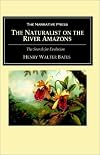
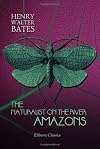
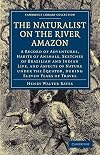
The Naturalist on the River Amazons
by Henry Walter Bates
On This Page
Description
This title is part of UC Press's Voices Revived program, which commemorates University of California Press's mission to seek out and cultivate the brightest minds and give them voice, reach, and impact. Drawing on a backlist dating to 1893, Voices Revived makes high-quality, peer-reviewed scholarship accessible once again using print-on-demand technology. This title was originally published in 1962.Tags
Recommendations
























Member Recommendations
Member Reviews
This is an enjoyable account of the travels of a nineteenth century naturalist in the Amazon. It is a book in the same vein as Darwin's "Voyage of the Beagle" and Humboldt's "Personal Narrative", and it paints a vivid picture of the wildlife and the people of the Amazon region. Bates sometimes shows the patronising prejudice of a "civilised" European towards the native peoples, but at other times he shows that he can be reasonably tolerant in his attitudes.
Bates describes his years in the Amazon as "eleven of the best years of my life". But the book also shows that they were years in which he faced dangers, disease and hardship. Bates travelled out to South America in 1848 with Alfred Russel Wallace, and the dangers of such expeditions show more are shown by the fact that Wallace's younger brother died of yellow fever in South America and by the fact that, while he was returning to England, Wallace's ship sank and he lost most of the specimens he had collected, with Wallace and the crew being rescued after spending ten days in an open boat.
Bates is also linked to Wallace, and to Darwin, in relation to the theory of evolution by natural selection. In 1858, while in the Far East, Wallace came up with the idea of natural selection independently of Darwin (although Darwin had first developed the idea in 1838). And Bates returned to England in 1859, the year that Darwin's "On the Origin of Species" was published.
When Bates read Darwin's book he was immediately convinced by it and he realised that something he had seen himself was a perfect example of natural selection. Bates had seen that some species of butterflies mimicked others in their appearance. The ones that were being mimicked avoided being eaten by being foul-smelling or noxious to predators. Although the mimics were not themselves foul or noxious, they avoided predation by evolving through natural selection to look like the foul-smelling species.
Darwin praised the paper that Bates published on what later came to be known as "Batesian mimicry", and he encouraged Bates to publish "The Naturalist on the River Amazons", which Darwin described as "the best work of Natural History Travels ever published in England."
Bates's conversion to Darwinism is evident in this book, which was first published in 1863. On page 65, for example, he writes of "the slow adaptation of the Fauna to a forest-clad country throughout an immense lapse of geological time." On page 407 he says that "nature appears not to invent organs at once for the functions to which they are now adapted, but avails herself, here of one already-existing structure or instinct, there of another, according as they are handy when need for their further modification arises." And on page 413, with reference to the wings of butterflies, he writes that "on these expanded membranes Nature writes, as on a tablet, the story of the modifications of species..."
I should finally mention that this edition of the book is a facsimile of the 1864 edition, and it includes some interesting illustrations, including one of an "adventure with alligator"! I recommend it. show less
Bates describes his years in the Amazon as "eleven of the best years of my life". But the book also shows that they were years in which he faced dangers, disease and hardship. Bates travelled out to South America in 1848 with Alfred Russel Wallace, and the dangers of such expeditions show more are shown by the fact that Wallace's younger brother died of yellow fever in South America and by the fact that, while he was returning to England, Wallace's ship sank and he lost most of the specimens he had collected, with Wallace and the crew being rescued after spending ten days in an open boat.
Bates is also linked to Wallace, and to Darwin, in relation to the theory of evolution by natural selection. In 1858, while in the Far East, Wallace came up with the idea of natural selection independently of Darwin (although Darwin had first developed the idea in 1838). And Bates returned to England in 1859, the year that Darwin's "On the Origin of Species" was published.
When Bates read Darwin's book he was immediately convinced by it and he realised that something he had seen himself was a perfect example of natural selection. Bates had seen that some species of butterflies mimicked others in their appearance. The ones that were being mimicked avoided being eaten by being foul-smelling or noxious to predators. Although the mimics were not themselves foul or noxious, they avoided predation by evolving through natural selection to look like the foul-smelling species.
Darwin praised the paper that Bates published on what later came to be known as "Batesian mimicry", and he encouraged Bates to publish "The Naturalist on the River Amazons", which Darwin described as "the best work of Natural History Travels ever published in England."
Bates's conversion to Darwinism is evident in this book, which was first published in 1863. On page 65, for example, he writes of "the slow adaptation of the Fauna to a forest-clad country throughout an immense lapse of geological time." On page 407 he says that "nature appears not to invent organs at once for the functions to which they are now adapted, but avails herself, here of one already-existing structure or instinct, there of another, according as they are handy when need for their further modification arises." And on page 413, with reference to the wings of butterflies, he writes that "on these expanded membranes Nature writes, as on a tablet, the story of the modifications of species..."
I should finally mention that this edition of the book is a facsimile of the 1864 edition, and it includes some interesting illustrations, including one of an "adventure with alligator"! I recommend it. show less
Henry Bates was a very famous mid-19th century English naturalist who spent 11 1/2 years in the Amazon River area, eventually going from the outlet at the Atlantic at what is now Belem to the border of Brasil with Peru. He collected thousands of specimens of EVERYTHING--birds, mammals, especially insects, many of which were unknown at the time. Many of his specimens now reside in the British Museum.
In those days, a "naturalist" was no specialist. It is a marvel to me to read today of someone who is knowledgeable not only in all of the above but a massive variety of plants as well. Today, a botanist, for example, would specialize maybe in one family of palms, let's say.
The book is well written, but the structure is not the easiest to show more deal with: the paragraphs can be very long. Also, you can get very tired of the verb 'to ramble".
There is a wealth of information although not too specialized. Bates became famous for many things but not the least his exposition on what are now known as army ants! His descriptions of the insect pests are lively and also deceptive. One fly, called the Puím, is a blood-sucking monster that he calmly disposes of by remarking that they’re sluggish and so easily picked off with the fingers! Yellow fever was a problem on the lower Amazon; it is fascinating from a modern point of view to know that at that time, there was no knowledge of the relationship of the appropriate mosquito with the disease. He finally contracted malaria, which forced him to leave the country somewhat earlier than he had anticipated. Again, no understanding of the fact that the disease is mosquito-borne; he attributed to the unhealthiness of the surroundings but not to the insect vector.
His descriptions of he rain forest are superb, as he differentiates what grows in the different areas and stretches of the river—it is not all identical. He readily saw that the soil of the Amazon River basin is not all poor and clayish; it seems that just in recent years has it been acknowledged that there are verdant areas of the Amazon that are rooted in deep, fertile, productive soil.
He also wrote extensively on the native populations he found living along the River; it's interesting to read, because while he praises many aspects of their culture (for most although not all tribes), he considers them without imagination and without creation myths! It's hard to judge 150 years later. Bates spoke both Portuguese and Tupí, the common Indian language, fluently, so it wasn't a lack of language skills.
Here is Bates on the Indians of Pará (Belém): “The people all seemed to be contented and happy but idleness and poverty were exhibited by many unmistakable signs”. Clearly Bates views these as unacceptable qualities and signs that the native peoples were inferior.
He spent 4 1/2 years in Ega which is now Tefé, where I've spent a lot of time. His descriptions are fascinating; I hardly recognized the geography. There is a memorable section on harvesting turtle eggs and his prediction that such a quantity of eggs lost had to mean the diminution of the then-abundant Amazon turtle, at least in that area.
I could go on and on about this wonderful book, but I suspect that despite my enthusiasm, it will hold little attraction except for those of us who either have spent time in the Amazon region and have fallen in love with that magic river or else for “naturalists", either amateur or professional, who recognize Bates’ monumental achievement. show less
In those days, a "naturalist" was no specialist. It is a marvel to me to read today of someone who is knowledgeable not only in all of the above but a massive variety of plants as well. Today, a botanist, for example, would specialize maybe in one family of palms, let's say.
The book is well written, but the structure is not the easiest to show more deal with: the paragraphs can be very long. Also, you can get very tired of the verb 'to ramble".
There is a wealth of information although not too specialized. Bates became famous for many things but not the least his exposition on what are now known as army ants! His descriptions of the insect pests are lively and also deceptive. One fly, called the Puím, is a blood-sucking monster that he calmly disposes of by remarking that they’re sluggish and so easily picked off with the fingers! Yellow fever was a problem on the lower Amazon; it is fascinating from a modern point of view to know that at that time, there was no knowledge of the relationship of the appropriate mosquito with the disease. He finally contracted malaria, which forced him to leave the country somewhat earlier than he had anticipated. Again, no understanding of the fact that the disease is mosquito-borne; he attributed to the unhealthiness of the surroundings but not to the insect vector.
His descriptions of he rain forest are superb, as he differentiates what grows in the different areas and stretches of the river—it is not all identical. He readily saw that the soil of the Amazon River basin is not all poor and clayish; it seems that just in recent years has it been acknowledged that there are verdant areas of the Amazon that are rooted in deep, fertile, productive soil.
He also wrote extensively on the native populations he found living along the River; it's interesting to read, because while he praises many aspects of their culture (for most although not all tribes), he considers them without imagination and without creation myths! It's hard to judge 150 years later. Bates spoke both Portuguese and Tupí, the common Indian language, fluently, so it wasn't a lack of language skills.
Here is Bates on the Indians of Pará (Belém): “The people all seemed to be contented and happy but idleness and poverty were exhibited by many unmistakable signs”. Clearly Bates views these as unacceptable qualities and signs that the native peoples were inferior.
He spent 4 1/2 years in Ega which is now Tefé, where I've spent a lot of time. His descriptions are fascinating; I hardly recognized the geography. There is a memorable section on harvesting turtle eggs and his prediction that such a quantity of eggs lost had to mean the diminution of the then-abundant Amazon turtle, at least in that area.
I could go on and on about this wonderful book, but I suspect that despite my enthusiasm, it will hold little attraction except for those of us who either have spent time in the Amazon region and have fallen in love with that magic river or else for “naturalists", either amateur or professional, who recognize Bates’ monumental achievement. show less
Excellent book. The author describes in great detail some 10 years of study in the Amazon River basin: the fauna, flora and its people. [SPOILER] The final chapters where the author contracts a tropical disease and cuts his trip short and his farewell account when leaving this “tropical Eden” are quite moving.
Ratings
Members
- Recently Added By
Lists

Trinity College Booklist (1951): Class One, Natural Science
98 works; 2 members

Philip Ward's Lifetime Reading Plan
592 works; 22 members
Author Information

12 Works 335 Members
Awards and Honors
Notable Lists
Series
Belongs to Publisher Series
Common Knowledge
- Original title
- The Naturalist on the River Amazons
- Original publication date
- 1863
- People/Characters*
- Henry Walter Bates
- Important places
- Amazon Rainforest, Amazon Basin, South America
- Original language
- English
*Some information comes from Common Knowledge in other languages. Click "Edit" for more information.
Classifications
Statistics
- Members
- 153
- Popularity
- 214,165
- Reviews
- 3
- Rating
- (4.08)
- Languages
- 6 — Dutch, English, German, Greek, Japanese, Portuguese
- Media
- Paper, Ebook
- ISBNs
- 34
- ASINs
- 8