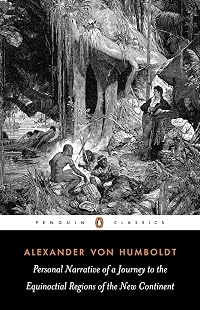
Personal Narrative of a Journey to the Equinoctial Regions of the New Continent [Abridged - Penguin Classics]
by Alexander von Humboldt
On This Page
Description
The Prussian naturalist Alexander von Humboldt (1769-1859) was one of the most famous explorers of his generation. Charles Darwin called him 'the greatest scientific traveller who ever lived'. In 1799, Humboldt and the botanist Aime? Bonpland secured permission from the Spanish crown for a voyage to South America. They left from Madrid and spent five years exploring the continent. Humboldt reported his findings in a total of thirty volumes, published in French over a period of more than show more twenty years beginning in 1805. This English translation by Helen Maria Williams of one important component of Humboldt's account, the Relation historique du voyage (1814-1825), consists of seven volumes and was published in London between 1814 and 1829. Volume 1 describes the beginning of the expedition, its departure from Spain, experiments conducted on board ship, and the scientists' arrival in the Canary Islands and exploration of Tenerife. show lessTags
Recommendations
















Member Recommendations

Member Reviews
A fascinating journey to the new world, with abundant descriptions and rich anecdotes. For example: "Francisco Lozano, a labourer who lived in this village, presented a curious physiological phenomenon that struck our imagination...This man breast feed a child with his own milk. When the mother fell ill, the father, to pacify the child, took it to bed and pressed it to his nipples. Lozano, then thirty two years old, had never noticed before that he had milk, but the irritation of the nipple sucked by the child caused liquid to accumulate. The milk was thick and very sweet." And then there's this one..."It was at the cataracts that we first heard talk about the hairy man of the jungle, called salvaje, who rapes women, builds huts, and show more sometimes eats human flesh. Neither Indians nor missionaries doubt the existence of this man-shaped monkey, which terrifies them. Father Gili seriously related the story of a lady from San Carlos who praised the gentle character of the man of the jungle. She lived several years with him in great domestic harmony..." show less
Last year the Dutch public tv company VPRO made and aired a tv-series where they followed in the tracks of the Beagle and Charles Darwin. Every episode scientists, historians and relatives of Darwin would discuss the area they were in at that moment and how it was fairings now, 200 years after Darwin first passed through. Along on this journey came the travel writer Redmond O'Hanlon with crates of his books. During the journey he read from these books, which were travel journals and reports from the nineteenth century (along with a first edition of Darwin's Origin of Species!).
This inspired me to read some of these travel books, and the first one I picked was Alexander Von Humboldt's Personal Narrative of a Journey to the Equinoctial show more Regions of the New Continent. In it he describes his journey to South America (mainly current day Venezuela) via Tenerife. He explores the Orinoco river system, looking for a link between the Orinoco and the Amazon. He describes and collects flora and fauna along the way, but also writes about the native tribes and the many missions they stay at.
I read the 1995 Penguin edition by Jason Wilson, which has been heavily cut down. I read some original chapters online through the Gutenberg project, and all I can say is that I am glad I read this abridged version. In the original version Humboldt writes in length about all his measurements and the geology. All very interesting I am sure, but what I wanted was a description of his journey and the wonders he sees, and that is exactly what the Penguin edition gives me.
A very interesting read, from an early explorer. It has wet my appetite and I do want to read more in this 'genre'. Four stars out of five. show less
This inspired me to read some of these travel books, and the first one I picked was Alexander Von Humboldt's Personal Narrative of a Journey to the Equinoctial show more Regions of the New Continent. In it he describes his journey to South America (mainly current day Venezuela) via Tenerife. He explores the Orinoco river system, looking for a link between the Orinoco and the Amazon. He describes and collects flora and fauna along the way, but also writes about the native tribes and the many missions they stay at.
I read the 1995 Penguin edition by Jason Wilson, which has been heavily cut down. I read some original chapters online through the Gutenberg project, and all I can say is that I am glad I read this abridged version. In the original version Humboldt writes in length about all his measurements and the geology. All very interesting I am sure, but what I wanted was a description of his journey and the wonders he sees, and that is exactly what the Penguin edition gives me.
A very interesting read, from an early explorer. It has wet my appetite and I do want to read more in this 'genre'. Four stars out of five. show less
Ratings
Members
- Recently Added By
Lists

Trinity College Booklist (1951): Class One, Natural Science
98 works; 2 members
Author Information

216+ Works 1,672 Members
Baron Alexander von Humboldt was born in Berlin, Germany. During his early school years, he studied such subjects as geology, biology, metallurgy, and mining, and his main interest was in nature and other lands. In 1796 Humboldt traveled to the German Alps, where he measured the atmospheric pressure, humidity, and oxygen content of the air. show more Shortly after, in 1799, he was granted permission by the Spanish king to explore Spain's mysterious holdings in the Americas. For the next five years, he and his companion, Aime Bonplaud, explored the region that is now Venezuela, Cuba, Colombia, Peru, Ecuador, and Mexico. While in the Andes, he fell prey to mountain sickness, which led him to become the first person to explain that the sickness was caused by a lack of oxygen. During these travels, he and Bonplaud collected 60,000 plant specimens; mapped the area; and studied its climates, bodies of water, wildlife, and minerals. The findings of this exhaustive adventure were published in a 23-volume series, Voyage de Humboldt et Bonplaud (1805--34). In 1829, at the invitation of the Russian government, Humboldt made an expedition to Russia and Siberia, categorizing, observing, and recording as he went. One of the results of this expedition was a 5-volume work, Kosmos (1845-62), in which he tried to combine the vague ideals of the eighteenth century with the exact scientific requirements of his own. Considered one of the founders of modern geography, Humboldt showed geographers that there was more to the study of geography than the shape of Earth and its regions. He gave them a system of geographic inquiry, he was the first to draw an isothermal map, studied tropical storms and volcanoes, and pioneered the field of terrestrial magnetism. Equally important, he was responsible for one of the first examples of international scientific cooperation, which led to the formation of a system of meteorological stations throughout Russia and Great Britain. During one of his many expeditions, he measured the temperature of the current with which his ship sailed from Lima, Peru, to Acapulco, Mexico. Later this current was named the Humboldt Current in his honor. (Bowker Author Biography) show less
Work Relationships
Common Knowledge
- Canonical title
- Personal Narrative of a Journey to the Equinoctial Regions of the New Continent [Abridged - Penguin Classics]
- Important places
- Venezuela
- Disambiguation notice
- This edition, ISBN 0140445536, is abridged. Please do not combine with the unabridged work. Thank you.
Classifications
- Genres
- Travel, Nonfiction, Science & Nature, General Nonfiction, Biography & Memoir
- DDC/MDS
- 918.0413 — History & geography Geography & travel Geography of and travel in South America Travel Early history to 1806 1498–1806
- LCC
- F2216 .H9093213 — Local History of the United States, Canada and Latin America Latin America. Spanish America South America General
- BISAC
Statistics
- Members
- 159
- Popularity
- 206,431
- Reviews
- 2
- Rating
- (3.89)
- Languages
- English
- Media
- Paper, Ebook
- ISBNs
- 9
- ASINs
- 1