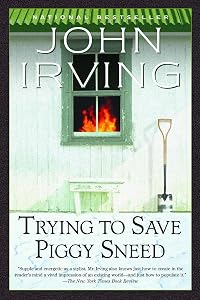
Trying to Save Piggy Sneed
by John Irving
On This Page
Description
A commemorative hardcover edition of the only collection ever published of the celebrated novelist's shorter works. Here is a treat for devoted fans of John Irving. First published twenty years ago, Trying to Save Piggy Sneed contains a dozen short works by the author, beginning with three memoirs. The longest of the memoirs is "The Imaginary Girlfriend," his candid account of his twin careers in writing and wrestling, which, as the Denver Post observed, is filled "with anecdotes that are show more every bit as hilarious as the antics in his novels . . . [and] combines the lessons of both obsessions." The middle portion of the book is fiction. Over a career that spans thirteen novels, these are the six stories that Mr. Irving considers finished. Among them is "Interior Space," for which he won the O. Henry Award. In the third and final section are three homages: one to Günter Grass and two to Charles Dickens. To each of the twelve pieces, he has contributed author's notes, which provide some perspective on the circumstances surrounding the writing of each piece. For readers who prefer a hardcover, this commemorative edition is a book to treasure. For new readers, it is a perfect introduction to the author of works as moving and mischievous as The World According to Garp, A Prayer for Owen Meany, and In One Person. Skyhorse Publishing, as well as our Arcade, Yucca, and Good Books imprints, are proud to publish a broad range of books for readers interested in fiction-novels, novellas, political and medical thrillers, comedy, satire, historical fiction, romance, erotic and love stories, mystery, classic literature, folklore and mythology, literary classics including Shakespeare, Dumas, Wilde, Cather, and much more. While not every title we publish becomes a New York Times bestseller or a national bestseller, we are committed to books on subjects that are sometimes overlooked and to authors whose work might not otherwise find a home. show lessTags
Recommendations









Member Reviews
Reading Trying to Save Piggy Sneed is like examining a blueprint for a great writer's greater works. If you want to know what it's like to be John Irving (hey, I smell a movie concept: Being John Irving), with a complete "behind the scenes" glance at his writing habits and literary influences, then go to market for Piggy.
If, however, you're looking for a superb, evocative reading experience, save your money and buy A Prayer for Owen Meany or A Widow for One Year instead. Not since A Son of the Circus have I been as unimpressed with Irving as I was with this collection of autobiographical sketches, short fiction and reverent homages to his favorite writers.
Using the words "John Irving" and "disappointment" in the same sentence is painful show more for me since I'm such an unabashed fan of the man I consider our modern-day Dickens. [Note: That explosive sound you heard on Oscar night was me leaping off my sofa, jumping five feet into the air, pumping my fist and yelling "Yea! All right!" when Mr. Irving won the Academy Award for Best Adapted Screenplay].
Swallowing my pain, however, I must admit that this Irving hodgepodge, published in 1996, is for die-hard fans only.
Piggy is divided into three sections: Memoir, Homage and Fiction (which includes the complete and uninterrupted version of "The Pension Grillparzer," the story-within-a-story from The World According to Garp). Each piece is followed by an “Author’s Note,âÂ? which provides the details behind IrvingâÂÂs composition. In some cases, the AuthorâÂÂs Note is longer than the story itself. Here, then, is where we really see the intricate (and, admittedly, interesting) blueprint sketches. In one (for the short story âÂÂOther PeopleâÂÂs DreamsâÂ?), Irving writes: Here is another short story that spent a number of years in my bottommost drawer; every few months, I would take it out and revise itâÂÂthen I would put it away again.
With all due respect, I would suggest to Mr. Irving that he should have done the same with Piggy in toto. Most of the short stories feel like second drafts at best. They should have lingered longer in that desk drawer.
So, you ask, is there anything worth the cover price of this book? Well, of course there is. We are talking about John Irving, after all.
The Memoirs section seems to hold up best. The longest piece, "The Imaginary Girlfriend," describes Irving's amateur career in wrestling, a sport for which he's long held a passion (and if you've read Garp, you know the strength of that passion). That selection also includes a scrapbook of photos showing Irving on the mat. As he says, wrestling was the first thing he was good at (even before he was "good at" writing) and that's why it was his first love. It's also interesting to note that his first cameo in a motion picture was as a wrestling referee in The World According to Garp.
Another memoir in Piggy is the best-forgotten "My Dinner at the White House," a name-dropping exercise in ho-hum writing.
His talents are on better display in the title piece, where he tells the true story of a garbage collector named Piggy Sneed whose life intersected with the authorâÂÂs when he was a volunteer firefighter. ItâÂÂs tragic and movingâÂÂjust like anything youâÂÂd normally find in the pages of his magnificent novels.
Did I say âÂÂtrueâÂ?? Well, okay, mostly true. I doubt Irving can leave anything unembellished when he sits down to the keyboard. In the opening paragraphs of âÂÂTrying to Save Piggy Sneed,âÂ? he explains: A fiction writer's memory is an especially imperfect provider of detail; we can always imagine a better detail than the one we can remember.
Since Irving's novels are so richly cluttered with details, I can only imagine that his imagination is like an overheated furnace, burning up nouns and adverbs and semi-colons like they were thick logs. When I read his novels, I inhabit his fictional worlds so completely that I growl and grumble when the spell is broken by the phone ringing or my wife calling me to dinner.
And this, I think, is the core problem with Piggy: Irving's forte is with longer works, not short fiction where we're offered half-finished sketches (at least in this collection). It's like the difference between six bars of music and an entire symphony. Given the choice, I'll take the adagios of his novels any day.
Speaking of symphonic, Irving ends Piggy on a trio of grace notes: two critical appreciations of Charles Dickens and one of last year's Nobel Prize winner, Gunter Grass. In the case of Dickens, it would be just as well to say that Irving was writing a tribute to his literary forefather. If any modern writer comes within spitting distance of the Victorian author, it is Irving.
In the essay, "The King of the Novel," he writes:
Dickens' gift is how spontaneously he can render a situation both sympathetic and hilarious...What he is most unafraid of is sentimentality: of anger, of passion, of emotionally and psychologically revealing himself...Dickens took sentimental risks with abandon.
Ahem. Mr. Irving, were you looking in the mirror when you wrote that?
But Dickens and wrestling aside, the whole of Trying to Save Piggy Sneed lacks the usual Irving touch. It feels, instead, like sweepings from the dustbin. The only thing more unexciting would have been reading last month's grocery list.
Well, I suppose it could be worse. Maybe, after he shuffles off this mortal coil, some enterprising, dollar-signs-for-eyeballs young publisher will come out with a new volume: The Complete Collected Jots and Tittles of John Irving. show less
If, however, you're looking for a superb, evocative reading experience, save your money and buy A Prayer for Owen Meany or A Widow for One Year instead. Not since A Son of the Circus have I been as unimpressed with Irving as I was with this collection of autobiographical sketches, short fiction and reverent homages to his favorite writers.
Using the words "John Irving" and "disappointment" in the same sentence is painful show more for me since I'm such an unabashed fan of the man I consider our modern-day Dickens. [Note: That explosive sound you heard on Oscar night was me leaping off my sofa, jumping five feet into the air, pumping my fist and yelling "Yea! All right!" when Mr. Irving won the Academy Award for Best Adapted Screenplay].
Swallowing my pain, however, I must admit that this Irving hodgepodge, published in 1996, is for die-hard fans only.
Piggy is divided into three sections: Memoir, Homage and Fiction (which includes the complete and uninterrupted version of "The Pension Grillparzer," the story-within-a-story from The World According to Garp). Each piece is followed by an “Author’s Note,âÂ? which provides the details behind IrvingâÂÂs composition. In some cases, the AuthorâÂÂs Note is longer than the story itself. Here, then, is where we really see the intricate (and, admittedly, interesting) blueprint sketches. In one (for the short story âÂÂOther PeopleâÂÂs DreamsâÂ?), Irving writes: Here is another short story that spent a number of years in my bottommost drawer; every few months, I would take it out and revise itâÂÂthen I would put it away again.
With all due respect, I would suggest to Mr. Irving that he should have done the same with Piggy in toto. Most of the short stories feel like second drafts at best. They should have lingered longer in that desk drawer.
So, you ask, is there anything worth the cover price of this book? Well, of course there is. We are talking about John Irving, after all.
The Memoirs section seems to hold up best. The longest piece, "The Imaginary Girlfriend," describes Irving's amateur career in wrestling, a sport for which he's long held a passion (and if you've read Garp, you know the strength of that passion). That selection also includes a scrapbook of photos showing Irving on the mat. As he says, wrestling was the first thing he was good at (even before he was "good at" writing) and that's why it was his first love. It's also interesting to note that his first cameo in a motion picture was as a wrestling referee in The World According to Garp.
Another memoir in Piggy is the best-forgotten "My Dinner at the White House," a name-dropping exercise in ho-hum writing.
His talents are on better display in the title piece, where he tells the true story of a garbage collector named Piggy Sneed whose life intersected with the authorâÂÂs when he was a volunteer firefighter. ItâÂÂs tragic and movingâÂÂjust like anything youâÂÂd normally find in the pages of his magnificent novels.
Did I say âÂÂtrueâÂ?? Well, okay, mostly true. I doubt Irving can leave anything unembellished when he sits down to the keyboard. In the opening paragraphs of âÂÂTrying to Save Piggy Sneed,âÂ? he explains: A fiction writer's memory is an especially imperfect provider of detail; we can always imagine a better detail than the one we can remember.
Since Irving's novels are so richly cluttered with details, I can only imagine that his imagination is like an overheated furnace, burning up nouns and adverbs and semi-colons like they were thick logs. When I read his novels, I inhabit his fictional worlds so completely that I growl and grumble when the spell is broken by the phone ringing or my wife calling me to dinner.
And this, I think, is the core problem with Piggy: Irving's forte is with longer works, not short fiction where we're offered half-finished sketches (at least in this collection). It's like the difference between six bars of music and an entire symphony. Given the choice, I'll take the adagios of his novels any day.
Speaking of symphonic, Irving ends Piggy on a trio of grace notes: two critical appreciations of Charles Dickens and one of last year's Nobel Prize winner, Gunter Grass. In the case of Dickens, it would be just as well to say that Irving was writing a tribute to his literary forefather. If any modern writer comes within spitting distance of the Victorian author, it is Irving.
In the essay, "The King of the Novel," he writes:
Dickens' gift is how spontaneously he can render a situation both sympathetic and hilarious...What he is most unafraid of is sentimentality: of anger, of passion, of emotionally and psychologically revealing himself...Dickens took sentimental risks with abandon.
Ahem. Mr. Irving, were you looking in the mirror when you wrote that?
But Dickens and wrestling aside, the whole of Trying to Save Piggy Sneed lacks the usual Irving touch. It feels, instead, like sweepings from the dustbin. The only thing more unexciting would have been reading last month's grocery list.
Well, I suppose it could be worse. Maybe, after he shuffles off this mortal coil, some enterprising, dollar-signs-for-eyeballs young publisher will come out with a new volume: The Complete Collected Jots and Tittles of John Irving. show less
The most interesting aspect of this collection of memoirs, short stories, and essays is reading Irving's discussion on writing, and his overall career. The memoir portion is funny and poignant, and is a must-read for any Irving fan.
However, John Irving is a novelist, and his short fiction is somewhere between decent and forgettable, with the exception of one or two.
However, John Irving is a novelist, and his short fiction is somewhere between decent and forgettable, with the exception of one or two.
BOOK #11
REVIEW: This was the only Iriving book I had yet to read. It had been sitting on my shelf for a couple of years now, at least three. So, after I finished my last book, I grabbed this one- which I'm glad I did! I really enjoyed this one! I loved learning about his life- and realizing how much of his life is woven into his stories. I liked the short stories- especially "Weary Kingdom" and "Brennbar's Rant." The only part I didn't like was the last section, which was a collection of different introductions he wrote for other books. I found this boring! I normally skip intros. to books anyways, so I just skipped these! I was actually shocked with how fast I read this book, as I normally find his novels take me sometime to get show more through. If you're a Iriving fan and have yet to read it, I reccomend you pick it up! FAVORITE QUOTES: "Talent is overrated," Ted told me. "That you're not very talented needn't be the end of it." // Most self-destructive behavior is simply ridiculous- never mind how complexly compelled by personal demons. // There are many unintentionally cruel talents that the world, indiscriminately, hands out to us. Whether we can use these gifts we never asked for is not the world's concern. // Early-morning goals are among the illusions we must indulge if we're going to get anywhere at all. show less
REVIEW: This was the only Iriving book I had yet to read. It had been sitting on my shelf for a couple of years now, at least three. So, after I finished my last book, I grabbed this one- which I'm glad I did! I really enjoyed this one! I loved learning about his life- and realizing how much of his life is woven into his stories. I liked the short stories- especially "Weary Kingdom" and "Brennbar's Rant." The only part I didn't like was the last section, which was a collection of different introductions he wrote for other books. I found this boring! I normally skip intros. to books anyways, so I just skipped these! I was actually shocked with how fast I read this book, as I normally find his novels take me sometime to get show more through. If you're a Iriving fan and have yet to read it, I reccomend you pick it up! FAVORITE QUOTES: "Talent is overrated," Ted told me. "That you're not very talented needn't be the end of it." // Most self-destructive behavior is simply ridiculous- never mind how complexly compelled by personal demons. // There are many unintentionally cruel talents that the world, indiscriminately, hands out to us. Whether we can use these gifts we never asked for is not the world's concern. // Early-morning goals are among the illusions we must indulge if we're going to get anywhere at all. show less
I really liked learning more about John Irving's life through the non fiction parts of this book.
A nice little book. Illuminating as to Irving's life and influences, teachers (Vonnegut) and general opinions and ways of thinking. A must read for any serious fan of Irving's works.
DNF, couldn't get interested, even though the rioting is good.
Autobiographical centerpiece, The Imaginary Girlfriend, lapses into raw wrestling statistics on occasion.
Members
- Recently Added By
Lists

Lucy's Long List
69 works; 1 member
Author Information

61+ Works 96,585 Members
John Irving published his first novel at the age of twenty-six. He has received awards from the Rockefeller Foundation, the National Endowment for the Arts, and the Guggenheim Foundation; he has won an O. Henry Award, a National Book Award, and an Academy Award. (Publisher Provided) John Irving was born John Wallace Blunt, Jr. on March 2, 1942 in show more Exeter, New Hampshire. His named was changed to John Winslow Irving when his stepfather adopted him at the age of six. He was a dyslexic child and it took him five years to get through Exeter Academy, which is where his adoptive father taught Russian history. He received a B.A. (cum laude) from the University of New Hampshire in 1965 and an M.F.A. from the Iowa Writers' Workshop, in 1967, where he studied with Kurt Vonnegut Jr. His first novel was Setting Free the Bears (1969) but it wasn't until The World According to Garp was published in 1978, that he became a literary star. The novel spent six months on the bestseller list and won the American Book Award in 1980. It was also made into a movie in 1982 starring Robin Williams and costarring Glenn Close and John Lithgow. In 1981, he received an O. Henry Award for the short story Interior Space. Some of his other novels were also made into movies including The Hotel New Hampshire starring Jodie Foster and Rob Lowe; A Prayer for Owen Meany, which was titled Simon Birch starring Jim Carrey; and The Cider House Rules starring Michael Caine. He won the Oscar for Best Adapted Screenplay for The Cider House Rules in 2000. Irving also wrote two memoirs; one detailing his wrestling adventures entitled The Imaginary Girlfriend, and another concerning his novels made into Hollywood films entitled My Movie Business: A Memoir. (Bowker Author Biography) show less
Some Editions
Series
Belongs to Publisher Series
detebe (22779)
Common Knowledge
- Original title
- Trying to Save Piggy Sneed
- Original publication date
- 1993
- First words
- This is a memoir, but please understand that (to any writer with a good imagination) all memoirs are false.
Classifications
Statistics
- Members
- 1,996
- Popularity
- 10,540
- Reviews
- 11
- Rating
- (3.36)
- Languages
- 12 — Czech, Danish, Dutch, English, Finnish, French, German, Japanese, Norwegian (Bokmål), Polish, Spanish, Swedish
- Media
- Paper, Audiobook, Ebook
- ISBNs
- 47
- UPCs
- 1
- ASINs
- 14