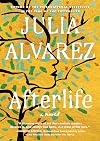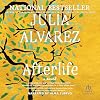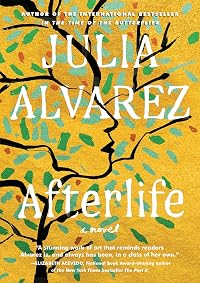
Afterlife
by Julia Alvarez
On This Page
Description
"A literature professor tries to rediscover who she is after the sudden death of her husband, even as a series of family and political jolts force her to ask what we owe those in crisis in our families, biological or otherwise"--Tags
Recommendations















Member Reviews
Julia Alvarez took what, to me, sounds like the worst nightmare I can imagine and built something beautiful from it.
Antonia Vega retired from her job as a professor of writing and went to wait for her husband, a doctor, to arrive at their favourite restaurant to celebrate. But her husband, Sam, never shows up. He had a fatal heart attack on the way to the restaurant. A year later Antonia is somewhat adrift trying to figure out what her life should be like now. Her three sisters telephone her regularly (well two of them do, the oldest sibling isn't so organized) to check up on her. Her next door neighbour also checks in on her. In fact, it is him who is the impetus for a major change in her life. He has a dairy farm and he hires show more undocumented workers to help because otherwise he cannot make it financially. He offers to send one of his workers over to clean the gutters on Antonia's house and when he comes the young man asks Antonia to help him call his girlfriend. Antonia was born in the Dominican Republic and speaks Spanish so it is easier for him to communicate with her. It turns out his girlfriend has crossed into the US with the help of coyotes who are now demanding more money to send her to Vermont. Antonia is not asked for money but she ends up buying a bus ticket to bring the girl from Colorado to Vermont. She then goes away to spend her birthday with her sister in Chicago and the other two sisters decide to join the celebration. Except the oldest sister never shows up and all the sisters have to drop everything to try to find her. When Antonia does get home she finds the girlfriend in her garage because the man who was supposed to be marrying her refuses when she is obviously pregnant and it can't be his child. These dual crises have Antonia trying to figure out what Sam would do and, as long-married couples tend to do, she knows what Sam's reactions would be.
I hope I never have to face living after my husband's death. He's a year younger than I am and his parents lived long healthy lives so hopefully he outlasts me. If it did happen I hope my personal circumstances wouldn't be as fraught as Antonia's but I also hope I would be able to have guidance from my husband to face difficulties. Even if that guidance is only discerning what he would say and do. show less
Antonia Vega retired from her job as a professor of writing and went to wait for her husband, a doctor, to arrive at their favourite restaurant to celebrate. But her husband, Sam, never shows up. He had a fatal heart attack on the way to the restaurant. A year later Antonia is somewhat adrift trying to figure out what her life should be like now. Her three sisters telephone her regularly (well two of them do, the oldest sibling isn't so organized) to check up on her. Her next door neighbour also checks in on her. In fact, it is him who is the impetus for a major change in her life. He has a dairy farm and he hires show more undocumented workers to help because otherwise he cannot make it financially. He offers to send one of his workers over to clean the gutters on Antonia's house and when he comes the young man asks Antonia to help him call his girlfriend. Antonia was born in the Dominican Republic and speaks Spanish so it is easier for him to communicate with her. It turns out his girlfriend has crossed into the US with the help of coyotes who are now demanding more money to send her to Vermont. Antonia is not asked for money but she ends up buying a bus ticket to bring the girl from Colorado to Vermont. She then goes away to spend her birthday with her sister in Chicago and the other two sisters decide to join the celebration. Except the oldest sister never shows up and all the sisters have to drop everything to try to find her. When Antonia does get home she finds the girlfriend in her garage because the man who was supposed to be marrying her refuses when she is obviously pregnant and it can't be his child. These dual crises have Antonia trying to figure out what Sam would do and, as long-married couples tend to do, she knows what Sam's reactions would be.
I hope I never have to face living after my husband's death. He's a year younger than I am and his parents lived long healthy lives so hopefully he outlasts me. If it did happen I hope my personal circumstances wouldn't be as fraught as Antonia's but I also hope I would be able to have guidance from my husband to face difficulties. Even if that guidance is only discerning what he would say and do. show less
"You, who quite truly knew him, can quite truly continue in his spirit and on his path. Make it the task of your mourning to explore what he had expected of you, had hoped for you, had wished to happen to you...his influence has not vanished from your existence..."~from The Dark Interval by Rainer Maria Rilke
Reading about the death of a loved one during the time of Coronavirus is difficult. I feel the cold blade of fear which I daily push back down into my subconscious, then "tie my hat and crease my shawl" to perform my tasks and obligations.
Afterlife is the story of Hispanic retired literature teacher Antonia who mourns the loss of her husband Sam. She struggles to understand how to now live. Her sisters are calling her to join them show more in confronting their sibling's bipolar illness. An illegal immigrant employed by her Vermont farmer neighbor implores her to help him bring his girl to join him.
All these demands! Antonia just wants to tend her own garden and live with her sorrow. But knowing Sam has changed her. His compassion remains an example of how to live in this world. Sam"seems to be resurrecting inside her," and she wonders, "is this all his afterlife will amount to? Saminspired deeds from the people who love him?"
Antonia's mind is filled with the books she loved and taught, including Rainer Maria Rilke. Last year I had read The Dark Interval which shares Rilke's letters of condolences. Alvarez's novel embodies Rilke's philosophy.
Against her nature and inclination, Sam leads Antonia to risk becoming involved in the lives and problems of other people. "Living your life is a full-time job," a sister justifies. Isn't that the truth? Then, a therapist reads Rilke to the sisters: "Death does not wound us without, at the same time, lifting us toward a more perfect understanding of this being and of ourselves."
Antonia's students always responded to Rilke's poem 'Archaic Torso of Apollo" which ends, "you must change your life." It is a line that has haunted ever me since I first read it. The question Antonia wonders, is how and when do we change it?
It is a question to be asked over and over. There is no end to such a consideration. We read a book and what we learn reminds us that we must change our life. We see a work of art, Rilke his Greek torso, for Antonia it’s Landscape with The Fall of Icarus, or when hear a symphony, or observe a beautiful spring flower or a deep woods filled with birdsong--
All the world is life-changing if we allow ourselves to truly live and open our senses and hearts and minds. To be alive is life-changing. To die is life-changing.
Antonia accepts the challenge to be Saminspired.
Alvarez is a brilliant writer who has combined a deep reflection on existence with timely questions. There is no better time for this message.
I received a free ebook from the publisher through NetGalley. My review is fair and unbiased. show less
Reading about the death of a loved one during the time of Coronavirus is difficult. I feel the cold blade of fear which I daily push back down into my subconscious, then "tie my hat and crease my shawl" to perform my tasks and obligations.
Afterlife is the story of Hispanic retired literature teacher Antonia who mourns the loss of her husband Sam. She struggles to understand how to now live. Her sisters are calling her to join them show more in confronting their sibling's bipolar illness. An illegal immigrant employed by her Vermont farmer neighbor implores her to help him bring his girl to join him.
All these demands! Antonia just wants to tend her own garden and live with her sorrow. But knowing Sam has changed her. His compassion remains an example of how to live in this world. Sam"seems to be resurrecting inside her," and she wonders, "is this all his afterlife will amount to? Saminspired deeds from the people who love him?"
Antonia's mind is filled with the books she loved and taught, including Rainer Maria Rilke. Last year I had read The Dark Interval which shares Rilke's letters of condolences. Alvarez's novel embodies Rilke's philosophy.
Against her nature and inclination, Sam leads Antonia to risk becoming involved in the lives and problems of other people. "Living your life is a full-time job," a sister justifies. Isn't that the truth? Then, a therapist reads Rilke to the sisters: "Death does not wound us without, at the same time, lifting us toward a more perfect understanding of this being and of ourselves."
Antonia's students always responded to Rilke's poem 'Archaic Torso of Apollo" which ends, "you must change your life." It is a line that has haunted ever me since I first read it. The question Antonia wonders, is how and when do we change it?
It is a question to be asked over and over. There is no end to such a consideration. We read a book and what we learn reminds us that we must change our life. We see a work of art, Rilke his Greek torso, for Antonia it’s Landscape with The Fall of Icarus, or when hear a symphony, or observe a beautiful spring flower or a deep woods filled with birdsong--
All the world is life-changing if we allow ourselves to truly live and open our senses and hearts and minds. To be alive is life-changing. To die is life-changing.
Antonia accepts the challenge to be Saminspired.
Alvarez is a brilliant writer who has combined a deep reflection on existence with timely questions. There is no better time for this message.
I received a free ebook from the publisher through NetGalley. My review is fair and unbiased. show less
I love this book! It is beautiful inside and out and is so well-crafted that tiny details mentioned at the beginning surface again later, expanding context and meaning. Antonia Sawyer has 2 major simultaneous life changes: she retires from college teaching and her husband Sam has an aortic aneurysm, leaving her adrift in a new phase of life. 9 mos. later, her struggle gets compounded and distracted by the needs of others: her oldest sister, Izzy is in a mental health crisis which rallies The Sisterhood (3 of them) to try to come to her rescue. The dynamic among them is another treasure in this book - each sister has a role that they fall back into easily once gathered, and is hinted at in their ring tones (Antonia is church bells) but show more they fiercely love each other and will do whatever it takes to support the current weak link. Then, next door, there is a migrant crisis. The farmer employs undocumented workers and one wants to bring his girlfriend to his VT location after she crosses from Mexico with coyotes. Antonia translates since she is 'Spanish' in the eyes of the small town, though her heritage is Dominican. Soon she is embroiled in their domestic drama, though she strives to set boundaries against all this neediness. Sam was the 'good cop' in their marriage as the town doctor and philanthropist and Antonia feels he was truly the 'better half.' The part I liked best is that literature is her guide and companion (Tolstoy's Three Questions, for example) throughout and she has a rolodex of authors and literary works in her head that she pulls out as needed, though she eventually learns that it is her own voice she needs to listen to. It is a gorgeous story of healing and becoming 'more than' despite what loss has taken away. Favorite quote: "Let us see what love can do." show less
She is keeping to her routines, walking a narrow path through the loss--not allowing her thoughts to stray. Occasionally, she takes a sip of sorrow, afraid the big wave might wash her away. Widows leaping into a husband's pyre, mothers jumping into a child's grave. She has taught those stories.
Today, like every other day, you wake up empty and frightened, she quotes to herself as she looks at her reflection in the mirror in the morning. Her beloved Rumi no longer able to plug the holes.
Late afternoons as the day wanes, in bed in the middle of the night, in spite of her efforts, she finds herself at the outer edges where, in the old maps, the world drops off, and beyond is terra incognita, sea serpents, the Leviathan--HERE THERE BE show more DRAGONS.
Recently (and almost simultaneously) retired and widowed, former English professor Antonia Vega is trying to get her bearings in her drastically altered life. She clings to her routines and her favorite literary lines, like The world is ugly, / And the people are sad (from a Wallace Stevens poem). But the world outside her quiet home and her grief continues: her two younger sisters are worried about their eldest sister's mental health, an attempt to help an undocumented immigrant from the farm next door brings a pregnant (also undocumented) teen into her life, a rumored ICE raid endangers the most vulnerable members of her Vermont community. (Yes, this is set in Trump's America, and Ms. Alvarez shares my disdain.)
Written without quotation marks (which can be a deal-breaker when used by less skilled authors), the third-person narration allows the reader to follow Antonia's thoughts, but at the same time keeps a distance from Antonia's life -- doling out details sparingly. For example, it isn't until well into the novel that we learn (details that don't affect the main plot): that Antonia's beloved Sam was her second husband and that Antonia apparently published a book (novel? memoir?) that featured her sisters or very similar characters. Despite their sometimes cryptic histories, Antonia and the other characters fill the pages with life. (Her second-youngest, chain-smoking, profanity-spewing sister Tilly is my favorite.)
My only previous experience with Julia Alvarez's writing is [b:In the Time of the Butterflies|11206|In the Time of the Butterflies|Julia Alvarez|https://i.gr-assets.com/images/S/compressed.photo.goodreads.com/books/1411410276l/11206._SY75_.jpg|1408023], which I remember enjoying. After reading Afterlife about four Dominican-American sisters in their 60s, I'm looking forward to reading [b:How the García Girls Lost Their Accents|11208|How the García Girls Lost Their Accents|Julia Alvarez|https://i.gr-assets.com/images/S/compressed.photo.goodreads.com/books/1386922914l/11208._SY75_.jpg|92888]. In both novels, the second-oldest sister seems to be an alter-ego for the author, and I'm curious how much the other sisters' characteristics line up between books. show less
Today, like every other day, you wake up empty and frightened, she quotes to herself as she looks at her reflection in the mirror in the morning. Her beloved Rumi no longer able to plug the holes.
Late afternoons as the day wanes, in bed in the middle of the night, in spite of her efforts, she finds herself at the outer edges where, in the old maps, the world drops off, and beyond is terra incognita, sea serpents, the Leviathan--HERE THERE BE show more DRAGONS.
Recently (and almost simultaneously) retired and widowed, former English professor Antonia Vega is trying to get her bearings in her drastically altered life. She clings to her routines and her favorite literary lines, like The world is ugly, / And the people are sad (from a Wallace Stevens poem). But the world outside her quiet home and her grief continues: her two younger sisters are worried about their eldest sister's mental health, an attempt to help an undocumented immigrant from the farm next door brings a pregnant (also undocumented) teen into her life, a rumored ICE raid endangers the most vulnerable members of her Vermont community. (Yes, this is set in Trump's America, and Ms. Alvarez shares my disdain.)
Written without quotation marks (which can be a deal-breaker when used by less skilled authors), the third-person narration allows the reader to follow Antonia's thoughts, but at the same time keeps a distance from Antonia's life -- doling out details sparingly. For example, it isn't until well into the novel that we learn (details that don't affect the main plot):
My only previous experience with Julia Alvarez's writing is [b:In the Time of the Butterflies|11206|In the Time of the Butterflies|Julia Alvarez|https://i.gr-assets.com/images/S/compressed.photo.goodreads.com/books/1411410276l/11206._SY75_.jpg|1408023], which I remember enjoying. After reading Afterlife about four Dominican-American sisters in their 60s, I'm looking forward to reading [b:How the García Girls Lost Their Accents|11208|How the García Girls Lost Their Accents|Julia Alvarez|https://i.gr-assets.com/images/S/compressed.photo.goodreads.com/books/1386922914l/11208._SY75_.jpg|92888]. In both novels, the second-oldest sister seems to be an alter-ego for the author, and I'm curious how much the other sisters' characteristics line up between books. show less
Antonia has no sooner retired from her academic post than her husband dies suddenly, leaving her grief-stricken and trying to channel her husband's best generous impulses. This becomes a challenge when an immigrant worker from the neighboring farm requests her help with getting his pregnant girlfriend to Vermont. At the same time, one of her three sisters has gone missing, leading to the need for a sister intervention. Antonia attempts to respond to both emergencies, moving between Vermont, the mid-west, and Massachusetts, finding it difficult to be all things to others while keeping her own self intact. The themes of family relationships and the legal issues of immigrants make this novel especially timely and meaningful. And who can show more forget the image of a sister pulling up with rescue llamas in the back of a truck? show less
Antonia, a middle sister of four, originally from the Dominican Republic, suffers the loss of her beloved husband Sam, who has a heart attack on the way to the dinner at which they were to celebrate her retirement from teaching at a Vermont college. It has been nearly a year, and Antonia is still grieving when the world intrudes: first in the form of her neighbor's undocumented worker, who is trying to bring his girlfriend up from Mexico, and then in the form of two of her sisters, who want to have an intervention for the fourth; they suspect that Izzy is bipolar.
Antonia is guided and grounded by lines of poems and stories that live in her head after so many years of teaching; she misses her students, but most of all, she misses Sam, show more and she muses on the afterlife - will he send her a sign? Or is his only afterlife the one he has in her head, when she asks herself what he would say or do in her situation?
See also: Life After Life by Jill McCorkle; Simon Van Booy
Quotes
Occasionally, she takes sips of sorrow, afraid the big wave might wash her away. (6)
Her mind is full of quotations, the slate never wiped clean, always the feeling that she is plagiarizing someone else's wisdom. (15)
A part of you dies with them, Antonia now knows, but wait awhile, and they return, bringing you back with them. So, is this all the afterlife will amount to? Sam-inspired deeds from the people who loved him? (27)
The landscape of grief is not very inviting. Visitors don't want to linger. (44)
...whether true or not anymore, by now their roles have self-perpetuating lives of their own. The mask stuck to the face; take it off at your own peril. (53)
...there is an aggression to fame, a violence to it, whereas anonymity is companionable; we're all in this together... (61)
It has always worked, a guardrail of the best that has been thought and said. (87)
She recalls friends consoling her...saying that the hole in her heart would heal with time. But Antonia suspects this is not quite what will happen. More likely she will learn to live with a hole in her heart. (97)
What...does it mean? An afterlife? All she has come up with is that the only way not to let the people she loves die forever is to embody what she loved about them. (115)
We all have to make peace with that longing, learn to live with the holes in our hearts. (146)
The default for most of the world is not happiness. Why then do we feel aggrieved when suffering strikes us? (171)
If I try to be like you, who will be like me? (Yiddish saying, 175)
How can her own sister not know immediately what she, Izzy, is thinking? It's a great effrontery to discover other people aren't you. (196)
Even in her worst crisis, Izzy has these moments when her heart opens and makes room for someone else. (197)
Antonia's never known Izzy to lie in order to deceive or mislead. It's more that she lies to make things more like they ought to be. (201)
..their grievances momentarily bigger than their hearts. (214)
...pessimism would be an ethical catastrophe. (re: climate change, 229)
...the lines of repair showing up as lines in poems and stories she has loved, evidence of the damage done. (re: kintsugi, 256) show less
Antonia is guided and grounded by lines of poems and stories that live in her head after so many years of teaching; she misses her students, but most of all, she misses Sam, show more and she muses on the afterlife - will he send her a sign? Or is his only afterlife the one he has in her head, when she asks herself what he would say or do in her situation?
See also: Life After Life by Jill McCorkle; Simon Van Booy
Quotes
Occasionally, she takes sips of sorrow, afraid the big wave might wash her away. (6)
Her mind is full of quotations, the slate never wiped clean, always the feeling that she is plagiarizing someone else's wisdom. (15)
A part of you dies with them, Antonia now knows, but wait awhile, and they return, bringing you back with them. So, is this all the afterlife will amount to? Sam-inspired deeds from the people who loved him? (27)
The landscape of grief is not very inviting. Visitors don't want to linger. (44)
...whether true or not anymore, by now their roles have self-perpetuating lives of their own. The mask stuck to the face; take it off at your own peril. (53)
...there is an aggression to fame, a violence to it, whereas anonymity is companionable; we're all in this together... (61)
It has always worked, a guardrail of the best that has been thought and said. (87)
She recalls friends consoling her...saying that the hole in her heart would heal with time. But Antonia suspects this is not quite what will happen. More likely she will learn to live with a hole in her heart. (97)
What...does it mean? An afterlife? All she has come up with is that the only way not to let the people she loves die forever is to embody what she loved about them. (115)
We all have to make peace with that longing, learn to live with the holes in our hearts. (146)
The default for most of the world is not happiness. Why then do we feel aggrieved when suffering strikes us? (171)
If I try to be like you, who will be like me? (Yiddish saying, 175)
How can her own sister not know immediately what she, Izzy, is thinking? It's a great effrontery to discover other people aren't you. (196)
Even in her worst crisis, Izzy has these moments when her heart opens and makes room for someone else. (197)
Antonia's never known Izzy to lie in order to deceive or mislead. It's more that she lies to make things more like they ought to be. (201)
..their grievances momentarily bigger than their hearts. (214)
...pessimism would be an ethical catastrophe. (re: climate change, 229)
...the lines of repair showing up as lines in poems and stories she has loved, evidence of the damage done. (re: kintsugi, 256) show less
Antonia's husband died suddenly and now, a year or so later in the midst of her grief, an undocumented worker living at one of her neighbor's asks for her help bringing his girlfriend from Colorado to Vermont and freeing the girl from the coyotes who are demanding more money. Her relationships with her sisters, while important, are very draining for Antonia and everyone is concerned about the oldest, Izzy, who has sold her house and has yet another harebrained scheme, and then goes missing. Pulled in all directions, Antonia struggles with the right thing to do in all of this.
Though there's a lot happening around her, much of the focus is on Antonia's internal state of being, pondering the afterlife of her husband, Sam, what he would show more want her to do in these two situations, what the right thing to do is, what Antonia herself wants to do. It was compelling reading, but felt rushed in the end. Time does weird things: much of the story is focuses on a few days, and then towards the end accelerates months in mere pages. There are no quotation marks, blurring the external speech and internal thoughts a little. Giving about equal time to Izzy's predicament and that of Mario and Estela made me feel like neither were fully explored in the short length of this book, the resolutions of both very sudden. Ultimately, I thought In the Time of the Butterflies was a much better book, though I'm glad I read this one. show less
Though there's a lot happening around her, much of the focus is on Antonia's internal state of being, pondering the afterlife of her husband, Sam, what he would show more want her to do in these two situations, what the right thing to do is, what Antonia herself wants to do. It was compelling reading, but felt rushed in the end. Time does weird things: much of the story is focuses on a few days, and then towards the end accelerates months in mere pages. There are no quotation marks, blurring the external speech and internal thoughts a little. Giving about equal time to Izzy's predicament and that of Mario and Estela made me feel like neither were fully explored in the short length of this book, the resolutions of both very sudden. Ultimately, I thought In the Time of the Butterflies was a much better book, though I'm glad I read this one. show less
Members
- Recently Added By
Lists

Top Five Books of 2022
736 works; 272 members
Author Information

34+ Works 18,643 Members
Julia Alvarez was born in New York City on March 27, 1950 and was raised in the Dominican Republic. Before becoming a full-time writer, she traveled across the country with poetry-in-the-schools programs and then taught at the high school level and the college level. In 1991, she earned tenure at Middlebury College and published her first book How show more the Garcia Girls Lost Their Accent, which won the PEN Oakland/Jefferson Miles Award for excellence in 1991. Her other works include In the Time of the Butterflies, The Other Side of El Otro Lado, and Once upon a Quinceañera: Coming of Age in the USA. (Bowker Author Biography) show less
Some Editions
Awards and Honors
Awards
Distinctions
Notable Lists
Common Knowledge
- Canonical title
- Afterlife
- Original publication date
- 2020-04-07
- People/Characters
- Antonia Vega; Samuel "Sam" Sawyer; Roger; Mario; Estela Adelia Cruz Fuentes; Felicia "Izzy" Isabel Vega (show all 12); Ramona "Mona"; Matilda "Tilly"; José; Beth Trotter; Kim Campbell; Marianela
- Important places
- Vermont, USA; Chicago, Illinois, USA; Athol, Massachusetts, USA; Boston, Massachusetts, USA
- Epigraph
- We die with the dying;
See, they depart, and we go with them.
We are born with the dead:
See, they return, and bring us with them.
--T. S. Eliot, The Four Quartets, "Little Gidding"
These fragments I have shored against my ruins...
...Shantih shantih shantih
---T.S. ELIOT, The Waste Land - Dedication
- Maury
- First words
- She is to meet him / a place they often choose for special occasions / to celebrate her retirement from the college / a favorite restaurant / and the new life awaiting her / a half-hour drive from their home / a mountain town... (show all) / twenty if she speeds in the thirty mile zone /
- Quotations
- She recalls friends consoling her after Sam's service, saying that the hole in her heart would heal with time. But Antonia suspects this is not quite what will happen. More likely she will learn to live with a hole in her hea... (show all)rt.
The best thing you can give the people who love you is to take care of yourself so you don't become a burden on them.
If I try to be like you, who will be like me? - Last words
- (Click to show. Warning: May contain spoilers.)Is beautiful, No Teacher concludes.
- Blurbers
- Urrea, Luis Alberto; O'Nan, Stewart; Santlofer, Jonathan
Classifications
Statistics
- Members
- 670
- Popularity
- 43,005
- Reviews
- 33
- Rating
- (3.81)
- Languages
- English, Spanish
- Media
- Paper, Audiobook, Ebook
- ISBNs
- 17
- ASINs
- 3