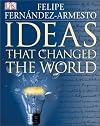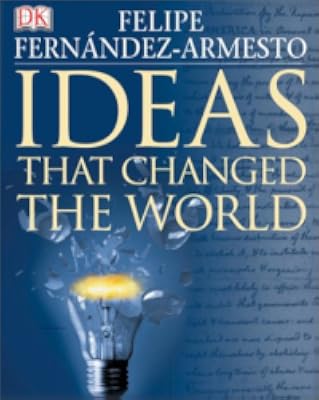
Ideas That Changed the World
by Felipe Fernández-Armesto
On This Page
Description
Ideas That Shaped Mankind flows from internationally respected historian Felipe FernAndez-Armesto's views on the notion that man's capacity to produce ideas in itself brings about sweeping changes in the world. This ability, seen most profoundly in individual, startling moments of genius-or equally startling moments of chance-is what separates humans from the animals and allows humans to re-imagine the world in ever more complex designs. From the earliest ideas, including cannibalism and the show more idea of farming, to theories of relativity and chaos, ideas reshape the world in surprising and wholly unexpected ways. Science, agriculture, religion, art, politics-Professor FernAndez-Armesto examines all these areas of thought and the moments in time when man's fertile intellect produced the sparks that set off blazes of change, even revolutions, that would forever alter the course of human history. show lessTags
Recommendations














Member Reviews
As I perused this lengthy volume I couldn't help but notice... Open to a random page... Boom! Discussion topic! This author created an encyclopedic guide book to a cornucopia of ideas which have been pivotal at various points in human history – going upon the thesis that it is superstructure (ideologies) that most shape history. The book is divided into vague historical eras, and all of the ideas fit somewhere into each of these eras – with early ideas consisting of things like the use of symbols, and more recent threads following trend such as anti-Americanism. Each idea is accompanied by references to pertinent foundational readings, and most have a sidebar about connections to other ideas discussed in the book. The images chosen show more for each page are high quality and either pertinent or, at least, witty. As this is more a reference book than anything else, I can't see having students read it, per se, but it could be an excellent tool to spark discussions, assign extra credit, or as a basis for the beginnings of debates. Frankly, I want to pick up a copy just to have for myself, and I will use it in my high school classrooms. This book is probably best, in terms of educational settings, for secondary students, but I would recommend it to any individual looking for a good reference book about human ideas and philosophies. show less
This is perhaps one of the more unique takes on history I have ever seen. Rather than chronicle one idea as it evolved through history, trace one culture's origins bak to its roots, or discuss one period of history, this book takes instead the tack of a broad brushstrokes attack of chronicling history, focusing on one idea for only 2 pages facing one another. The book is one that might be daunting for younger readers due to its size, but the quality of its contents make it a worthwile resource for any school or classroom library. Children are fascinated by ideas, hoping that they are having one that could be considered original; this book might prove that wrong, but will certainly help them to understand what others have thought and show more maybe even continue to think about that subject. The pictures are beautiful, fullcolor or black-and-white reproductions, and the inserts, though small, are very powerful: "connections" tell readers how the idea on the page connect with other ideas in the book, and "readings" act like miniature bibliographies to check out the ideas in more depth (the one thing these brief descriptions lack). The table of contents does group ideas into something like epochal organization, though the titles of each idea are designed more to be eyecatching and intrigueing than informative ("The Great Void" discusses the concept of 'nothing,' "Here comes the Sun" discusses heliocentrism). The author, Felipe Fernandez-Armesto has an impressive curriculum vitae and many other bestselling books to his name, but most importantly writes in a style that is informative without being patronizing and uses words that the average middleschooler can figure out if an unknown one comes along. show less
It states in the introduction of the book that it is taking a different approach to history. It is talking about history that "happens in the mind first." This is the history of ideas, a history driven by ideas. It is about looking at the very nature of the change in humanity. Every page is filled with wonderful illustrations and photos, designed to support the topic, weither it is about cannibalism, clavery, or environmentalism. The topics are to the point. They text is their to get you to think, not to just read and recall. The small connections insert gives you the pages to other topics that connect to what you are reading in the book, which helps tie everything together. My favorite part of the book is the readings section. Rather show more than have a seperate section in the back of the book or this, this book tries something different. The futher readings are put in a insert section for each topic. So as you are reading the topic on monetary theory, to can automaticly glance over to the insert that tells you of other books that can be read to continue on with this idea. I think this book is great to have for any class. It encourages you to think, which is a skill that we need to be teaching our students at any level. A good way to open our students up to the process of researching a topic. show less
Coffee table-style book but with surprisingly useful insights.
Read Sept 2005
Read Sept 2005
Authoritative, compelling, and provocative, Ideas That Changed the World presents the big themes in philosophy and history, and reveals how certain ideas have shaped our civilization. One of the most respected historians writing today, Felipe Fernandez-Armesto offers an unashamedly personal analysis on a wide range of ideas ? from the afterlife to taboo foods ? that will keep readers enthralled.
ilustr. (pretežno u bojama) ; 25 cm.
Prijevod djela: Ideas that changed world
Prijevod djela: Ideas that changed world
Jan 2, 2025Croatian
Ratings
Members
- Recently Added By
Author Information

65+ Works 6,170 Members
Felipe Fernandez-Armesto, a world-renowed scholar and author, is the Principe de Asturias Professor of Spanish Culture and Civilization at Tufts University
Series
Belongs to Publisher Series
Modern Scholar (045)
Common Knowledge
- Alternate titles
- Ideas That Changed the World; Ideas That Shaped Mankind
- Original publication date
- 2003
- People/Characters
- Jane Goodall; Dian Fossey; Zoroaster; Buddha; Plato, ca. 428-347 BC; Peter Abelard (1079-1142) (show all 19); Anselm of Canterbury (1033-1109); Francis Bacon; René Descartes (1596-1650); Niccolò Machiavelli; Charles Darwin [Charles Robert: 1809-1882]; Albert Einstein; Henri Bergson; William James; Ferdinand de Saussure; Ludwig Wittgenstein; Johann Heinrich Heidegger (1633-1698); Jean-Paul Sartre; Isaiah Berlin
Classifications
Statistics
- Members
- 390
- Popularity
- 80,248
- Reviews
- 6
- Rating
- (3.74)
- Languages
- Dutch, English, Portuguese, Croatian
- Media
- Paper, Audiobook, Ebook
- ISBNs
- 18
- UPCs
- 1
- ASINs
- 3