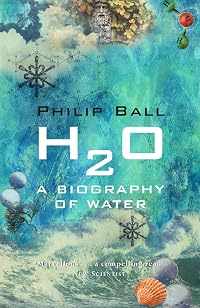
Life's Matrix: A Biography of Water
by Philip Ball
On This Page
Description
"Life's Matrix tells of water's origins, its history, and its fascinating pervasiveness: there are, for example, at least fourteen different forms of ice. An exploration of water on other planets highlights the possibilities of life beyond Earth. Life's Matrix reveals the unexpected in the most ordinary places - a drop of dew, a frozen pond, a cup of coffee - and the familiar in unexpected settings. There is water on the sun and the moon, at the heart of molecular biology, at the core of a show more cell, and there may be enough of it beneath the surface of the Earth to refill the oceans thirty times over. Life's Matrix also surveys the grim realities of our natural resources, and shows how water will become a scarce commodity in the twenty-first century."--Jacket. show lessTags
Recommendations


















Member Recommendations
by anonymous user
Member Reviews
I picked up this book because I was curious to see how someone could write a 380 page book about water. Ball does so by talking about everything connected with water, the hydrosphere, its chemical nature, biological functions, and rounds off the work with a consideration of some of the more prominent "myths" associated with water: "polywater" and homeopathy. This makes for a mixed brew: different readers will find different chapters more or less interesting according to their interests - I would have preferred a little more on the ecology and a little less on cellular chemistry - but Ball does a good job of making it all readable, informative, and relatively straightforward.
When I started this book I had the impression that it was going to be a bit superficial. In fact, it is anything but superficial. In fact, maybe Phillip Ball covers a bit too much and maybe a slightly more limited coverage with a bit more depth would be beneficial. Nevertheless he does manage to cover a great deal of surface chemistry and draws out the evidence for water having a range of unusual properties. Maybe a few coloured pictures might have been beneficial and maybe some better diagrams about the polarisation and hydrogen bonding of water molecules would have been helpful.
He managed to make a reasonable story about the way that water is drawn up huge trees.......probably a better explanation than I have seen elsewhere ....though show more he doesn't use the concept of water "potential" which might have made it easier to understand. His material about alkaline soils could have used a slightly better critique. He doesn't really seem to understand the concept of sodic soils that are generally alkaline but might be acid, high in sodium ions and crack significantly as they dry (thus tearing plant roots apart). And there is no discussion of the properties of water in the double layer between clay particles ...which I would have thought would be an interesting topic as part of the surface chemistry effects of water.
He does go into some detail about the multiple forms of ice; he debunks some famous apparent scientific breakthroughs...such as polywater and low temperature fusion and water with a "memory" after multiple dilutions.
On the whole an interesting and engaging book which covers a lot of ground. Nevertheless he is quick to point out that there is still a lot that we don't know about water's structure and surface chemistry. I give it 5 stars show less
He managed to make a reasonable story about the way that water is drawn up huge trees.......probably a better explanation than I have seen elsewhere ....though show more he doesn't use the concept of water "potential" which might have made it easier to understand. His material about alkaline soils could have used a slightly better critique. He doesn't really seem to understand the concept of sodic soils that are generally alkaline but might be acid, high in sodium ions and crack significantly as they dry (thus tearing plant roots apart). And there is no discussion of the properties of water in the double layer between clay particles ...which I would have thought would be an interesting topic as part of the surface chemistry effects of water.
He does go into some detail about the multiple forms of ice; he debunks some famous apparent scientific breakthroughs...such as polywater and low temperature fusion and water with a "memory" after multiple dilutions.
On the whole an interesting and engaging book which covers a lot of ground. Nevertheless he is quick to point out that there is still a lot that we don't know about water's structure and surface chemistry. I give it 5 stars show less
Excellent work of popular science that manages to escape the usual clichés and repeated anecdotes.
I found this slightly disappointing in that I was hoping for much more of a discussion of the chemistry of water, and instead got a whole lot of unexpected material on issues like the geology of water (which were, however, interesting).
Having complained that the book was not what I expected, it remains true that Philip Ball is a superior pop science author and that this book is entertaining, interesting, and well worth reading.
Having complained that the book was not what I expected, it remains true that Philip Ball is a superior pop science author and that this book is entertaining, interesting, and well worth reading.
Biographies of not-people I always find entertaining.
Ratings
Members
- Recently Added By
Published Reviews
ThingScore 75
"Ball does an excellent job of explaining how the physical and chemical peculiarities of water give rise to its unique properties, which make life on Earth possible."
added by wademlee
Lists

In Our Time books
4,934 works; 2 members
Author Information

41+ Works 6,172 Members
Philip Ball is a freelance writer who lives in London. He worked for over twenty years as an editor for Nature, writes regularly in the scientific and popular media, and has authored many books on the interactions of the sciences, the arts, and the wider culture, including, most recently, Serving the Reich: The Struggle for the Soul of Physics show more under Hitler, also published by the University of Chicago Press. show less
Series
Belongs to Publisher Series
Common Knowledge
- Canonical title*
- H2O. Una biografia dell'acqua
- Original title
- H2O - A Biography of Water
- Original publication date
- 1999
*Some information comes from Common Knowledge in other languages. Click "Edit" for more information.
Classifications
Statistics
- Members
- 338
- Popularity
- 94,009
- Reviews
- 5
- Rating
- (3.85)
- Languages
- 6 — English, German, Italian, Korean, Portuguese, Spanish
- Media
- Paper, Ebook
- ISBNs
- 15
- ASINs
- 2