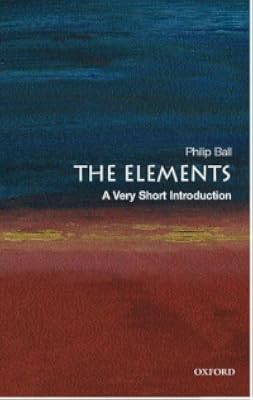
The Elements: A Very Short Introduction
by Philip Ball
On This Page
Description
This Very Short Introduction traces the history and cultural impact of the elements on humankind, and examines why people have long sought to identify the substances around them. The book covers from the Greek philosophers who propounded a system with four elements - earth, air, fire, and water - to the scientists who are able to create their own.Tags
Recommendations







Member Recommendations
wademlee Stories of the Invisible covers molecules, The Ingredients covers pure elements.
Member Reviews
Io adoro Philip Ball, è uno scrittore che sa il fatto suo e scrive di scienza come se fosse un lungo e appassionante romanzo. In italiano, per lo meno, i libri di argomento chimico sono pochi, e questo riesce da solo a coprire molti, molti buchi. Le storie su alcuni degli elementi della tavola periodica sono divertenti, interessanti, talvolta esilaranti, tutte istruttive e, il che non guasta, scritte veramente bene.
Oh to have been a fly on the wall when this book was pitched.
I say that because the title "The Elements" doesn't really tell you much about what the book will contain. How much discussion went into trying to figure out its role? What ideas did they bring up? Perhaps a catalog of elements with descriptions of how they behave and what they are used for, similar to John Emsley's excellent Nature's Building Blocks? Or a description of the physics of atoms? Chemical fun, like Field's Why There's Antifreeze In Your Toothpaste? Or a history of how we discovered the elements?
As it turns out, it's not any of these, but it comes closest to the last. Yet it is a curiously disordered history, talking about the innards of atoms (which we learned show more about starting in the early twentieth century) before it gets to the Periodic Table (which was discovered a third of a century earlier) and devoting a great deal of time to things such as the four elements of the ancients and the myriad silly things people have done with or for gold. Given how much there is to know about the real elements, iit seems rather a waste to spend so much time on something we know to be false.
In the end, I learned very little from this volume. But then, I'm not really the target of a book like this; I have a fair bit of scientific training. What's more, I enjoy catalogs like Emsley's, and I tend to like the history and mystery of science as it is discovered; all the peeking behind the curtain rather spoiled the book for me. For someone who needs or wants to know just a little about the basic chemistry and physics of elements, there is much that is good here: the initial discussion shows how the idea of "elements" came about, then the middle section describes what they are, and the last few pages describe a few interesting applications. If you want to study the matter seriously, get Emsley and perhaps a good book on Dmitry Mendeleev and another on, say, the discovery of radioactivity. If you just want some light reading, this may be all you'll want. show less
I say that because the title "The Elements" doesn't really tell you much about what the book will contain. How much discussion went into trying to figure out its role? What ideas did they bring up? Perhaps a catalog of elements with descriptions of how they behave and what they are used for, similar to John Emsley's excellent Nature's Building Blocks? Or a description of the physics of atoms? Chemical fun, like Field's Why There's Antifreeze In Your Toothpaste? Or a history of how we discovered the elements?
As it turns out, it's not any of these, but it comes closest to the last. Yet it is a curiously disordered history, talking about the innards of atoms (which we learned show more about starting in the early twentieth century) before it gets to the Periodic Table (which was discovered a third of a century earlier) and devoting a great deal of time to things such as the four elements of the ancients and the myriad silly things people have done with or for gold. Given how much there is to know about the real elements, iit seems rather a waste to spend so much time on something we know to be false.
In the end, I learned very little from this volume. But then, I'm not really the target of a book like this; I have a fair bit of scientific training. What's more, I enjoy catalogs like Emsley's, and I tend to like the history and mystery of science as it is discovered; all the peeking behind the curtain rather spoiled the book for me. For someone who needs or wants to know just a little about the basic chemistry and physics of elements, there is much that is good here: the initial discussion shows how the idea of "elements" came about, then the middle section describes what they are, and the last few pages describe a few interesting applications. If you want to study the matter seriously, get Emsley and perhaps a good book on Dmitry Mendeleev and another on, say, the discovery of radioactivity. If you just want some light reading, this may be all you'll want. show less
From the title and the series, one might expect to get an introduction to chemistry. What you get is a history of the science of chemistry from the ancient Greeks to cyclotrons. There are also some chapters on the role various elements (notable gold) have played in human history. This is all very interesting and extremely readable, but if you are looking for an introduction to chemistry, you will be disappointed.
Engaging, interesting and informative: this is what a Very Short Introduction should be like.
Not at all what it says it is. Mostly a colletction of science related trivia, interesting but not really helpful, except for the last chapter, which has some interesting bits about semi-conductors and palladium.
Not at all what it says it is. Mostly a colletction of science related trivia, interesting but not really helpful, except for the last chapter, which has some interesting bits about semi-conductors and palladium.
Scampers lightly from earth-air-fire-water to oxygen, to gold, to the Periodic Table, to the transuranics, to isotopes and applications.
Members
- Recently Added By
Published Reviews
ThingScore 50
"In this companion volume to his Stories of the Invisible: A Guided Tour of Molecules, Ball takes on chemistry in its uncombined form--the elements [...] The result is not as fresh or as original as Ball's previous work"
added by wademlee
Author Information

41+ Works 6,179 Members
Philip Ball is a freelance writer who lives in London. He worked for over twenty years as an editor for Nature, writes regularly in the scientific and popular media, and has authored many books on the interactions of the sciences, the arts, and the wider culture, including, most recently, Serving the Reich: The Struggle for the Soul of Physics show more under Hitler, also published by the University of Chicago Press. show less
Series
Belongs to Publisher Series
Very Short Introductions (104)
Common Knowledge
- Canonical title
- The Elements: A Very Short Introduction
- Original title
- The Elements: A Very Short Introduction
- Alternate titles
- The Ingredients: A Guided Tour of the Elements
- Original publication date
- 2002
- People/Characters
- Georgius Agricola; Aristotle, 384-322; John Dalton; Antoine Lavoisier; Dmitri Mendeleev; Ernest Rutherford
- First words
- Preface
When I was asked to write an introduction to the elements as a companion volume to my book Stories of the Invisible, itself an introduction to molecules, I had mixed feelings.
In 1624 the French chemist Étienne de Clave was arrested for heresy. - Last words
- (Click to show. Warning: May contain spoilers.)Indeed, that journey may still be only just beginning.
- Disambiguation notice
- First published as The Ingredients: A Guided Tour of the Elements, later incorporated into the 'A Very Short Introduction' series under the title, The Elements. (Information taken from verso of title page of ... (show all)The Elements.)
Classifications
Statistics
- Members
- 313
- Popularity
- 101,477
- Reviews
- 9
- Rating
- (3.64)
- Languages
- Arabic, English, Italian
- Media
- Paper, Ebook
- ISBNs
- 10
- ASINs
- 1