Nonsense! The Curious Story of Edward Gorey
by Lori Mortensen
On This Page
Description
Profiles the education and eccentric brilliance of writer and artist Edward Gorey, discussing the creative process that led to more than 100 children's books and inspired a generation of creators, from Lemony Snicket to Tim Burton.Tags
Recommendations




Member Reviews
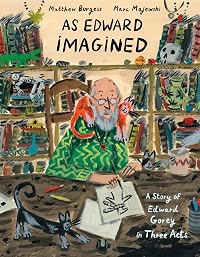
Edward Gorey, born in Chicago in 1925, and who died in 2000, was an author and illustrator known for his “strange combination of whimsy and gruesomeness,” and “with a hatful of nonsense thrown in.” His characteristic pen-and-ink drawings often depicted somewhat creepy Victorian and Edwardian settings.
As this biography for kids recounts, Edward wrote stories with curious titles like “The Wuggly Ump, and “The Galoshes of Remorse” and an alphabet book that began:
“A is for Amy who fell down the stairs
B is for Basil assaulted by bears
C is for Clara who wasted away
D is for Desmond thrown out of a sleigh….”
The characters in his books, Mortensen tells us, had silly names like Octavia Prong, Williboo Lake, Waffle, Skrump, show more Humglum, and Crunk.
What child schooled in right and wrong and propriety could resist such blatant and daring departures from convention?
Mortensen employs poetic text with suggestions of a Victorian tone to tell readers about Gorey, who was, as she writes, “a dandy boy who looked out his window, drew sausage-shaped pictures of city-bound trains, and taught himself to read.” He went to Harvard, but, Mortensen asks us to consider,“Did he know what he wanted to do with his life? Alas and alack, he did not.” Until one day, “Voilà!” He decided to write his own books. He used pen and ink to illustrate them, drawing “seas of sketchy black lines, as if the stories were set in a time and place long ago.” She observes:
“To Edward,
the world was an uncertain place
where anything might happen.
And in Edward’s stories, it did!
Anything less would be boring,
And who wanted that?
Not Edward!”
He didn’t explain what his stories meant; he thought readers should use their own imaginations. It would be “the height of folly,” he said, to take his work seriously: “It was just Edward being Edward, with a hatful of nonsense thrown in.”
An Author’s Note further explains that Gorey was a child prodigy, drawing by age one and a half and reading (he taught himself) by age three. She also recounts that Gorey published over one hundred books and illustrated over sixty books by other authors, including Charles Dickens and Lewis Carroll. She points out that “Gorey’s sweet and sinister style continues to have a profound effect,” offering as examples Lemony Snicket’s A Series of Unfortunate Events and Tim Burton’s The Nightmare Before Christmas, inter alia.
Back matter includes further sources.
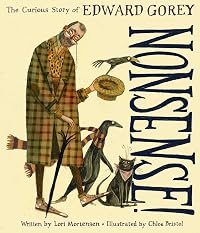
Illustrator Chloe Bristol captures Gorey’s style while avoiding the look of some of his possibly frightening work, but kids who are up for it can be introduced to Gorey’s art directly by using a Google Images search.
Evaluation: This tribute to someone who insisted on thinking outside of the box and drawing outside of the lines will no doubt delight many children, and introduce them to an artist well worth knowing. show less
As this biography for kids recounts, Edward wrote stories with curious titles like “The Wuggly Ump, and “The Galoshes of Remorse” and an alphabet book that began:
“A is for Amy who fell down the stairs
B is for Basil assaulted by bears
C is for Clara who wasted away
D is for Desmond thrown out of a sleigh….”
The characters in his books, Mortensen tells us, had silly names like Octavia Prong, Williboo Lake, Waffle, Skrump, show more Humglum, and Crunk.
What child schooled in right and wrong and propriety could resist such blatant and daring departures from convention?
Mortensen employs poetic text with suggestions of a Victorian tone to tell readers about Gorey, who was, as she writes, “a dandy boy who looked out his window, drew sausage-shaped pictures of city-bound trains, and taught himself to read.” He went to Harvard, but, Mortensen asks us to consider,“Did he know what he wanted to do with his life? Alas and alack, he did not.” Until one day, “Voilà!” He decided to write his own books. He used pen and ink to illustrate them, drawing “seas of sketchy black lines, as if the stories were set in a time and place long ago.” She observes:
“To Edward,
the world was an uncertain place
where anything might happen.
And in Edward’s stories, it did!
Anything less would be boring,
And who wanted that?
Not Edward!”
He didn’t explain what his stories meant; he thought readers should use their own imaginations. It would be “the height of folly,” he said, to take his work seriously: “It was just Edward being Edward, with a hatful of nonsense thrown in.”
An Author’s Note further explains that Gorey was a child prodigy, drawing by age one and a half and reading (he taught himself) by age three. She also recounts that Gorey published over one hundred books and illustrated over sixty books by other authors, including Charles Dickens and Lewis Carroll. She points out that “Gorey’s sweet and sinister style continues to have a profound effect,” offering as examples Lemony Snicket’s A Series of Unfortunate Events and Tim Burton’s The Nightmare Before Christmas, inter alia.
Back matter includes further sources.
Illustrator Chloe Bristol captures Gorey’s style while avoiding the look of some of his possibly frightening work, but kids who are up for it can be introduced to Gorey’s art directly by using a Google Images search.
Evaluation: This tribute to someone who insisted on thinking outside of the box and drawing outside of the lines will no doubt delight many children, and introduce them to an artist well worth knowing. show less
A picture book biography might have been a hard sell, but the author and illustrator pull it off beautifully. Gorey's life is presented chronologically, from his birth in Chicago in 1925, to his love of reading - and how reading Alice in Wonderland and Dracula back-to-back inspired a lifelong aesthetic ("A strange combination that captured his imagination like a penguin sipping tea on a runaway train").
"Quaint and curious, dark and disturbing," Edward was drafted into the army (he worked as a clerk), then went to Harvard, moved to New York, and worked in the art department at Doubleday. At last, he began to make the kind of books he wanted to write, and when no one would publish them, he launched his own company, Fantod Press.
(My show more 4.9-yo's favorite page is the one with all of Edward Gorey's anagrams, each with a different head-and-shoulders picture above it: Dreary Wodge, Edgar E. Wordy, Odgreg Weary, etc.)
Back matter includes an Author's Note and sources.
Illustrations were done in pencil and painted digitally; they hew closely to Gorey's style, softened slightly with color, and instead of a white background, it's a soft flecked cream, evoking handmade paper. show less
"Quaint and curious, dark and disturbing," Edward was drafted into the army (he worked as a clerk), then went to Harvard, moved to New York, and worked in the art department at Doubleday. At last, he began to make the kind of books he wanted to write, and when no one would publish them, he launched his own company, Fantod Press.
(My show more 4.9-yo's favorite page is the one with all of Edward Gorey's anagrams, each with a different head-and-shoulders picture above it: Dreary Wodge, Edgar E. Wordy, Odgreg Weary, etc.)
Back matter includes an Author's Note and sources.
Illustrations were done in pencil and painted digitally; they hew closely to Gorey's style, softened slightly with color, and instead of a white background, it's a soft flecked cream, evoking handmade paper. show less
"First, bright young Edward skipped grades—SKIP, SKIP, SKIP—and moved with his family a dozen times—1, 2, 3, 4, 5, 6, 7, 8, 9, 10, 11, 12. (Heavens to Betsy! That's a lot!)" By gum, it certainly is. So I shot myself. This book was definitely not written in the spirit of Edward Gorey, although Chloe Bristol's illustrations are lovely in a Brett Helquist for Lemony Snicket kind of way. I suggest giving three-year-olds Dracula or Alice in Wonderland or Gorey's own published works instead so that the wee tinies don't grow up to write books like this one.
Thanksgiving weekend family picture book read-aloud fun! (Book 12 of 13.)
A clever biography of an unconventional creator of unconventional children's books and picture books for adults told and illustrated in homage to his distinctive style.
A clever biography of an unconventional creator of unconventional children's books and picture books for adults told and illustrated in homage to his distinctive style.
Sweet tribute to this eccentric author and illustrator. I came acrid Gorey's work about 5 years ago and have been obsessed ever since. He was quite the character and his books and drawings attest to that.
Ratings
Members
- Recently Added By
Lists

Youth: Arts & Crafts
156 works; 1 member

Books Read in 2024
4,623 works; 126 members
Author Information
66 Works 1,649 Members
All Editions
Awards and Honors
Distinctions
Notable Lists
Common Knowledge
- Original publication date
- 2020
- People/Characters
- Edward Gorey; Dracula; Alice in Wonderland
- Dedication
- For my mother, who filled our home with books - L.M.
I want to dedicate this book to my parents, who always encouraged me to be the very best version of myself. And to my sister, Audrey, for years and years of free therapy. - C.B. - First words
- Greetings, Dear Reader!
Since you are reading this book, it's clear as the dimple on your chin that you love words and pictures. - Last words
- (Click to show. Warning: May contain spoilers.)It was just Edward being Edward, with a hatful of nonsense thrown in.
- Original language
- English
Classifications
Statistics
- Members
- 79
- Popularity
- 400,240
- Reviews
- 5
- Rating
- (4.10)
- Languages
- English, Spanish
- Media
- Paper, Ebook
- ISBNs
- 3
- ASINs
- 1